
How to Write Instagram Captions That Drive Clicks and Engagement

how to write Instagram captions

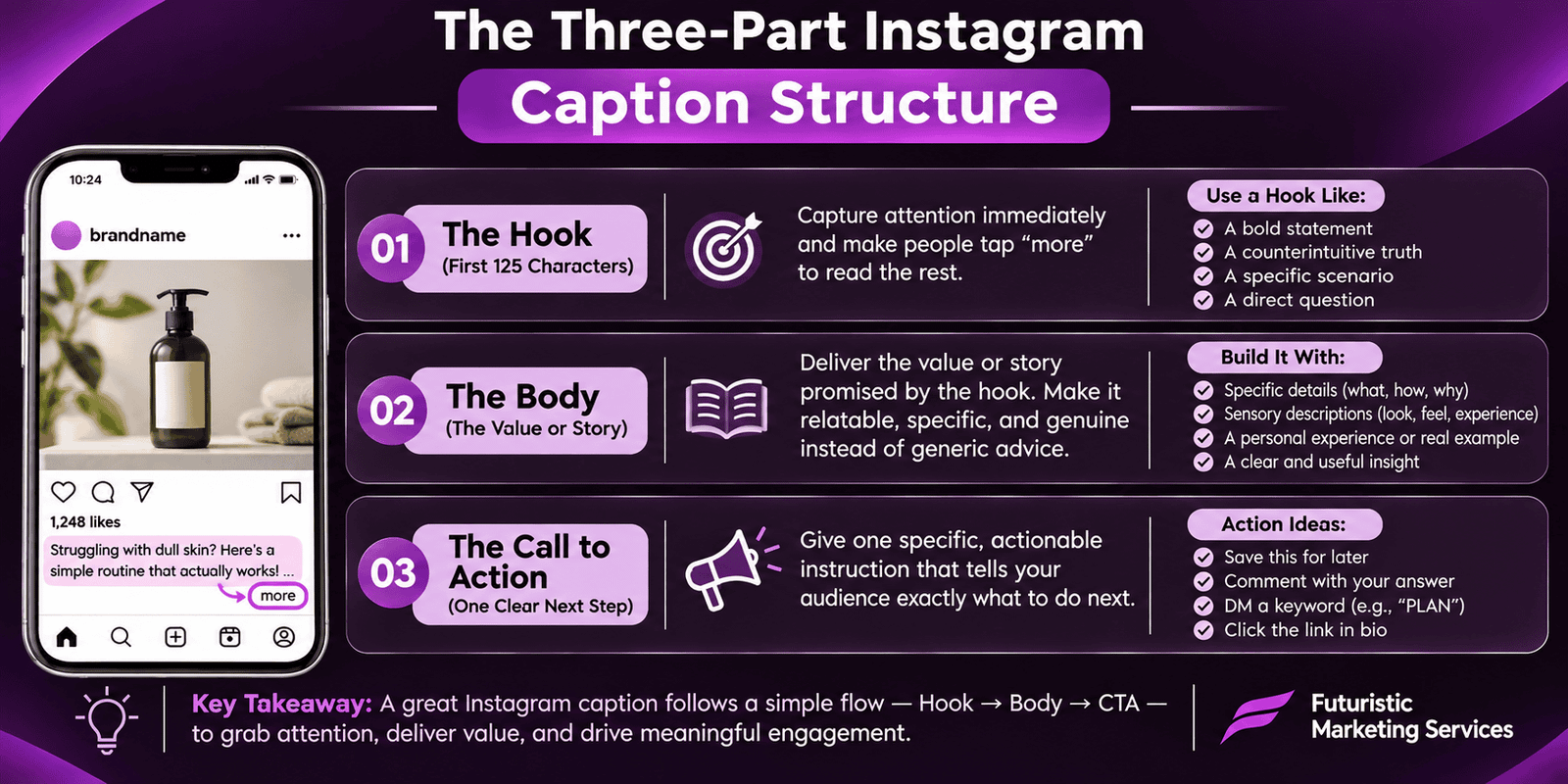
A high-performing Instagram caption has three parts: a hook in the first 125 characters that stops the scroll and earns the “more” tap, a body that delivers genuine value or emotional connection, and a single specific call to action that tells the audience exactly what to do next. Captions that follow this structure consistently generate more comments, saves, and clicks than captions written as afterthoughts to visual content.


Key Takeaways

  • According to River Blog's Instagram caption research, posts with captions containing clear calls to action generate 70% more comments than posts without a CTA, making the CTA the single most impactful addition to any caption that currently lacks one.
  • The first 125 characters of every Instagram caption are the only text visible before the "more" button. If that text does not create a compelling reason to keep reading, most viewers never see the rest of the caption regardless of how well-written it is.
  • Posts with personal anecdote followed by a call to action achieve 3x higher click-through rates than posts that go straight to the promotional pitch, according to StoryCraft's consumer engagement analysis.
  • 72% of Gen Z and Millennial Instagram users intentionally skip captions that feel AI-generated, making authentic, human-voiced writing the most commercially important caption quality in the current environment.
  • Instagram captions are indexed by Google since the 2025 platform integration, meaning well-written captions containing relevant keywords can drive website traffic from Google Search months or years after the original post date.
  • A post with 100 likes and 5 saves outranks algorithmically a post with 300 likes and no saves, meaning caption quality that drives saves and comments is more valuable than visual quality that drives passive likes.
  • According to Sprout Social's 2026 Instagram research, 60% of Instagram users engage with brand content multiple times per week, an audience primed for engagement that caption strategy either captures or wastes.

Want Captions That Actually Drive Business Results?

We Write Your Instagram Captions as Part of a Complete Content Strategy

Futuristic Marketing Services creates complete Instagram content strategies for businesses across India, covering caption writing, Reels scripting, visual content planning, and monthly performance reporting, all designed to generate engagement that advances real business goals.

Get Your Free Content Strategy Session

Why Instagram Captions Are More Important Than Most Businesses Realize

Most businesses treat Instagram captions as a functional requirement, something that needs to accompany the visual content rather than something that works alongside the visual to produce specific business outcomes. This approach systematically underutilizes the caption's actual commercial role. A great visual earns a pause in the scroll. A great caption converts that pause into engagement: a comment, a save, a click through to the website, or a direct message enquiry. According to Sprout Social's 2026 Instagram best practices research, 60% of Instagram users engage with brand content multiple times per week, an audience that is already primed for engagement and needs only a capable caption to direct that engagement toward a measurable outcome.
The stakes for getting captions right have also increased significantly because captions now serve a dual function: they drive immediate engagement on the platform and, following the 2025 Google-Instagram integration, they contribute to Google Search discoverability. Well-written captions containing relevant keywords for the business's service category function as mini-blog posts that can drive organic website traffic from Google Search long after the original post date. This development elevates caption writing from a social media task to a content marketing investment with compounding returns.

Instagram Captions Are Now Indexed by Google

Since the integration of professional Instagram account content into Google's indexing system, captions containing relevant keywords can surface in Google Search results alongside traditional web content. This means a well-written caption about "social media marketing for small businesses in Indore" can appear in Google results when a local business owner searches for that phrase, delivering traffic to the Instagram profile from outside the platform entirely.
The practical implication for caption writing is that keywords should be woven naturally into captions in the same way they would be incorporated into a well-optimized blog post, present in the text because they accurately describe the content, not forced in at the expense of readability. Captions written for genuine human engagement that happen to include relevant keywords benefit from both algorithmic distribution on Instagram and organic search discovery on Google. Captions keyword-stuffed without regard for readability perform poorly on both. The Instagram hashtag strategy that works alongside keyword-optimized captions creates a complementary discoverability system where hashtags handle within-platform categorization and caption keywords handle cross-platform Google discovery.

The Engagement Signals That Caption Quality Directly Produces
Caption quality directly determines which engagement actions a post generates, and different engagement actions carry different algorithmic weights. As covered in depth in the Instagram algorithm guide, saves and DM shares carry the strongest algorithmic weight, followed by substantive comments, with likes carrying the weakest signal. A caption that explicitly requests a save, "Save this for the next time you need to plan your content calendar", generates more saves than an identical post with no save request. A caption that asks a specific, interesting question generates more substantive comments than one that ends without prompting a response.
River Blog's research confirms the direct relationship between caption structure and engagement: a post with 100 likes and 5 saves algorithmically outranks a post with 300 likes and no saves. This means a caption that generates saves from a smaller but more engaged audience produces better algorithmic performance than a visually striking post that generates passive likes from a large audience without any active curation intent. Caption strategy that explicitly targets saves and comments rather than likes produces the engagement quality that the algorithm rewards with wider distribution.

The Anatomy of a High-Performing Instagram Caption

Every high-performing Instagram caption follows a three-part structure regardless of length, topic, or content type. This structure is not a rigid template that produces uniform-sounding captions. It is a functional framework that ensures every caption serves a complete communication purpose: capturing attention, delivering value, and directing action. The three parts are the hook, the body, and the call to action.

Part 1: The Hook, Everything Happens in the First 125 Characters

Instagram truncates captions after approximately 125 characters in the feed view, showing only the first line or two before a "more" button that requires an active tap to expand. The decision to tap "more" or scroll past is made in under two seconds based entirely on the quality and relevance of those first 125 characters. This makes the opening line of every caption the single most important piece of copywriting in the entire post, more important than the visual in many cases, because the visual earns the initial pause but the hook determines whether any further engagement occurs.
As Heropost's caption writing guide confirms, the first line of a caption must be compelling enough to trigger the "read more" click. A practical test for every hook is to read it aloud and ask: if a friend sent me this as a message, would I immediately want to know what comes next? If the answer is no, rewrite the hook before publishing. The most effective hook formats for business captions are a specific, relatable scenario ("If you have ever posted content you were proud of and got 11 likes, this is for you"), a bold or counterintuitive statement ("Posting every day on Instagram is killing your reach"), and a direct address question ("Why are your Instagram posts getting 0 new followers every week?").
The one-sentence hook principle is the most important caption writing discipline available: never open with context, never open with background, and never open with the brand name. Open with the most interesting or provocative sentence in the entire caption, and put all context and explanation in the body that follows for readers who have earned the right to that context by clicking "more."

Part 2: The Body, Deliver Value That Justifies the Click

The body of the caption is where the value promised or implied by the hook is delivered. If the hook created curiosity by stating "Posting every day on Instagram is killing your reach," the body must explain exactly why, with enough specificity and insight that the reader feels the click was worth it. A body that builds on a strong hook but delivers vague, generic, or surface-level information produces a negative impression stronger than no hook at all, the reader feels misled and is less likely to engage with future content from the same account.
According to StoryCraft's research, users spend 40% more time on posts that use first-person sensory language compared to instructional how-to lists. This data suggests that narrative-style captions, those that tell a story from personal experience using specific, sensory details, hold attention more effectively than the educational bullet-point format that most business accounts default to. "I spent three months posting daily on Instagram and watched my reach drop from 1,200 per post to 380" holds attention more effectively than "Posting daily can reduce your reach due to algorithm penalties" because the first version creates a specific, emotionally real scenario the reader can inhabit, while the second provides the same information in a format that requires no imaginative engagement from the reader.
Body length should match the depth of the idea being communicated rather than following a universal word-count rule. A quick tip that is genuinely complete in two sentences is better delivered in two sentences than padded to 150 words. A concept that genuinely requires context and nuance to be useful earns a 200-word body. The test is: does every sentence in the body add something that would be missed if the sentence were removed? If a sentence can be deleted without reducing the overall value of the caption, delete it. Heropost's rule of thumb, cut the first draft by 30%, produces captions that are consistently more effective than unedited first drafts because the 30% cut invariably removes the filler sentences that reduce reading pace without adding meaning.

What Drives Web Development Cost

Every caption ends with one specific call to action that tells the audience exactly what to do next. Captions without a CTA leave the audience's engagement to chance, which is why posts with clear CTAs generate 70% more comments than posts without one. Captions with multiple competing CTAs, "save this, follow us, comment below, and check our link in bio", produce lower action rates on each individual request than a single specific CTA, because divided instructions produce divided attention and typically result in the audience doing nothing specific.
Choose one CTA per caption based on the specific engagement action that most directly serves the post's goal. For educational content designed to generate saves: "Save this for the next time you need to write a caption from scratch." For community engagement posts designed to generate comments: "Tell me in the comments: what is the hardest part of writing Instagram captions for your business?" For traffic-driving posts: "The full guide is linked in bio, tap the link to read it." For direct enquiry generation: "If you want your Instagram content handled for you, DM me the word 'content' and I'll send you the details." Each of these CTAs is specific, actionable, and directs one clear audience behavior rather than a vague general invitation to engage.

Instagram Caption Formulas That Work for Business Accounts

The five caption formulas below are structural frameworks that produce consistently strong engagement across different content types and business goals. Each formula is paired with a brief template showing how the structure works in practice. Adapt the framework to the specific content and brand voice rather than using the template language verbatim, the formula provides the structure; the business's authentic voice provides the differentiation that makes the caption feel genuinely human rather than formulaic.
Formula Name Structure Best For Primary Engagement Signal
Problem-Solution-CTA Hook names a specific problem the audience faces. Body explains exactly why it happens and how to solve it. CTA asks the audience to save for future reference or comment with their experience. Educational carousels, how-to Reels, tip posts Saves, the audience bookmarks the solution for when they need it
Story-Lesson-CTA Hook opens mid-story with a specific, interesting moment. Body tells what happened with sensory, specific detail. Lesson extracted and applied to the audience's situation. CTA invites the audience to share their own experience. Founder or personal brand posts, behind-the-scenes content, milestone posts Comments and DM sends, people respond to stories and share them with others who face similar situations
Counterintuitive Truth Hook states a widely believed thing that is wrong or incomplete. Body explains what is actually true and why the conventional wisdom misleads. CTA invites comment or debate on the topic. Thought leadership posts, opinion content, myth-busting educational posts Shares and comments, people send contrarian content to friends who share the mistaken belief, and people who disagree comment to debate
Number List Hook Hook opens with a specific number that creates immediate expectation: "3 reasons your Instagram reach is dropping." Body delivers each numbered item with explanation. CTA asks for a save or a comment naming which point resonated most. Educational feed posts, carousel teaser captions, Reels with multiple tips Saves, list content is bookmarked for reference more reliably than narrative content
Direct Address Question Hook opens with a direct question addressing a specific experience or challenge the audience faces. Body validates the experience and provides useful context. CTA invites comment with the audience's specific answer or situation. Community engagement posts, conversation-starter content, opinion poll captions Comments, questions that validate the audience's experience generate higher comment rates than any other caption format

Instagram Caption Length Guide by Content Format

Caption length should match the content format and the relationship between the visual and the written content. A Reel that tells its complete story through the video requires a much shorter caption than a carousel where the caption adds context and value that the images alone do not fully communicate. The optimal lengths below are derived from current engagement data rather than character limit specifications.
Content Format Optimal Caption Length Caption Role for This Format Hook Requirement
Reels Under 150 characters (1 to 2 short lines) The video carries the content. Caption adds a single compelling context line, keyword for search, and one CTA. The visual and audio must stand alone. Short but critical, the caption hook reinforces the Reel's key message and drives the specific action (save, comment, or DM) after watching
Educational Carousels 150 to 300 words (the most engagement-optimal length for deep educational content) The caption teases what is in the carousel, sets context, and elaborates on the most important point the slides do not fully explain. Save CTA essential. Strong hook is most critical here because the carousel viewer decision to swipe often depends on how compelling the caption preview is
Static Images 50 to 150 characters for strong visuals; 100 to 200 words for quotes or context-heavy imagery Adds context the image cannot convey, or starts a conversation the image prompts. For strong visual content, short and sharp performs best. One powerful hook line followed immediately by CTA is often the most effective format for strong imagery
Behind-the-Scenes Posts 100 to 200 words using the Story-Lesson-CTA formula The caption is the primary content for these posts. The image provides visual context, but the story in the caption is what drives comments, saves, and DM responses. Opening mid-story is most effective, drop the reader into a specific moment before giving any context
Social Proof and Result Posts 50 to 150 characters if the result is in the visual; 100 to 150 words for case study context Provides the story behind the result, who the client was, what the problem was, what was done. Ends with a specific CTA inviting similar enquiries. Lead with the specific outcome achieved as the hook, the number or transformation, not the process that produced it

6 Caption Writing Techniques That Immediately Improve Business Captions

The following six techniques are specific, implementable improvements to caption writing that produce measurable engagement improvements within the first few posts that apply them. Each addresses a specific weakness common in business account captions that reduces engagement below the potential the content quality would otherwise produce.

6 Techniques to Write Better Instagram Captions Starting Today

1. Write the hook last

Write the full caption body and CTA first, then identify the single most interesting or provocative sentence from the entire draft and move it to the opening position. The most compelling line of any caption is rarely the first one written.

2. Replace vague words with specific ones

"Many businesses" becomes "businesses with under 5,000 followers." "Poor results" becomes "less than 2% engagement rate." Specificity creates credibility and makes the reader feel the caption was written for their exact situation rather than a broad generic audience.

3. Use line breaks for readability

Break the caption into single-sentence or two-sentence paragraphs with blank lines between them. Walls of unbroken text are abandoned immediately on mobile screens. Line breaks make long captions feel short by creating visual white space that makes the reading path feel achievable.

4. Ask questions the audience actually wants to answer

The worst question in a business caption is "What do you think?" The best questions are specific and personally relevant: "What is the biggest mistake you see businesses make on Instagram?" gives the audience a concrete, opinionated response to share rather than a vague invitation to comment.

5. Weave keywords naturally

Include one to three relevant industry keywords in the caption text naturally, not as keyword stuffing but as accurate descriptions of the content's topic. These keywords improve Instagram search discoverability and, since the 2025 Google indexing update, contribute to organic search visibility for the post.

6. Never describe what the visual already shows

If the image shows a team working together, do not begin the caption with "Here is our team working together." The audience can see the image. The caption's role is to add what the image cannot communicate, the story, context, meaning, or insight behind what is shown.

Common Instagram Caption Mistakes That Kill Engagement

The following mistakes appear in the majority of underperforming business Instagram captions. Each one reduces engagement in a specific, identifiable way that can be corrected through the techniques and formulas in this guide without requiring any changes to the visual content or posting frequency.
Starting with the brand name or a description of the post is the most common hook failure. "Welcome back to our page!" or "Check out our latest product!" burns the first 50 characters of the hook on content that provides no reason for the reader to continue. Every viewer already knows they are looking at the brand's post and has already seen the product in the visual. The caption hook must provide something new, an insight, a question, a provocation, or a story, that earns the reader's attention before asking anything of them.
Writing for a generic audience rather than a specific person is a structural caption weakness that produces engagement from no one in particular. The captions that generate the highest comment rates are those that describe a situation so specifically that a subset of the audience reads the hook and immediately thinks "this was written for me." The more precisely a caption describes the specific challenge, aspiration, or experience of the target customer, the more powerfully it activates the response that produces comments, saves, and DM shares from that specific audience. Write each caption as if for one specific person, a detailed, named representative of the target customer profile, and the engagement from the broader audience who shares that person's characteristics will follow.
Ending with a generic call to action such as "Follow us for more content" or "Let us know what you think in the comments" produces the lowest conversion rates of any CTA format because neither instruction gives the audience a specific reason to take the action being requested. The follow CTA competes with thousands of identical requests the audience has already declined from other accounts. The generic comment request provides no friction-reducing specificity about what the audience should actually say. Specific CTAs consistently outperform generic ones, "If you want the full list of Instagram caption templates, DM me the word 'captions' and I will send it to you" gives the audience a concrete, specific action with a clear and immediate reward for completing it. Our social media content creation services include full caption writing and strategy development as part of every monthly content management package, covering all five content pillars from the Instagram content ideas guide.

Captions That Convert. Content That Grows Your Business.

We Write Your Instagram Captions Every Month as Part of a Complete Strategy

Our team writes every caption using the three-part hook-body-CTA framework, matched to the specific content type and business goal for each post, so your Instagram content consistently drives the engagement actions that the algorithm rewards and the business outcomes that justify the investment.

Book Your Free Content Session

Frequently Asked Questions About Writing Instagram Captions

How do you write a good Instagram caption for a business?

A good Instagram business caption follows a three-part structure: a hook in the first 125 characters that creates a compelling reason to tap "more" and keep reading, a body that delivers genuine value, story, or insight related to the hook's promise, and one specific call to action that tells the audience exactly what to do next. Every element of the caption serves the primary goal of the post, whether that is generating saves, driving comments, producing clicks, or encouraging DM enquiries. The caption must add something the visual cannot communicate on its own rather than simply describing what the image or video already shows.

How long should an Instagram caption be for a business?

Caption length should match the content format and the depth of the idea being communicated. For Reels, keep captions under 150 characters because the video carries the content. For educational carousels, 150 to 300 words performs best because the caption adds context and earns the save. For static images with strong visuals, 50 to 150 characters is optimal. For behind-the-scenes or story-driven posts, 100 to 200 words using the story-lesson-CTA formula works well. The universal rule is that every sentence must add something worth reading, delete anything that could be removed without reducing the caption's overall value.

What should be in the first line of an Instagram caption?

The first line of an Instagram caption must be the single most compelling, interesting, or provocative sentence in the entire post. This is the only text visible before the "more" button, and the decision to tap "more" or scroll past is made in under two seconds based entirely on this line. The most effective first line formats are a specific relatable scenario that describes the exact situation of the target audience, a bold or counterintuitive statement that challenges a widely held belief, or a direct question addressing a challenge or experience the audience faces. Never open with the brand name, context, or background information that provides no immediate reason to keep reading.

How do you write an Instagram caption that gets more comments?

Captions that generate the most comments end with a specific, personally relevant question that gives the audience a concrete, opinionated response to share. Generic questions like "What do you think?" produce few responses because they provide no direction about what to say. Specific questions such as "What is the one Instagram mistake you see businesses make most often?" or "How many hours per week do you currently spend on Instagram content?" give the audience a definite, shareable answer that requires real engagement rather than a vague agreement to comment. Captions that validate the audience's experience before asking the question generate even higher response rates because readers feel understood before being asked to contribute.

How do you write Instagram captions that get more saves?

Captions designed to generate saves contain information the audience will want to reference again at a specific future point, step-by-step frameworks, checklist-style lists, resource recommendations, or formulas they can apply to their own situation later. The save is triggered when the viewer thinks "I will want this again when I need to do that task." Including an explicit save CTA such as "Save this for the next time you need to write an Instagram caption from scratch" increases save rate significantly compared to identical content without the save request. Educational carousels consistently generate the most saves of any Instagram format when the caption provides complementary context and reinforces the save request.

What is the maximum number of characters for an Instagram caption?

Instagram allows up to 2,200 characters per caption across feed posts, Reels, and carousels. However, the caption is truncated in the feed view to approximately 125 characters before a "more" button appears, meaning only the first 125 characters are visible without a deliberate tap to expand. The practical implication is that the first 125 characters are treated as a headline that determines whether anyone reads the rest, regardless of how many total characters the caption contains. Write the first 125 characters with the same attention given to a headline, and use the remaining character allowance for the body and CTA only for posts where the content genuinely warrants longer-form treatment.

Should Instagram captions include keywords for SEO?

Yes. Since professional Instagram account content was integrated into Google's indexing system, captions containing relevant keywords can surface in Google Search results and drive website traffic from outside the platform. Include two to three relevant industry keywords naturally in each caption where they fit the content accurately, not as keyword stuffing but as accurate descriptions of the post's subject matter. A caption about Instagram marketing tips for small businesses in Indore that naturally includes those terms benefits from both Instagram's internal search algorithm and Google's external indexing without requiring any forced keyword insertion that compromises the caption's readability or engagement quality.

How important is the call to action in an Instagram caption?

The call to action is the most directly measurable component of any Instagram caption. Posts with clear CTAs generate 70% more comments than posts without one, according to Instagram marketing research. The CTA converts the engagement the rest of the caption has built into a specific, measurable action that advances the post's goal. Without a CTA, even an excellent hook and valuable body produce passive engagement, people read and scroll past without performing the specific action the business needs. A single, specific CTA matched to the post's primary goal produces significantly higher action rates than multiple competing CTAs or a generic invitation to engage without direction.

Why do AI-generated Instagram captions perform poorly?

72% of Gen Z and Millennial Instagram users intentionally skip captions that feel AI-generated because they lack the specific, human details, genuine perspective, and authentic voice that make captions feel worth reading. AI-generated captions typically use generic examples, lack first-person sensory specificity, and feel structured the same way as every other AI caption on the platform, producing the homogenized content quality that trained audiences have learned to recognize and dismiss. The remedy is not avoiding AI tools entirely but using them as a starting draft that is then rewritten to include specific details from the business's actual experience, authentic opinions and perspectives, and the kind of particular language that reflects a genuine human voice rather than a predictable pattern.

How do you write Instagram Reels captions differently from feed post captions?

Instagram Reels captions should be significantly shorter than feed post captions because the video content carries the primary communication and the caption plays a supporting role rather than the lead role it plays in a text-heavy carousel or story post. The optimal Reel caption is under 150 characters: one compelling hook line that reinforces the video's key message, includes a relevant keyword for search discovery, and ends with one specific CTA prompting the most commercially valuable engagement action, typically a save, comment, or DM. Viewers who have just finished watching a Reel are in an action-oriented state and respond well to a clear, direct CTA without requiring the longer contextual build-up that a carousel caption warrants.

What is the difference between a caption formula and a caption template?

A caption formula is a structural framework, a pattern of parts such as hook, problem, solution, and CTA, that guides the structure of the caption without dictating the specific language. A caption template is a fill-in-the-blank text where specific placeholders are replaced with the relevant details for a particular post. Formulas are more versatile and produce more authentic-sounding captions because they allow the brand's genuine voice to fill the structure. Templates are faster to execute and work well when producing high volumes of similar content types, such as monthly product launch captions or weekly tip posts. The best approach for most business accounts is to internalize two or three formulas deeply enough that the structure feels natural, and use templates only for recurring content types where efficiency is more important than creative differentiation.

How do you measure whether Instagram caption strategy is working?

Track four metrics monthly to assess caption strategy effectiveness. Comment rate, the number of substantive comments per post, indicates how well captions are generating audience response. Save rate, saves divided by reach per post, indicates how well educational and reference-oriented captions are delivering perceived future value. Click-through rate on posts with link-in-bio CTAs, tracked via UTM parameters in Google Analytics, indicates how effectively traffic-driving captions are converting viewers into website visitors. Direct messages received per month, tracked manually or through the DM inbox, indicates how well enquiry-oriented CTAs are converting caption readers into potential leads. Review these four metrics monthly across different caption formulas to identify which structure produces the strongest results for each content type in the account's regular publishing mix.

Futuristic Marketing Services

Every Caption Written to Convert. Every Post Designed to Grow Your Business.

We write all your Instagram captions using the hook-body-CTA framework, plan your complete monthly content calendar, create your Reels and carousel content, and report on performance every month, so your Instagram consistently produces the engagement and enquiries your business needs.

Talk to a Content Specialist


Conclusion

Instagram captions are not decorative text that accompanies visual content. They are the mechanism that converts a viewer's initial attention into measurable engagement actions, saves, comments, clicks, and direct message enquiries, and increasingly, through Google's indexing of professional Instagram content, a source of organic search traffic that extends the commercial life of each post far beyond its initial publication date.
The three-part hook-body-CTA structure, the five caption formulas, and the six writing techniques in this guide give every business the framework to write captions that consistently produce the engagement signals the algorithm rewards and the business outcomes that justify the time invested in creating content. The most important single improvement available to most business accounts is a stronger hook, that one change, applied consistently to every post, will produce measurable engagement improvement within weeks as the first 125 characters begin earning the "more" taps that the rest of the caption currently never has the opportunity to convert.
If you want professional caption writing as part of a complete Instagram content strategy, Futuristic Marketing Services creates every caption, every month, for businesses across India, using the frameworks in this guide alongside a complete content planning and performance reporting system that ensures every post advances a specific, measurable business goal.
Share this post :
Picture of Devyansh Tripathi
Devyansh Tripathi

Devyansh Tripathi is a digital marketing strategist with over 5 years of hands-on experience in helping brands achieve growth through tailored, data-driven marketing solutions. With a deep understanding of SEO, content strategy, and social media dynamics, Devyansh specializes in creating results-oriented campaigns that drive both brand awareness and conversion.

All Posts