

eCommerce website development is the process of designing, building, and launching an online store, from product catalogue and shopping cart through to payment processing, order management, and fulfilment integration. In the UK, eCommerce revenue reached £224 billion in 2026, making a professional online store one of the highest-ROI digital investments available to product-based businesses. The platform choice (WooCommerce, Shopify, or custom), the SEO architecture, and the checkout performance together determine whether the store generates the revenue it is capable of producing.
Key Takeaways
- UK eCommerce revenue reached £224 billion in 2026 according to Statista. Product-based businesses without a professional online store are leaving revenue accessible only through digital channels to competitors who invested earlier.
- WooCommerce powers 28% of all global eCommerce stores. WooCommerce on WordPress is the strongest platform when: organic SEO is a primary growth channel; 0% platform transaction fees matter at volume; or complete code and data ownership is required.
- Shopify is the strongest platform when: fastest time to a live store is the priority; the team has no technical resource for ongoing maintenance; or the product catalogue is straightforward with standard checkout requirements. See our WooCommerce vs Shopify comparison.
- According to Baymard Institute, 68 to 70% of eCommerce carts are abandoned before purchase. The most impactful single checkout optimisation, guest checkout without forced account creation, can reduce abandonment by 20 to 35%.
- Page speed directly determines eCommerce revenue. Portent research found that pages loading in 1 second convert 3 times higher than pages loading in 5 seconds. Core Web Vitals Good status is a commercial requirement, not a technical vanity metric.
- eCommerce SEO, particularly category page optimisation with unique copy, product schema markup for star ratings in search results, and Core Web Vitals performance, is the highest long-term ROI investment in any eCommerce business because it drives traffic with zero cost per click.
- UK professional eCommerce development costs range from £5,000 for a basic WooCommerce store to £150,000 or more for a custom eCommerce application. The platform, product count, and required integrations are the three primary cost drivers. Always get fixed-price quotes from a written specification.
eCommerce Development
Professional Online Store Development That Converts and Ranks
Futuristic Marketing Services builds eCommerce stores on WooCommerce and Shopify, custom design, payment integration, Core Web Vitals engineering, and SEO foundations from day one.
Get Your eCommerce QuoteeCommerce Platform Comparison: WooCommerce vs Shopify vs Custom
| Factor | WooCommerce | Shopify | Custom eCommerce |
|---|---|---|---|
| Platform cost | Free plugin, pay hosting and extensions | $39 to $399/month subscription | Zero ongoing platform fee, own infrastructure |
| Transaction fees | 0%, payment gateway fee only | 0% with Shopify Payments; 0.5 to 2% third-party | 0%, own payment gateway integration |
| Code ownership | Complete, all files and data | None, hosted on Shopify | Complete |
| SEO ceiling | Very high, full technical control | High, some architectural constraints | Unlimited, complete control |
| Setup complexity | Moderate, hosting and plugin setup | Low, managed platform | High, full build from scratch |
| Mobile Lighthouse | 75 to 90+ on managed hosting | 65 to 80 on standard themes | 85 to 98 with Next.js front-end |
| B2B and wholesale | Full, via plugins | Limited, B2B apps required | Full, custom build |
| Subscriptions | WooCommerce Subscriptions plugin | Recharge or native subscriptions | Custom implementation |
| Best for | SEO-led growth, 0% fees, full ownership | Fastest launch, managed simplicity | Unique business logic, maximum performance |
Which Platform Is Right for Your Business?
eCommerce Website Development Costs in the UK
| Store Type | Development Cost | Monthly Running Cost | Timeline |
|---|---|---|---|
| Basic WooCommerce (under 50 products, premium theme) | £5,000 to £12,000 | £30 to £80/month | 4 to 7 weeks |
| Professional WooCommerce (50 to 500 products, custom design) | £12,000 to £30,000 | £60 to £150/month | 6 to 12 weeks |
| Basic Shopify store (under 100 products) | £3,000 to £8,000 plus £39+/month platform | £39 to £100/month | 3 to 6 weeks |
| Professional Shopify (custom theme, integrations) | £8,000 to £25,000 plus platform | £79 to £200/month | 5 to 10 weeks |
| WooCommerce with custom extensions and ERP | £25,000 to £80,000 | £100 to £400/month | 10 to 20 weeks |
| Headless eCommerce (Shopify/WooCommerce + Next.js) | £40,000 to £150,000 | £150 to £600/month | 3 to 6 months |
Essential Features Every eCommerce Site Must Have
Essential eCommerce Development Features
Guest checkout
Forced account creation is the single highest-impact checkout barrier, responsible for 26% of cart abandonments according to Baymard Institute. Guest checkout must be the primary checkout path. Offer account creation post-purchase as an upsell, never as a requirement.
Mobile-optimised checkout
Over 60% of eCommerce traffic comes from mobile devices. The checkout flow on mobile, form inputs, payment entry, address autocomplete, must be tested on real iOS and Android devices, not just emulated. Express checkout options (Apple Pay, Google Pay) reduce mobile checkout friction to a single tap. See our Core Web Vitals guide.
Shipping cost transparency
Unexpected shipping costs at checkout are cited in 49% of cart abandonments. Display shipping costs on the product page or cart, not as a surprise in the checkout. Free shipping thresholds drive average order value while removing the primary checkout abandonment trigger.
Product page conversion elements
Every product page needs: multiple high-quality images (main, lifestyle, detail); a clear price with VAT status; size or variant selection with stock indicator; add-to-cart button above the fold on mobile; star rating and review count; returns policy summary; and delivery timeframe. These elements collectively determine product page conversion rate. See our conversion rate optimisation guide.
Abandoned cart recovery
An automated 3-email abandoned cart sequence (immediate reminder, 24-hour follow-up, 72-hour final offer) recovers 5 to 15% of abandoned revenue. On a store with £10,000 of monthly cart abandonment value, a 10% recovery rate is £1,000 per month of otherwise-lost revenue.
Search and filtering
Internal site search is the highest-intent navigation action a user can take, searchers convert at 3 to 5 times the rate of non-searchers. Implement a fast, relevant product search (WooCommerce native search is inadequate for large catalogues, use SearchWP or Algolia) and filtering by all commercially relevant product attributes.
Schema markup for rich results
Product, Offer, and AggregateRating JSON-LD schema enables price, availability, and star ratings to appear in Google search results. This 20 to 30% increase in click-through rate is free traffic improvement that requires only correct implementation. eCommerce SEO schema is automated by Rank Math Pro and Yoast Premium on WooCommerce.
Secure payment and trust signals
Every checkout page must display: SSL padlock in the browser; accepted payment method logos; security badges (if genuine accreditations, not decorative); and the returns and refund policy summary adjacent to the payment button. Trust signals at the point of payment reduce checkout abandonment from security anxiety.
eCommerce SEO and Performance
eCommerce SEO
eCommerce Store Built for Organic Growth From Launch
Futuristic Marketing Services builds eCommerce stores with the SEO technical foundation built in from day one, category page architecture, product schema, Core Web Vitals, and an eCommerce content strategy.
Discuss Your eCommerce Project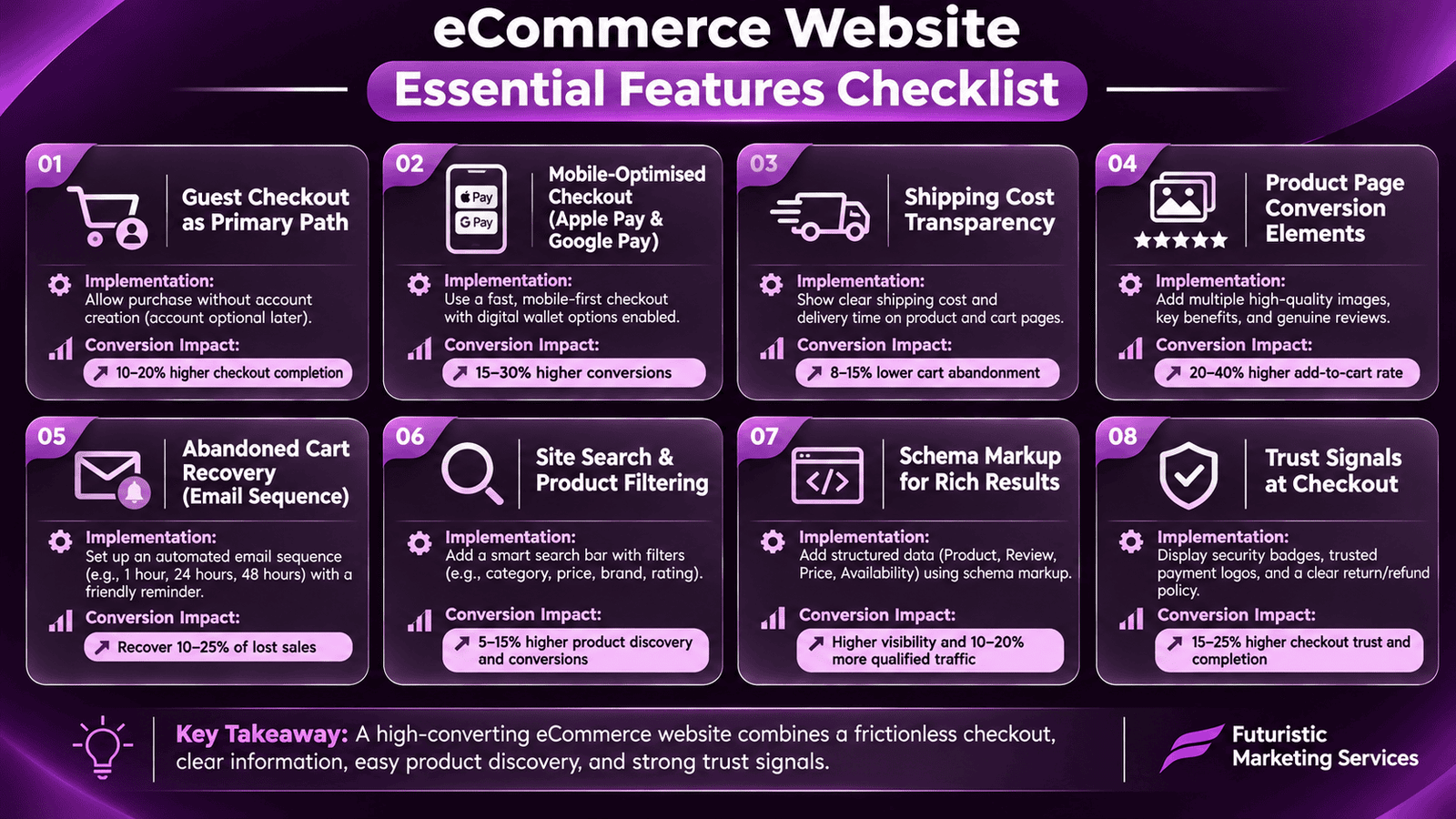
Frequently Asked Questions About eCommerce Website Development
How much does eCommerce website development cost in the UK?
What is the best eCommerce platform for UK businesses?
How long does it take to build an eCommerce website?
What payment gateways work with WooCommerce and Shopify?
What is cart abandonment and how do I reduce it?
Does page speed affect eCommerce conversion rates?
Do I need product schema markup for my eCommerce store?
What is headless eCommerce and when should I consider it?
What eCommerce features should I prioritise at launch?
How do I structure my eCommerce site for SEO?
What ongoing services does an eCommerce store need after launch?
Can I migrate my existing eCommerce store to a new platform?
Futuristic Marketing Services
Build an eCommerce Store That Grows Your Revenue
Futuristic Marketing Services builds professional eCommerce stores on WooCommerce and Shopify, with guest checkout, mobile-optimised payment flows, Core Web Vitals engineering, and eCommerce SEO foundations built in from day one.
Start Your eCommerce Project