YouTube Shorts Algorithm: How Editing Style Directly Affects Your Views and Distribution

YouTube Shorts algorithm editing

The YouTube Shorts algorithm does not distribute content based on subscriber count, channel authority, or keyword optimisation in the way that long-form YouTube search does. It distributes content based on behavioural signals: how many viewers watched the Short all the way through, how many replayed it, how quickly viewers scrolled past it, and whether viewers engaged or signalled disinterest. Every one of these behavioural signals is a direct output of editing quality.

This means editing style has a more direct, measurable relationship with algorithmic distribution on YouTube Shorts than on any other major video platform. This guide covers how the Shorts algorithm works, which specific editing decisions control each distribution signal, and the technical techniques that earn consistent algorithmic reach to new audiences. For the professional editing service that applies these techniques, the YouTube Shorts editing service guide covers the complete service standard.

Key Takeaways

  • The YouTube Shorts algorithm distributes content based on four primary behavioural signals -- loop rate, scroll-stop rate, first-half view rate, and viewer satisfaction -- all directly controlled by editing decisions rather than content quality or channel authority alone
  • YouTube Creator Academy documentation confirms that Shorts earning high replay rates receive disproportionately stronger algorithmic distribution than Shorts with equivalent views but low replay rates
  • The scroll-stop decision happens in the first 1.5 seconds of a Short -- the editing of those first frames determines whether the viewer stays or scrolls, making the opening hook the highest-leverage edit decision in any Short
  • A seamless loop edit where the final frame flows naturally back to the first frame earns 2-3x more replays than a Short with a hard ending, because the algorithm serves the Short again immediately upon completion
  • According to VidIQ algorithm research, Shorts with consistently high loop rates earn compounding distribution advantages -- each high-performing Short improves the algorithmic profile of subsequent Shorts from the same channel
  • For the specific editing techniques that engineer each algorithm signal step by step, the how to edit YouTube Shorts for engagement guide provides the complete technical framework

Want Your Shorts Edited to Maximise Every Algorithm Signal?

Futuristic Marketing Services edits YouTube Shorts with loop rate engineering, scroll-stop hook production, kinetic captions, and the four-signal optimisation framework that earns consistent algorithmic distribution.

Get Algorithm-Optimised Shorts Editing
How the YouTube Shorts Algorithm Works

The YouTube Shorts algorithm operates differently from the long-form YouTube recommendation algorithm. Long-form recommendation is driven by watch time, click-through rate from thumbnails, and channel authority accumulated over time. The Shorts Feed algorithm is driven by short-window engagement signals measured from the first batch of viewers shown a Short.
When a Short is first published, YouTube serves it to a small initial test audience -- typically a few hundred to a few thousand viewers drawn partly from the channel's existing subscribers. It measures the four primary signals from this test group. If signals are above threshold -- loop rate high, scroll-stop rate strong, first-half view rate good -- it expands distribution to progressively larger audience pools. If signals are below threshold in the test batch, distribution is suppressed and the Short never reaches significant reach.

THE CRITICAL IMPLICATION

Because the initial test batch determines distribution fate, every Short must be edited to its maximum quality before publishing. There is no algorithm benefit to publishing quickly with a rough edit and improving later. The distribution decision is made from the first few hours of viewer behaviour, and a poor-performing initial batch permanently limits the Short's reach regardless of any edits made after publication.

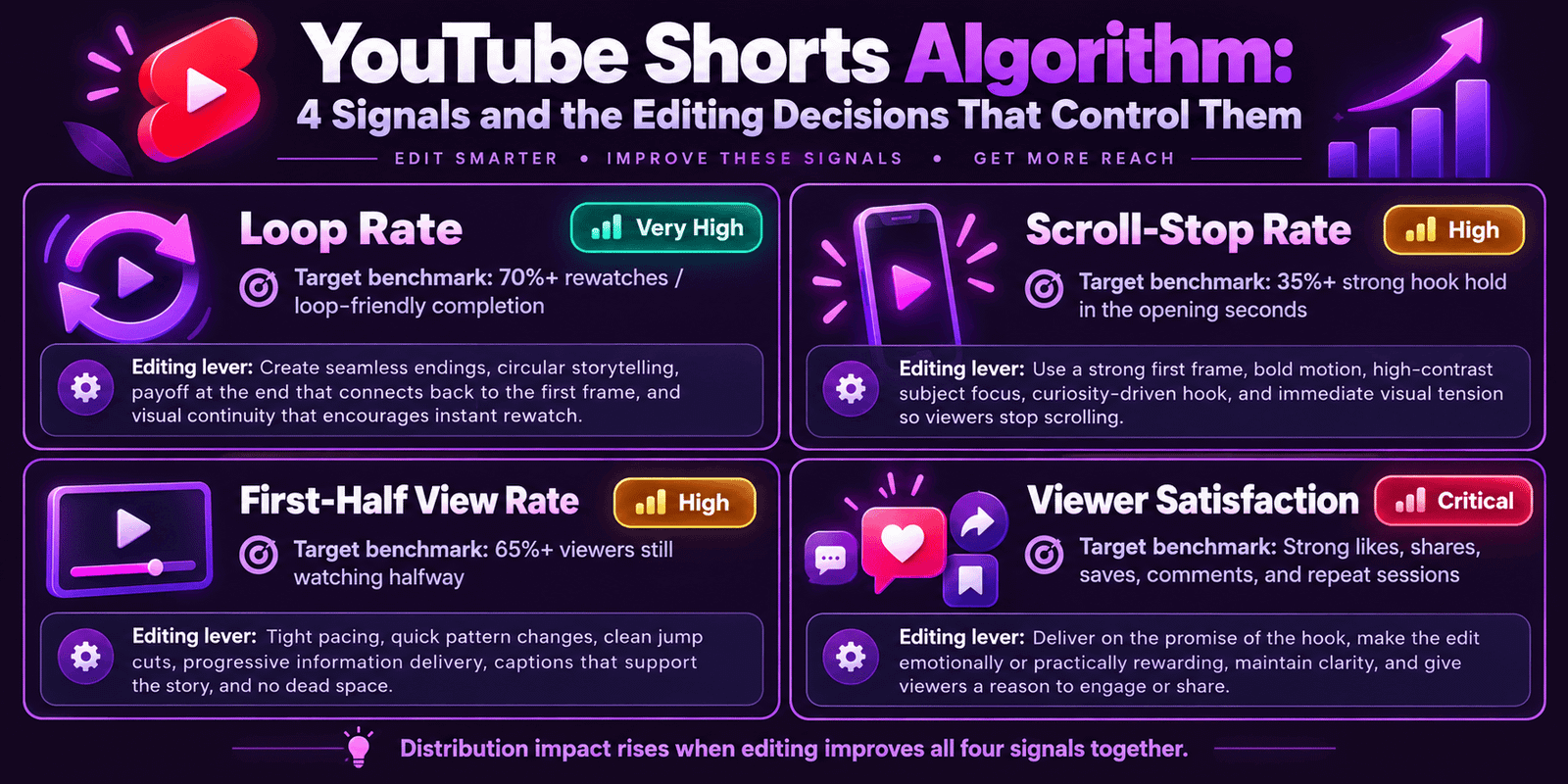
Signal 1: Loop Rate -- The Most Powerful Distribution Trigger

Loop rate is the percentage of viewers who watch a Short all the way to the final frame and allow it to loop back to the beginning. A Short with a 35% loop rate means 35 out of every 100 viewers replayed it at least once -- an exceptionally strong positive signal that the content was compelling enough to watch again immediately.
The editing techniques that engineer high loop rates all remove the clear signal of ending that causes viewers to scroll away before the loop begins. Specific techniques include: cutting the final 1-2 seconds so the Short ends mid-sentence rather than at a natural conclusion; ending on a question or statement that creates curiosity satisfied only by watching again from the beginning; ensuring the final visual flows naturally into the opening frame; and avoiding all "video is finished" signals -- no fade-to-black, no outro card, no endcap animation.

Signal 2: Scroll-Stop Rate -- Engineering the First 1.5 Seconds

The scroll-stop rate measures the percentage of viewers who stopped scrolling the Shorts Feed to watch a specific Short. It is determined almost entirely by what happens in the first 1-1.5 seconds of the clip -- the window in which the viewer decides whether this Short is worth their attention or whether they should continue scrolling.
Editing techniques that maximise scroll-stop rate: Open with the most visually or verbally surprising moment in the entire clip rather than with context-setting; use a pattern interrupt in the first frame -- an unexpected visual, a bold on-screen text card, a counter-intuitive statement; ensure the first spoken word is specific and concrete rather than vague or general; and avoid any kind of preamble that signals the best content is not yet present.

Signal 3: First-Half View Rate -- Sustaining Momentum After the Hook

First-half view rate measures the percentage of viewers who watch past the midpoint of the Short. It separates Shorts with good hooks from Shorts with good hooks and good content. A Short can earn a strong scroll-stop rate through an excellent hook but lose most of its audience at the 10-15 second mark if the content following the hook does not deliver on the promise of the opening.
Editing techniques that maintain first-half view rate: Ensure information density stays high throughout -- every 5 seconds should introduce a new data point, insight, or narrative development; use visual variety to prevent habituation; keep pacing tight by removing all pauses over 0.5 seconds and all filler words; and preview the payoff of the clip without fully delivering it, creating forward momentum that pulls the viewer through the midpoint.

Signal 4: Viewer Satisfaction -- Likes, Saves, and Shares

Viewer satisfaction is a composite signal drawn from explicit engagement actions (likes, saves, shares, comments) and negative feedback signals (not interested, report, immediate scroll-away). A Short with high loop rate but low satisfaction signals sends a mixed message -- the content retained viewers but did not generate genuine enthusiasm. Satisfaction signals are primarily driven by content quality but editing contributes through value density, emotional authenticity, and the completeness of the payoff at the conclusion.
Editing DecisionSignal AffectedSpecific TechniqueImpact
Opening frame selectionScroll-stop rateUse highest-energy or most surprising moment as frame zeroVery High
Hook engineering (first 3 sec)Scroll-stop ratePattern interrupt -- bold text, unexpected visual, direct claimVery High
Pacing throughoutFirst-half view rateRemove pauses over 0.5 sec, remove filler words, high info densityHigh
Final frame engineeringLoop rateEnd mid-sentence or mid-thought, no visual ending signalsVery High
Caption accuracy and stylingFirst-half view rateWord-by-word animation, brand font, reviewed for errorsHigh
Audio qualityScroll-stop rateFirst 3 seconds with poor audio generate disproportionate scroll-awayHigh
Information completenessViewer satisfactionClip must fully deliver on the promise of its openingHigh

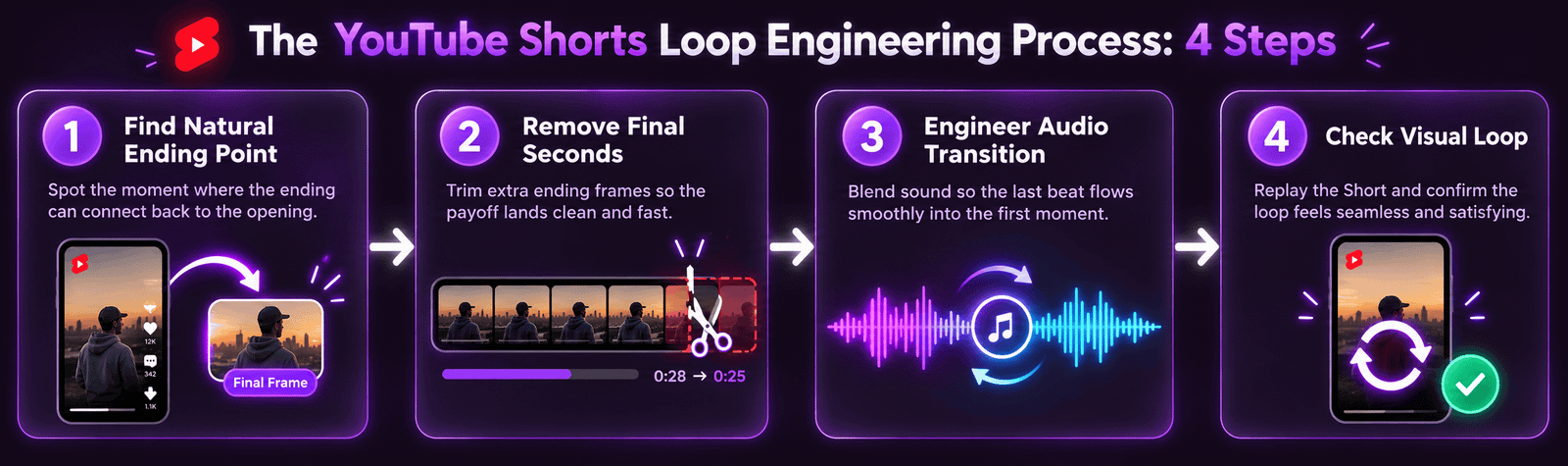
The Loop Engineering Technique: Step by Step

Loop engineering is the editing process that creates a seamless transition from the last frame of a Short to the first frame when the clip replays. It is the most technically specific Shorts editing skill and the one with the highest direct impact on loop rate.
Step 1 -- Find the natural ending point: Identify where the clip's content naturally concludes -- typically at a sentence ending, a rhetorical conclusion, or a call to action. This is the frame the algorithm uses as the transition point back to the beginning when the Short loops.
Step 2 -- Remove the last 1-3 seconds: Cut the clip 1-3 seconds before the natural ending point so it ends mid-thought. The viewer is left in suspense about the conclusion -- which the beginning of the clip resolves when the loop starts.
Step 3 -- Engineer the audio transition: If the audio at the cut-out point ends with a downward inflection (signalling conclusion), find an earlier cut point with an upward inflection (signalling continuation). The audio tone of the final word should feel like the sentence will continue -- because it does, in the next loop.
Step 4 -- Check the visual transition: Play the clip from the final 2 seconds through the loop back to the first 2 seconds. The visual should not create a jarring jump or a clear end signal. Adjust the cut point until the loop transition feels intentional and seamless.

Want Your Shorts Loop-Engineered for Maximum Replay Rate?

Futuristic Marketing Services applies the complete four-signal optimisation framework to every Short -- loop engineering, scroll-stop hook production, first-half view rate pacing, and kinetic captions.

Get Algorithm-Optimised Shorts

Frequently Asked Questions

Q. Does posting time affect YouTube Shorts distribution?

A. Posting time has a minor effect on the initial test batch composition -- posting when your existing audience is most active gives the initial batch a higher percentage of engaged existing viewers more likely to loop and engage. However, because the Shorts algorithm serves content to non-subscribers in the Shorts Feed, algorithm behaviour is a far larger distribution lever than posting time. A well-edited Short with high loop rate posted at any time will outperform a poorly-edited Short posted at optimal time.

Q. How long should a YouTube Short be for maximum algorithm performance?

A. Research from VidIQ and TubeBuddy consistently shows that Shorts in the 30-55 second range outperform both very short Shorts (under 20 seconds) and near-maximum Shorts (58-60 seconds) on loop rate and first-half view rate. This range is long enough to develop a complete thought and deliver a satisfying payoff, and short enough that the barrier to completing and looping the content remains low.

Q.Does the Shorts algorithm penalise repurposed content from other platforms?

A.YouTube explicitly states that Shorts with watermarks from other platforms (TikTok, Instagram Reels) receive reduced distribution in the Shorts Feed. Remove all watermarks before publishing repurposed content as a YouTube Short. Beyond watermarks, the algorithm does not penalise cross-platform repurposed content -- the distribution decision is based entirely on the viewer behaviour signals generated after publication.

Build Shorts That the Algorithm Pushes to New Audiences Every Week

Futuristic Marketing Services edits YouTube Shorts with every algorithm signal optimised -- loop engineering, hook production, caption animation, and the quality standard that compounds distribution over time.

Start Algorithm-Optimised Shorts


Conclusion

The YouTube Shorts algorithm is a meritocracy of viewer behaviour -- it distributes the content that viewers demonstrate they want through their loop rate, scroll-stop rate, first-half view rate, and satisfaction signals. Because all four signals are directly controlled by editing decisions, editing quality has a more direct and measurable relationship with algorithmic distribution on Shorts than on any other major video platform.
For the complete professional editing service that applies these techniques, the YouTube Shorts editing service guide and the YouTube Shorts monetisation guide provide the full commercial framework.
Share this post :
Picture of Devyansh Tripathi
Devyansh Tripathi

Devyansh Tripathi is a digital marketing strategist with over 5 years of hands-on experience in helping brands achieve growth through tailored, data-driven marketing solutions. With a deep understanding of SEO, content strategy, and social media dynamics, Devyansh specializes in creating results-oriented campaigns that drive both brand awareness and conversion.

All Posts