Key Takeaways
- Users spend 57% of their page-viewing time above the fold (Nielsen Norman Group), the hero banner is the single most important design asset on most websites
- Personalised or targeted banners convert at twice the rate of generic equivalents, making audience-specific banner design one of the highest-return conversion optimisation investments
- The four laws of visual hierarchy, one dominant element, deliberate size contrast, directional flow, and contrast and separation, govern every high-performing banner regardless of type or industry
- Banner text must follow the minimum density rule: hero banners should contain no more than 15 words in the headline zone to maintain visual clarity and immediate message comprehension
- Mobile-first banner design is not optional: over 60% of website traffic in India arrives on mobile devices, and banners designed only for desktop degrade severely on mobile screens
- The CTA button is the highest-value single element in any banner, button colour, copy specificity, size, and positioning each independently affect conversion rate and must be tested systematically
- LCP (Largest Contentful Paint) is directly determined by hero banner image load speed, slow-loading banner images both reduce conversions and harm SEO rankings through Core Web Vitals scoring
Need Professional Website Banner Design That Converts?
Futuristic Marketing Services designs high-converting website banners for Indian businesses, hero banners, promotional banners, and complete banner systems built for desktop and mobile with the correct dimensions, file formats, and conversion-optimised design principles.
Get a Free Banner Design ConsultationThe Business Case for Better Banner Design
| Design Variable | Performance Impact | Research Source |
|---|---|---|
| Banner visible above the fold | 80% of visitor attention concentrated in this zone, below-fold banners receive only 20% of total attention regardless of design quality | Hotjar scroll-map research, cited in Elementor statistics |
| First impression formation time | 50 milliseconds, users form a visual impression of a website faster than conscious thought can evaluate it, making the banner's visual quality a pre-cognitive trust signal | Gitte Lindgaard, Carleton University study published in Behaviour and Information Technology |
| Personalised vs generic banner | Personalised calls to action convert 202% better than generic equivalents across HubSpot's analysed customer dataset | HubSpot personalisation research |
| Above-fold time share | 57% of total page-viewing time spent above the fold; attention declines consistently with scroll depth regardless of content quality below the fold | Nielsen Norman Group eye-tracking research |
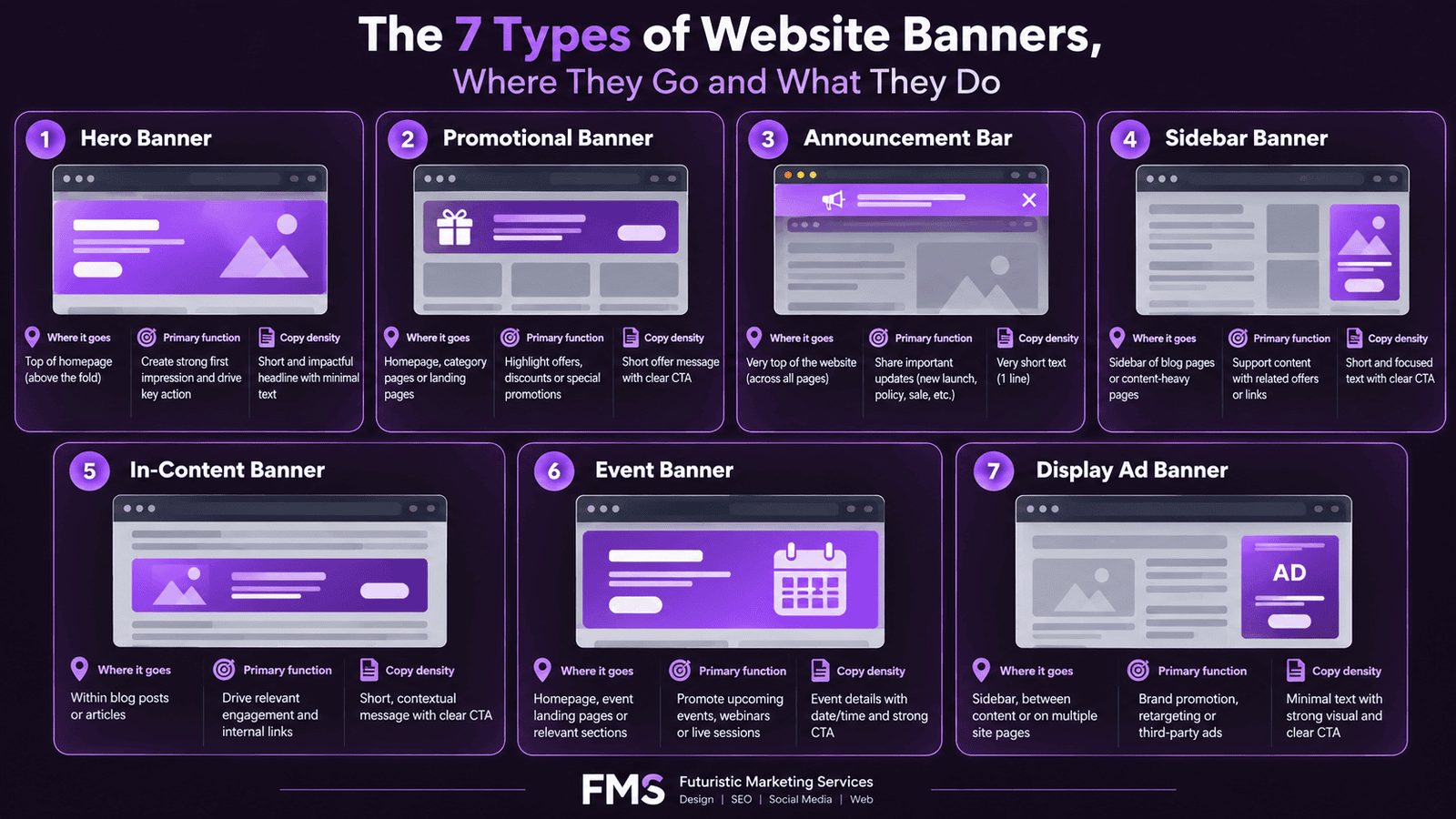
The Seven Types of Website Banners and When to Use Each
| Banner Type | Placement | Primary Function | Copy Density Rule |
|---|---|---|---|
| Hero Banner | Homepage top, above the fold | Brand story, primary value proposition, first impression, main conversion entry point | Maximum 15 words in the headline zone; sub-headline under 20 words |
| Promotional Banner | Homepage, category pages, landing pages | Announce offer, drive purchase, promote time-limited discount or seasonal campaign | Medium density, offer, discount value, deadline, and CTA must all be present |
| Announcement Bar | Site-wide top bar above navigation | Inform about shipping, policy changes, new services, or time-sensitive news | Very low, one short sentence maximum; dismissible design preferred |
| Sidebar Banner | Right or left column on blog pages, articles | Promote a related service or product to users engaged in reading content; lead magnet promotion | Low density, one hook and one CTA; no body copy |
| In-Content Banner | Within article or page body, between paragraphs | Contextually relevant promotion that matches the topic of the surrounding content; highest-intent placement | Medium density, relevance to surrounding content is more important than brevity |
| Event Banner | Homepage, email headers, social profiles | Promote a specific event, webinar, sale, launch, or conference, with a clear deadline and registration CTA | Date, time, event name, and CTA are mandatory elements; everything else is optional |
| Display Ad Banner | Google Display Network, third-party websites | Drive awareness or conversions for paid advertising campaigns; served to targeted audiences on external websites | Very low, one message, one visual, one CTA; complexity destroys performance at small display sizes |
The Four Laws of Visual Hierarchy in Website Banner Design
Law 1: One Dominant Element
Law 2: Deliberate Size Contrast
Law 3: Directional Flow
Law 4: Contrast and Separation
Typography for Website Banner Headlines
| Typography Element | Desktop Specification | Mobile Specification | Critical Rule |
|---|---|---|---|
| Primary Headline | 48–80px; Bold or ExtraBold weight; maximum 10–15 words | 28–44px; same weight; line breaks must be controlled so no word wraps awkwardly | Never use a font weight below Bold for primary headline text; thin weights lose legibility on low-brightness mobile screens |
| Sub-Headline | 18–28px; Regular or Medium weight; maximum 20 words; different colour or weight from headline | 16–20px; same weight; often hidden on very small screens if it duplicates information from the headline | Sub-headline must add specific information not already communicated by the headline, not restate the headline in different words |
| CTA Button Text | 14–18px; Bold weight; imperative verb opening; maximum 4 words | 14–16px; Bold; button must be minimum 44×44px touch target | CTA text must start with an action verb and specify what happens when clicked; "Click Here" is not a CTA, "Get Your Free Quote" is |
| Supporting Label / Badge | 11–14px; Bold or uppercase; high-contrast background | 11–13px minimum; never smaller than 11px on any screen | Labels below 11px are invisible on low-DPI screens; if the label content is important enough to include, it must be readable |
CTA Button Design: The Highest-Return Single Element in Any Banner
| Banner Type | High-Converting CTA Copy | Weak CTA Copy to Avoid | Why the Strong Version Works |
|---|---|---|---|
| Service / B2B Hero | Get a Free Strategy Call | Learn More / Contact Us | Specifies the exact offer (strategy call), confirms it is free, implies immediate availability |
| E-Commerce Promotional | Shop the Sale, Ends Sunday | Shop Now / Buy Here | Adds deadline urgency directly into the CTA, reinforcing the promotional banner's time-limited framing |
| Content / Lead Magnet | Download the Free Checklist | Download / Submit / Click | Names the specific asset (checklist), confirms the cost (free), specifies the action (download) |
| Event / Webinar | Save My Free Seat | Register / Sign Up | First-person phrasing ("My") increases personal commitment; "Free" removes financial friction; "Seat" creates mild scarcity |
Photography vs Illustration in Website Banners
Mobile-First Website Banner Design Principles
- Vertical stacking on mobile: most desktop banners use horizontal layouts (text left, image right or vice versa); on mobile, these elements must stack vertically with the headline first, image second, and CTA button third, ensuring the message sequence is maintained even when the layout changes dramatically
- Image safe zones: on mobile, only the central portion of a banner image is visible; elements placed at the edges of a banner designed at 1920px width will be cropped on 375px mobile screens; design at mobile width first, then extend the background for desktop without adding critical content to the extended areas
- Touch target sizing: all CTA buttons in mobile banners must be minimum 44×44px to meet Apple and Google human interface guidelines; buttons smaller than this are difficult to tap accurately and produce high mobile abandonment rates even when the banner design is otherwise strong
- Image file size for mobile: mobile users on 4G networks are disproportionately affected by large image files; hero banner images must be served in WebP format and compressed to under 150KB for mobile viewports without visible quality degradation
- Text size on mobile: the minimum readable text size on a mobile screen is 16px at 1x resolution; any text smaller than this in a banner is either invisible or requires pinch-to-zoom to read, both of which represent complete communication failures
Technical Specifications for Website Banners
| Specification | Recommended Standard | Why It Matters |
|---|---|---|
| File format | WebP (primary); PNG as fallback for browsers without WebP support; JPEG for photographic banners with no transparency requirement | WebP provides 25–35% smaller file sizes than JPEG at equivalent quality; directly improves Core Web Vitals LCP score |
| Desktop hero size | 1920×600–1080px depending on banner height proportion; minimum 1280px width | Ensures sharp display on 1920px monitors without serving unnecessarily large files to smaller viewports |
| Mobile hero size | 800×1000–1200px (portrait orientation) for vertical mobile hero; 768×400px for horizontal mobile hero | Serving desktop-sized images to mobile devices wastes bandwidth and dramatically slows load time for mobile users |
| Maximum file size | Under 200KB for mobile-served banner images; under 400KB for desktop hero images | Google's Core Web Vitals requires LCP under 2.5 seconds; a 1MB+ hero image on a mobile 4G connection routinely produces LCP above 4 seconds |
| Colour profile | sRGB for all web-published banner images | Adobe RGB and CMYK profiles display with incorrect colours in browsers; sRGB is the universal web standard |
| Alt text | Descriptive alt text for every banner image; maximum 125 characters; describes the image and its function without stuffing keywords | Alt text is required for screen reader accessibility compliance and contributes to Google Image Search visibility for relevant visual queries |
A/B Testing Website Banners: The Tests That Move the Needle
- Headline copy test: test two different value propositions, one focused on the outcome the customer receives, one focused on the problem the business solves, with all other elements identical; this consistently produces the largest conversion differences because the headline determines whether the banner is relevant to the viewer
- CTA button colour test: test the brand's accent colour against a complementary high-contrast alternative; button colour is the highest-return single visual element test because it directly affects how visible the conversion mechanism is against the banner background
- CTA copy test: test a specific outcome-oriented CTA ("Get My Free Website Audit") against a more generic equivalent ("Contact Us"); specific copy consistently wins, but the margin of improvement reveals how much the generic copy was hurting conversion
- Image vs no image test: for service businesses, test a banner with a human face (team member, founder, or client) against a version with a product or abstract visual; the relative performance reveals whether the audience is buying the person or the service
- Social proof placement test: test a trust signal (number of clients served, years in business, specific result achieved for a client) positioned above vs below the CTA; the position that converts higher reveals where in the decision sequence the audience needs social proof
Need a Professional Banner Design System for Your Website?
Futuristic Marketing Services designs complete website banner systems, hero banners, promotional banners, announcement bars, sidebar banners, and in-content banners, all designed to work together as a unified visual system across desktop and mobile with the correct specifications for your platform.
Start Your Banner Design ProjectFrequently Asked Questions
Q. What is a website banner?
Q. What is the ideal size for a website banner?
Q. How do I design a banner that converts visitors into leads?
Q. Should a hero banner be an image or a video?
Q. What file format should website banners be?
Q. How important is the landing page my banner links to?
Build a Complete Website Banner System That Converts
Futuristic Marketing Services designs website banner systems for Indian businesses, every banner type designed to the correct specifications, with the correct hierarchy, mobile-first, and built for systematic A/B testing from day one.
See Our Website Design Services