
Internal Linking Strategy: The Complete SEO Guide for 2026

internal linking strategy

Internal linking is the practice of adding hyperlinks within your website that point from one page to another on the same domain. These links tell Google which pages are related to each other, distribute page authority (PageRank) across your site, guide users to relevant content, and help Google discover and index pages that might otherwise be missed. A well-planned internal linking architecture is one of the highest-impact SEO improvements available without requiring any external resources.

This guide covers the complete internal linking strategy for SEO: how PageRank flows through internal links, the silo architecture that concentrates authority where it matters most, the anchor text rules that maximise relevance signals, how to audit your current internal linking structure using Screaming Frog and Google Search Console, how to identify and fix orphan pages, and the ongoing internal linking maintenance process that ensures every new page is properly integrated into your authority network from day one of publication.

Key Takeaways

  • According to Google Search Central, internal links are how Google discovers new pages and understands the relationship between pages on your site, making internal linking both a crawlability and a ranking factor simultaneously
  • A service page receiving internal links from 10 relevant blog posts consistently outranks an isolated service page with no internal links pointing to it, even when both have identical external backlink profiles
  • Anchor text is the most important dimension of internal link quality, descriptive keyword-relevant anchor text provides Google with relevance signals for the linked page
  • Orphan pages, pages with no internal links pointing to them, may not be discovered, indexed, or ranked by Google regardless of how strong their content quality is
  • The correct internal linking priority order is: service and conversion pages first, then pillar pages, then cluster articles, then supporting content
  • Every new blog post should link to at least 3 existing pages and receive at least 2 internal links from existing pages within the first week of publication, our content strategy guide covers how to build this into your production workflow

Want Your Internal Linking Audited and Optimised for Maximum Rankings?

Futuristic Marketing Services conducts complete internal linking audits, identifying orphan pages, weak authority pages, and linking opportunities, then implements the strategic architecture that distributes authority to your most commercially important pages.

Get an Internal Linking Audit

How PageRank Flows Through Internal Links
PageRank is Google's original algorithm for measuring page authority based on the quantity and quality of links pointing to it. While Google's ranking systems have grown far more sophisticated, PageRank remains a foundational component, pages with more high-quality links (both internal and external) pointing to them consistently rank better than equivalent pages without those links. According to Moz, PageRank flows through internal links in the same way it flows through external backlinks, each internal link from a high-authority page to a lower-authority page transfers a portion of that authority.
The practical implication: pages that receive many internal links from other authoritative pages on your site rank higher than isolated pages with no internal links pointing to them, even when their external backlink profiles are identical. This means you can deliberately engineer which pages on your site rank best by controlling where your internal links point. High-authority blog posts can act as internal link boosters for service pages, passing accumulated external backlink authority down to the pages most important for your business goals.

The Silo Architecture, Concentrating Authority Where It Matters

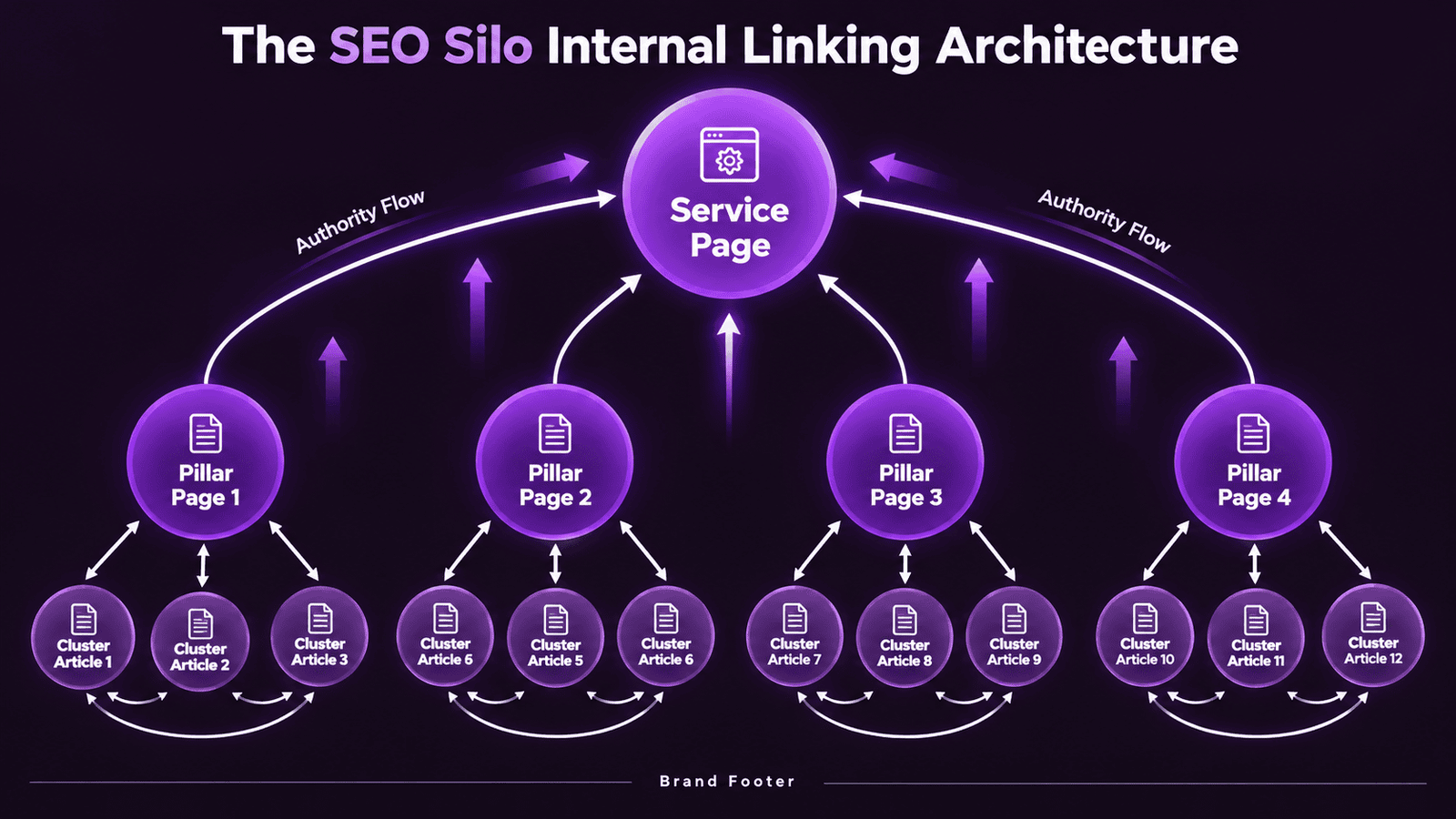
A silo structure organises your site's internal linking architecture so that topically related pages link primarily to each other, concentrating topical authority in the pages that matter most for each topic area. This mirrors the topical cluster architecture covered in our SEO content strategy guide and topical authority guide, but applies it specifically to the internal linking layer.
In a well-built silo, a service page (the highest-priority conversion page) sits at the top of the silo and receives internal links from all relevant blog posts and guides in that topic cluster. Those blog posts and guides link to each other where contextually relevant, and all link back to the service page and the subtopic pillar above them. External backlinks earned by any page in the silo flow to the service page through this internal linking chain, concentrating external authority at the pages most important for generating business results.
Silo LevelPage TypeReceives Links FromLinks ToAuthority Priority
Level 1 (top)Service or conversion pageAll cluster articles, subtopic pillars, and blog posts in the siloCategory page, homepageHighest, maximise internal links pointing here
Level 2Subtopic pillar pageAll cluster articles in its sub-clusterLevel 1 service page, related cluster articlesHigh, receives and passes authority
Level 3Cluster article or blog postRelated cluster articles, supporting contentIts parent subtopic pillar, the Level 1 service pageMedium, earns and distributes external backlinks
Level 4 (base)Supporting content, definitions, FAQsHomepage or category onlyIts parent cluster article, subtopic pillarLow, created for coverage breadth

Anchor Text Rules for Internal Links

Anchor text is the clickable, visible text of a hyperlink. For internal links, anchor text is a direct relevance signal, Google uses the words in your anchor text to understand what the linked page is about. Correct anchor text strategy for internal links is therefore one of the most powerful on-page signals you can control entirely without any external dependency.
Internal link anchor text rules: use the primary keyword of the destination page as the anchor text base (for a page targeting 'local SEO guide', use anchor text like 'local SEO guide', 'local SEO strategy', or 'how to do local SEO'). Vary the phrasing across different linking pages, 70% partial match anchors and 30% exact match anchors is the recommended distribution for internal links. Never use generic anchor text like 'click here', 'read more', or 'this page' for internal links, these provide Google with no context about the destination page's topic and waste the relevance signal opportunity completely.
Anchor Text TypeExampleWhen to UseSEO Signal Strength
Exact matchinternal linking strategyUp to 30% of links to any one pageStrong, direct keyword signal for destination page
Partial matchcomplete guide to internal links for SEO70% of links, the primary approachStrong, topical relevance with natural variation
BrandedFuturistic Marketing Services internal linking guideWhen referencing specific branded contentMedium, brand authority signal
Genericclick here, read more, learn moreNever, for any internal linkZero, no relevance signal, wasted opportunity

How to Identify Internal Linking Opportunities

Finding relevant internal link opportunities efficiently requires a systematic approach rather than reading every existing article to spot potential connections. Use these three methods in combination.
Google site search: When writing a new article about Topic X, search Google for site:yourdomain.com Topic X. Every existing page that mentions Topic X in its content is a potential source of an internal link to your new article. This takes 2 minutes and consistently surfaces the most contextually relevant existing pages to link from.
Screaming Frog link analysis: Crawl your site with Screaming Frog and export the Inlinks report for your highest-priority pages (service pages and pillar pages). Pages with fewer than 3 inlinks are under-linked relative to their commercial importance. Sort by inlink count ascending to find your most authority-starved pages, these are your highest-priority internal linking opportunities.
Google Search Console search queries: Check which pages rank in positions 11 to 30 for their target keywords in GSC. Pages in this position range are often stuck there primarily due to insufficient internal link authority. Adding 2 to 3 strong internal links from high-authority existing pages to a position-11-to-30 page frequently moves it to page one without any other changes.

Fixing Orphan Pages

Orphan pages are pages on your site that have no other internal pages linking to them. Google's crawlers discover pages primarily by following links, an orphan page can only be discovered through the XML sitemap or a direct URL entry, and it receives zero PageRank from your internal linking network. Many sites accumulate orphan pages over time as content is created without being properly integrated into the existing linking architecture.
Find orphan pages by comparing your XML sitemap URL list against the list of all URLs discovered during a Screaming Frog crawl of your site's internal links. Any URL appearing in the sitemap but not in the crawled link list is an orphan. For each orphan page: identify the most relevant existing page that should logically link to it, add a contextual internal link from that existing page, and verify the orphan is now discoverable through the internal link network.

Internal Link Placement Rules

The placement of an internal link within a page significantly affects both its user value and its SEO signal strength. Links embedded naturally within editorial body content carry more weight than links in navigation menus, sidebars, footers, or link lists. This is because editorially placed links represent a genuine content recommendation, the page is contextually relevant to the surrounding discussion, which Google evaluates as a stronger relevance signal than navigational links that appear on every page regardless of content relevance.
  • Place internal links within the first 300 words where possible, links earlier in the content receive slightly more weight than links at the bottom of a long article
  • Link from a relevant sentence where the anchor text appears naturally in context, never force a link into a sentence where it reads awkwardly
  • Do not link to the same destination URL twice in the same article, once per page is the maximum
  • Do not create a separate 'Related Articles' or 'See Also' link list at the bottom of articles, these are lower-value than contextual body links and signal low editorial investment to Google quality evaluators
  • Minimum 3 internal links per article as a publishing standard, our {ilink('how to write SEO blog posts guide',12)} covers how to integrate this into the writing process

Let Our SEO Team Build Your Complete Internal Linking Architecture

Our SEO specialists audit your current internal linking structure, identify orphan pages and authority gaps, then implement the strategic linking architecture that distributes authority to your highest-priority pages.

Start Your Internal Linking Optimisation

Frequently Asked Questions

Q. What is internal linking in SEO?

A. Internal linking is the practice of adding hyperlinks within your website that connect one page to another on the same domain. These links serve three SEO functions: they tell Google which pages are topically related, they distribute PageRank (page authority) from high-authority pages to pages needing a ranking boost, and they help Google discover and index all pages on your site rather than only those in the XML sitemap. A well-planned internal linking architecture is one of the most impactful SEO improvements available entirely within your own site.

Q. How many internal links should each page have?

A. Each page should receive a minimum of 3 internal links from other pages on your site, with more links for your highest-priority commercial pages. Service pages and pillar pages should receive internal links from every relevant blog post and guide published on your site. There is no maximum limit for inbound internal links, the more high-quality, contextually relevant internal links a page receives, the stronger its authority signal becomes. The constraint is that the links must appear naturally within contextually relevant content, not in manufactured link lists.

Q. What anchor text should I use for internal links?

A. Use descriptive anchor text that reflects the primary keyword or topic of the destination page. For a page targeting 'technical SEO audit', use anchors like 'technical SEO audit', 'how to do a technical SEO audit', or 'technical SEO audit checklist'. Vary the phrasing across different linking pages rather than using identical anchor text from every source. Never use generic text like 'click here', 'read more', or 'this article', these provide Google with no relevance signal for the linked page and waste the internal linking opportunity entirely.

Q. What is an orphan page and why is it an SEO problem?

A. An orphan page is a page on your site that has no other internal pages linking to it. It is an SEO problem for three reasons: Google's crawlers primarily discover pages by following links, so orphan pages may not be regularly recrawled and their content updates may not be reflected in search results; orphan pages receive zero PageRank from your internal linking network, making them authority-starved regardless of their content quality; and Google's quality evaluation considers isolation from the site's internal architecture as a negative signal. Find orphan pages by comparing your XML sitemap against a Screaming Frog internal link crawl.

Q. What is a silo structure in SEO?

A. A silo structure is an internal linking architecture that organises topically related pages into interconnected groups, called silos, where pages within each silo link primarily to each other. At the top of each silo sits the highest-priority page (typically a service or conversion page). Below it are pillar pages and cluster articles that cover related subtopics. All pages in the silo link up to the conversion page and across to related pages in the same silo. This concentrates topical authority and PageRank within the silo, improving rankings for every page in the group rather than each page competing in isolation.

Q. How do internal links help Google understand my site?

A. Internal links help Google understand your site in two specific ways: (1) Discovery, Googlebot follows internal links to find all pages on your site; pages not linked from any other page (orphan pages) may not be regularly crawled or indexed. (2) Relationship understanding, the anchor text and context of internal links communicate to Google which pages are topically related. A blog post about technical SEO that internally links to your technical SEO audit page tells Google that those two pages cover related topics and should be evaluated together as part of a coherent topical cluster.

Q. How do I audit my internal linking structure?

A. Audit your internal linking structure using three tools in combination: Screaming Frog (crawl your full site, export the Inlinks report for your highest-priority pages to see how many internal links each receives, and compare sitemap URLs against crawled URLs to find orphan pages), Google Search Console (check which pages rank in positions 11 to 30 for their target keywords, these are prime candidates for internal link boosts from existing high-authority pages), and Google site: search (search site:yourdomain.com [topic] to find existing pages that mention a topic and could contextually link to a target page).

Build the Internal Linking Architecture That Amplifies Every Page on Your Site

At Futuristic Marketing Services, we build systematic internal linking architectures that distribute authority from your strongest content to your most commercially important pages, improving rankings across your entire site without a single new external backlink.

Talk to an Internal Linking Specialist

Conclusion

Internal linking is the most underutilised high-impact SEO tactic available to most websites, because it costs nothing to implement, requires no external cooperation, and produces measurable ranking improvements within weeks of proper implementation. The silo architecture, correct anchor text strategy, orphan page elimination, and systematic new-page integration process together create an internal authority network that makes every piece of content on your site stronger than it would be in isolation.
Start with the highest-impact action: identify your 5 most commercially important pages in Google Search Console, find all relevant existing blog posts using site: search, and add 2 to 3 contextual internal links to your target pages from those existing articles. Run a Screaming Frog crawl to find orphan pages and add them to the internal linking network. Then build the ongoing process into your content strategy so every new piece of content is properly linked from day one.
Share this post :
Picture of Devyansh Tripathi
Devyansh Tripathi

Devyansh Tripathi is a digital marketing strategist with over 5 years of hands-on experience in helping brands achieve growth through tailored, data-driven marketing solutions. With a deep understanding of SEO, content strategy, and social media dynamics, Devyansh specializes in creating results-oriented campaigns that drive both brand awareness and conversion.

All Posts