Social Media Marketing for Beginners: Complete Step by Step Guide

social media marketing for beginners

Social media marketing for beginners starts with one clear business goal, one or two target platforms, and a simple content plan that can be executed consistently every week. Before creating any content, beginners must define who they are trying to reach, what problem their business solves for that audience, and what success looks like at the end of the first 90 days of activity.

Social media marketing for beginners starts with one clear business goal, one or two target platforms, and a simple content plan that can be executed consistently every week. Before creating any content, beginners must define who they are trying to reach, what problem their business solves for that audience, and what success looks like at the end of the first 90 days of activity.
This guide walks complete beginners through every step of starting social media marketing for a business, covering how social media marketing actually works, how to identify your target audience, how to choose the right platforms for your specific business type, how to optimize your profiles, how to plan and publish your first content, and how to measure whether your early efforts are producing results worth building on. Each step is written in plain language with specific actions to take at each stage, making this guide usable by anyone regardless of prior marketing experience. By the end, you will have a clear, executable starting plan for your first 90 days of social media marketing activity.

Key Takeaways

  • Social media marketing for beginners works best when focused on two platforms maximum, one clear goal, and a posting frequency that is genuinely sustainable with current resources.
  • According to Sprout Social, social platforms including TikTok, Instagram, and YouTube now account for over 60% of all product discovery, making social media a non-negotiable channel for any business trying to grow.
  • Profile optimization is a one-time setup that directly affects how new visitors decide whether to follow your account, making it the highest-leverage early action for beginners.
  • Content pillars, three to five topic areas your brand covers consistently, are the beginner's most important planning tool because they eliminate the daily question of what to post.
  • Short-form video delivers the highest ROI of any content format, cited by 41% of marketers, and should be a primary format in every beginner's content plan regardless of platform.
  • Engagement with your audience is as important as publishing content. Responding to every comment and message within 24 hours is the single most impactful habit for early account growth.
  • Consistent, moderate activity always outperforms intense but unsustainable bursts. Starting with three posts per week and maintaining that frequency for 90 days produces far better results than daily posting for two weeks followed by a complete stop.

Want to Skip the Learning Curve?

Let Our Experts Build and Manage Your Social Media from Day One

Futuristic Marketing Services helps businesses across India launch and grow their social media presence with complete strategy, content creation, and management, so you see results faster without spending months learning through trial and error.

Get a Free Beginner's Consultation

What Beginners Need to Understand About Social Media Marketing First

The most important thing to understand before starting social media marketing is that it is a long-term system, not a short-term campaign. Beginners who approach it expecting immediate results typically abandon their strategy before it has produced enough data to guide improvement, which is the primary reason most businesses describe social media as "not working" when the real issue is insufficient time and consistency.
Social media marketing requires three things to produce results: a clear understanding of who the target audience is and what they need, a content plan that delivers genuine value to that audience consistently over time, and an engagement practice that builds real relationships rather than simply broadcasting messages and waiting for followers to appear. Businesses that approach social media as a two-way communication channel, rather than a one-way advertising platform, consistently outperform those that treat it as a digital billboard.
According to Digital Applied's research, 5.24 billion people now use social media globally, representing 64.8% of the total global population. The opportunity is enormous. But size of opportunity does not equal ease of capture. The businesses that extract real business value from social media are those that treat it with the same strategic seriousness they bring to any other significant business investment. For a deeper foundation before following this step-by-step guide, our comprehensive article on what is social media marketing explains the complete definition, types, platforms, and business applications in detail.

▸ How Social Media Marketing Actually Works for a Business

Social media marketing works by placing your business in front of its target audience in the environment where that audience already spends its time. Unlike advertising that interrupts the audience's existing activity, well-executed social media content becomes part of the content the audience actively chooses to consume. This distinction is what makes social media a fundamentally different marketing channel from paid search, email, or traditional advertising.
The mechanism is straightforward: your business creates content that the target audience finds valuable, entertaining, or informative; the platform algorithm distributes that content to followers and, through shares and discovery features, to non-followers in the same interest category; the audience engages with the content by liking, commenting, saving, or sharing; and the platform interprets that engagement as a signal to distribute the content further. Over time, consistent engagement from a relevant audience builds reach, brand recognition, and the trust that converts social media followers into customers.
Paid advertising accelerates this process by paying the platform to place your content in front of a specifically targeted audience segment rather than waiting for organic distribution to build. Most effective social media marketing strategies combine both organic content that builds long-term audience trust and paid promotion that generates faster reach and more immediate lead volume. Buffer's complete social media marketing guide describes this as a cyclical system that moves from goal-setting and strategy through content creation, publishing, and performance analysis back to strategy refinement, a loop that improves with every revolution.

▸ What Social Media Marketing Can and Cannot Do for Your Business
Social media marketing can build genuine brand awareness among a targeted audience faster and at lower cost than most traditional channels, generate leads and direct enquiries through a combination of organic content and paid campaigns, establish thought leadership and expertise within a specific industry, support customer retention through ongoing engagement, and drive meaningful website traffic that converts at rates competitive with other digital channels.
Social media marketing cannot replace a high-quality product or service, generate instant revenue from a single campaign without prior audience building, produce consistent results without consistent investment of time and creative resources, or substitute for a complete social media marketing strategy that defines goals, audience, platforms, content, and measurement in advance. Understanding both sides of this equation prevents the disappointment that comes from expecting social media to deliver outcomes it is not designed to produce on the timescale that is assumed.

The Beginner's Roadmap: 9 Steps to Start Social Media Marketing

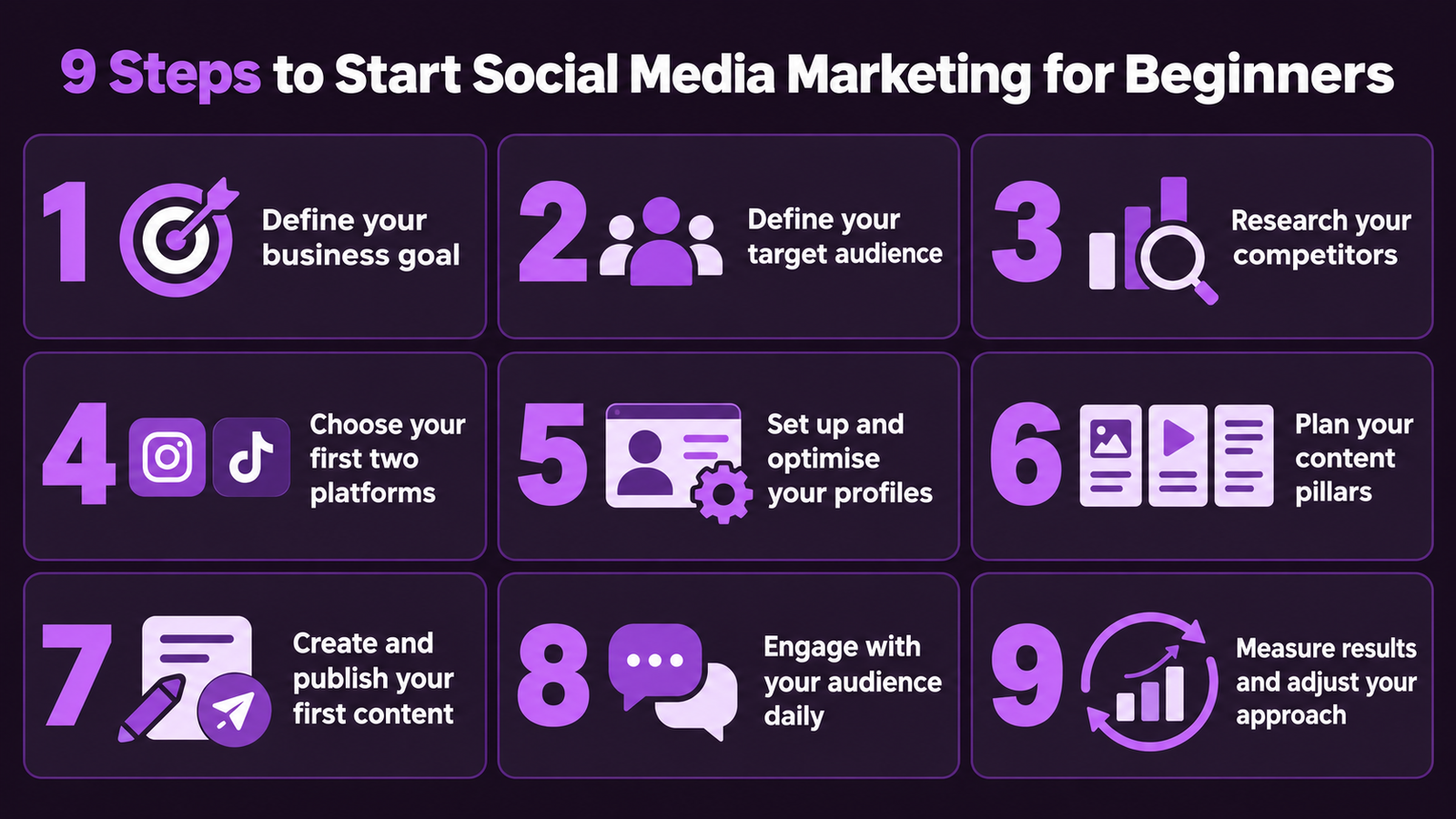
These nine steps take a complete beginner from having no social media marketing activity to having a structured, consistently executed strategy in place within one to two weeks. Each step is designed to be completed in sequence because the decisions made in earlier steps directly determine the most effective choices in later ones. Skipping steps to get to content creation faster is the most common beginner mistake and produces the unfocused, inconsistent activity that delivers no measurable results.

▸ Step 1: Define Your Business Goal Before Touching Any Platform

Every social media marketing effort must begin with a single, clearly defined business goal. Without a goal, every platform choice, every content decision, and every measurement becomes arbitrary because there is no outcome to optimize toward. The goal is what gives your entire social media activity its direction, and it is what determines whether the effort was worth the investment when you review results at the end of 90 days.
For beginners, the most actionable starting goals are one of three types. Brand awareness goals focus on making more people in your target market aware that your business exists and what it offers. Lead generation goals focus on producing a specific number of enquiries, booking requests, or contact form submissions each month from social media activity. Website traffic goals focus on driving a specific number of qualified visitors from social platforms to a key page on your website each month.
Choose one primary goal for your first 90 days and resist the urge to pursue all three simultaneously. A beginner with a single clear goal builds a measurable track record and a useful data set for the next quarter's planning. A beginner trying to achieve three goals at once typically achieves none of them with enough focus to produce meaningful results or learning. For a comprehensive guide to writing goals that are specific and trackable, our article on how to set social media marketing goals covers the full SMART framework with worked examples for every goal type.

▸ Step 2: Define Your Target Audience in Specific Detail

Your target audience is the specific group of people your social media content is created for. The more precisely you can define this group, the more relevant your content will be to them, and the more likely they are to follow your account, engage with your posts, and eventually become customers. Vague audience definitions such as "anyone who could use our service" produce vague, unfocused content that resonates with no one in particular.
Build a specific audience profile by documenting the following: the age range of your ideal customer, their location, their profession or daily role, their primary goals and challenges related to what your business offers, the social media platforms they use most frequently, the type of content they engage with most actively, and the questions they ask most often when researching products or services like yours. The final point is particularly valuable because questions your target audience asks become the topics your content addresses, connecting your publishing directly to demonstrated audience need rather than assumed interest.
Two practical sources of audience data are available to every beginner immediately. First, study your existing customers if you have any. Identify the common characteristics of your best customers, the ones who buy most frequently, value the relationship most, or refer others most often, and use that profile as the template for your social media target audience. Second, read the comments on competitor social media accounts and on relevant community forums such as Reddit, Quora, and industry Facebook Groups to understand exactly how your target audience describes their own problems and what content they actively engage with.

▸ Step 3: Research Your Competitors on Social Media

Competitor research tells you what is already working in your industry before you spend a single hour creating content. Analyzing three to five direct competitors across their active social media platforms reveals which content formats your shared target audience responds to most positively, which platforms competitors are prioritizing, what topics they cover regularly, and, most valuably, what gaps exist in their content that your business can fill to differentiate from the start.
For each competitor, spend 20 to 30 minutes reviewing their last 30 posts on their primary platform. Document the content formats they use most frequently, the top three posts by engagement, the posting frequency they maintain, whether and how they respond to audience comments, and the tone and personality they project in their captions. Do not copy anything you find. Use this research purely to understand the competitive content landscape your audience already navigates and to identify where creating genuinely different and more valuable content gives your new presence an immediate differentiation advantage.
The most important output of competitor research for a beginner is identifying one or two content angles or topic areas that competitors in your market are consistently ignoring. That gap is your opportunity. A business that enters a market providing educational content that answers the questions competitors never address builds audience trust and topical authority at a pace that the followers of those competitors actively seek out.

▸ Step 4: Choose Your First Two Platforms

Platform selection is one of the highest-stakes decisions for social media marketing beginners because the wrong choice means investing months of time and creative energy into building an audience that is not made up of potential customers. The right choice means every post reaches people who are genuinely likely to become clients, customers, or referrers.
Platform selection should follow two rules. First, choose platforms where your target audience is most active, not platforms you personally prefer or that feel most familiar. Second, choose platforms where your business type and content format strengths align with what the platform rewards. A business that can produce compelling short-form video is well-suited to Instagram Reels and YouTube Shorts. A B2B consultancy whose target audience is business decision-makers belongs on LinkedIn first, not Instagram. A local food business with strong visual content belongs on Instagram and Facebook before YouTube.
Use the platform guide in the table below to select your starting combination. Start with two platforms, build genuine audience and consistent publishing quality on both over 90 days, then consider adding a third platform once you have established a repeatable content production system for the first two.

The 5 Key Social Media Platforms: What Beginners Need to Know

Each major social media platform has distinct characteristics, audience demographics, and content format preferences that determine how well it aligns with a specific business type and marketing goal. Understanding these differences before choosing platforms prevents the common beginner mistake of selecting platforms based on personal familiarity rather than audience alignment. The table below summarizes what beginners need to know about each platform to make an informed selection decision.
Platform Best Audience Match Top Performing Formats Beginner Priority Ideal Business Types
Instagram 18 to 44 year olds; visual and lifestyle focused consumers Reels (highest reach), carousels (highest saves), Stories (daily engagement) High, most beginner-friendly for visual brands Fashion, food, fitness, beauty, interior design, retail, coaching, photography
Facebook 25 to 55+ age group; community-oriented and local market buyers Video posts, Facebook Groups, event listings, boosted posts High, largest user base; essential for local and service businesses Local businesses, healthcare, education, services, real estate, restaurants
LinkedIn Business professionals, decision-makers, B2B buyers aged 25 to 55 Text posts with personal perspective, carousels, native video, articles High for B2B, the most underutilized platform for professional services B2B services, consulting, agencies, software, finance, recruitment, law
YouTube All age groups searching for education, tutorials, and how-to content Long-form tutorials, YouTube Shorts, product demonstrations, reviews Medium, high investment required but exceptional long-term organic returns Education, software, home improvement, finance, tech, coaching, DIY
Twitter X News and opinion-focused users; tech, media, and finance communities Short text posts, threads, real-time commentary, industry news reactions Lower priority for most beginners, best as a secondary platform Media, technology, thought leadership, public affairs, finance

▸ Step 5: Set Up and Optimize Your Social Media Profiles

Your social media profile is your business's digital storefront on each platform. It is the first thing a new visitor sees when they land on your page and it determines within seconds whether they follow your account or leave without engaging. A poorly optimized profile wastes every piece of effort you put into content because visitors who are not converted into followers by your profile never see the content you subsequently publish.
Every social media profile requires five essential optimization elements to convert a first-time visitor into a follower. The profile photo must be a clear, professional image of either the business logo or the founder's face depending on whether the brand identity is corporate or personal. The username should be consistent with your business name and ideally identical across all platforms so that your brand is findable regardless of which platform a potential follower uses to search for you.
The bio or about section must answer three questions within its character limit: what your business does, who it serves, and what a new follower should expect to gain from following your account. A strong Instagram bio example reads: "We help small businesses in India grow on social media. 3 posts per week: tips, strategy, and results." This bio tells a first-time visitor exactly what the account is about, who it is for, and what content rhythm to expect, all in three lines. The profile must also include an active link to your website or a relevant landing page, and all contact information fields available on the platform should be completed accurately.

▸ Step 6: Plan Your Content Pillars

Content pillars are the three to five topic categories your social media content will consistently cover. They are the planning tool that eliminates the daily question of what to post and replaces reactive, random content decisions with a structured framework that keeps every post connected to your audience's needs and your business objectives.
Choose your content pillars by identifying the intersection of three factors: what your target audience wants to learn about based on the questions they ask and the problems they face, what your business has genuine expertise in, and what topics naturally connect to the services or products you offer. Each pillar should be specific enough to give clear content direction but broad enough to generate dozens of distinct post ideas across multiple formats without the theme becoming repetitive.
A beginner-friendly pillar structure for most businesses is three pillars to start: one educational pillar covering how-to content and tips directly relevant to what your business does, one social proof pillar covering client stories, results, and testimonials, and one behind-the-scenes pillar showing the human side of the business and building the personal connection that distinguishes genuine small business social media from corporate broadcasting. These three pillars can sustain a consistent three to four post per week schedule indefinitely while naturally evolving in topic depth and content format as the account grows. Once this three-pillar structure is running consistently, add a fourth and fifth pillar as content production capacity increases. Our social media content creation services include complete pillar development and monthly content planning for businesses that want professional guidance on building their content framework from the start.

▸ Step 7: Create and Publish Your First Content

Creating your first social media content is the step most beginners overthink and therefore delay for far too long. The perfect content does not exist. Published content that is good enough always outperforms perfect content that stays in draft form. The goal of your first two weeks of content is not to go viral or immediately generate enquiries; it is to establish your brand's presence, voice, and posting rhythm so that the algorithm begins understanding your account and your audience begins recognizing your content in their feeds.
Short-form video should be among your earliest content investments even if it feels uncomfortable initially. Sprout Social data confirms that short-form video delivers the highest ROI of any content format, cited by 41% of marketers, and platforms including Instagram, YouTube, and Facebook all algorithmically favor video over static image content in terms of organic reach distribution. A beginner's first Reel does not need professional production quality. It needs a clear, useful message delivered to the right audience in a format the platform distributes widely. Quality improves rapidly with practice. Starting early means the learning curve is behind you rather than ahead of you when the stakes are higher.
Use a simple social media content calendar from your very first week to plan and schedule content in advance. Even a basic Google Sheets document tracking date, platform, format, and topic for each upcoming post gives you the structural discipline that prevents the last-minute content scrambling that produces consistently poor output.

▸ Step 8: Engage With Your Audience Every Single Day

Publishing content and then going silent until the next post is one of the most common and costly beginner mistakes. Social media platforms are designed to reward two-way engagement, not one-way broadcasting. Accounts that respond to every comment, answer every direct message, and actively engage with other relevant content in their niche receive significantly more algorithmic distribution than accounts that publish high-quality content but ignore the conversations their posts generate.
For a beginner, the daily engagement practice is straightforward. Spend 15 to 20 minutes each day responding to every comment posted on your content, answering every direct message within 24 hours, and leaving three to five genuine, thoughtful comments on posts by other accounts in your niche or within your target audience. This activity builds the engagement signals that tell the platform your account generates genuine community interaction, which results in wider organic distribution of your future posts to audiences who have not yet discovered you.
The Buffer Social Media Marketing Guide highlights that in the current social media environment, the biggest driver of post performance is not when or how you post but whether you show up and actively participate in conversations with your audience. The platforms are explicitly rewarding responsiveness, and the brands that understand this are building audience relationships that their silent-but-polished competitors cannot replicate. This is one of the few areas where a small business with direct founder engagement has a genuine competitive advantage over larger, more polished brands that respond slowly or with generic templated replies.

▸ Step 9: Measure Your Results and Adjust Your Approach

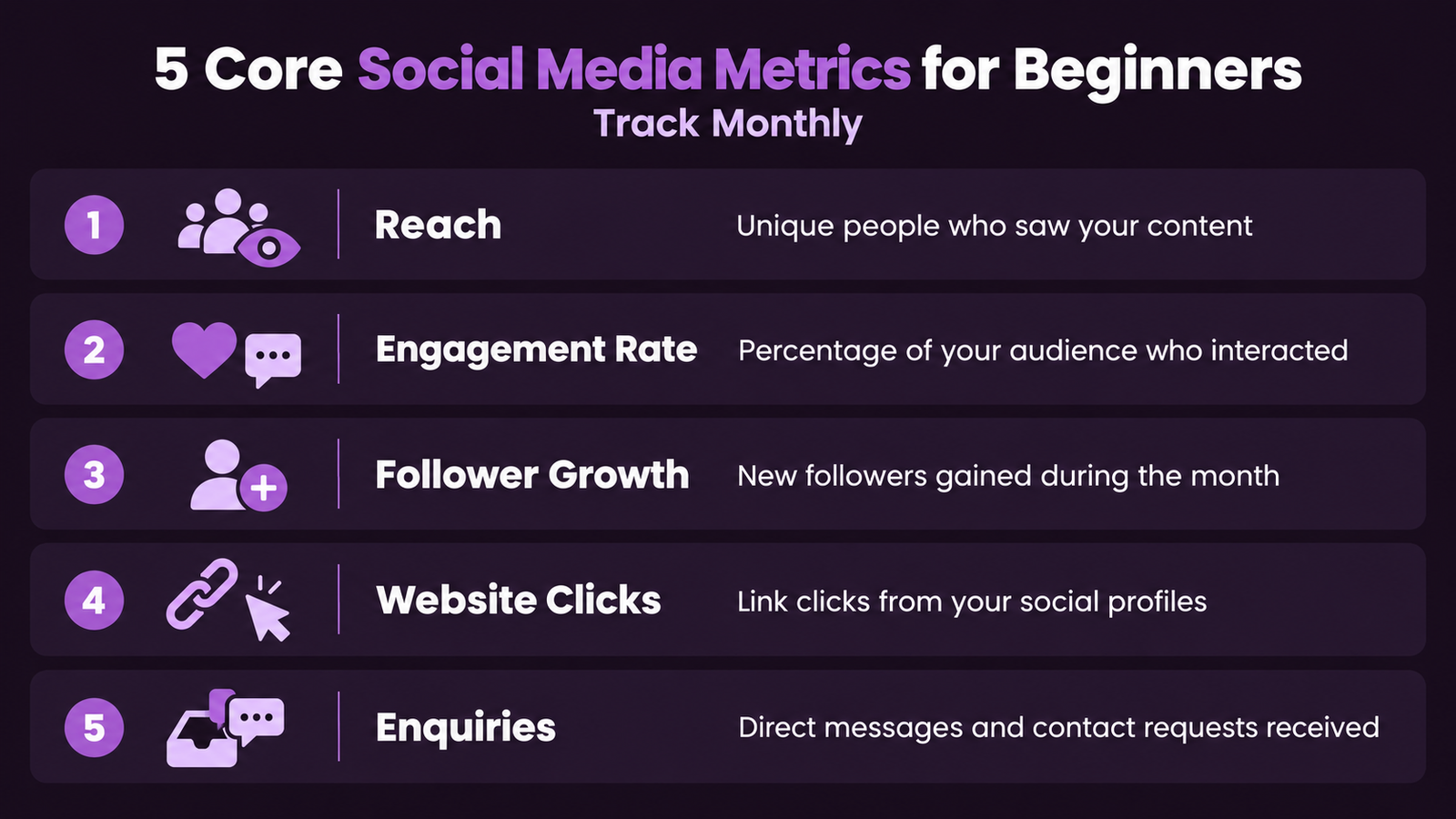
Measurement converts social media from a creative activity into a managed business channel. Without reviewing performance data regularly, beginners have no way of knowing whether their strategy is working, which specific elements are driving the results they want, or where resources should be redirected to improve return on investment. Data review does not need to be complex. For a beginner, a monthly 30-minute review session that covers five core metrics is sufficient to produce the insights needed to improve the next month's plan.
The five metrics every beginner should track monthly are reach (how many unique people saw your content), engagement rate (what percentage of people who saw your content interacted with it), follower growth (how many new followers were gained in the period), website clicks (how many times your link was clicked from your profile or posts), and the number of direct enquiries or messages that came through social media. These five data points give a complete picture of whether your content is reaching the right people, resonating with them, growing your audience, and converting that audience interest into business activity.
After your first 30 days, compare performance to the goal you set in Step 1. If the results are significantly below target, identify the specific variable most likely responsible, platform choice, content format, posting frequency, engagement practice, or profile optimization, and make one specific change rather than overhauling the entire approach at once. Single-variable adjustments produce clear data about what changed the result. Multiple simultaneous changes produce confusing data where it is impossible to identify which change produced the improvement. According to HubSpot's 2026 Social Media Strategy research, 20.6% of marketers still cite measuring ROI as their biggest challenge, making the ability to track and act on even simple performance data a meaningful competitive skill for any business that develops it early.

Social Media Marketing Budget Guide for Beginners

One of the most common questions beginners ask is how much social media marketing will cost. The answer depends on two variables: whether you plan to manage it yourself or work with an agency, and how much you plan to invest in paid advertising in addition to organic content. The table below outlines realistic budget ranges for each approach to help beginners allocate resources appropriately from the start rather than discovering unexpected costs after the strategy is already underway.
Approach Monthly Cost Estimate (India) What Is Included Best For
DIY Organic Only INR 0 to 2,000 (tools and design subscriptions) Your own time for content creation and scheduling; free Canva account; free scheduling tool such as Buffer's starter plan Bootstrapped businesses with time to invest and willingness to learn through direct experience
DIY with Paid Ads INR 5,000 to 15,000 (your time plus ad spend) Self-managed organic content plus a small Meta or Google advertising budget to accelerate reach for key posts or lead generation campaigns Businesses with a modest budget wanting faster early results than organic alone typically produces
Freelancer Support INR 8,000 to 25,000 (freelancer fee) Part-time content creation or management support from a freelancer covering graphic design, caption writing, or account management for one to two platforms Businesses that want help with specific production tasks while maintaining strategic control internally
Agency Managed (Starter) INR 10,000 to 30,000 (management fee, excluding ad spend) Strategy, content creation, scheduling, basic community management, and monthly reporting across one to two platforms managed by a professional agency team Businesses that want professional execution from day one without investing time in learning the channel themselves
Agency Managed (Full Service) INR 30,000 to 1,00,000+ (management fee, excluding ad spend) Complete multi-platform strategy, content production, paid advertising management, community management, influencer outreach, and comprehensive monthly performance reporting Established businesses that need comprehensive social media presence management across three or more platforms with paid advertising integration
Most beginners start with the DIY organic approach to learn the channel firsthand before investing in professional management. The practical value of this experience is significant: understanding how the platforms work, what content your specific audience responds to, and how the analytics data maps to real business outcomes makes you a far more effective client or manager of any future professional social media investment. Our social media marketing agency works with businesses at every stage from first-time starters through established brands scaling their paid activity, with packages designed for realistic starting budgets.

Biggest Beginner Mistakes That Ruin Early Social Media Results

The gap between beginners who see early results and those who quit social media after two months saying "it doesn't work" typically comes down to a handful of specific, avoidable mistakes. Identifying these before you begin prevents the frustration and wasted effort that causes most businesses to underinvest in social media at the stage when consistent effort would produce the most compounding long-term value.
Trying to be on every platform simultaneously is the first mistake that consistently derails beginners. The instinct to maintain a presence everywhere is understandable but counterproductive. Each additional platform you add requires unique content, consistent engagement, and performance monitoring. A beginner spreading thin across five platforms produces mediocre content on all of them rather than genuinely valuable content on two. The audience on each platform notices. Focus on two platforms for the first 90 days, build real quality and consistency there, and add additional platforms only when you have demonstrated that you can maintain quality on the existing ones.
Posting only promotional content is the second most common beginner error and the fastest way to kill early follower growth. New audiences do not follow business accounts to receive advertising. They follow accounts that give them something genuinely valuable: useful information, entertainment, inspiration, or a human connection to a brand whose values resonate with theirs. An account that publishes three promotional posts per week about why people should buy its product attracts very few followers and retains even fewer. Balance your promotional content with educational and community content at no less than a four to one ratio in favor of non-promotional posts from the very start.
Ignoring comments and messages is a mistake that is both visible to the audience and penalized by the algorithm. When a new follower leaves a comment on one of your first posts and receives no response, that single experience of being ignored eliminates the most important early impression you could have made, that your brand is genuinely engaged with its community. Respond to every comment, even if the only response is a thoughtful sentence of acknowledgment. This single habit, applied consistently from day one, builds audience loyalty at a pace that no content strategy improvement can replicate.
Measuring the wrong metrics and quitting before real data is available are related mistakes that typically happen together. Beginners who measure total followers as their primary success indicator focus on a number that is almost entirely disconnected from business outcomes. When follower growth feels slow, as it always does in the first 60 days of an organic strategy, they conclude that social media does not work and stop before the data set is large enough to contain any meaningful signal. Measure engagement rate, website clicks, and direct enquiries from week one. These metrics reflect real audience interest and business impact, and they typically show positive trends within four to six weeks of consistent quality content even when follower count growth remains slow.

Ready to Start the Right Way?

Get a Professional Social Media Strategy Built for Your Business

From audience research and platform selection through content creation, scheduling, and monthly performance reporting, our team builds and manages your complete social media presence so your business grows consistently from the very first month.

Book Your Free Strategy Call

Frequently Asked Questions About Social Media Marketing for Beginners

Q:How do I start social media marketing as a complete beginner?

A: Start by defining one clear business goal, then identify your specific target audience in detail before choosing any platforms. Select two platforms where your target audience is most active, set up and fully optimize your profiles, define three content pillars, and begin publishing three posts per week consistently. Respond to every comment and message within 24 hours, review your performance data monthly, and make one specific adjustment based on what the data shows. This sequence, followed consistently for 90 days, produces meaningful early results for most businesses starting from zero.

Q:Which social media platform should a beginner start with?

A: The right starting platform depends entirely on where your target audience is most active, not on personal preference. For consumer-facing businesses selling products or services to individuals aged 18 to 45, Instagram is the most effective starting platform because of its combination of high visual engagement and broad demographic reach. For B2B businesses targeting professionals and business decision-makers, LinkedIn is the correct first platform. For local service businesses and community-focused brands, Facebook provides the most direct access to local adult audiences. Start with the platform most aligned to your audience before adding additional channels.

Q:How long does it take to see results from social media marketing?

A: Beginners should expect three to six months of consistent activity before organic social media marketing produces meaningful, measurable business results. The first month establishes your brand's presence and posting rhythm. The second and third months reveal which content types and topics your specific audience responds to most actively. Months four through six begin producing compounding results as the algorithm rewards consistency with wider reach and the audience grows through organic discovery. Paid social advertising can generate leads within days of launch, but still requires two to four weeks of optimization to reach its best performance level.

Q:How much time does social media marketing take each week?

A: For a beginner managing two platforms with a three to four post per week schedule, expect to invest three to five hours per week in total. This breaks down into approximately one to two hours for content creation using batching across all posts for the week, 30 to 45 minutes for scheduling posts in advance using a free tool, and 20 to 30 minutes daily for engagement activity including responding to comments and messages. As content production systems improve and a library of reusable assets builds, this time investment typically decreases while output quality increases. Total time can be reduced further by working with a professional agency that handles the production and scheduling workload.

Q: Do beginners need to invest in paid advertising?

A:Paid advertising is not required to begin social media marketing, but a modest advertising budget accelerates early results significantly. An organic-only approach builds audience and brand awareness more slowly but at no direct cost beyond time. A small paid budget of INR 5,000 to 10,000 per month directed at boosting the best-performing organic posts or running a targeted lead generation campaign can produce meaningful lead volume within the first month that organic activity alone would take three to four months to achieve. Most beginners benefit from starting with organic content for the first month to understand what resonates with their audience, then adding paid amplification to the content types that demonstrate the strongest organic engagement.

Q: What kind of content should beginners post on social media?

A: Beginners should organize their content around three to four pillars from the start. An educational pillar covering tips, how-to content, and common questions your audience has about your industry. A social proof pillar covering client results, testimonials, and case studies. A personality and behind-the-scenes pillar showing the human side of the business. A fourth promotional pillar covering service announcements and offers at no more than 20% of total post volume. Short-form video should be the primary format across all pillars on platforms where it is available, with static images and carousels as supporting formats for audiences who prefer reading over watching.

Q: How do you grow a social media following from zero?

A: Growing a social media following from zero requires three consistent activities: publishing high-quality content that your target audience actively wants to see, engaging genuinely with your audience and with other accounts in your niche every day, and using platform-specific growth features such as Instagram Reels and YouTube Shorts that the algorithm distributes to non-followers who have not yet discovered your account. Hashtag research, collaboration with other accounts through joint content or shout-outs, and paid follower growth campaigns all supplement these three fundamentals. The single most effective growth tactic for most beginners is publishing short-form video consistently, as this is the format that platforms most aggressively distribute to new audiences beyond existing followers.

Q:Is social media marketing free?

A: Creating accounts and publishing organic content on social media platforms is free. However, the time investment required to create quality content, manage community engagement, and analyze performance data represents a real cost even without direct platform charges. Free tools such as Canva, Buffer's starter plan, and Google Analytics reduce the paid tool cost, but most growing businesses eventually invest in a paid scheduling or analytics tool at INR 500 to 2,000 per month. Paid social advertising is separate from organic activity and costs start from as little as INR 100 to 200 per day on Meta platforms, though a meaningful campaign typically requires INR 5,000 per month minimum to produce consistent results worth analyzing.

Q:What is the most important thing beginners should focus on first?

A: The most important focus for beginners is establishing a consistent, sustainable posting schedule and sticking to it for 90 consecutive days before making significant strategy changes. Consistency is the variable that most directly predicts long-term social media success, more than content quality, posting frequency, or platform selection. A business that publishes three good posts per week for 90 days builds significantly more algorithmic momentum, audience trust, and performance data than one that publishes 20 posts in the first week and then stops for three weeks. Set a frequency that is genuinely sustainable given your current resources, then protect that rhythm as the non-negotiable foundation of the entire strategy.

Q:Should beginners hire an agency or do social media marketing themselves?

A: The right choice depends on available time, budget, and the competitive landscape of your specific industry. Beginners with time to invest and a tolerance for learning through trial and error benefit from managing social media themselves initially because direct experience builds platform understanding that makes any future professional investment more effective. Beginners who need results faster, operate in a competitive market where content quality directly affects first impressions, or simply cannot spare five hours per week for social media management will see a better return from working with a professional agency from the start. Our social media marketing agency offers starter packages specifically designed for businesses beginning their social media journey with realistic budgets and timelines.

Q:Can social media marketing work for every type of business?

A:Social media marketing can deliver measurable results for virtually every type of business, but the platforms, content formats, and strategies that work best differ significantly by business type. Consumer-facing businesses with strong visual products achieve the fastest results on Instagram and Facebook. B2B businesses generate the most qualified leads through LinkedIn. Service businesses build trust most effectively through educational content and client case study posts across their most relevant platform. Even businesses in industries that feel unsuited to social media, such as industrial B2B suppliers or legal services, consistently find that LinkedIn and YouTube generate meaningful lead volume when the content addresses specific audience questions rather than simply broadcasting promotional messages. The question is never whether social media can work for your business type, but which platform and content approach is most aligned with how your target audience makes its buying decisions.

Q: How do you know if your social media marketing is actually working?

A: Social media marketing is working when the metrics that correspond to your specific business goal are trending in the right direction over a minimum 60-day period. If your goal is brand awareness, look for growing reach, rising impressions, and increasing follower growth rate month over month. If your goal is lead generation, track click-through rate on posts, website sessions from social referral traffic in Google Analytics, and the number of direct messages or enquiries received through social channels. If your goal is community building, watch engagement rate per post and comment volume trends. Never judge performance on a single post or a single week. Social media marketing produces meaningful data at the monthly trend level, not the individual post level.

Futuristic Marketing Services

Start Your Social Media Marketing Journey the Right Way

Whether you are a complete beginner or a business that has tried social media without results, our team builds the strategy, creates the content, and manages the execution so your brand grows consistently from the very first month without the trial-and-error period most businesses go through alone.

Get a Free Consultation Today


Conclusion

Social media marketing for beginners is not complicated when approached in the right sequence. Define your goal first. Understand your audience before choosing platforms. Research your competitors before creating content. Optimize your profiles before publishing. Plan your content pillars before writing a single caption. Publish consistently. Engage every day. Measure monthly. Adjust based on data. Repeat.
The nine steps in this guide give any beginner a clear, actionable framework that eliminates the guesswork and the false starts that cause most businesses to underinvest in social media at the stage when consistent effort produces the most compounding long-term value. According to Sprout Social, social media platforms now account for over 60% of all product discovery globally. The question is not whether your target customers are using social media to find businesses like yours. They are. The question is whether your business is present, visible, and compelling enough to be the one they choose.
If you want to start social media marketing for your business with professional guidance from day one, Futuristic Marketing Services helps businesses across India build and execute complete social media strategies with the consistency, quality, and measurement discipline that produces real business outcomes rather than just platform activity.
Share this post :
Picture of Devyansh Tripathi
Devyansh Tripathi

Devyansh Tripathi is a digital marketing strategist with over 5 years of hands-on experience in helping brands achieve growth through tailored, data-driven marketing solutions. With a deep understanding of SEO, content strategy, and social media dynamics, Devyansh specializes in creating results-oriented campaigns that drive both brand awareness and conversion.

All Posts