Instagram Hashtag Strategy: How to Use Hashtags for Business Growth

Instagram hashtag strategy

An effective Instagram hashtag strategy for business uses three to five highly relevant, carefully researched hashtags per post selected from a mix of niche-specific, audience-specific, and location-based categories. Hashtags now function as classification signals that help the algorithm categorize content for search and recommendation matching rather than as standalone reach drivers, making relevance and precision far more important than volume.

This guide covers the complete Instagram hashtag strategy for business growth, including how hashtags actually function within the current algorithm, how many to use and why the old 30-hashtag approach now actively hurts performance, the five hashtag types every business should understand and how to use each effectively, a five-step framework for researching and building your own hashtag sets, platform-specific hashtag approaches for feed posts versus Reels, and the most common hashtag mistakes that reduce reach instead of improving it. Every recommendation in this guide reflects Instagram's current platform behavior and official guidance rather than outdated tactics that were relevant in earlier algorithm versions but no longer align with how the platform actually works.

Key Takeaways

  • Instagram now enforces a maximum of five hashtags per post and Reel. The era of 30-hashtag strategies is permanently over following a platform-level update.
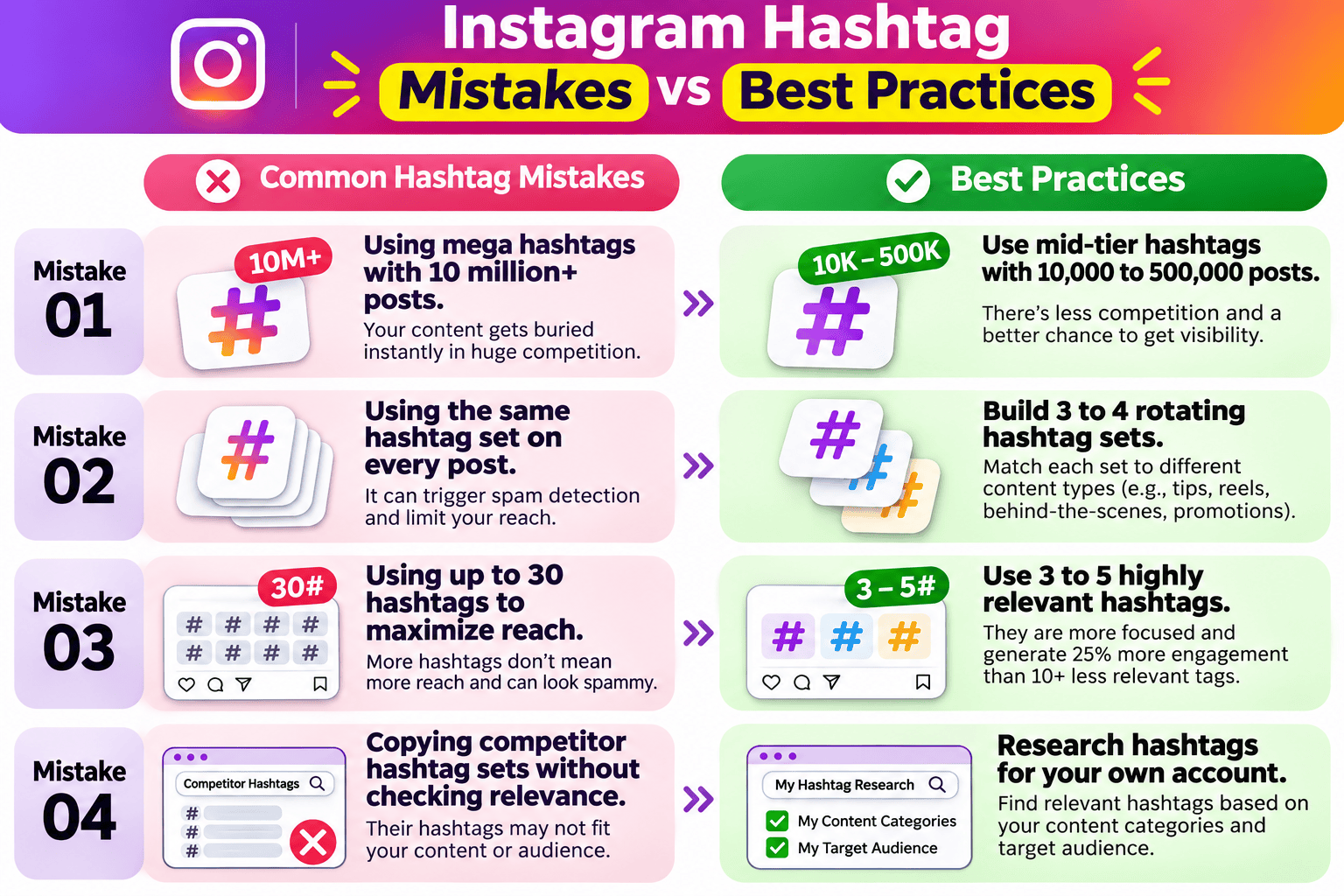
  • According to Funnl.ai's hashtag performance research, posts using 3 to 5 highly relevant hashtags generate 25% more engagement than posts using 10 or more less relevant tags.
  • Hashtags function as classification signals that tell the algorithm what your content is about, helping it match posts to the right search queries and interest-based recommendations rather than directly driving reach.
  • Mid-tier hashtags with 10,000 to 500,000 posts consistently outperform mega hashtags for discoverability because content can actually compete for visibility within the hashtag rather than being buried under millions of competing posts.
  • Using the same hashtag set on every post triggers Instagram's spam detection, reducing the effectiveness of those hashtags over time. Rotating between multiple sets prevents this penalty.
  • Location hashtags remain genuinely effective for local businesses because they surface content to people actively searching within a specific geographic area.
  • According to a HubSpot study cited by InfluenceFlow, creators who A/B test different hashtag sets improve their reach by 40% within three months compared to those using static hashtag strategies.

Want an Instagram Strategy That Actually Grows Your Business?

We Build Complete Instagram Growth Strategies Including Hashtag Research

Futuristic Marketing Services creates data-backed Instagram strategies for businesses across India, covering content planning, Reels production, hashtag research, community management, and monthly performance reporting.

Get Your Free Instagram Audit

Do Instagram Hashtags Still Work for Business Growth?

Yes, but not in the way most businesses expect, and not through the mechanisms that dominated Instagram hashtag advice for the previous decade. The fundamental role of hashtags has shifted from a primary reach driver to a supporting classification tool, and the strategies that were effective under the old model actively suppress performance under the current one. Businesses that understand this shift and adapt their approach accordingly consistently outperform those still using high-volume hashtag tactics that the platform's algorithm now treats as a negative signal rather than a positive one.
The most important structural change is the platform-enforced five-hashtag limit. As Later's 2026 Instagram hashtag guide confirms, Instagram implemented a hard cap of five hashtags per post and Reel, ending the possibility of the 30-hashtag strategies that social media managers used for years. This is not a recommendation, it is a platform-level enforcement that makes the debate about optimal hashtag count irrelevant. The maximum is five, and the data confirms that using fewer, more relevant hashtags within that limit outperforms attempting to reach the maximum with lower-quality matches.
Within this constrained environment, strategic hashtag use still produces meaningful results. According to Funnl.ai's hashtag performance data, posts with strategic hashtag use generate 13% more engagement than posts with zero hashtags, and posts using 3 to 5 highly relevant hashtags generate 25% more engagement than posts using 10 or more less relevant tags. The return on hashtag investment is real, it simply requires precision and research rather than volume and automation.

What Changed and What Stayed the Same

The most significant change is the role hashtags play in the algorithm's content distribution decision. In the earlier algorithm model, hashtags were a primary discovery mechanism: users who followed or searched a hashtag would see content tagged with it, making high-volume tagging a volume play for reach. The current algorithm uses Instagram's advanced Computer Vision and Natural Language Processing to understand what content is about directly from the visual content, caption text, and audio, meaning hashtags are now one of several categorization inputs rather than the primary one.
What has remained constant is that accurately chosen hashtags still help the algorithm categorize content correctly for search and recommendation matching. When a business publishes a carousel about social media marketing tips and tags it with #SocialMediaMarketing, #ContentStrategy, and #InstagramTips, it confirms the AI's categorization of the post and improves the precision with which the algorithm matches it to users who have shown interest in those topics. The mistake is treating hashtags as the categorization engine when they are now the confirmation layer on top of what the algorithm already understands from the content itself.

What Hashtags Actually Do for the Instagram Algorithm Now

Hashtags serve three specific functions in the current Instagram algorithm. First, they act as topic confirmation signals that reinforce the algorithm's AI-driven categorization of the content's subject matter, improving the precision of interest-based recommendation matching for both the Explore page and Reels discovery. Second, they improve search discoverability by making posts findable when users search for a specific hashtag within the Instagram app, which remains a genuine discovery pathway particularly for niche interest communities. Third, they provide additional context for recommendation targeting that helps the algorithm identify the right non-follower audience segment for content distribution beyond the account's existing followers.
Understanding how the Instagram algorithm works more broadly is the essential context for using hashtags effectively, because hashtag strategy cannot be understood in isolation from the complete set of signals the algorithm evaluates. Hashtags that confirm an accurate topic categorization are a positive signal. Hashtags that send mixed or irrelevant signals because they were chosen for volume rather than precision actively confuse the algorithm's categorization model and can reduce recommendation accuracy rather than improving it.

How Many Hashtags Should a Business Use on Instagram?

Instagram officially recommends three to five highly relevant hashtags per post, and the platform enforces a maximum of five. Within this range, the research consistently shows that specificity and relevance matter more than reaching the maximum five. A post using three precisely matched hashtags from the mid-tier volume range typically outperforms a post using five hashtags where two are precise and three are added to fill the remaining slots with loosely relevant tags.
The practical approach is to use the maximum of five only when all five tags are genuinely relevant and accurately describe the content, audience, or location context of the specific post. Use three or four when only three or four accurate tags exist for that specific piece of content. An empty hashtag slot is better than an inaccurate one, because inaccurate hashtags send conflicting categorization signals that reduce rather than improve the algorithm's ability to match the content to the right audience.
For Reels specifically, Later's guide recommends prioritizing topic and niche community hashtags that help Instagram categorize the video for the Reels tab and interest-based recommendation engine. The Reels algorithm relies heavily on AI-driven interest matching rather than hashtag search behavior, making the categorization function of hashtags more important than their search discoverability function for this format. A practical Reel hashtag mix includes one to two topic-specific hashtags, one to two niche community hashtags, and one location or branded hashtag where relevant.

The 5 Types of Instagram Hashtags Every Business Should Know

Not all hashtags serve the same function in a business Instagram strategy. Each type contributes a different classification signal to the algorithm and reaches a different type of audience through different discovery pathways. Understanding all five types and building a rotation that includes the right combination for each piece of content is what separates a systematic hashtag strategy from the random tag selection that most businesses use when they run out of ideas or default to volume over relevance.
Hashtag Type Volume Range Function Best Use Example
Niche Community 10K to 500K posts Places content within a specific engaged community where your target audience actively follows the hashtag and browses recent posts Primary discovery tag, include in every post as the highest-priority hashtag type #SocialMediaStrategyTips, #IndieBusinessOwner, #ServiceBusinessGrowth
Topic Specific 100K to 2M posts Confirms the content's subject category to the algorithm, improving topic-based recommendation accuracy for both Explore and Reels surfaces Secondary classification tag, use 1 to 2 per post to confirm the primary topic #ContentMarketing, #InstagramGrowth, #DigitalMarketingTips
Audience Specific 50K to 1M posts Identifies the intended audience for the content, helping the algorithm match it to users who self-identify with the described role or lifestyle Use when the audience identity is as specific as the topic, particularly effective for B2B content #SmallBusinessOwner, #MarketingManager, #WomenEntrepreneurs, #StartupFounder
Location Based Variable by city or region Surfaces content to users actively searching for businesses, events, or recommendations within a specific geographic area Essential for local businesses; include on every post with local relevance #IndoreBusinesses, #IndoreMarketing, #MadhyaPradeshBusiness, #IndoreFoodie
Branded Unique to the business Creates a searchable archive of all the business's own content and encourages user-generated content to be tagged and attributed to the brand Use on every post as a branded content library builder; encourage clients to use on testimonial posts #FuturisticMarketing, #GrowWithFuturistic, or any unique branded term

How to Build Your Instagram Hashtag Strategy in 5 Steps

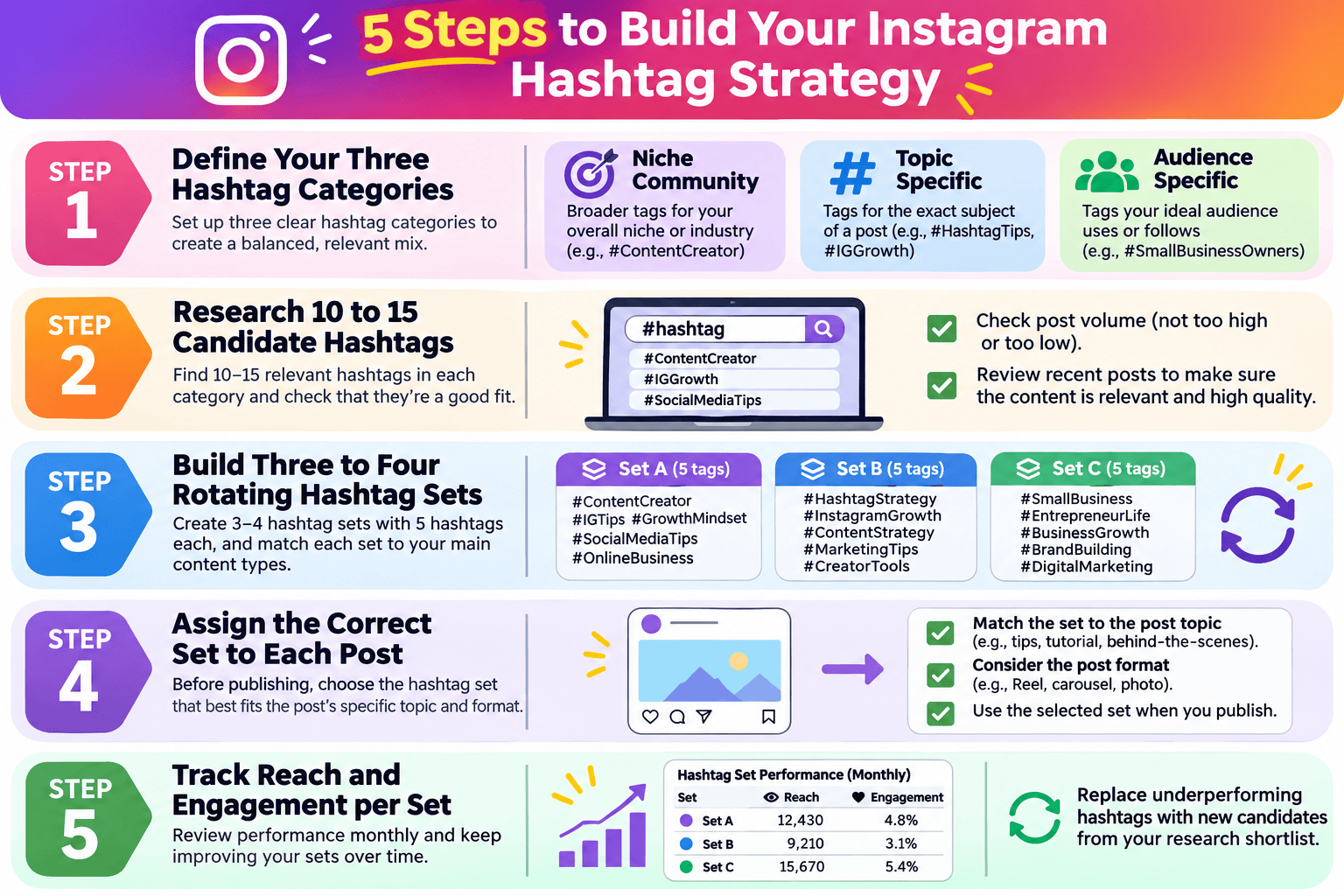
Building a systematic Instagram hashtag strategy requires a structured research and testing process rather than searching for popular tags and adding whichever ones appear most relevant in the moment. The five-step framework below produces a library of tested hashtag sets that improve over time as performance data reveals which specific tags are driving discovery and engagement for the account's unique audience and content type.

Step 1: Define Your Three Core Hashtag Categories

Before researching any specific hashtags, define the three categories of tags your business will draw from for every post: a niche community category that represents the specific interest area your target audience participates in, a topic category that describes the primary subject matter of your content types, and an audience category that identifies who your content is created for. For a social media marketing agency targeting small business owners in Indore, the niche community category might cover small business social media communities, the topic category might cover marketing tips and strategy content, and the audience category might target business owners and entrepreneurs in India.
Having these three categories defined prevents the most common hashtag research error: selecting tags that feel relevant in the moment without a consistent category framework that ensures every post's hashtag set sends coherent classification signals rather than a mixed collection of loosely related tags from different audience and topic segments.

Step 2: Research Candidate Hashtags Within Each Category

For each of the three categories, research ten to fifteen candidate hashtags that could work for your specific content. For each candidate hashtag, check three things before adding it to your shortlist. First, check the total post volume, aim for hashtags with 10,000 to 500,000 posts for niche community tags and up to 2 million for broader topic tags. Hashtags with over 5 million posts offer effectively zero discovery value for most accounts because content is buried within seconds of publication by the enormous volume of competing posts. Second, check the quality of recent posts within the hashtag by browsing the most recent tab, if the content quality is low or the posts are from accounts irrelevant to your niche, the hashtag community engagement is low-value. Third, check whether the hashtag is still active with posts being added recently, as some hashtags lose community activity over time and no longer deliver meaningful discovery.
According to HeroPost's comprehensive hashtag guide, niche community hashtags with under 500,000 posts that represent genuine interest communities consistently drive the highest-quality discovery for business accounts, reaching people who are actively engaged with the topic rather than passive scrollers who use popular generic hashtags without topical intent.

Step 3: Build Three to Four Rotating Hashtag Sets

Using the candidates identified through research, build three to four distinct hashtag sets of five tags each, each set designed for a specific content type in the account's regular publishing mix. A social media marketing account might build one set for educational strategy content, one for client result and case study content, one for behind-the-scenes and team content, and one for promotional and service announcement content. Each set draws from the same three core categories but uses different specific tags matched to the content type's particular topic and audience focus.
Building multiple sets rather than using a single universal set prevents the spam detection penalty that Instagram applies to accounts using identical hashtag combinations on every post. As HeroPost's research confirms, repetitive use of the same hashtag set triggers Instagram's spam detection, reducing the effectiveness of those specific hashtags over time. Rotating between three or four distinct sets ensures each hashtag is used frequently enough to build category association while avoiding the repetition pattern that triggers the penalty. Incorporating this hashtag rotation into the broader social media content calendar makes the rotation systematic rather than remembered on a per-post basis.

Step 4: Assign the Correct Set to Each Post Before Publishing

Match each post to the appropriate hashtag set based on its specific topic and content type before scheduling or publishing. Educational strategy carousels get the strategy content set. Client result posts get the social proof set. Behind-the-scenes Reels get the brand personality set. This matching process takes approximately 30 seconds per post when the sets are pre-built and the content calendar clearly identifies each post's content type, making the assignment automatic rather than requiring fresh research for every publication.
For posts that fall between content categories, identify the primary audience intent, who is most likely to discover this post and what are they looking for when they find it, and assign the set that most accurately describes that intent. An educational Reel that also happens to feature the team falls into the educational set rather than the behind-the-scenes set because the primary discovery context is the educational topic, not the team culture moment.

Step 5: Test, Track, and Rotate Monthly

Hashtag performance requires ongoing testing because the optimal set for a specific content type evolves as the account grows, the algorithm updates its categorization logic, and certain hashtag communities become more or less active over time. A HubSpot study cited by InfluenceFlow found that creators who actively A/B test different hashtag sets improve their reach by 40% within three months compared to those using static strategies, a significant performance gain available simply from systematic testing rather than any additional content creation effort.
At the end of each month, review the reach and engagement data for posts using each hashtag set. Identify which set produced the highest reach-to-engagement ratio and which produced the weakest results. Replace the one or two lowest-performing tags in the underperforming sets with new candidates from the research shortlist and run the updated sets for the following month. This incremental testing approach gradually optimizes each hashtag set toward the specific combinations that work best for the account's unique content type and audience behavior rather than relying on generic recommendations that do not account for the particularities of any individual account.

Platform-Specific Hashtag Approaches for Feed Posts and Reels

Feed posts and Reels have different discovery patterns that require slightly different hashtag approaches to maximize their respective categorization and recommendation contributions. Using the same hashtag logic across both formats misses the opportunity to align tags with the specific algorithm surface that distributes each content type.
Format Recommended Hashtag Mix Priority Hashtag Type Key Consideration
Feed Posts and Carousels 2 to 3 niche community tags, 1 to 2 topic tags, 1 branded tag (total: 4 to 5) Niche community, feeds where followers search specific hashtags and browse recent posts in their interest area Feed posts reach existing followers primarily; hashtags improve Explore page distribution and search discoverability for new audiences
Reels 1 to 2 topic tags for Reels tab categorization, 1 to 2 niche community tags, 1 audience or location tag (total: 3 to 5) Topic categorization, Reels are distributed by interest-based AI recommendation; accurate topic tags improve recommendation precision Reels reach is primarily driven by watch time and engagement signals, not hashtags; hashtags are secondary categorization support
Stories 1 location or topic hashtag via the hashtag sticker (Stories have a different hashtag mechanism from feed posts) Location or community, Stories hashtags can make Stories discoverable in the Explore tab for location and topic searches Stories hashtags are used via the sticker feature rather than in the caption; primarily useful for local discovery
Local Business Posts 1 to 2 city or region hashtags, 1 local industry hashtag, 1 niche community tag, 1 branded tag (total: 4 to 5) Location, local hashtags surface content to people searching within a geographic area and drive the highest-intent local discovery Location hashtags are one of the few remaining areas where hashtags consistently drive direct, measurable discovery for local businesses

Common Instagram Hashtag Mistakes That Reduce Reach

The following mistakes are the most common reasons businesses find their hashtag strategy delivering no measurable improvement in reach or discovery. Each error either sends negative signals to the algorithm's categorization system or prevents the hashtag from delivering its classification function effectively.
Using mega hashtags with tens of millions of posts is the most widespread tactical error. A post tagged with #Business (300 million posts) or #Marketing (100 million posts) has effectively zero chance of appearing in the recent posts section of that hashtag before being buried under the thousands of posts added in the same second. The only accounts that benefit from mega hashtags are those already generating thousands of engagements per post, the very accounts that need discovery help the least. For every other account, mega hashtags contribute nothing to discovery and waste one of only five available slots. Replace every mega hashtag in the current set with a mid-tier alternative that describes the same topic at greater specificity.
Copying the hashtag sets of competitors or large accounts in the same industry without considering whether those tags match the specific content being published is a categorization mismatch that reduces algorithm accuracy. A competitor with 100,000 followers using specific hashtags may be using tags that are appropriate for their content type, audience size, and posting history. The same tags applied to an account with 2,000 followers publishing different content types on a different schedule will produce different results, and not necessarily better ones. Research hashtags specifically for the account's content categories and audience characteristics rather than importing sets that appear to work for others.
Neglecting hashtag research entirely and using a fixed set of ten tags selected informally and never updated is a stagnation pattern that prevents the compounding improvement that systematic testing and rotation produces. As the research confirms, creators who A/B test hashtag sets improve their reach by 40% within three months. Businesses that never test, never rotate, and never update their hashtag sets forgo this performance improvement and often find their hashtag-attributed reach declining as hashtag communities evolve and the account's content catalog grows beyond the original tags' relevance. Our social media content creation services include quarterly hashtag research and set rotation as part of every Instagram content management package because static hashtag strategies consistently underperform systematically managed ones over six to twelve month periods.

Want the Right Hashtags Researched and Managed for Your Business?

We Handle Your Complete Instagram Strategy Including Hashtag Research

Our team researches, builds, tests, and rotates your hashtag sets as part of a complete monthly Instagram management service, alongside content creation, Reels production, community engagement, and performance reporting.

Book Your Free Strategy Session

Frequently Asked Questions About Instagram Hashtag Strategy

Q. How many hashtags should I use on Instagram in 2026?

A. Instagram officially recommends three to five highly relevant hashtags per post and enforces a maximum of five. Research confirms that posts using three to five specific, well-researched hashtags generate 25% more engagement than posts using ten or more less relevant tags. The focus should be entirely on relevance and precision within the five-hashtag limit rather than attempting to reach the maximum with low-quality matches. When fewer than five genuinely relevant hashtags exist for a specific post, use the accurate number rather than filling slots with inaccurate tags.

Q. Do Instagram hashtags still work for increasing reach?

A. Yes, with important qualification. Strategically chosen hashtags still improve content discoverability and generate 13% more engagement compared to posts with zero tags. However, hashtags now function primarily as classification signals that help the algorithm categorize content for search and interest-based recommendations rather than as direct reach drivers. The expectation shift is significant: hashtags help the right audience find content; they do not independently push content to a larger audience the way high-volume hashtag strategies were intended to in earlier algorithm versions.

Q. What is the best hashtag size for Instagram business posts?

A. Mid-tier hashtags with 10,000 to 500,000 posts consistently outperform both very small hashtags and mega hashtags for business account discoverability. Hashtags below 10,000 posts represent very small communities with limited active discovery traffic. Hashtags above 5 million posts bury content instantly under the volume of competing posts. The mid-tier range provides enough active community traffic to deliver meaningful discovery while being small enough that a well-performing post can remain visible in the recent posts section long enough for the target audience to find and engage with it.

Q. Should I put hashtags in the caption or first comment on Instagram?

A. Instagram has confirmed that both placements work identically in terms of algorithmic function. The choice is entirely aesthetic. Hashtags in the caption are more visible and require no additional action after publishing. Hashtags in the first comment keep the caption visually clean and allow the written caption to communicate its message without hashtag clutter. Either approach produces the same categorization and discovery results. If the caption is already long, moving hashtags to the first comment improves readability without any algorithmic penalty for the placement choice.

Q. How do I find the right Instagram hashtags for my business?

A. Research hashtags for your business using four methods. First, search your primary topic keywords directly in Instagram's search bar and observe which hashtag suggestions appear with post volumes in the 10,000 to 500,000 range. Second, browse the posts of directly relevant competitor accounts and note which hashtags they use most consistently. Third, look at the hashtag lists used by high-performing posts from accounts in the same niche as yours to identify tags that appear repeatedly across multiple successful posts. Fourth, use a dedicated hashtag research tool such as Later, Flick, or Hashtagify to access volume and engagement data for candidate hashtags before committing them to the rotation.

Q. What is a branded hashtag and should my business use one?

A. A branded hashtag is a unique tag that includes your business name or a tagline specific to your brand, for example #FuturisticMarketing or #GrowWithFuturistic. Every business should create and consistently use a branded hashtag because it serves as a searchable archive of all the brand's Instagram content and creates a collection point for user-generated content from clients who tag the brand in their own posts. Encourage satisfied clients to use the branded hashtag when they share results or testimonials, and include it in every post to build the archive consistently over time.

Q. Are location hashtags worth using for businesses in India?

A. Location hashtags are among the most effective hashtag types available to Indian local businesses because they connect content directly to users who are actively searching for businesses, recommendations, or events within a specific city or region. For a business in Indore, hashtags like #IndoreBusinesses, #IndoreMarketing, and #MadhyaPradeshBusiness surface content to local users who are specifically looking for services in that area, a high-intent discovery audience that broader topic hashtags cannot replicate. Include one to two location hashtags in every post that has genuine local relevance, particularly for service businesses whose primary customer base is geographically concentrated.

Q. How often should I change my Instagram hashtags?

A. Review and rotate hashtag sets monthly, replacing the one or two lowest-performing tags in each set with new candidates from the research shortlist. Never use identical hashtag sets on every post in the same month, Instagram's spam detection flags repetitive hashtag patterns and reduces the effectiveness of those specific tags for the account. Building three to four distinct sets and rotating between them across different content types provides enough variety to avoid the spam detection threshold while maintaining the category consistency that builds algorithmic classification accuracy over time.

Q. Do hashtags work differently for Reels than for feed posts?

A. Yes. Reels are distributed primarily through Instagram's AI-driven interest-based recommendation engine rather than through hashtag search behavior, making topic categorization the most important function of Reels hashtags. For Reels, prioritize one to two topic-specific hashtags that accurately describe the video's subject matter to help the algorithm categorize it correctly for interest-based distribution. For feed posts and carousels, niche community hashtags with active, engaged communities are the highest-priority type because they connect content to users who actively browse specific hashtag feeds. Both formats benefit from accurate tagging; they simply benefit through different discovery mechanisms.

Q. Can I use trending hashtags on Instagram and do they help?

A. Trending hashtags help only when the content is genuinely relevant to the trend. Using a trending hashtag simply because it is receiving high traffic without a genuine content connection attracts viewers who are interested in the trend but not in the business's actual content, producing inflated reach with very low engagement quality, which signals to the algorithm that the content performed poorly relative to its distribution. This suppresses future reach more than it helps in the moment. Use trending hashtags only when they accurately describe a real connection between the trend and the content being published, not as a reach tactic applied regardless of topical relevance.

Q. What is Instagram SEO and how does it relate to hashtags?

A. Instagram SEO is the practice of optimizing the full set of text signals the algorithm reads, including the profile name field, bio, caption text, on-screen video text, and alt text, to improve the account's searchability and recommendation accuracy within Instagram's search and discovery systems. Hashtags are one component of Instagram SEO but no longer the primary one. The algorithm's AI now reads caption text, video transcript, and on-screen text to categorize content independently of hashtags. This means that keyword-rich captions and on-screen text in Reels contribute to search discoverability even without hashtags, while accurate hashtags confirm and reinforce the categorization signals the algorithm has already derived from the other text elements.

Q. How do I know if my hashtag strategy is working?

A. Measure hashtag strategy effectiveness by tracking the reach and engagement data for posts using each different hashtag set across a 30-day period. In Instagram Insights, check the reach breakdown for each post to see what proportion of reach came from hashtag discovery versus the home feed, Explore, and profile visits. Compare the reach-from-hashtags figure across posts using different sets to identify which set produces the highest hashtag discovery contribution for its specific content type. Update the lowest-performing set's tags monthly using the testing framework in this guide, and track whether the updated sets produce improved hashtag reach in subsequent months. The 40% reach improvement from systematic A/B testing takes three months of consistent data collection to fully materialize.

Futuristic Marketing Services

Build an Instagram Strategy Where Every Element Works Together to Grow Your Business.

From hashtag research and content pillar development through Reels scripting, community management, and monthly performance reporting, our team handles your complete Instagram presence with the consistency and data-driven approach that produces sustained, compounding growth.

Talk to an Instagram Specialist

Conclusion

The Instagram hashtag landscape has permanently changed. The maximum is now five per post, hashtags function as classification signals rather than reach drivers, and the tactics that worked under the old 30-hashtag model now actively suppress performance rather than improve it. Businesses that adapt their hashtag strategy to this new reality, using three to five precisely matched, mid-tier hashtags from the five category types, rotating between multiple sets, and systematically testing performance, consistently outperform those still applying outdated volume-based approaches.
The practical takeaway is straightforward: spend 10% of your Instagram strategy effort on hashtag research and rotation, and spend the remaining 90% on content quality, consistent publishing, and genuine community engagement. Hashtags help the right audience find content the algorithm has already determined is worth distributing. The algorithm's distribution decision is driven primarily by watch time, saves, DM shares, and relationship history, the signals that great content and authentic engagement produce. Hashtags do not replace those fundamentals; they amplify them for accounts that have already got the fundamentals right.
If you want professional support building and managing a complete Instagram strategy that integrates hashtag research alongside content planning, Reels production, and community engagement, Futuristic Marketing Services provides comprehensive Instagram management for businesses across India with the systematic, data-driven approach that produces consistent, measurable results every month.
Share this post :
Picture of Devyansh Tripathi
Devyansh Tripathi

Devyansh Tripathi is a digital marketing strategist with over 5 years of hands-on experience in helping brands achieve growth through tailored, data-driven marketing solutions. With a deep understanding of SEO, content strategy, and social media dynamics, Devyansh specializes in creating results-oriented campaigns that drive both brand awareness and conversion.

All Posts