On-page SEO is the practice of optimising the content and HTML elements of individual web pages to rank higher in search results for target keywords. It covers everything on the page itself, title tags, headings, body content, image alt text, internal links, URL structure, and structured data, and communicates both relevance and quality to search engines at the page level.</p>
Key Takeaways
- On-page SEO covers everything on the page itself, from title tags and heading structure to body content, images, and internal links
- The title tag is the single most important on-page HTML element, it must include the primary keyword, a clear benefit, and stay within 50 to 60 characters
- Search intent match is more important than keyword frequency, our search intent guide explains how to identify and match the correct intent for every page
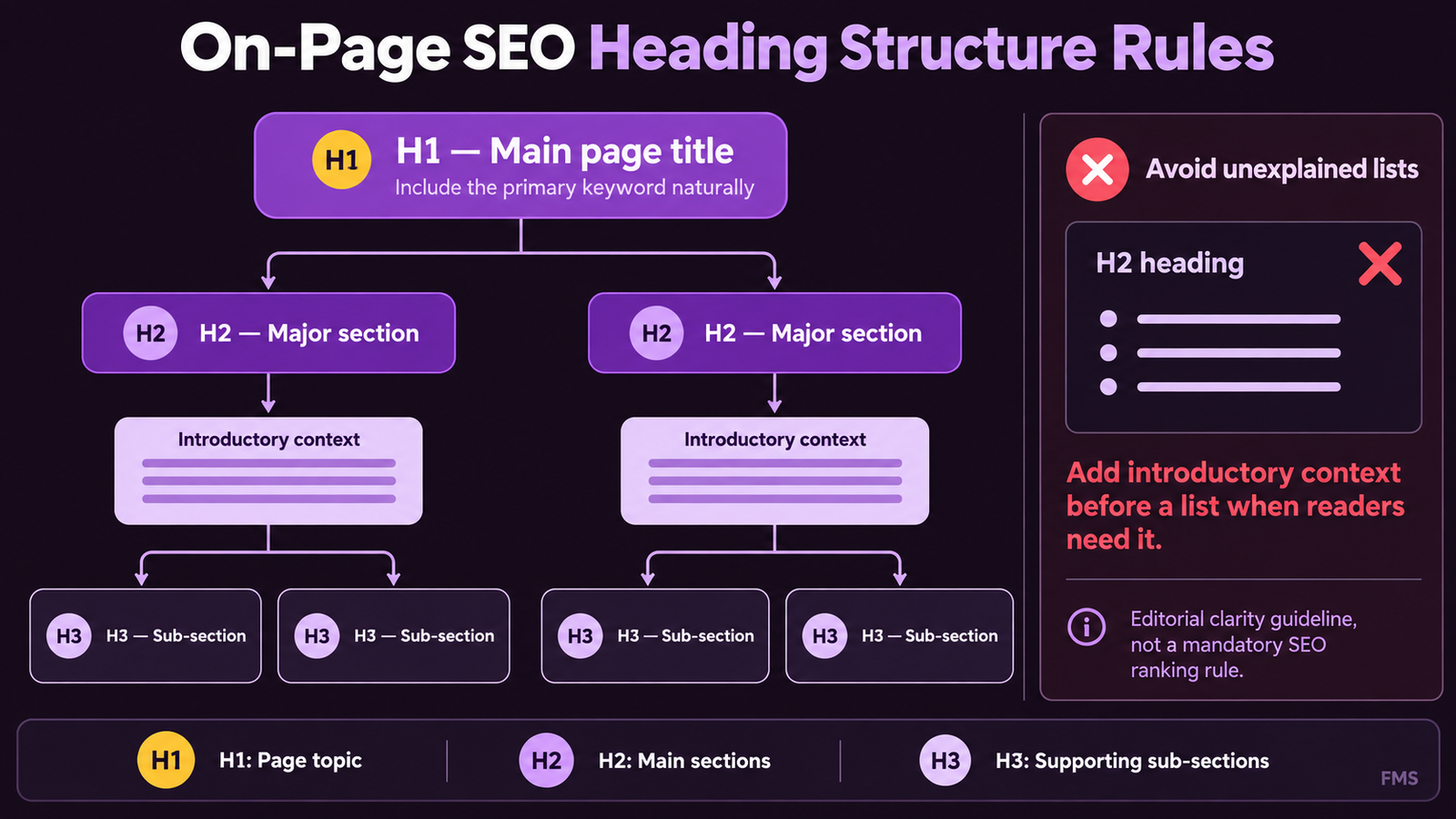
- Every H2 section must begin with 2 to 3 sentences of introductory context before any lists or H3 subheadings, Google quality raters specifically evaluate this
- Primary keyword density should be 0.8% to 1.2% of total word count, write naturally for humans, then verify with a density checker after completion
- Internal links distribute page authority across your site and help Google understand topical relationships, minimum 3 relevant internal links per article
Want Every Page on Your Site Properly Optimised for Google?
Futuristic Marketing Services conducts full on-page SEO audits and implements the complete optimisation framework, from title tags and heading structure to schema markup and internal linking, across your entire site.
Get an On-Page SEO Audit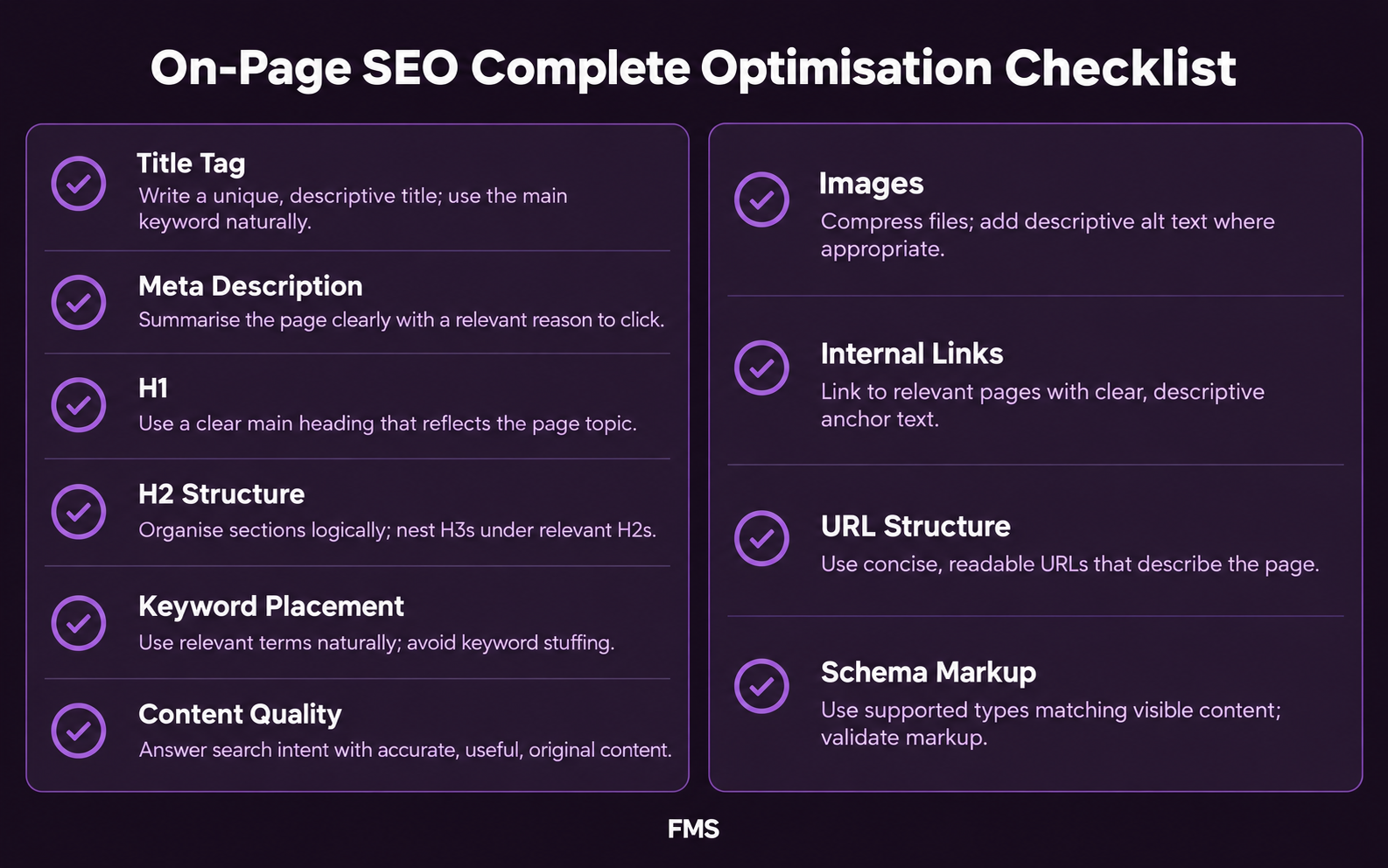
Title Tag Optimisation, The Most Important On-Page Element
The title tag is the HTML element that specifies a page’s title. It appears as the clickable blue headline in Google search results and is the single strongest on-page ranking signal available. Getting title tags right is the highest-ROI on-page action on most websites.
| Page Type | Title Formula | Character Target | Example |
|---|---|---|---|
| Informational Blog | Primary Keyword: What the Article Covers | 50 to 58 chars | On-Page SEO: The Complete Guide to Optimising Every Page |
| Service Page | Service + Location + Benefit | 52 to 60 chars | SEO Services in Mumbai for Measurable Business Growth |
| Product Page | Brand + Product Name + Key Attribute | 48 to 58 chars | Sony WH-1000XM6 Noise Cancelling Headphones, 30 Hour Battery |
| Comparison Article | Keyword A vs Keyword B: Key Difference | 52 to 60 chars | Ahrefs vs Semrush: Which SEO Tool Delivers Better Data? |
| Commercial Investigation | Best/Top + Primary Keyword + Year | 50 to 58 chars | Best Keyword Research Tools in 2026: Compared and Ranked |
Meta Description Optimisation, Driving Click-Through Rate
Heading Structure, Organising Content for Google and Users
Headings tell Google how your content is organised and which topics are covered. They are also the primary way users scan content, over 80% of users scan before reading. Use exactly one H1 per page containing the primary keyword. H2 headings divide the article into major sections, at least 2 H2s should include the primary keyword naturally. H3s break H2 sections into specific sub-points.
The critical heading rule that most sites miss: after every H2 heading, write 2 to 3 introductory sentences before adding any bullet list or H3 subheading. Google’s quality rater guidelines specifically evaluate whether sections have explanatory context before structured content appears. Jumping directly from a heading to bullets without context is a quality signal failure that suppresses rankings even when individual content quality is high.
Content Quality and Keyword Placement
Keyword placement rules: the primary keyword must appear in the first paragraph of the article body, naturally in the H1, in at least 2 H2 headings, and in the conclusion. Secondary keywords distribute naturally throughout the body. Target keyword density of 0.8% to 1.2% for the primary keyword, write naturally first, then verify. Never force keywords into sentences where they read awkwardly; natural variation using semantic terms and synonyms is always better than forced repetition.
Image SEO, Making Visual Content Work for Rankings
Images are both conversion assets and SEO opportunities. Properly optimised images earn traffic from Google Images, improve Core Web Vitals LCP scores, and strengthen topical relevance. Four image SEO rules: rename files with descriptive keyword-containing names before upload (product-photography-lighting-tips.jpg, not IMG_4567.jpg), add descriptive alt text of 5 to 15 words including the target keyword where natural, convert all images to WebP format for 25 to 35 percent smaller file sizes at equivalent quality, and add explicit width and height attributes to every image element to prevent CLS layout shifts during page load.
Internal Linking, Distributing Authority and Improving Rankings
Schema Markup, Earning Rich Results in Search
Let Our SEO Team Optimise Your Pages for More Organic Traffic
Our on-page SEO specialists apply the complete 2026 optimisation framework, title tags, heading structure, keyword placement, schema markup, and internal linking, to every key page on your site.
Start Your On-Page OptimisationFrequently Asked Questions
What is on-page SEO?
How important is the title tag for SEO?
What is the correct heading structure for SEO?
How long should on-page content be?
What is keyword density and what is the right level?
How do internal links help on-page SEO?
Does on-page SEO still matter with Google's AI systems?
Your Pages Are Leaving Rankings on the Table Without Proper On-Page SEO
At Futuristic Marketing Services, we audit every on-page element against current Google standards and implement the fixes that produce measurable ranking and traffic improvements.
Talk to an On-Page SEO SpecialistConclusion
On-page SEO is the foundation layer of every successful organic ranking. Properly optimised title tags, heading structures, content quality, keyword placement, image alt text, internal links, and schema markup work together to communicate both relevance and quality to Google’s AI systems simultaneously. No off-page authority can compensate for fundamental on-page failures, and no technical SEO can compensate for content that fails to genuinely satisfy user intent.