How AI Video Generation Is Changing Content Marketing Forever

AI video content marketing

Content marketing has undergone several transformative shifts, the blog era, the social media era, the video-first era. Each shift created structural competitive advantages for early adopters that late movers struggled to close regardless of budget. The AI video generation shift is the fastest-moving of all, with meaningful capability gaps between teams that have integrated AI video production and those that have not already visible in content output volume, search visibility, and distribution reach.

According to Wyzowl research, 91% of marketers report that video is now an important part of their marketing strategy, and AI video generation is the technology that makes the content volume required to compete across every relevant platform operationally achievable for teams of any size. This guide covers six specific ways AI video generation has changed content marketing strategy, with practical implications for team structure, workflow, and a framework for integration.

Key Takeaways

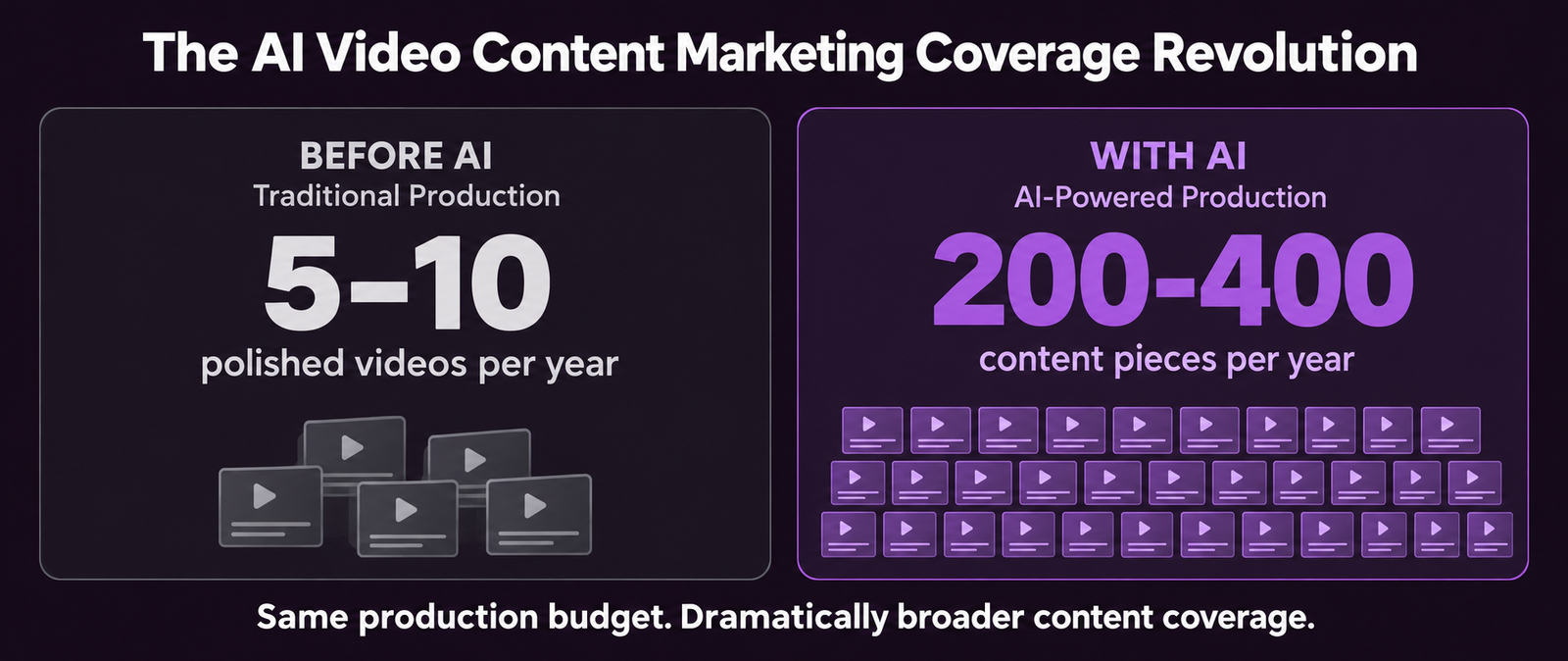
  • Before AI: a £50,000 video budget produced 5–10 polished assets. Today: the same budget produces 200–400 content pieces, covering every product, every use case, every audience segment, and every platform format simultaneously
  • Publishing frequency is now a structural competitive moat: according to Sprout Social's research, brands publishing video daily on LinkedIn earn 5x more reach than brands publishing weekly; AI production makes daily publishing operationally achievable for any team
  • AI video generation enables segment-specific personalisation at scale: the same script in 40 languages, the same product demonstration for 5 different buyer profiles, the same onboarding video updated instantly when the product changes, capabilities previously exclusive to enterprise brands with seven-figure production budgets
  • Team roles are restructured, not eliminated: content strategy, AI tool operation, quality review, and distribution expertise increase in commercial value; technical production execution decreases
  • The brands building AI video content libraries now are compounding structural advantages in search visibility, algorithmic authority, and content depth that will be difficult for slower movers to close, the competitive gap widens every quarter
  • For the operational framework that makes daily multi-platform publishing sustainable, the viral content calendar guide covers the pillar-to-derivative model that produces 30+ content pieces from each recording session
Want an AI Video Content Marketing Programme Built for Your Brand?

Futuristic Marketing Services builds AI-assisted video content programmes, combining generation efficiency with specialist human editorial strategy to produce the content volume and quality that drives measurable marketing results.

Get Your AI Content Programme

Shift 1: Production Economics, The Cost Floor Has Permanently Changed

Video content marketing has always been constrained by production economics. A professional product video cost £1,500–8,000. A brand documentary cost £10,000–50,000. These costs forced content marketing teams to prioritise ruthlessly, video was reserved for flagship products and major campaigns, creating systematic coverage gaps that competitors with larger budgets could exploit.
AI video generation has compressed this cost floor by 80–95% for most commercial video formats. A brand can now produce a product explainer for £30–200 using AI avatar tools, ad creative variants for £100–400 using AI ad creative platforms, and a full suite of social clips at near-zero marginal cost using AI clip extraction tools.
The brands that understood this shift earliest are producing 10–20 times more video content at the same budget, with compounding advantages in search visibility, algorithmic reach, and audience development that grow every quarter.

THE COVERAGE COMPOUND EFFECT

Before AI: a £50,000 budget produced 5-10 polished assets. Today: the same budget produces 200-400 content pieces, product videos for every SKU, FAQ answers for every customer question, social clips for every platform. This coverage advantage compounds in Google SEO, YouTube search, paid advertising performance, and organic social simultaneously.

Shift 2: Content Velocity, Publishing Frequency as Competitive Advantage

Publishing frequency determines algorithmic authority on every major content platform. YouTube channels publishing 3–4 times per week build recommendation reach that channels publishing once per week cannot close the gap on without matching the frequency. TikTok channels publishing daily outperform identical-quality channels publishing three times per week in total reach by 40–80%. LinkedIn posts earn 3–6x more reach for creators publishing daily versus weekly.
Traditional video production workflows could not sustain these publishing frequencies at commercial quality without enormous team size or agency budgets. AI video generation removes this constraint.
The constraint has shifted from production capacity to editorial capacity, the limiting factor is now the team's ability to produce enough well-researched content ideas, not their ability to turn ideas into publishable video assets. For the operational framework that makes this publishing velocity sustainable, the viral content calendar guide covers the complete pillar-to-derivative publishing system.

Shift 3: Personalisation at Scale

Traditional production made personalisation prohibitively expensive, one video had to serve every customer segment because producing segment-specific variants cost thousands of pounds each.
AI video generation removes this constraint entirely: the same script delivered by different avatar presenters for different demographics, the same product demonstration with different use case framings for different buyer profiles, the same onboarding video in 40 languages at near-zero marginal cost per language variant.
The commercial implications are significant. B2B brands produce trade-specific product demonstrations for each industry vertical. E-commerce brands produce a dedicated video for every SKU rather than only for hero products.
SaaS companies produce role-specific onboarding videos that reduce churn by providing the exact guidance each user type needs. These personalisation capabilities were previously exclusive to enterprise brands with seven-figure production budgets.

Shift 4: The Content Funnel Revolution
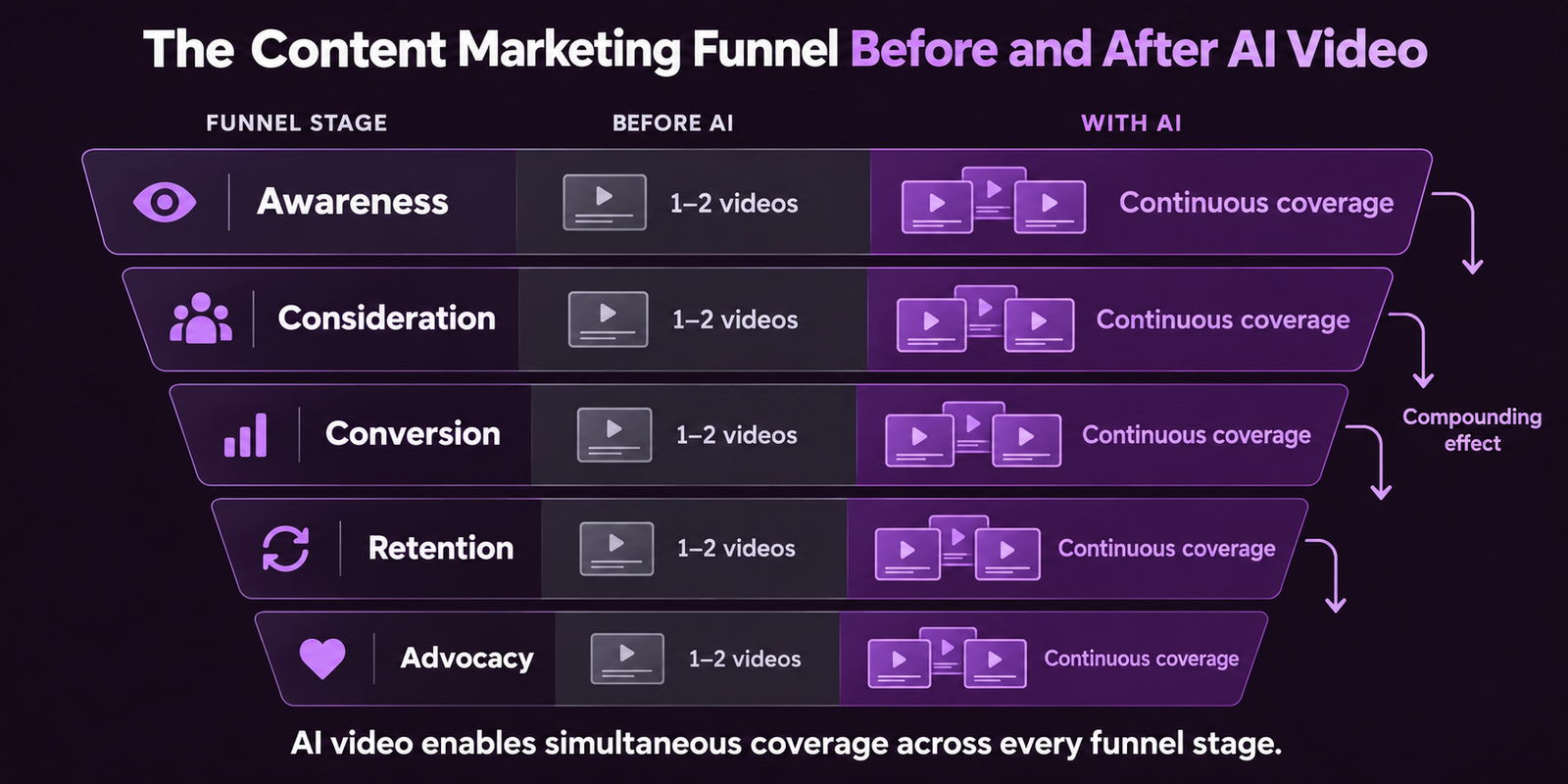
Funnel StagePre-AI ApproachAI Video ApproachCommercial Impact
Awareness1–2 brand films/yearDaily short-form across all platforms10–20x reach; algorithmic authority builds
ConsiderationMonthly product videos (hero items only)AI video for every SKU and use case50–100x coverage; long-tail SEO benefit
Decision1 hero VSL per offerA/B tested variants with AI efficiency5–10x faster creative testing iteration
RetentionQuarterly training video updatesAI-updated onboarding continuouslyReduced churn; faster time-to-value
AdvocacyCase studies produced on requestAutomated testimonial clip extraction3–5x social proof volume at low cost

Shift 5: Team Structure and Skills

AI video generation does not eliminate the content marketing team, it restructures which skills create commercial value. Understanding this restructuring helps content leaders plan team development and hiring in the context of AI adoption.
Skills that increase in value: Content strategy and editorial judgment (deciding what to produce and why), AI tool operation and prompt engineering (getting high-quality output from generation platforms), brand compliance and quality review (ensuring AI output meets standards before publication), and distribution strategy (platform-specific optimisation for each content type and format).
Roles that are restructured: Technical production execution, filming coordination, crew management, basic post-production for standardised formats, is being restructured by AI adoption. These functions change rather than disappear. A video producer whose role was primarily scheduling and logistics becomes a content operations manager whose role is managing AI tool workflows, quality review processes, and the production calendar.

Shift 6: The Competitive Landscape Is Compounding

Content marketing competitive advantage is built on three compounding assets: the depth of the content library (how many topics and use cases are covered), the algorithmic authority of distribution channels (the engagement history that determines how widely new content is distributed), and the search authority built from consistent publication over time.
AI video generation accelerates all three simultaneously, brands that started building AI-assisted content libraries early have compounding structural advantages that are difficult for slower movers to overcome regardless of the budget they eventually commit.

How to Build AI Video Into Your Content Marketing Strategy

The integration framework has four stages

Measuring AI Video ROI

Content GoalPrimary MetricAI Video ImpactMeasurement Method
Organic search trafficSearch rankings for video content2–5x more ranking content pagesGoogle Search Console impressions
Social media reachAlgorithmic distribution and reachPublishing frequency directly drives reachPlatform analytics reach data
Paid ad performanceROAS from video ad creativeFaster creative testing = better performing adsAd platform ROAS comparison
Website conversionCVR on video-equipped pages80–120% lift from video vs no videoA/B test conversion rate
Customer support volumeSupport ticket reduction15–30% reduction with tutorial videosSupport ticket trend analysis

Frequently Asked Questions

Will AI video generation replace human content creators?

AI video generation replaces specific production tasks, not strategic thinking, editorial judgment, or creative direction. Content marketers who use AI tools as productivity multipliers will see their output capacity increase while their strategic contribution becomes more valuable. The roles genuinely at risk are those whose primary value was in technical production execution with limited strategic contribution, a transition analogous to how desktop publishing changed graphic design.

What is the quality risk of AI-generated video for brand reputation?

The quality risk is real and manageable with appropriate review processes. Primary risks are factual inaccuracies in AI-generated scripts, avatar video not meeting brand tone standards without calibration, and visual content inconsistent with brand values. A two-stage review process, brand compliance review of the script before generation, visual quality review before publication, manages these risks systematically. Brands rushing AI content to publication without review have experienced issues; those with systematic review processes have not.

How quickly can a content team see ROI from AI video adoption?

Most teams see measurable efficiency ROI within 30–60 days of systematic AI adoption, the time saving on caption generation, clip extraction, and format variant production is immediate and consistent. Audience and commercial ROI (search rankings, social reach, conversion rates) typically shows measurable improvement within 3–6 months of consistently higher-frequency publishing enabled by AI production efficiency.

Start Your AI Video Content Marketing Programme

Futuristic Marketing Services builds AI-assisted video content programmes for brands, combining generation efficiency with specialist editorial strategy to produce the content volume and quality that drives measurable marketing results.

Get Started with AI Content

Conclusion

AI video generation has permanently shifted the production economics, competitive dynamics, and strategic possibilities of content marketing. Brands building systematic AI video workflows now are compounding structural advantages in content coverage, publishing frequency, and distribution authority. The starting point is always the same: identify the content types in your plan with the largest gap between desired volume and current production capacity, then deploy AI tools specifically to close that gap.
For the complete tool selection framework, the best AI video generation tools guide and the AI video generation service overview provide the full reference. For the content repurposing workflow that maximises AI video output from every recording session, the content repurposing ROI guide provides the complete operational framework.
Share this post :
Picture of Devyansh Tripathi
Devyansh Tripathi

Devyansh Tripathi is a digital marketing strategist with over 5 years of hands-on experience in helping brands achieve growth through tailored, data-driven marketing solutions. With a deep understanding of SEO, content strategy, and social media dynamics, Devyansh specializes in creating results-oriented campaigns that drive both brand awareness and conversion.

All Posts