What Is Shopify? The Complete Business Guide

what is shopify

Shopify is a fully managed eCommerce platform that enables businesses to create, launch, and run online stores without managing hosting, software updates, or server infrastructure. Founded in 2006 and headquartered in Ottawa, Shopify powers over 4.6 million merchants across 175 countries and is used by brands ranging from independent artisans to enterprise retailers. Merchants pay a monthly subscription (£29 to £259 per month on standard plans), use Shopify’s hosted infrastructure, and access an ecosystem of 8,000 or more apps to extend the platform’s functionality.

This guide covers everything a business needs to know about Shopify, how the platform works, the plan comparison and true cost structure, the core eCommerce features, the 8,000 or more app ecosystem, the honest assessment of Shopify SEO capability and limitations, the performance benchmarks, when Shopify is and is not the right choice, and how Shopify compares to WooCommerce for the specific requirements that matter most to UK businesses.

Key Takeaways

  • According to BuiltWith, Shopify powers 21% of all global eCommerce stores, making it the second-most-used eCommerce platform after WooCommerce. Its primary commercial advantage is managed simplicity: hosting, security, software updates, and platform infrastructure are all handled by Shopify, requiring no technical resource from the merchant.
  • Shopify charges 0% transaction fees when using Shopify Payments (their integrated payment processor). For all other payment gateways, Stripe, PayPal, Klarna, Shopify charges 0.5% (Advanced), 1% (Shopify), or 2% (Basic) per transaction in addition to the gateway fee. This transaction fee structure significantly affects total cost at volume.
  • Shopify SEO capability is strong for basic on-page optimisation but has structural limitations: the /products/ and /collections/ URL prefixes cannot be changed; platform JavaScript adds overhead that constrains mobile Lighthouse scores to 65 to 80 on standard themes; and the blog is less capable than WordPress for content marketing at scale. See our Shopify SEO guide for the complete framework.
  • Shopify themes come in two versions: free themes included with all plans (9 available), and premium themes from the Shopify Theme Store (150 or more, priced at £130 to £320 one-time). Custom Shopify theme development using Liquid templating is available for brands requiring bespoke design beyond what templates can achieve.
  • The Shopify App Store has 8,000 or more apps covering every eCommerce function: email marketing (Klaviyo), subscription billing (Recharge), loyalty programmes, reviews (Okendo, Judge.me), upsell and cross-sell (frequently bought together), and advanced analytics. Most critical eCommerce features not built into Shopify natively have a well-developed app solution.
  • Shopify Hydrogen is Shopify's React-based headless framework for building custom storefronts with maximum performance. Hydrogen storefronts achieve 88 to 98 on mobile Lighthouse, far above standard Shopify themes, and are the correct choice for enterprise Shopify merchants where performance is a hard requirement. Development cost is £30,000 to £200,000.
  • The correct Shopify versus WooCommerce decision comes down to two factors: technical resource and growth strategy. If no technical resource is available for ongoing platform management, Shopify is the right choice. If organic search is the primary growth channel and 0% transaction fees matter at volume, WooCommerce is the stronger long-term platform.

Shopify Development

Professional Shopify Store Development for UK Businesses

Futuristic Marketing Services builds professional Shopify stores, custom theme development, app integration, Shopify SEO setup, and Core Web Vitals performance from day one.

Get Your Shopify Quote
How Shopify Works

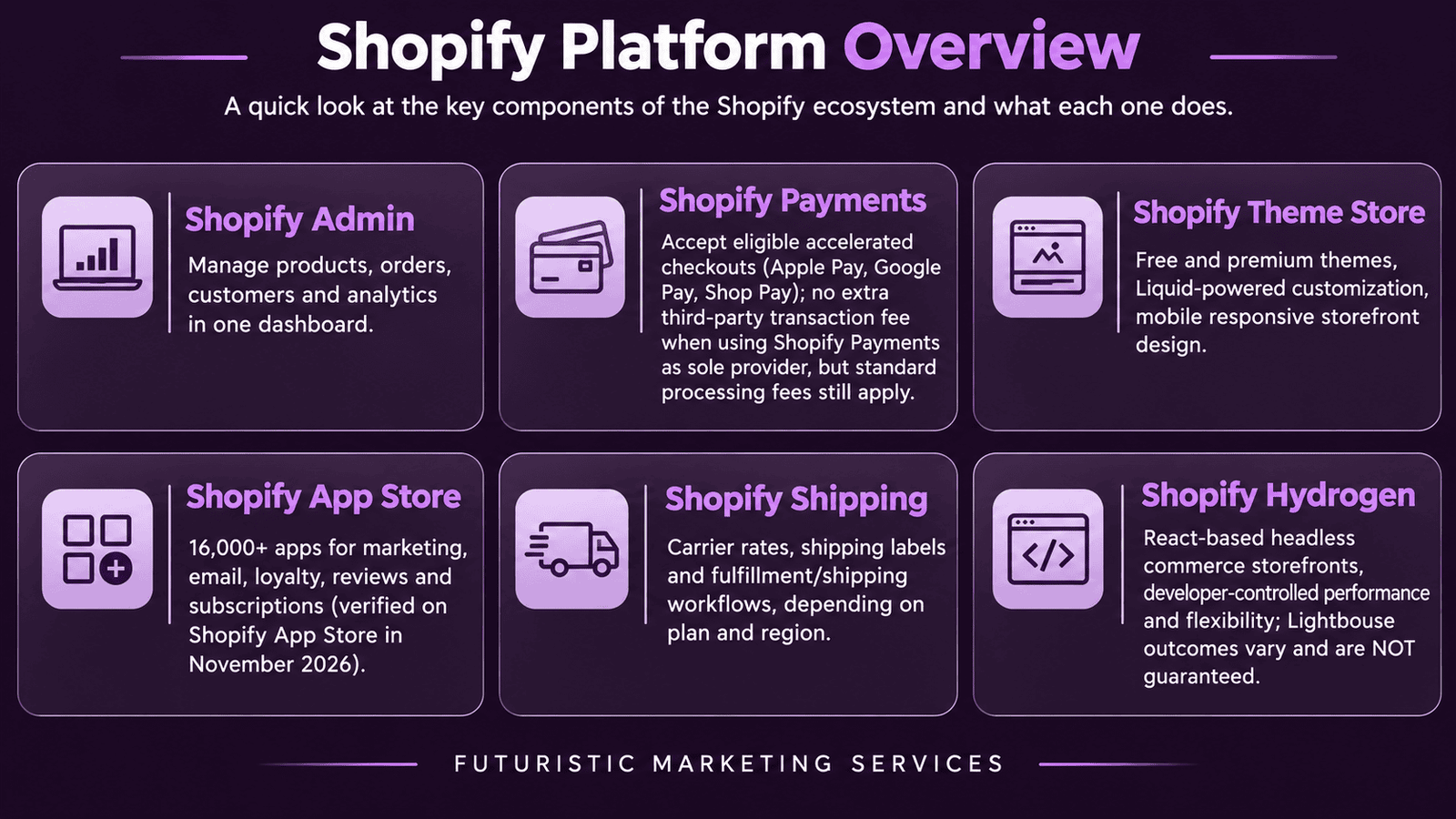
Shopify is a software-as-a-service (SaaS) platform, you access it through a browser and pay a monthly subscription. Unlike WordPress and WooCommerce (which you install on your own hosting server), Shopify runs entirely on Shopify's infrastructure. This means no hosting account to configure, no software to install, no server updates to manage, and no security patches to apply. The trade-off is that all of your store's code, data, and infrastructure runs on Shopify's servers, you do not own the underlying infrastructure.
Shopify ComponentWhat It IsWho Manages It
Shopify AdminBrowser-based dashboard for managing products, orders, customers, analytics, and store settingsMerchant, full control
Storefront (theme)The customer-facing design of the store, built with Shopify Liquid templates or a headless React frameworkMerchant (theme customisation) or developer (custom theme)
Shopify PaymentsIntegrated payment processing, eliminates transaction fees; supports Apple Pay, Google Pay, shop PayShopify, no separate gateway account needed
Hosting and CDNShopify's global infrastructure hosts all store files, images, and databases with global CDN deliveryShopify, merchant has no direct server access
Security and SSLPCI DSS compliance, automatic SSL certificate, DDoS protectionShopify, no merchant action required
App Store8,000 or more third-party apps extending Shopify functionality, email marketing, loyalty, subscriptions, etc.Third-party app developers, merchant chooses and installs
Shopify LiquidShopify's templating language, the code that controls how the storefront rendersDeveloper (for custom themes) or theme template

Shopify Plans and Pricing

PlanMonthly Cost (USD)Monthly Cost (GBP approx.)Transaction Fee (non-Shopify Payments)Staff AccountsBest For
Basic Shopify$39£312%2New stores with limited budget and simple requirements
Shopify$105£841%5Growing stores needing lower transaction fees and more staff accounts
Advanced Shopify$399£3190.5%15High-volume stores where transaction fee saving offsets the plan cost
Shopify PlusFrom $2,300From £1,8400.15% (negotiated)UnlimitedEnterprise stores requiring custom checkout, B2B, and dedicated account management
Starter$5£45%1Social commerce and direct message selling only, no full online store

The True Cost of Shopify

Shopify plan pricing is the starting point, not the total cost. Add: Shopify Payments processing fees (1.4% plus 30p for UK cards, or gateway fee plus 0.5 to 2% if using a third-party gateway); premium theme cost at £130 to £320 one-time; app subscription costs at £50 to £500 per month for a standard marketing and operations app stack (email marketing, reviews, subscriptions, loyalty); and any custom development for theme customisation or app integrations. A realistic first-year total for a professionally set up Shopify store on the Basic plan is £2,500 to £6,000 beyond the subscription, before including development costs.

Shopify Core eCommerce Features

Shopify Built-In eCommerce Features

Product management

Unlimited products with variants (size, colour, material, up to 100 variants per product), product images, inventory tracking, product collections, and CSV bulk import. Digital product delivery is built in for downloadable products.

Payment processing

Shopify Payments (0% transaction fee) supports all major cards, Apple Pay, Google Pay, and Shop Pay, Shopify's buy-now-pay-later option. International cards and currencies supported with multi-currency pricing. For UK merchants, Shopify Payments is available and competitive with Stripe rates.

Shipping and fulfilment

Carrier-calculated shipping rates, shipping zones, flat rate and free shipping options, and Shopify Shipping (discounted rates with selected carriers). Integration with fulfilment networks including Shopify Fulfilment Network for US merchants.

Checkout

Shopify checkout is a proprietary, hosted checkout page. It is PCI DSS compliant, mobile-optimised, and conversion-tested. Customisation is limited on standard plans, full checkout customisation (custom fields, custom scripts) requires Shopify Plus.

Analytics and reporting

Sales reports, customer reports, acquisition reports, and inventory reports are built in. Advanced reports (cohort analysis, custom report builder) require Shopify or Advanced plan. Google Analytics 4 integration is straightforward via the Shopify channel.

Marketing tools

Basic abandoned cart emails, discount codes, gift cards, and email marketing (Shopify Email, limited to basic campaigns). For professional email marketing, automation flows, post-purchase sequences, and segmentation, Klaviyo or Omnisend integration via the App Store is required.

Shopify SEO: Capability and Limitations

SEO FactorShopify CapabilityLimitation vs WooCommerce
Meta titles and descriptionsCustomisable per product and collection pageNo limitation, both platforms equal here
URL structureClean URLs but /products/ and /collections/ prefixes are mandatoryCannot be changed, competitor may rank /shoes/ while Shopify ranks /collections/shoes/
Mobile Lighthouse65 to 80 on standard themesWooCommerce achieves 75 to 90 on managed hosting, consistent Core Web Vitals advantage
Schema markupBasic Product and BreadcrumbList, additional schema via appsLess systematic than Rank Math Pro automated schema on WooCommerce
Blog and content marketingFunctional blog, adequate for basic contentWordPress CMS is significantly more capable for content marketing at scale
Canonical tagsAutomatic canonical generationLimited manual control, WooCommerce gives complete canonical management
XML sitemapAutomatic, submit to GSCNo limitation, both equal
International SEOMulti-domain and hreflang support availableMore complex to configure than WordPress, requires careful setup
Shopify SEO is adequate for most standard eCommerce stores, particularly when the primary acquisition channel is paid advertising rather than organic search. The limitations become significant when: organic search is the primary growth channel; the store competes for high-volume category keywords where mobile performance differences affect rankings; or content marketing at scale is the organic traffic strategy. For the complete Shopify SEO implementation framework, see our Shopify SEO guide.

Shopify Setup

Launch Your Shopify Store With the Right Technical Foundation

Futuristic Marketing Services sets up Shopify stores with custom theme development, Shopify SEO foundations, Shopify Payments configuration, and an app stack optimised for your specific business model.

Start Your Shopify Project

Frequently Asked Questions About Shopify

What is Shopify and what is it used for?

Shopify is a fully managed eCommerce platform used to build and run online stores. It is used by over 4.6 million merchants globally, according to Shopify, ranging from independent creators selling handmade products to enterprise retailers managing hundreds of thousands of product SKUs. Shopify handles hosting, security, SSL, software updates, and payment processing infrastructure, merchants focus on products, marketing, and customer service rather than technical platform management. It is particularly strong for businesses where managed simplicity is valued over technical ownership.

How much does Shopify cost per month in the UK?

Shopify monthly plans in UK approximate costs: Basic at £31/month, Shopify at £84/month, Advanced at £319/month. Add: Shopify Payments processing (1.4% plus 30p for UK cards) or third-party gateway fee plus Shopify transaction fee (0.5 to 2% depending on plan); premium app subscriptions at £50 to £500/month for a professional app stack; and any development costs for theme customisation. Annual billing saves approximately 25% on plan cost. See our WooCommerce vs Shopify guide for the 5-year total cost comparison between platforms.

Is Shopify good for SEO?

Shopify is adequate for SEO on standard eCommerce stores but has structural limitations versus WordPress WooCommerce. The mandatory /products/ and /collections/ URL prefixes cannot be changed, a minor structural limitation. Mobile Lighthouse scores of 65 to 80 on standard themes make consistent Good Core Web Vitals status challenging versus WooCommerce's 75 to 90 on managed hosting. The Shopify blog is functional but less capable than WordPress for content marketing at scale. For stores where organic search is the primary acquisition channel and content marketing is the organic strategy, WooCommerce has a meaningful long-term SEO advantage. See our Shopify SEO guide.

What are the Shopify transaction fees?

Shopify charges 0% transaction fees when using Shopify Payments. For all other payment gateways (Stripe, PayPal, Klarna, Worldpay), Shopify charges: 2% per transaction on Basic, 1% on Shopify, and 0.5% on Advanced, in addition to the gateway's own processing fee. On £200,000 annual revenue using a third-party gateway on the Basic plan, this 2% fee adds £4,000 per year. The transaction fee structure is a significant cost consideration, Shopify Payments is strongly recommended for UK merchants where it covers the required payment methods.

How do I set up a Shopify store?

Setting up a Shopify store: (1) Create an account at shopify.com, 3-day free trial available. (2) Add products with descriptions, images, and pricing. (3) Choose and customise a theme from the Shopify Theme Store. (4) Configure Shopify Payments or connect your preferred payment gateway. (5) Set up shipping zones and rates. (6) Configure the domain (use a custom domain via the Shopify admin). (7) Set up Google Analytics 4 and Google Search Console. (8) Install required apps (email marketing, reviews). (9) Test the full checkout flow with a test transaction. (10) Launch. For a professionally set up store with custom theme development and Shopify SEO foundations, work with a Shopify development partner.

Is Shopify better than WooCommerce?

Neither is universally better, the correct choice depends on priorities. Shopify is better when: fastest path to a live store is the priority; no technical resource is available for WordPress maintenance; or Shopify Payments covers all required payment methods. WooCommerce is better when: organic SEO is the primary growth channel; 0% platform transaction fees matter at volume; complete data ownership is required; or B2B and complex subscription pricing is needed. See our complete WooCommerce vs Shopify comparison for the full analysis across all commercial dimensions.

What are Shopify themes?

Shopify themes are the templates that control the visual design of a Shopify store, built with Shopify's Liquid templating language (free and premium themes) or React (for Shopify Hydrogen headless storefronts). The Shopify Theme Store has 9 free themes and 150 or more premium themes priced at £130 to £320 one-time. Premium themes provide more design sections, greater customisation options, and better built-in performance than free themes. Custom Shopify theme development, building a bespoke Liquid theme from scratch, costs £8,000 to £30,000 and provides unlimited design flexibility. See our dedicated Shopify themes guide.

Does Shopify host your website?

Yes, Shopify is a fully hosted platform. All store files, product images, databases, and customer data are stored on Shopify's infrastructure. Shopify manages hosting, security, SSL certificates, software updates, and global CDN delivery. Merchants do not need a separate hosting account, server configuration, or software installation. This is the primary operational advantage of Shopify over WordPress WooCommerce, the technical infrastructure is completely managed. The trade-off is that the merchant does not have direct access to the server files and cannot customise the hosting infrastructure.

What apps do I need for a Shopify store?

The essential Shopify app stack for a professional store: Klaviyo or Omnisend for email marketing automation (abandoned cart, post-purchase, winback sequences); Judge.me or Okendo for product reviews and ratings display; Recharge for subscription billing if the business model requires it; a loyalty programme app (Smile.io or LoyaltyLion) for repeat purchase incentivisation; and a upsell or cross-sell app (Frequently Bought Together) for average order value improvement. Total monthly app cost for this standard stack is typically £80 to £200/month. For eCommerce SEO, the Shopify SEO Manager app provides additional schema and meta tag control beyond Shopify native capabilities.

Can Shopify handle large product catalogues?

Shopify scales well to large product catalogues, the platform itself has no hard product limit and Shopify Plus merchants manage catalogues of hundreds of thousands of SKUs. Performance at large catalogue scale depends on theme quality and search implementation: Shopify's default collection filtering slows down on very large collections; the default search is basic. For catalogues over 5,000 products, implement Shopify Search and Discovery (free official app) or integrate Algolia for fast, relevant search. Ensure the theme is optimised for large catalogue performance, some premium themes are not designed for very large product volumes.

What is Shopify Hydrogen?

Shopify Hydrogen is Shopify's official React-based framework for building headless storefronts, where the front-end presentation layer is custom-built in React, separate from the Shopify back-end (which handles products, orders, and checkout). Hydrogen storefronts achieve 88 to 98 on mobile Lighthouse, significantly above the 65 to 80 of standard Shopify themes, because the front-end is pre-rendered as static HTML served from a CDN edge. Hydrogen is appropriate for enterprise Shopify merchants where mobile performance above 80 Lighthouse is a hard requirement and a React development team is available. Development cost is typically £30,000 to £200,000.

How do I migrate from WooCommerce to Shopify?

Migrating from WooCommerce to Shopify: export products from WooCommerce as CSV and import to Shopify; migrate customer data via CSV export and import; rebuild the store design using a Shopify theme; reconfigure payment gateways and shipping zones; and critically, create 301 redirects from all WooCommerce product URLs (/shop/product-name/) to Shopify product URLs (/products/product-name/) to preserve organic authority. Professional website migration SEO management is essential, missing redirects cause permanent ranking loss. Allow 3 to 6 months for full ranking stabilisation after migration.

Futuristic Marketing Services

Launch Your Shopify Store With Professional Setup

Futuristic Marketing Services builds Shopify stores with custom theme development, Shopify SEO foundations, payment and app configuration, and Core Web Vitals performance, ready to sell from day one.

Start Your Shopify Build


Conclusion: Shopify Is the Right Platform for the Right Business

Shopify is an excellent eCommerce platform for businesses where managed simplicity, fastest time to launch, and Shopify's native checkout conversion tools outweigh the trade-offs of monthly subscription fees, transaction fees on non-Shopify Payments gateways, and constrained SEO ceiling versus WordPress.
It is the wrong platform for businesses where organic search is the primary customer acquisition strategy (WooCommerce has a structural performance advantage), where 0% transaction fees are commercially significant at volume, or where content marketing at scale is central to the growth strategy. Make the platform decision based on a 5-year commercial strategy, not a 5-week launch preference. See our WooCommerce vs Shopify comparison for the complete decision framework and our eCommerce development guide for the broader context.
For Shopify-specific implementation: Shopify SEO | Shopify themes | Shopify Hydrogen | eCommerce SEO.
Share this post :
Picture of Devyansh Tripathi
Devyansh Tripathi

Devyansh Tripathi is a digital marketing strategist with over 5 years of hands-on experience in helping brands achieve growth through tailored, data-driven marketing solutions. With a deep understanding of SEO, content strategy, and social media dynamics, Devyansh specializes in creating results-oriented campaigns that drive both brand awareness and conversion.

All Posts