How the Instagram Algorithm Works and How to Use It for Your Business

Instagram algorithm explained

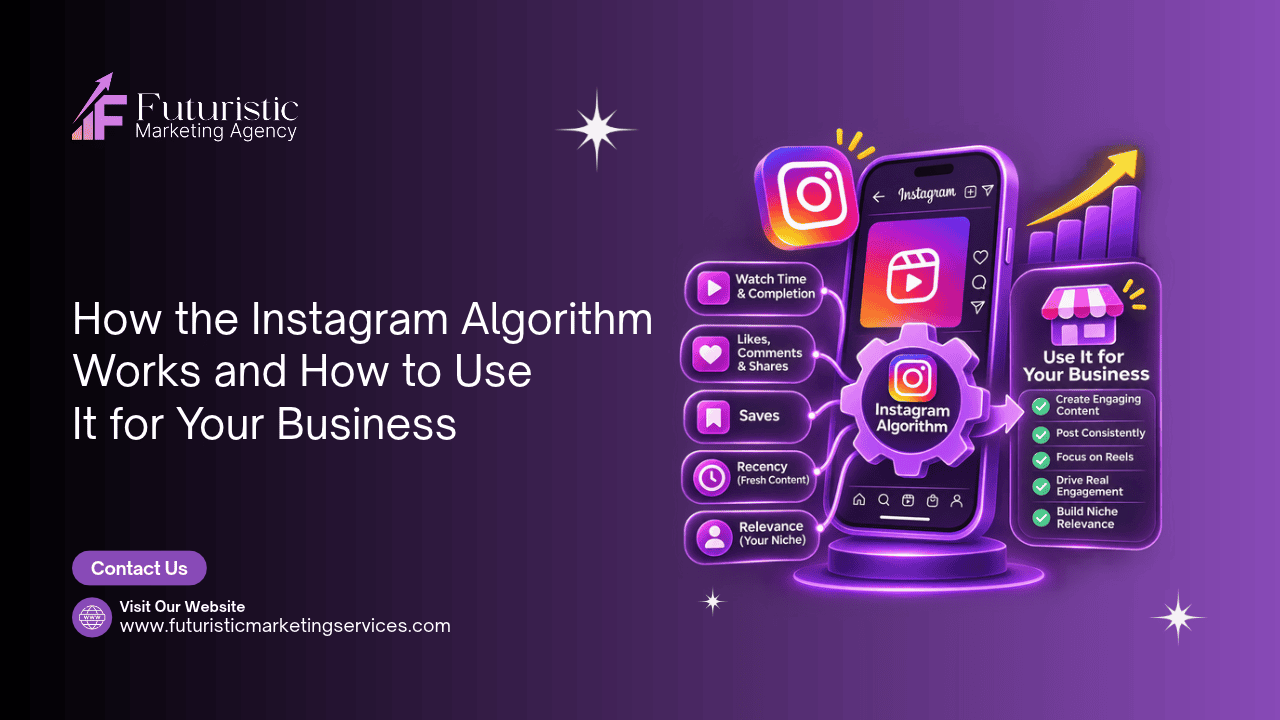
The Instagram algorithm is not a single system. It is a set of multiple AI-driven ranking systems, each governing a different surface: the Home Feed, Reels, Stories, Explore, and Search. Each system evaluates content using different signals, with DM shares now the strongest ranking factor across most surfaces, followed by saves, watch time for video, substantive comments, and relationship history between the account and viewer.

This guide explains exactly how the Instagram algorithm works across every major surface, which specific signals carry the most weight in determining how widely each piece of content is distributed, what actions suppresses reach and why, and seven practical strategies business accounts can implement immediately to work with the algorithm rather than against it. You will also find a complete breakdown of the most persistent Instagram algorithm myths that cause businesses to make decisions based on outdated assumptions, and a clear explanation of how business accounts differ from personal accounts in the algorithm's evaluation system. Every strategy in this guide is based on confirmed platform behavior from Instagram's own communications and current research data.

Key Takeaways

  • Instagram does not have one algorithm. It operates six separate AI ranking systems for the Home Feed, Reels, Stories, Explore, Search, and recommendations, each using different signals and ranking logic.
  • According to Sprout Social's Instagram algorithm research, DM shares, when a viewer sends your post to a friend via direct message, is now the strongest engagement signal Instagram uses to determine how widely content is distributed.
  • Likes now carry approximately one-tenth of the algorithmic weight they carried in previous years. A post with 100 likes and 20 DM shares outperforms a post with 1,000 likes and zero shares, according to GOSO's 2026 algorithm analysis.
  • Business accounts receive slightly lower baseline organic reach than personal accounts, a 7% to 12% base rate versus 10% to 20% for personal accounts, making strong engagement signals even more critical for overcoming this structural disadvantage.
  • Instagram actively penalizes accounts that repost other creators' content without adding original value, replacing their posts with the original creator's version in recommendations and reducing the account's overall distribution.
  • The algorithm now factors in engagement signals from across all Meta platforms, not just activity within Instagram itself, making Facebook page activity relevant to Instagram recommendation performance.
  • Captions are a confirmed Reels ranking factor, read by Instagram's AI to categorize content for recommendation matching, making keyword-rich caption writing a genuine algorithmic optimization tactic.

Struggling to Get Instagram Reach for Your Business?

We Build Algorithm-Optimized Instagram Strategies That Consistently Grow Reach

Futuristic Marketing Services creates content strategies specifically designed around how the Instagram algorithm evaluates and distributes business content, so every post your brand publishes works with the platform, not against it.

Get Your Free Instagram Strategy Audit

Instagram Does Not Have One Algorithm, It Has Six

The most important thing to understand about the Instagram algorithm is that the term refers to a collection of separate AI systems rather than a single ranking formula. Adam Mosseri, head of Instagram, has publicly confirmed that the platform runs different algorithms for different surfaces within the app, each designed around the specific user behaviors and content types found in that environment. As Buffer's comprehensive algorithm guide explains, Instagram uses thousands of ranking factors called signals, organized into different priority hierarchies depending on where the content is being distributed.
This matters enormously for business content strategy because an approach optimized for the Reels algorithm is different from an approach optimized for the Feed algorithm, which differs again from what the Stories algorithm prioritizes. Businesses that treat Instagram as a single system and apply the same strategy uniformly across all their content types are systematically underoptimizing for every surface by failing to align each content format with the specific signals that the relevant algorithm values most. Understanding each surface's distinct ranking logic is what allows a business to create content intentionally for each part of the platform rather than publishing broadly and hoping the single algorithm distributes it appropriately.

The Home Feed Algorithm

The Home Feed shows a mix of posts from accounts the user follows, posts from accounts Instagram thinks the user might like based on behavior patterns, and sponsored content. According to Buffer's Instagram algorithm research, the Feed algorithm prioritizes content based on three primary signals in order of importance: the viewer's relationship history with the creator, how frequently they have interacted with that account in the past, the viewer's past engagement patterns revealing what type of content they consistently respond to, and how quickly other users have interacted with the post since it was published.
For business accounts, the Feed algorithm means that posts reaching existing followers are ranked based primarily on the account's established relationship with each individual follower. Followers who regularly like, comment on, save, or DM the account will see the business's posts higher in their feed than followers who never interact. This is why building genuine engagement through comments, DMs, and saves is not just a vanity metric exercise but an algorithmic investment that increases the Feed visibility of every subsequent post with each engaged follower.

The Reels Algorithm

The Reels algorithm is the most powerful distribution mechanism on Instagram for business accounts because it is the only surface that actively recommends content to users who do not follow the account. The Reels algorithm evaluates content through a sequential evaluation process: first assessing the quality of early engagement signals in the period immediately after publication, then expanding distribution to larger audience segments based on that early performance, and continuing to expand or suppress distribution based on ongoing engagement quality as the Reel accumulates more views.
The primary signals the Reels algorithm evaluates are watch time and completion rate (what proportion of viewers watch the Reel through to the end), DM shares (how often viewers send the Reel to someone else via direct message), saves, and substantive comments. According to Fanpage Karma's Instagram algorithm analysis, the platform also introduced Trial Reels, a feature that allows accounts with over 1,000 followers to test a Reel with non-followers before showing it to their own audience. If the Trial Reel performs well among non-followers, it is then expanded to followers, giving businesses a low-risk way to validate content before committing it to the existing audience. Our Instagram Reels strategy guide covers each of these algorithm signals in detail with specific content production approaches for maximizing performance on each one.

The Stories Algorithm

The Stories algorithm prioritizes content from accounts the viewer has the most frequent and genuine interactions with, surfacing those accounts' Stories at the front of the horizontal Stories tray rather than distributing Stories chronologically as they were originally designed. Accounts that the viewer regularly replies to, DMs, tags in their own Stories, or interacts with through polls and question stickers appear at the front of the tray. Accounts that the viewer never engages with appear at the back and are rarely seen.
For business accounts, this means that the same engagement-building practices that benefit Reels and Feed distribution, actively responding to every DM, reply, and Story interaction, directly improve Stories tray position for every individual follower who interacts with the account. A business that responds to every poll vote, every question box submission, and every DM generated by Stories content builds the two-way interaction history that places its Stories at the front of its most engaged followers' queues, ensuring maximum visibility for the daily content the strategy in our Instagram Stories for business guide recommends publishing.

The Explore Page and Search Algorithm

The Explore page surfaces content the user has not seen before, selected by the algorithm based on the user's demonstrated interest patterns from accounts they follow and content they engage with regularly. Businesses do not post directly to Explore. Content appears there only when the Reels or feed algorithm has determined that it performs strongly enough with the existing audience to warrant distribution to similar non-followers through the Explore surface. Consistently high-performing feed posts and Reels are the indirect mechanism for Explore page visibility.
The Search algorithm evaluates keywords in account names, bio text, captions, and, for video content, the on-screen text visible within the video itself. As Instagram has evolved toward a search-driven discovery environment, Search algorithm optimization has become a genuine growth strategy rather than a supplementary tactic. Including relevant industry keywords naturally in profile name fields, caption text, and on-screen Reel text contributes to the account's searchability for users who are actively looking for businesses, products, or content in that category within the Instagram app.

The 5 Ranking Signals That Determine Instagram Distribution

Across all six Instagram algorithm systems, five core engagement signals carry the most algorithmic weight in determining how widely any piece of content is distributed. Understanding the hierarchy of these signals is what allows a business to design content specifically to trigger the highest-value actions rather than creating content that generates high visible metrics while producing weak algorithmic signals. The signal hierarchy has shifted significantly, and businesses still making decisions based on the pre-2023 engagement model are systematically underperforming relative to what their content quality could produce with correctly targeted optimization.

Signal 1: DM Shares, The Most Powerful Engagement Signal

DM shares, also referred to as sends per reach, occur when a viewer taps the share icon on a post and sends it to a specific person or group via direct message. According to Sprout Social's comprehensive algorithm analysis, sends per reach is now arguably the strongest engagement signal in Instagram's ranking system because it indicates that the viewer found the content valuable enough to recommend to a specific person they know, a more deliberate and intentional action than any passive engagement metric.
Content that generates DM shares tends to fall into specific categories. Highly specific, named-list content that makes a viewer immediately think of one friend who needs to see this generates shares because it activates the viewer's social instinct to be helpful to their network. Transformation content, before-and-after reveals, dramatic result demonstrations, and "I cannot believe this" moments, generates shares because the surprise value compels the viewer to show someone else. Content that resolves a disagreement or validates a position the viewer already holds generates shares because the viewer wants external confirmation of their perspective. Designing content specifically to trigger this "send this to someone" instinct is the highest-leverage algorithmic optimization available for any Instagram surface.

Signal 2: Saves, The Future-Reference Quality Signal

Saves occur when a viewer bookmarks a post to return to it later. The save action tells the algorithm that the content has perceived future utility, that the viewer found it valuable enough to want to access again rather than consuming it once and scrolling past. Educational frameworks, step-by-step guides, checklist content, recipe-style instructional posts, and reference lists consistently generate the highest save rates because they contain information the viewer knows they will want to access again in a specific future situation rather than simply at the moment of first encounter.
Saves carry significantly more algorithmic weight than likes because they reflect active curation intent rather than passive approval. A viewer who saves a post has taken a deliberate action to retain access to the content, which the algorithm interprets as a strong signal that the content delivered genuine value beyond the duration of a single scroll-through. Business accounts that design educational carousels and how-to content specifically to earn saves, including explicit save CTAs in captions such as "Save this for the next time you need to plan your Instagram content", consistently achieve higher algorithmic distribution for those post types than accounts that never prompt the save behavior.

Signal 3: Comments, Speed and Substance Both Matter

Comments are evaluated by the algorithm along two dimensions: the speed at which they arrive after publication and the substantive quality of their content. Early comments that arrive within the first 30 minutes of a post going live carry greater algorithmic weight than comments that arrive days later, because rapid comment generation signals to the algorithm that the content immediately activated audience engagement rather than accumulating slow trickle responses that suggest passive visibility rather than active interest.
The substance of comments also matters. Single-word comments and emoji-only responses carry less weight than comments that contain genuine responses to the content, questions prompted by the information, or experiences shared in relation to the topic. Content specifically designed to generate substantive comments, opinion posts that invite disagreement, question posts that prompt personal sharing, hot take posts that people want to respond to, produces the kind of comment quality and volume that signals genuine audience conversation rather than performative engagement.

Signal 4: Watch Time and Completion Rate for Video Content

For Reels and video content, watch time and completion rate are the format-specific signals that complement the broader engagement hierarchy. Watch time measures the total seconds a viewer spends watching a video, while completion rate measures what proportion of viewers watch the video all the way through rather than abandoning it partway. Both signals tell the algorithm whether the video content delivered on the promise made in its opening frames, whether the hook that captured initial attention was followed by content that maintained it for the full duration.
Completion rate is particularly powerful because a high completion rate signals that the video content was well-structured, relevant, and valuable to its audience from beginning to end. Early abandonment in the first few seconds signals that the opening frame was misleading or the content quality dropped immediately after the hook, which suppresses distribution. According to Fanpage Karma's algorithm research, early performance signals including watch time and completion rate directly influence the algorithm's decision to expand a Reel's distribution beyond the initial test audience, making them the primary variables that determine whether a Reel reaches hundreds or hundreds of thousands of accounts.

Signal 5: Relationship History and Interaction Patterns

The fifth signal is the accumulated history of interactions between the account and each individual viewer. An account that a viewer has regularly liked, commented on, saved content from, and DM'd in the past is treated as a higher-priority source in that viewer's Feed than an account they have never engaged with. This relationship signal explains why engagement consistency matters beyond the immediate algorithmic impact of individual posts: every interaction a follower makes with the account's content adds to the relationship history that improves the visibility of every future post with that specific follower.
This signal also explains the strategic value of actively engaging with followers' content. When a business account comments on, likes, or saves content from its followers' accounts, those interactions contribute to the mutual relationship history that improves the business account's visibility in those followers' Feeds. Accounts that engage only with the content sent to them, without proactively engaging with followers' own posts, build a weaker relationship signal than accounts that maintain genuinely two-way interactions with their most engaged community members.

What Suppresses Instagram Reach, The Algorithm's Negative Signals

H3: Recognition and Credibility

Understanding what suppresses Instagram reach is as important as understanding what expands it. The algorithm evaluates negative signals alongside positive ones, and several common business account behaviors consistently trigger the suppression mechanisms that reduce a post's distribution below what its content quality would otherwise produce.
Reposting other creators' content without adding original value is the most damaging suppression trigger in the current algorithm. According to Sprout Social's research, Instagram now actively penalizes aggregator accounts by replacing their reposted content with the original creator's version in recommendations, effectively removing the reposter from the discovery system entirely for that content. The Originality Score assessment that drives this behavior is permanent and cumulative, accounts with a history of reposting face ongoing reach limitations even after switching to original content, requiring months of consistent original publishing to rebuild the distribution baseline.
Publishing content without a clearly defined topic or niche is a structural suppression factor that many multi-topic business accounts fail to recognize. The algorithm categorizes content and accounts by topic to match them with interest-appropriate audiences. Accounts that publish across four or five unrelated topics provide unclear categorization signals, reducing the precision with which the algorithm can identify the right non-follower audiences to recommend the content to. Tightly defined content pillars, the framework covered in the Instagram content ideas guide, solve this categorization problem by ensuring the algorithm develops a clear, consistent understanding of what the account is about and who it should be shown to.
Low early engagement relative to the account's audience size is the most immediate suppression trigger for any individual post. The algorithm tests each piece of content with a small initial audience subset and uses the engagement rate from that initial test to determine whether to expand distribution or suppress the post. Content that generates below-average engagement in the first 30 to 60 minutes receives reduced distribution regardless of how much effort went into its production. This is why maintaining a consistent engagement practice immediately after posting, responding to early comments, engaging with relevant content in the same niche, and prompting engagement through Stories in the same posting session, is a direct algorithmic intervention that improves the initial test results the algorithm uses to make its expansion decision.

How to Use the Instagram Algorithm to Your Advantage: 7 Strategies

The seven strategies below translate the algorithm's signal hierarchy directly into specific, implementable content and engagement practices. Each strategy is connected to the specific algorithm signal it is designed to improve, giving every action a clear algorithmic justification rather than relying on general best practice advice that may not reflect how the algorithm currently operates.
Strategy What to Do Algorithm Signal It Improves Expected Impact
Design for DM shares Create specific, named-list content or transformation content that makes a viewer immediately think of one friend who needs to see it. Include "send this to someone who needs it" in captions Sends per reach, the strongest ranking signal across all surfaces Significant increase in algorithmic distribution when share rate exceeds account baseline
Engineer saves with educational carousels Publish educational how-to carousels and checklist posts with explicit save CTAs. Structure each carousel around information the viewer will want to reference again in a specific future situation Saves, the second-highest ranking signal, especially powerful on Feed posts and carousels Higher Feed distribution and increased profile visits from new audience members who discovered the content
Engage in the 30-minute post-publication window Spend 20 to 30 minutes immediately after publishing responding to every comment, leaving genuine comments on related content, and prompting engagement through a supporting Story Early comment speed, directly improves the initial test engagement rate that determines expansion decision Higher initial distribution to the full follower base and improved Reels expansion to non-followers
Optimize Reels captions with keywords Write captions using natural language that includes relevant industry keywords. Add keyword-relevant on-screen text to Reels. Include searchable terms in the profile name field Search and recommendation categorization, helps the algorithm match content to the right non-follower audiences Improved Reels discovery through Search and more precisely targeted Explore page recommendations
Tighten content niche and topic focus Organize all content around three to five content pillars and remove topics that fall outside those categories. Use the content calendar to plan monthly content across pillars only Recommendation categorization, gives the algorithm a consistent topic model for matching content to interest-appropriate non-followers Improved Reels and Explore recommendations to audiences who are genuinely interested in the content category
Build Reels for high completion rate Open every Reel with a specific, compelling hook in the first three seconds. Deliver the promised value throughout without filler. End with a CTA that gives the viewer a reason to remain engaged rather than scrolling away Watch time and completion rate, the primary video-specific signals that determine Reels expansion to non-follower audiences Wider Reels distribution through the algorithm's expansion logic when completion rates exceed the initial test group's average
Maintain consistent posting frequency Publish at the same frequency every week for a minimum of 12 consecutive weeks. Never go dark for more than five days. Use batch production and scheduled publishing to protect posting consistency during busy periods Account health and history, the algorithm builds a performance model for each account that improves baseline distribution for accounts with consistent engagement histories Higher baseline distribution for new content as the algorithm builds increasing confidence in the account's performance consistency

Instagram Algorithm Myths That Business Accounts Still Believe

Persistent myths about how the Instagram algorithm works lead businesses to make decisions based on outdated assumptions, wasting content effort on tactics that either no longer work or never worked as described. The following are the most common algorithm myths that continue to influence business account strategies despite being contradicted by Instagram's own communications and current performance data.
The most widespread myth is that the algorithm punishes business accounts. Instagram has publicly confirmed that it does not deliberately penalize content from business profiles. The lower baseline reach that business accounts typically experience compared to personal accounts, 7% to 12% versus 10% to 20% according to GOSO's data, reflects the content behavior patterns and engagement quality typical of business accounts rather than any deliberate suppression based on account type. A business account that produces content generating high DM shares, saves, and genuine comments will receive the same algorithmic distribution expansion that personal accounts producing the same signals would receive. The problem is not account type. It is content quality and engagement signal strength.
The myth that hashtags are the primary growth mechanism is equally outdated. Hashtags remain functional as supporting categorization signals that help the algorithm understand a post's topic context, but they are no longer the primary discovery driver they were in earlier years. Instagram's recommendation system now relies primarily on content quality signals, watch time, saves, shares, and AI-driven interest matching based on the viewer's behavior history rather than on hashtag matching. Using three to five highly relevant hashtags per post contributes to categorization accuracy. Using 30 hashtags regardless of relevance contributes nothing useful and may signal to the algorithm that the account is attempting to game the system rather than creating content naturally matched to its topic category.
The myth that posting frequency alone drives reach causes some accounts to increase volume at the expense of quality, which typically worsens algorithmic performance rather than improving it. The algorithm evaluates the engagement rate of each post relative to the account's audience size and recent performance history. Publishing five low-quality posts per week that each receive below-average engagement produces lower average engagement rate than publishing three high-quality posts per week that each receive above-average engagement. The algorithm rewards engagement quality, not posting volume. An account that publishes three excellent posts per week for six months will consistently outperform an account that publishes seven mediocre posts per week over the same period. Our social media management services are specifically structured around quality-first content calendars that prioritize engagement signal strength over posting volume.

Let the Algorithm Work For You, Not Against You

We Create Instagram Content Built Around How the Algorithm Actually Works

Every piece of content we create for clients is designed to generate the specific engagement signals, DM shares, saves, substantive comments, and strong Reel completion rates, that the Instagram algorithm uses to expand reach. The result is consistent, compounding organic growth rather than unpredictable performance.

Book Your Free Strategy Call

Frequently Asked Questions About How the Instagram Algorithm Works

Q. Does Instagram have one algorithm or multiple?

A. Instagram operates multiple separate AI-driven ranking systems rather than a single algorithm. Each major surface within the app, the Home Feed, Reels, Stories, Explore, and Search, uses a different set of ranking signals and priorities tailored to the specific user behaviors and content types on that surface. This means the strategy for optimizing Feed post performance differs from Reels optimization, which differs again from Stories. Understanding which signals each surface values most is the foundation of an algorithm-aware content strategy.

Q. What is the most important Instagram algorithm signal in 2026?

A. DM shares, when a viewer sends a post to someone else via direct message, is now the strongest ranking signal across most Instagram surfaces. This reflects a broader platform shift toward valuing private sharing behavior as evidence of genuine content quality, since a viewer who sends a post to a specific friend is making a deliberate recommendation rather than a passive engagement. Content designed to trigger the "send this to someone who needs it" response consistently receives the strongest algorithmic distribution expansion across both Feed and Reels surfaces.

Q. How does the Instagram algorithm decide who sees your content?

A. For Feed posts, the algorithm predicts how likely each individual follower is to engage based on their past interactions with the account and their general engagement patterns. For Reels, the algorithm tests the content with a small initial non-follower audience and expands distribution based on early engagement quality signals including watch time, completion rate, saves, and shares. For Stories, the algorithm ranks each account's Stories based on the viewer's interaction history with that account. For Explore and Search, the algorithm matches content to users based on interest signals from past behavior rather than follow relationships.

Q. Why has my Instagram reach suddenly dropped?

A. Sudden reach drops typically result from one or more specific causes: a period of posting inconsistency that reset the account's algorithmic performance model, publication of content that generated below-average early engagement signals and trained the algorithm to distribute the account's content less widely, content topic drift that confused the algorithm's categorization model for the account, or reposting behavior that triggered the Originality Score suppression. To diagnose the cause accurately, review the account's posting frequency in the 30 days before the drop, the engagement rate per post over that period, and whether any topic or format changes coincided with the beginning of the decline.

Q. Do hashtags help with Instagram reach in 2026?

A. Hashtags remain useful as supporting context signals that help the algorithm categorize content by topic for recommendation matching, but they are no longer a primary reach driver. The algorithm now relies primarily on content quality signals, watch time, saves, shares, and AI-driven interest matching based on viewer behavior history. Using three to five highly relevant hashtags per post contributes to accurate topic categorization. Using 20 to 30 hashtags regardless of relevance provides no meaningful additional reach benefit and may signal inauthentic optimization behavior to the algorithm's quality assessment systems.

Q. Does posting more often improve Instagram reach?

A. Posting frequency improves reach only when the additional posts maintain or exceed the account's established average engagement quality. Publishing more posts at the same quality level gradually builds account health signals through accumulated performance history. Publishing more posts at lower quality than the account's established average reduces the overall engagement rate, which signals to the algorithm that the account's content is becoming less relevant to its audience, leading to progressive reach reduction. Consistency at a sustainable quality level is always more effective than volume at reduced quality. Start at a frequency you can sustain with quality indefinitely before scaling up.

Q. >How does the Instagram algorithm treat business accounts differently?

A. Business accounts receive a slightly lower baseline organic reach than personal accounts, approximately 7% to 12% of followers per post versus 10% to 20% for personal accounts, according to current platform data. Instagram has publicly confirmed that it does not deliberately penalize content from business profiles. The lower baseline reflects typical content behavior patterns and engagement quality differences rather than intentional suppression. Business accounts that generate DM shares, saves, and genuine comments at levels that exceed the account's baseline can receive the same algorithmic expansion that personal accounts with equivalent engagement signals achieve.

Q. What suppresses Instagram reach for business accounts?

A. The primary reach suppressors for business accounts are: reposting other creators' content which triggers the Originality Score penalty, publishing content with below-average early engagement that signals low quality to the algorithm's initial test evaluation, posting inconsistently with gaps of more than five to seven days which resets the account's distribution model, publishing across too many unrelated topics which prevents the algorithm from accurately categorizing the account for recommendation matching, and using the same generic hashtag set on every post which signals inauthentic optimization rather than naturally topic-matched content.

Q. How long does it take for the Instagram algorithm to recognize consistent posting?

A. The Instagram algorithm begins building an updated performance model for an account within two to four weeks of consistent posting behavior change. Meaningful improvements in distribution visibility typically become apparent within 30 to 60 days of sustained consistent publishing at improved engagement quality levels. Full recovery from a significant reach drop caused by extended posting gaps or Originality Score penalties requires three to six months of consistent original, high-engagement-quality content before the account's distribution baseline returns to its pre-suppression level. Patience and consistency during this rebuilding period is the only reliable mechanism for algorithm recovery.

Q. What content generates the highest completion rate for Reels?

A. Reels with high completion rates share three structural characteristics: a compelling hook in the first three seconds that creates a specific expectation the viewer wants to see fulfilled, consistent delivery of value throughout the middle section that meets or exceeds the hook's promise, and a natural conclusion that does not feel artificially extended beyond the content's natural endpoint. Tutorial Reels that promise to reveal how to do something specific, then methodically walk through each step without unnecessary padding, consistently achieve the highest completion rates because the viewer's motivation to reach the "reveal" or final step naturally sustains attention through the full video duration.

Q. Does responding to comments improve Instagram reach?

A. Yes. Responding to comments improves reach through two distinct mechanisms. First, each response generates an additional comment event on the post, which continues to signal active engagement to the algorithm even after the initial publication window has passed, extending the algorithmic distribution signal beyond the first 30-minute critical window. Second, accounts that regularly respond to comments build stronger relationship histories with individual followers, which improves Feed ranking for those followers' future views of the account's content. Responding to every substantive comment within 24 hours is one of the most cost-effective algorithmic improvement practices available to any business account.

Q. Can using the same hashtags on every post hurt Instagram reach?

A. Repetitive use of the same hashtag set on every post can signal to the algorithm that the account is applying hashtags as a reach tactic rather than as genuine content categorization, which may reduce the categorization value of those hashtags over time. More importantly, using the same generic hashtags regardless of each post's specific topic provides the algorithm with imprecise categorization signals that reduce recommendation accuracy. Rotating hashtag sets to match the specific topic of each post, using three to five highly relevant hashtags per post that accurately describe the content, produces better categorization signals than any high-volume hashtag strategy regardless of how relevant the individual tags feel.

Futuristic Marketing Services

Build an Instagram Strategy That Works With the Algorithm Every Single Month.

We create Instagram content designed around the specific signals the algorithm values, DM shares, saves, completion rate, and engagement quality, so your business builds consistent, compounding organic reach without depending on paid advertising to stay visible.

Talk to an Instagram Specialist

Conclusion

Understanding how the Instagram algorithm works is not an optional technical detail for businesses using the platform. It is the foundational knowledge that determines whether every piece of content effort and every creative investment the business makes produces compounding organic reach or disappears into a feed that reaches only a fraction of its potential audience. The algorithm is not an adversary to be defeated. It is a distribution system designed to show users the content they are most likely to value, and a business that consistently creates content the algorithm recognizes as genuinely valuable will receive the distribution to match.
The key insights from this guide that should inform every content decision going forward: DM shares are the strongest signal, design content that makes viewers want to send it to someone. Saves are the second strongest signal, design educational content that viewers want to reference again. Completion rate determines Reels expansion, invest creative effort in the first three seconds and deliver consistently throughout. Relationship history determines Feed visibility, build genuine two-way interactions with every engaged follower. Topical consistency improves recommendation accuracy, maintain clear content pillars and resist the temptation to publish outside them.
If you want professional support building an Instagram strategy specifically designed around how the algorithm evaluates and distributes business content, Futuristic Marketing Services creates complete Instagram growth strategies for businesses across India, from content pillar development and Reels scripting through community engagement, scheduling, and monthly performance reporting that tracks the signals that actually determine algorithmic reach.
Share this post :
Picture of Devyansh Tripathi
Devyansh Tripathi

Devyansh Tripathi is a digital marketing strategist with over 5 years of hands-on experience in helping brands achieve growth through tailored, data-driven marketing solutions. With a deep understanding of SEO, content strategy, and social media dynamics, Devyansh specializes in creating results-oriented campaigns that drive both brand awareness and conversion.

All Posts