
Internal linking is the practice of adding hyperlinks within your website that point from one page to another on the same domain. These links tell Google which pages are related to each other, distribute page authority (PageRank) across your site, guide users to relevant content, and help Google discover and index pages that might otherwise be missed. A well-planned internal linking architecture is one of the highest-impact SEO improvements available without requiring any external resources.
Key Takeaways
- According to Google Search Central, internal links are how Google discovers new pages and understands the relationship between pages on your site, making internal linking both a crawlability and a ranking factor simultaneously
- A service page receiving internal links from 10 relevant blog posts consistently outranks an isolated service page with no internal links pointing to it, even when both have identical external backlink profiles
- Anchor text is the most important dimension of internal link quality, descriptive keyword-relevant anchor text provides Google with relevance signals for the linked page
- Orphan pages, pages with no internal links pointing to them, may not be discovered, indexed, or ranked by Google regardless of how strong their content quality is
- The correct internal linking priority order is: service and conversion pages first, then pillar pages, then cluster articles, then supporting content
- Every new blog post should link to at least 3 existing pages and receive at least 2 internal links from existing pages within the first week of publication, our content strategy guide covers how to build this into your production workflow
Want Your Internal Linking Audited and Optimised for Maximum Rankings?
Futuristic Marketing Services conducts complete internal linking audits, identifying orphan pages, weak authority pages, and linking opportunities, then implements the strategic architecture that distributes authority to your most commercially important pages.
Get an Internal Linking AuditHow PageRank Flows Through Internal Links
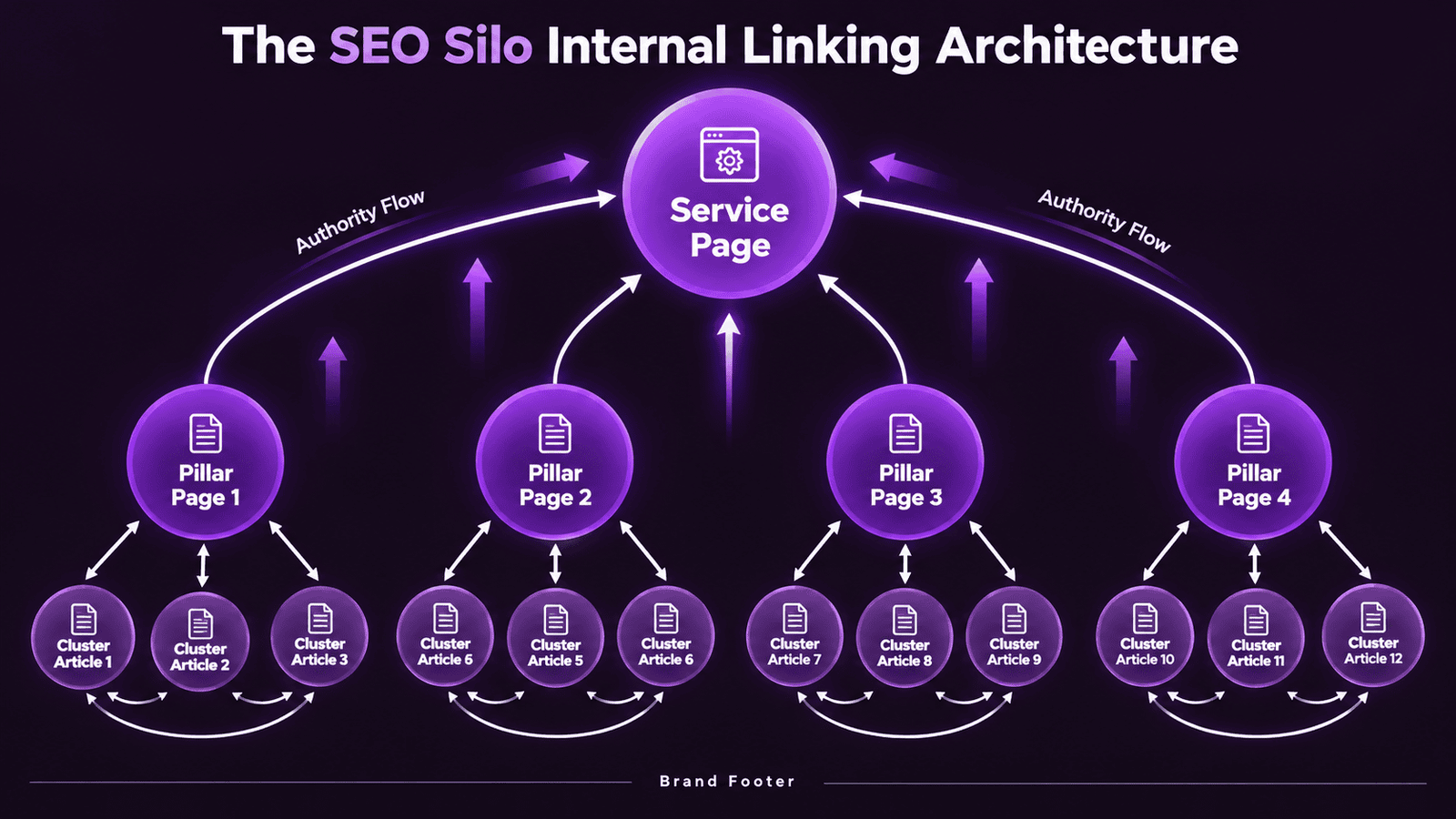
The Silo Architecture, Concentrating Authority Where It Matters
| Silo Level | Page Type | Receives Links From | Links To | Authority Priority |
|---|---|---|---|---|
| Level 1 (top) | Service or conversion page | All cluster articles, subtopic pillars, and blog posts in the silo | Category page, homepage | Highest, maximise internal links pointing here |
| Level 2 | Subtopic pillar page | All cluster articles in its sub-cluster | Level 1 service page, related cluster articles | High, receives and passes authority |
| Level 3 | Cluster article or blog post | Related cluster articles, supporting content | Its parent subtopic pillar, the Level 1 service page | Medium, earns and distributes external backlinks |
| Level 4 (base) | Supporting content, definitions, FAQs | Homepage or category only | Its parent cluster article, subtopic pillar | Low, created for coverage breadth |
Anchor Text Rules for Internal Links
| Anchor Text Type | Example | When to Use | SEO Signal Strength |
|---|---|---|---|
| Exact match | internal linking strategy | Up to 30% of links to any one page | Strong, direct keyword signal for destination page |
| Partial match | complete guide to internal links for SEO | 70% of links, the primary approach | Strong, topical relevance with natural variation |
| Branded | Futuristic Marketing Services internal linking guide | When referencing specific branded content | Medium, brand authority signal |
| Generic | click here, read more, learn more | Never, for any internal link | Zero, no relevance signal, wasted opportunity |
How to Identify Internal Linking Opportunities
Fixing Orphan Pages
Internal Link Placement Rules
- Place internal links within the first 300 words where possible, links earlier in the content receive slightly more weight than links at the bottom of a long article
- Link from a relevant sentence where the anchor text appears naturally in context, never force a link into a sentence where it reads awkwardly
- Do not link to the same destination URL twice in the same article, once per page is the maximum
- Do not create a separate 'Related Articles' or 'See Also' link list at the bottom of articles, these are lower-value than contextual body links and signal low editorial investment to Google quality evaluators
- Minimum 3 internal links per article as a publishing standard, our {ilink('how to write SEO blog posts guide',12)} covers how to integrate this into the writing process
Let Our SEO Team Build Your Complete Internal Linking Architecture
Our SEO specialists audit your current internal linking structure, identify orphan pages and authority gaps, then implement the strategic linking architecture that distributes authority to your highest-priority pages.
Start Your Internal Linking OptimisationFrequently Asked Questions
Q. What is internal linking in SEO?
Q. How many internal links should each page have?
Q. What anchor text should I use for internal links?
Q. What is an orphan page and why is it an SEO problem?
Q. What is a silo structure in SEO?
Q. How do internal links help Google understand my site?
Q. How do I audit my internal linking structure?
Build the Internal Linking Architecture That Amplifies Every Page on Your Site
At Futuristic Marketing Services, we build systematic internal linking architectures that distribute authority from your strongest content to your most commercially important pages, improving rankings across your entire site without a single new external backlink.
Talk to an Internal Linking Specialist