WooCommerce Website Development: The Complete Business Guide

woocommerce website development

WooCommerce is the world’s most widely used eCommerce platform, powering approximately 28 percent of all online stores globally. Built as a free, open-source plugin for WordPress, it transforms a WordPress website into a fully functional online store, with product catalogue management, shopping cart, checkout, payment processing, order management, and inventory tracking. WooCommerce charges 0 percent platform transaction fees, every file and customer record is fully owned by the merchant, and the complete feature set is extendable through 400 or more official and third-party extensions.

This guide provides the complete framework for WooCommerce website development in the UK in 2026, from the initial platform decision and realistic cost benchmarks through to payment gateway selection, performance optimisation, SEO setup, and the essential extension stack for a professional online store. Whether you are building your first eCommerce site or evaluating whether WooCommerce or Shopify is the right choice for your next project, this guide gives you the data and framework to decide correctly.

Key Takeaways

  • WooCommerce powers approximately 28% of all global eCommerce stores, according to BuiltWith, more than any other single eCommerce platform. It is free open-source software, costs come from hosting, premium extensions, and development, not platform subscription fees.
  • WooCommerce charges 0 percent platform transaction fees. At £500,000 in annual revenue, this saves £15,000 per year versus Squarespace Commerce (3 percent fee) and £2,500 to £10,000 per year versus Shopify (0.5 to 2 percent with non-Shopify Payments gateway).
  • WooCommerce versus Shopify: WooCommerce is stronger when organic SEO is the primary growth channel, transaction fees matter at volume, subscription or B2B pricing is complex, or complete code ownership is required. Shopify wins on managed simplicity and fastest time to launch.
  • WooCommerce on WordPress has the highest eCommerce SEO ceiling of any widely used platform, complete control over URL structure, category page copy, product schema, and Core Web Vitals performance.
  • Professional WooCommerce stores in the UK cost £8,000 to £25,000 for a standard build (50 to 500 products). Total year-one cost including hosting, extensions, and maintenance is typically £12,000 to £35,000.
  • Stripe is the recommended primary payment gateway for UK WooCommerce merchants, 1.4 percent plus 30p for European cards, Apple Pay and Google Pay built in, and the best developer experience of any payment provider.
  • WooCommerce performance depends on hosting quality. Managed WordPress hosting on Kinsta or WP Engine with Redis object caching achieves Good Core Web Vitals status and the ranking advantage it provides. Shared hosting is not suitable for any production eCommerce store.

Building a WooCommerce Store?

Professional eCommerce Development With Performance Built In

Futuristic Marketing Services builds WooCommerce stores with custom design, payment integration, performance engineering, and full SEO foundations, ready to sell from day one.

Get a Free Consultation
WooCommerce vs Shopify: The 2026 Decision Guide

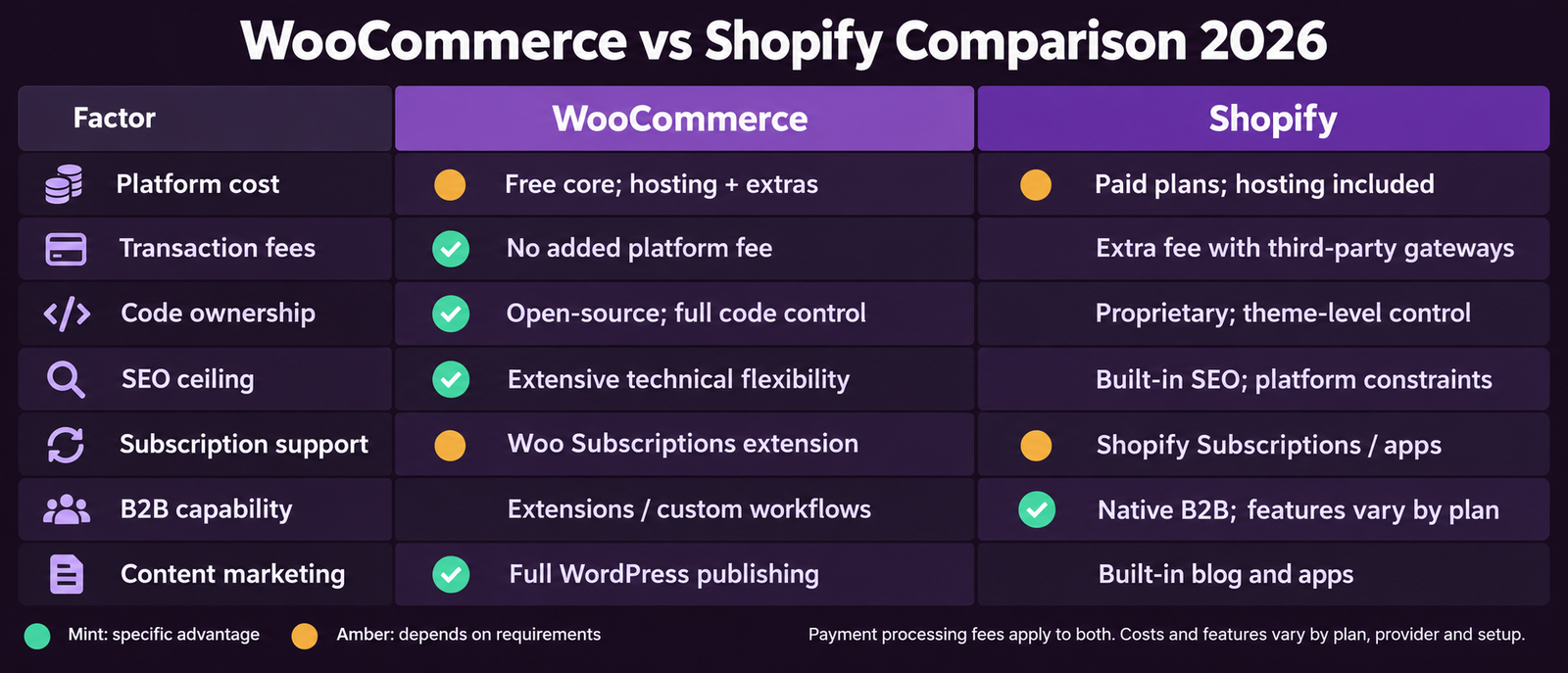
WooCommerce and Shopify are the two most widely evaluated eCommerce platforms in the UK. The correct choice depends on your specific business priorities, there is no universally correct answer, but the decision framework is clear once the key factors are understood.
Factor WooCommerce Shopify
Platform cost Free, pay only for hosting and extensions $39 to $399 per month subscription
Transaction fees 0 percent, your payment gateway fee only 0 percent with Shopify Payments; 0.5 to 2 percent with third-party gateway
Code ownership Complete, all code, database, and files are yours None, hosted on Shopify infrastructure
SEO ceiling Very high, complete technical SEO control including Core Web Vitals High, good SEO tools but platform-constrained architecture
Setup simplicity Requires hosting configuration and plugin setup Fastest path to a live store, managed platform
Subscriptions WooCommerce Subscriptions plugin (£20 per month) Recharge app or built-in, simpler setup
B2B wholesale pricing Full support via plugins Limited, requires B2B-specific apps
Content marketing Excellent, WordPress blog with full CMS capability Good, Shopify blog is functional but less capable
Developer ecosystem Largest, 60,000 or more WordPress plugins Large, 8,000 or more Shopify apps
The core decision: choose WooCommerce when organic search is a primary growth channel, 0 percent platform transaction fees matter at your expected revenue volume, subscription or B2B pricing logic is complex, or complete code and data ownership is a requirement. Choose Shopify when managed platform simplicity is the priority, the fastest path to a live store matters most, and ongoing technical maintenance is not something the team can manage. See our dedicated WooCommerce vs Shopify comparison for a full analysis.

WooCommerce Development Cost

WooCommerce development costs span a wide range because the platform serves stores from 10 products to 100,000 products, and the complexity of custom functionality varies enormously. The table below reflects UK professional agency costs in 2026.
Project Type Development Cost Monthly Running Costs Timeline
Simple store (under 50 products, premium theme) £4,000 to £10,000 £30 to £80 per month 4 to 7 weeks
Professional store (50 to 500 products, custom design) £10,000 to £25,000 £50 to £150 per month 6 to 12 weeks
Complex store (500 or more products, integrations) £20,000 to £60,000 £100 to £400 per month 10 to 20 weeks
Enterprise WooCommerce (ERP integration, custom extensions) £50,000 to £200,000 or more £300 to £2,000 or more per month 4 to 9 months
Beyond development: budget for managed WordPress hosting at £30 to £150 per month (Kinsta, WP Engine, or Cloudways), payment gateway fees at 1.4 to 2.9 percent plus 30p per transaction (Stripe), premium WooCommerce extensions at £100 to £600 per year depending on the extension stack, and a maintenance retainer at £80 to £300 per month for updates, security monitoring, and backup management.

Payment Gateways for UK WooCommerce Stores

Gateway UK Card Rate Setup Complexity Best For
Stripe 1.4% + 30p (EU cards) / 2.9% + 30p (non-EU) Easy, official WooCommerce Stripe plugin Primary gateway for most UK merchants, best developer experience, Apple Pay and Google Pay built in, excellent fraud protection
PayPal 1.2 to 3.4% plus fixed fee (varies by volume) Easy, official WooCommerce PayPal plugin Secondary gateway, important to offer for the segment of customers who prefer PayPal, particularly 35 to 65 age group
Klarna 3 to 5% merchant fee (varies) Moderate, Klarna official plugin Buy now pay later for higher AOV products above £50, fashion, electronics, furniture
Worldpay Negotiated rates for high volume Complex, requires integration work High-volume merchants with over £500,000 annual revenue who can negotiate better rates

WooCommerce Performance and Core Web Vitals

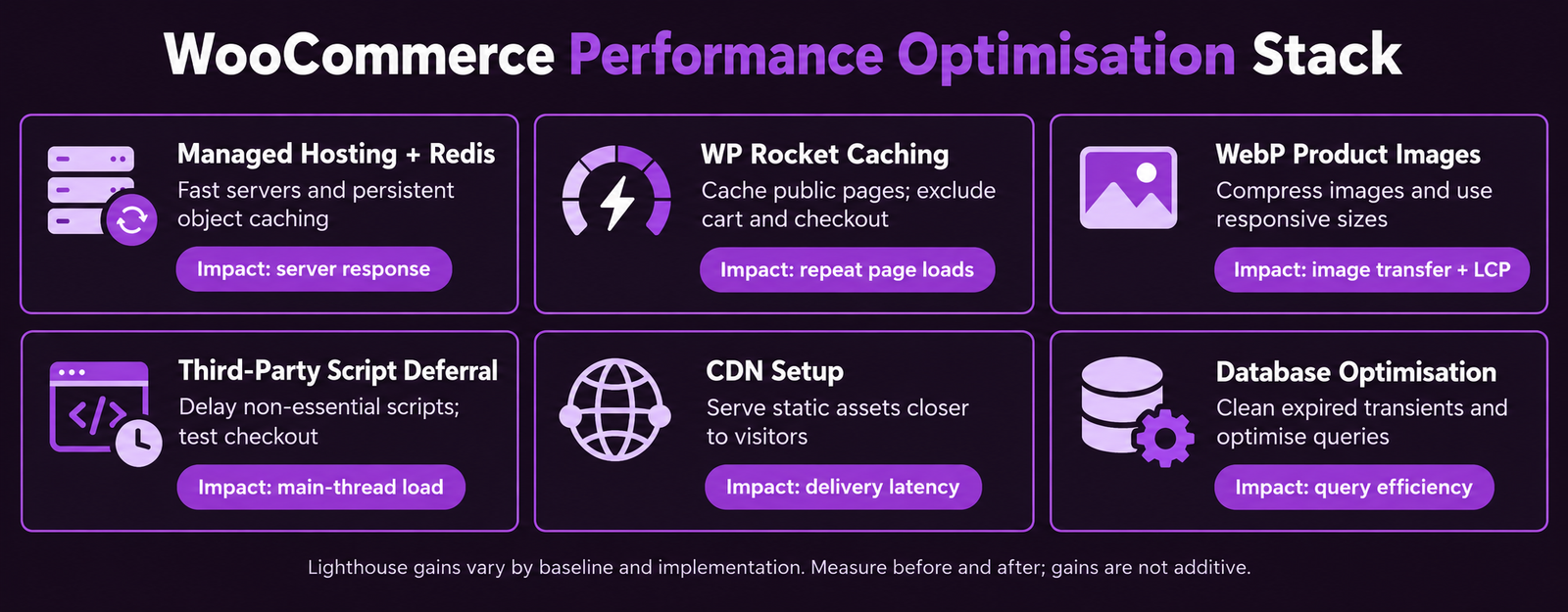
WooCommerce performance is determined by three factors above all others: hosting quality, caching configuration, and database optimisation. An unoptimised WooCommerce store on shared hosting scores 30 to 50 on mobile Lighthouse. The same store on managed hosting with Redis object caching and WP Rocket achieves 75 to 90 or higher, the difference between Poor and Good Core Web Vitals status and the SEO ranking advantage that comes with it.

The WooCommerce Performance Stack

Essential WooCommerce Performance Configuration

Managed WooCommerce hosting

Kinsta, WP Engine, or Cloudways include server-level caching optimised for WooCommerce, essential because cart and checkout pages cannot be page-cached and require server-level handling. See our website speed guide.

Redis object caching

WooCommerce makes frequent database queries. Redis stores frequently queried results in memory, dramatically reducing database load and improving TTFB. Included on Kinsta and WP Engine.

WP Rocket caching

Page caching for non-cart pages, CSS and JavaScript minification, image lazy loading, and database cleanup, the single highest-impact performance plugin for WooCommerce.

Product image optimisation

Product images are typically the LCP element on product pages. Serve all images in WebP format at viewport-correct sizes with explicit width and height. See our Core Web Vitals guide.

Deferred third-party scripts

Analytics, heatmaps, marketing pixels, and chat widgets all add JavaScript that delays interactivity. Load all third-party scripts after the page is interactive using a tag manager or Partytown.

CDN for global stores

A global CDN serves static assets (images, CSS, JavaScript) from the nearest edge server, reducing load time for customers outside the UK or when the origin server is under load.

WooCommerce SEO

WooCommerce on WordPress is the strongest eCommerce SEO platform available. It combines complete technical SEO control with the content marketing capability of WordPress, the combination that drives the highest long-term organic revenue for eCommerce businesses.
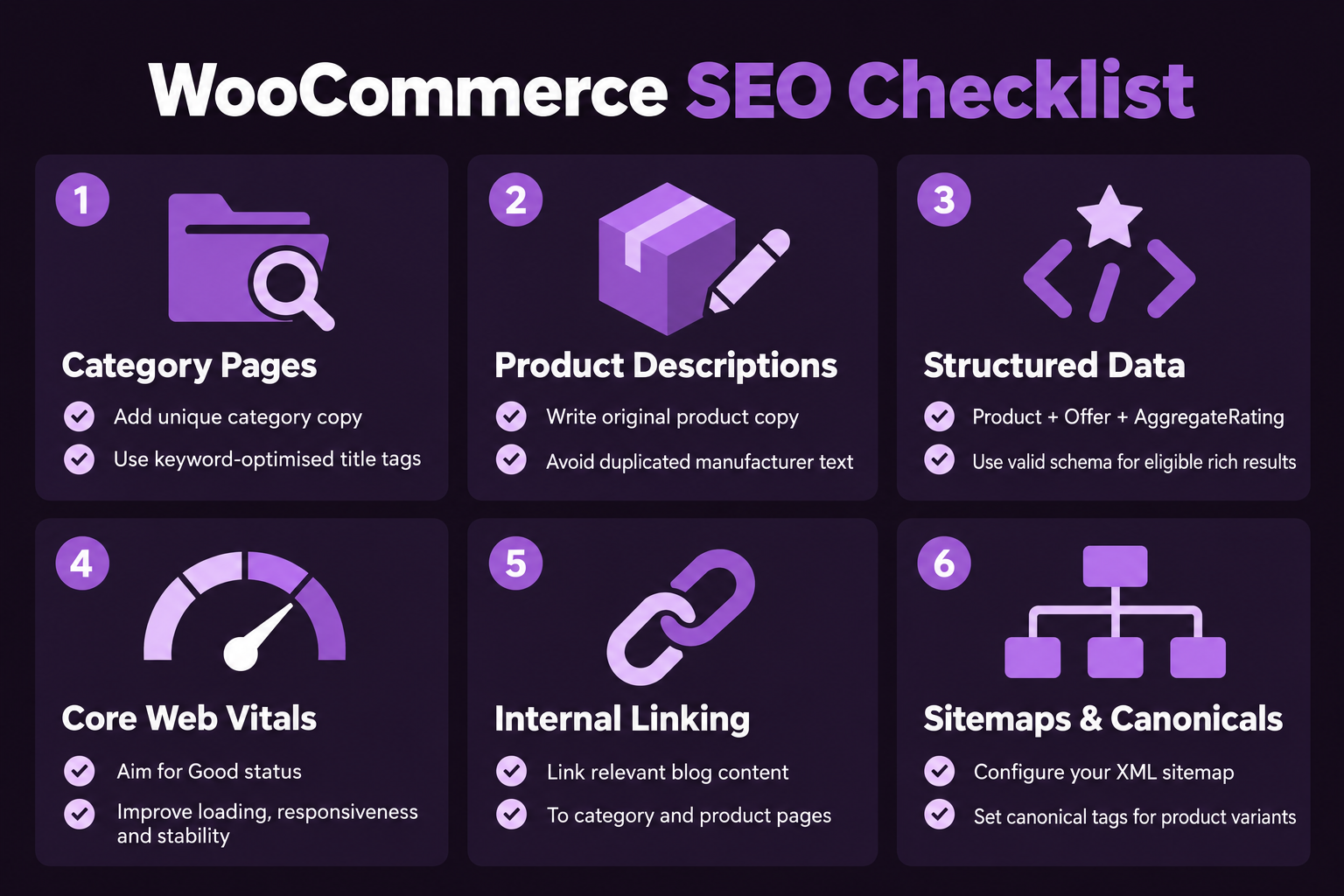
The highest-priority eCommerce SEO investments for WooCommerce stores: category page optimisation (each category page targets a high-volume commercial keyword with unique introductory copy and an optimised title tag); unique product descriptions for all products above the revenue threshold (manufacturer descriptions create duplicate content across all retailers); Product, Offer, and AggregateRating schema markup (automated by Yoast SEO Premium or Rank Math Pro, enables price and review stars in search results); and Core Web Vitals performance (Good status is a confirmed ranking advantage). See our dedicated eCommerce SEO guide and WordPress SEO guide for the complete implementation frameworks.

Ready to Launch Your WooCommerce Store?

Get a Complete WooCommerce Build With SEO and Performance Built In

Futuristic Marketing Services builds professional WooCommerce stores, custom design, payment integration, SEO foundations, Core Web Vitals engineering, and ongoing maintenance support.

Get Your WooCommerce Quote
Frequently Asked Questions About WooCommerce Development

Q: What is WooCommerce?

A: WooCommerce is a free, open-source eCommerce plugin for WordPress that transforms a WordPress website into a fully functional online store. It handles product catalogue management, shopping cart, checkout, payment processing, order management, and inventory tracking. Because it is built on WordPress, it inherits all of WordPress capabilities: complete code ownership, the largest CMS plugin ecosystem, superior SEO control, and unlimited design flexibility. WooCommerce is used by approximately 28% of all global eCommerce stores, according to BuiltWith.

Q: How much does a WooCommerce store cost to build in the UK?

A: A professional WooCommerce store in the UK costs between £4,000 and £200,000 or more depending on complexity. A standard store with up to 100 products, custom design, payment integration, and basic SEO setup costs £8,000 to £20,000. Add year-one running costs: managed hosting at £30 to £150 per month, premium extension licences at £200 to £600 per year, and a maintenance retainer at £80 to £300 per month. Total year-one investment for a professionally built mid-complexity WooCommerce store is typically £15,000 to £35,000.

Q: Should I use WooCommerce or Shopify?

A: WooCommerce is the stronger choice when: organic search is a primary growth channel (higher SEO ceiling); you want 0 percent platform transaction fees at volume; subscription or B2B pricing logic is complex; or you need complete code and data ownership. Shopify is stronger when: managed platform simplicity is the priority; fastest time to launch matters most; and ongoing technical maintenance is not manageable in-house. See our detailed WooCommerce vs Shopify comparison for a full analysis.

Q: What payment gateways work with WooCommerce in the UK?

A: Stripe is the recommended primary gateway for UK WooCommerce merchants, 1.4 percent plus 30p for European cards, excellent fraud protection, Apple Pay and Google Pay built in, and the best developer experience. Add PayPal as a secondary option for the segment of customers who prefer it. For stores selling higher-ticket items, Klarna buy-now-pay-later increases conversion rate. WooCommerce supports over 100 payment gateways via official and third-party plugins.

Is WooCommerce free?

A: WooCommerce core plugin is free and open-source. The costs associated with a WooCommerce store are: WordPress hosting (£5 to £80 per month), domain registration (£8 to £15 per year), premium WooCommerce extensions (£100 to £600 per year for subscriptions, product add-ons, booking, and so on), payment gateway processing fees (1.4 to 2.9 percent plus fixed fee per transaction), and development costs if professional design and setup are required.

Q: What is WooCommerce Subscriptions and do I need it?

A: WooCommerce Subscriptions is a premium extension (£20 per month or £240 per year) that adds recurring payment functionality to WooCommerce, enabling weekly, monthly, or annual subscription products with automatic renewal billing. It is required for any business model with recurring revenue: subscription boxes, SaaS products, membership sites, software licences, or service retainers. It integrates with Stripe and PayPal for automated recurring billing and includes a complete subscription management dashboard.

Q: How do I optimise a WooCommerce store for speed?

A: WooCommerce performance optimisation in priority order: upgrade to managed WordPress hosting on Kinsta or WP Engine with Redis object caching; install WP Rocket for page caching and JavaScript optimisation; convert all product images to WebP format with explicit width and height attributes; defer all third-party scripts (analytics, chat, marketing pixels) until after the page is interactive; and enable a CDN for image delivery. These five steps consistently move a WooCommerce store from 40 to 60 Lighthouse to 75 to 90 on mobile. See our Core Web Vitals guide.

Q: How does WooCommerce handle VAT for UK businesses?

A: WooCommerce includes a full tax calculation system. For UK businesses, configure the standard 20% VAT rate in WooCommerce, Settings, Tax, enter the UK tax rate and apply it to the appropriate tax classes (standard rate, reduced rate, and zero rate for applicable product categories). WooCommerce automatically calculates and displays VAT in the cart, checkout, and order confirmation emails. For businesses selling to the EU post-Brexit, configure separate EU tax rates per country or use an automated VAT compliance plugin such as TaxJar or Avalara.

Q: What are the best WooCommerce extensions?

A: The essential WooCommerce extension stack for most UK online stores: WooCommerce Subscriptions for recurring revenue products, WooCommerce Product Add-Ons for product personalisation options, Stripe for WooCommerce for payment processing, YITH WooCommerce Wishlist for customer save-for-later functionality, and Klaviyo for WooCommerce for abandoned cart and post-purchase email automation. For stores selling services, WooCommerce Bookings adds appointment scheduling. Total annual extension cost for the standard stack is typically £300 to £600.

Q: Does WooCommerce have good SEO?

A: WooCommerce on WordPress has the highest SEO ceiling of any widely used eCommerce platform. It gives complete control over URL structure, canonical tags for product variants, category page copy, structured data (Product, Offer, and AggregateRating schema via Yoast SEO Premium or Rank Math Pro), and Core Web Vitals performance. Organic search drives an average 43% of eCommerce traffic. See our eCommerce SEO guide for the complete framework.

Can WooCommerce handle large product catalogues?

Yes, WooCommerce scales to very large product catalogues when properly configured. The key requirements for large catalogues: managed hosting with Redis object caching to handle the increased database query load; a CDN for image delivery at scale; database optimisation to prevent product meta table bloat; and indexed database queries for product search. Stores with over 10,000 products may benefit from dedicated product search plugins (SearchWP, Algolia) to replace WooCommerce default search with a performant indexed search system.

How do I migrate my existing shop to WooCommerce?

Migrating to WooCommerce from Shopify, Magento, or another platform involves: exporting product data (CSV format); importing products to WooCommerce using the built-in product importer or Cart2Cart migration service; rebuilding the site design in WordPress; migrating customer accounts; setting up 301 redirects from every old URL to the corresponding WooCommerce URL; and verifying payment gateway configuration and order flow. A professional WooCommerce migration that preserves SEO rankings and customer data typically costs £2,000 to £8,000 depending on catalogue size and the source platform. Contact our team to discuss your specific migration requirements.

Q: What is included in a graphic design package for small business?

A: The specific inclusions depend entirely on the package type. A brand starter kit typically includes logo design (two to three concepts; one to two revision rounds), a brand colour palette with Hex/RGB/CMYK codes, typography selection, and basic brand usage guidelines. A full brand identity package adds business card design, letterhead, social media profile images, email signature, and a comprehensive brand guidelines document. A monthly social media design package includes a defined number of post designs per month (typically 15 to 30), story templates, Reel covers, and optionally ad creatives. A monthly retainer package provides a fixed number of design hours per month applicable to any mix of social, print, digital, and campaign work. An unlimited design subscription provides unlimited requests at a flat monthly rate. Every package at any tier must include source files, multiple export formats, a clear revision policy, and intellectual property transfer to the client on full payment.

Q: How much do graphic design packages cost for a small business?

A: Costs vary significantly by package type, quality tier, and geographic market. In India, a brand starter kit from a professional freelancer costs approximately Rs 10,000 to Rs 25,000. A full brand identity package from a professional freelancer costs Rs 30,000 to Rs 1,00,000. A monthly social media design package covers Rs 8,000 to Rs 25,000 per month for a mid-level freelancer providing 15 to 25 posts. A monthly design retainer for mixed work runs Rs 15,000 to Rs 40,000 per month for 15 to 25 hours. In the US and UK, equivalent packages cost 50 to 70% more: a US freelancer mid-level brand identity package runs $3,000 to $8,000; a US monthly retainer runs $1,000 to $2,500 per month. Unlimited design subscription platforms charge $300 to $1,000 per month globally, with India-based services offering competitive pricing.

Q: What is the difference between a graphic design package and a retainer?

A: A graphic design package typically refers to a one-time, defined set of deliverables at a fixed price - for example, a brand starter kit that delivers a logo, colour palette, and guidelines document for a single project fee. A retainer is an ongoing engagement where the client pays a recurring monthly fee for a defined volume of design work that can be applied to any task mix within the agreed scope. The key distinction is continuity: a package has a defined end when deliverables are complete; a retainer is a sustained relationship that provides ongoing design support month after month. Both can be structured as tiered offerings, and many agencies use ‘package’ to describe both one-time and ongoing offerings. Always clarify whether a ‘package’ being proposed is a one-time scope or an ongoing monthly commitment before agreeing.

Q: How do I choose the right graphic design package for my business?

A: Match the package type to your primary need and business stage. If you have no brand identity at all, start with a brand starter kit or full brand identity package - this is a prerequisite for everything else. If you have a brand identity but need ongoing social media content, a monthly social media design package or retainer is the right choice. If your design needs are high-volume, varied, and unpredictable month to month, an unlimited design subscription provides the best value. If you have a specific campaign or product launch, a project-based campaign package is most cost-effective. The business stage framework in Section 13 of this guide maps common business stages to the most appropriate package type with budget ranges for the India market.

Q: What is an unlimited graphic design service?

A: An unlimited graphic design service is a subscription model where the client pays a flat monthly fee and can submit as many design requests as they want, with one active project in production at a time and a defined turnaround per completed project. According to DDIY’s graphic design pricing list, these services typically charge $300 to $800 per month, with premium platforms like ManyPixels and Penji at higher tiers ($500 to $2,400 per month). The practical output in any given month is limited by how quickly each project completes its revision cycle - not by any formal limit on requests. Unlimited design subscriptions are best suited for businesses with high and varied monthly design volumes whose per-project cost at a la carte rates would significantly exceed the subscription fee. They typically cover static graphic design, social media graphics, banner ads, presentation design, and print collateral. They generally do not cover logo design, brand identity development, video production, or complex custom illustration - DDIY's graphic design pricing list provides a side-by-side comparison of what Penji, ManyPixels, and Design Pickle each include and exclude at their respective price tiers.

Q: Should I buy a graphic design package or hire a designer?

A: Graphic design packages and hiring a designer are not mutually exclusive - most packages are purchased from a hired designer or agency. The relevant decision is between buying an off-the-shelf package (with predefined inclusions at a fixed price), a custom-scoped package (tailored to your specific requirements), or a continuous engagement (retainer or subscription). Off-the-shelf packages are faster to start and appropriate when the predefined inclusions closely match your needs. Custom packages are better when your requirements do not map cleanly to standard offerings. The hiring decision (Blog #29) addresses how to find and evaluate the right designer or agency for your needs. Once you have identified the right provider, the package structure is the commercial framework for the engagement.

Q: What is included in a brand identity package?

A: A brand identity package at a professional mid-level tier typically includes: the complete logo system (all orientations, colour versions, and file formats including vector source files); a brand colour palette with Hex, RGB, and CMYK codes; a typography system specifying headline, body, and accent fonts with usage guidelines; a brand guidelines document (typically 15 to 30 pages) covering all of the above plus imagery style, do’s and don’ts, and template examples; business card design; letterhead and email signature; and social media profile images for the primary platforms. Premium packages add social media post templates, packaging design, pitch deck templates, and extended brand guidelines. Logo-only packages are not brand identity packages - brand identity requires the complete visual system that makes the logo consistently usable across all contexts.

Q: How many revision rounds should be included in a graphic design package?

A: Industry standard is one to three revision rounds included in the base project or package scope. According to BusinessDojo’s graphic designer retainer fee guide, most designers include one to three rounds of revisions in the base project rate, with additional revisions charged between $25 and $100 per round (or at the designer’s standard hourly rate). For brand identity packages, two revision rounds is the typical standard - the first for structural feedback (does the direction work?) and the second for refinement (is the execution at the right quality level?). For ongoing social media design packages, revisions per post should be limited to one round per design to maintain production efficiency. Always confirm the revision policy - what counts as a revision, how many are included, and how additional revisions are priced - before signing a package agreement.

Q: Do graphic design packages include source files?

A: They should, but not all of them do. Source files - the editable Photoshop (PSD), Illustrator (AI or EPS), or Figma files behind the final exported designs - should be included in every professional graphic design package. Source files are the proof of complete design ownership and the prerequisite for any future modification, extension, or handoff to a new designer. However, some designers and platforms - particularly at low price points - deliver only final exports (JPG, PNG, PDF) without source files, creating permanent design dependency on that single provider. Always confirm source file delivery as an explicit, written deliverable in any package agreement before work begins. If a package explicitly excludes source files, this is a significant limitation that should affect your willingness to purchase it.

Q: What is a graphic design retainer package?

A: A graphic design retainer package is a monthly engagement where the client pays a fixed monthly fee to secure a defined amount of a designer’s time - typically expressed in hours per month (8, 20, or 40 hours, for example) - which can be applied to any design task the business needs during that month. According to DesignRush’s graphic design price guide, monthly retainer fees typically range from $500 to $5,000 or more, with key considerations including scope definition and priority service terms. Retainer clients typically receive a 10 to 20% discount on standard rates, priority queue placement, and a consistent designer relationship over time. Retainer packages suit businesses with regular, varied design needs across multiple materials (social media, print, ads, presentations) who benefit more from flexible time access than from fixed-deliverable packages.

Futuristic Marketing Services

Launch Your WooCommerce Store With Confidence

Futuristic Marketing Services delivers complete WooCommerce builds, from product catalogue structure and payment gateway integration to performance engineering and ongoing maintenance, for UK businesses ready to grow online.

Start Your WooCommerce Project


WooCommerce: The Right Platform for Growth-Focused UK eCommerce

WooCommerce is the right eCommerce platform for UK businesses where organic search growth, full data ownership, and zero platform transaction fees are commercial priorities. Its combination of complete technical SEO control, the largest plugin ecosystem of any eCommerce platform, and 0 percent platform fees makes it the strongest long-term foundation for any eCommerce business with a growth strategy beyond paid acquisition.
The investment required, managed hosting, a professional development build, and an ongoing maintenance programme, is higher than a Shopify subscription in year one. But over 3 to 5 years, for any store generating meaningful revenue through organic search, the combination of zero platform fees and superior SEO performance makes WooCommerce the more commercially efficient choice. Build it correctly from the start: correct product architecture, performance-engineered hosting stack, technical SEO foundation, and structured maintenance programme.
For the platform comparison, see our WooCommerce vs Shopify guide. For the eCommerce SEO strategy, see our eCommerce SEO guide. For the broader WordPress development context, see our WordPress development guide.
Share this post :
Picture of Devyansh Tripathi
Devyansh Tripathi

Devyansh Tripathi is a digital marketing strategist with over 5 years of hands-on experience in helping brands achieve growth through tailored, data-driven marketing solutions. With a deep understanding of SEO, content strategy, and social media dynamics, Devyansh specializes in creating results-oriented campaigns that drive both brand awareness and conversion.

All Posts