What Is Off-Page SEO? The Complete Guide to Building Authority in 2026

off page seo

Off-page SEO refers to all actions taken outside your website to improve its authority, trustworthiness, and search engine rankings. It primarily involves earning backlinks from reputable external websites, building brand entity signals across the web, and establishing your site as a credible authoritative source through the kind of external validation that other publishers choose to provide.

This guide covers the complete off-page SEO landscape for 2026: what authority signals Google evaluates, how backlinks work and why quality matters far more than quantity, the seven most effective off-page strategies, how digital PR earns the highest-quality links available, how entity building has become essential for AI-era citation eligibility, and the measurement framework for tracking off-page progress across both traditional rankings and AI Overview citations. It works in combination with our link building guide and E-E-A-T guide for the complete off-page authority programme.

Key Takeaways

  • Off-page SEO covers everything affecting your rankings from outside your website, primarily backlinks, brand mentions, and entity signals in Google's Knowledge Graph
  • According to Ahrefs, 91% of all web pages receive zero organic traffic, and backlinks are the single variable most strongly correlated with the 9% that do rank
  • Google treats backlinks as editorial endorsements, one link from a high-authority, topically relevant site outweighs hundreds from low-quality directories
  • Digital PR is now the highest-value off-page SEO strategy, it earns editorial links from major publications that no volume outreach programme can replicate
  • Entity building, establishing your brand in Google's Knowledge Graph through schema markup, Wikidata, and earned media, is now critical for AI Overview citation eligibility
  • SpamBrain identifies manipulative link patterns at scale through network analysis, making white-hat link acquisition the only sustainable long-term approach

Want to Build the Domain Authority That Earns Top Google Rankings?

Futuristic Marketing Services builds sustainable off-page SEO programmes, from digital PR and editorial link acquisition to entity establishment, that compound authority month after month.

Get an Off-Page SEO Strategy

Why Off-Page SEO Matters, The Authority Signal Google Cannot Manufacture

Google's PageRank algorithm was built on a single insight: a link from one website to another is an endorsement. A page that many credible sites link to is probably more valuable than a page nobody links to. Two decades of algorithm evolution later, that insight remains the foundation of how Google evaluates domain authority, because genuine editorial endorsements cannot be automated or manufactured at scale, only earned.
On-page SEO can be done by anyone with access to a CMS. Technical SEO can be implemented by any developer. But genuine editorial backlinks from authoritative publications cannot be manufactured, they can only be earned through content or a brand credible enough that other publishers choose to reference it. This scarcity is exactly what makes off-page signals so valuable and so durable as ranking factors. According to Ahrefs research, 91% of all web pages receive zero organic traffic from Google, and backlink authority is the single most consistent differentiator between the 9% that do rank and the 91% that do not.

How Backlinks Work, Quality and Relevance Over Volume

Not all backlinks are equal. A single link from a major industry publication carries more ranking authority than thousands of links from low-quality directories. Google evaluates every link across multiple dimensions: the authority of the linking domain, the topical relevance of the linking page, the placement within the page (editorial body content links outweigh footer and sidebar links), the anchor text used, and whether the link is followed or nofollowed.
Link Quality DimensionWhat to EvaluateStrong SignalWarning Signal
Domain authorityDR or DA of the linking domainDR 40 or higher with real organic traffic in AhrefsDR 0 to 5, no organic traffic, site exists primarily for links
Topical relevanceHow closely the linking site matches your nicheSame industry, serves overlapping audienceCompletely unrelated topic linking to your content
Editorial placementWhere on the page the link appearsWithin the editorial body of a relevant articleFooter, sidebar, or a list of hundreds of outgoing links
Anchor textThe clickable text of the linkBranded, natural topical, or partial-match anchor100% exact-match commercial anchors across the entire profile
Link typeFollowed vs nofollowedFollowed links pass authority and rankings signal100% nofollowed profile suggests no genuine editorial endorsement

The Seven Most Effective Off-Page SEO Strategies in 2026
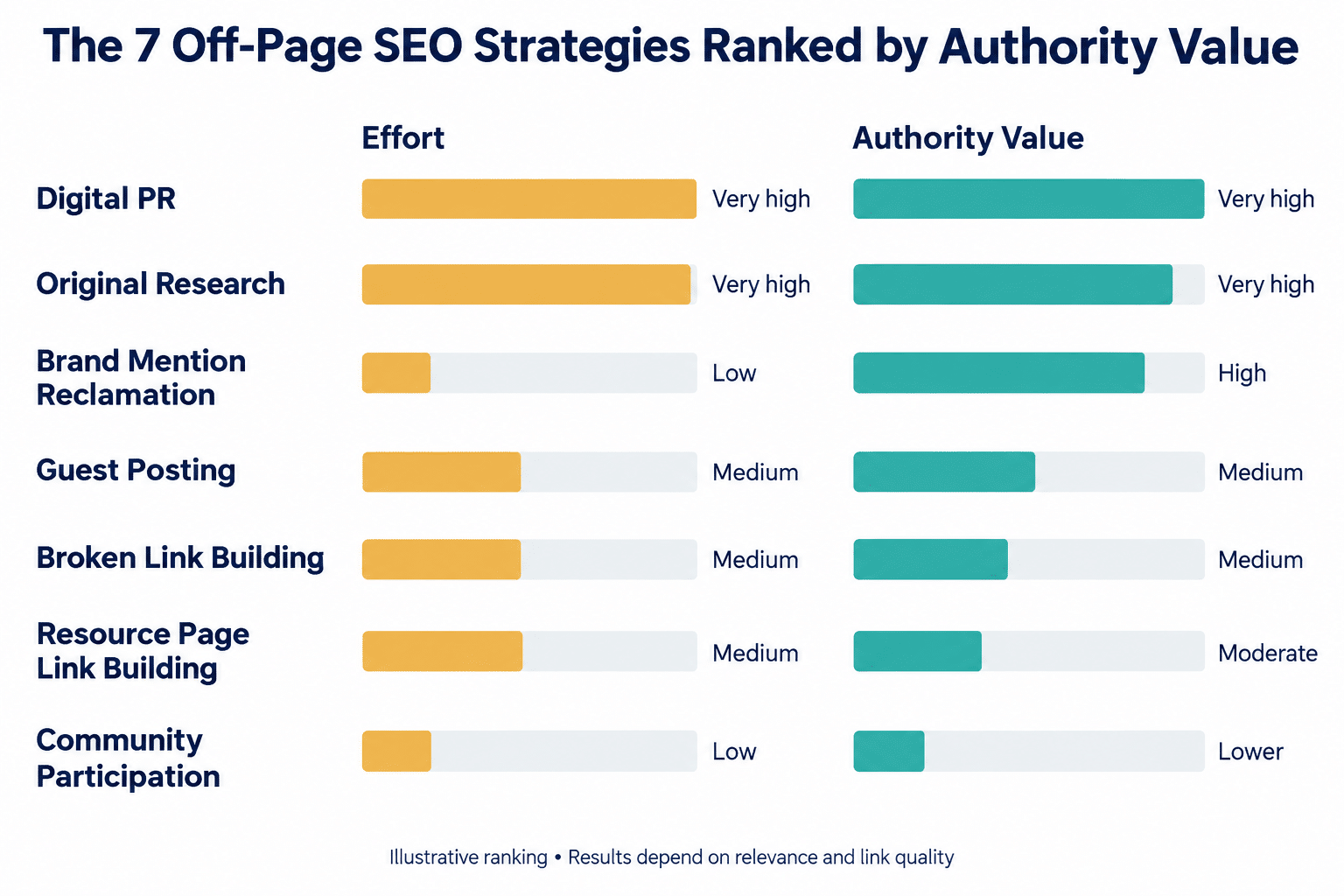
Seven strategies consistently produce the strongest off-page results across different industries and authority levels. Each differs in time investment, scalability, and the type of authority it builds.

1. Digital PR and Earned Media

Creating genuinely newsworthy content, data studies, or stories that journalists want to cover. When major publications write about your brand or cite your research, the resulting links carry enormous authority that no outreach campaign can replicate. A single link from a national news site provides more ranking benefit than dozens of guest post links combined.

2. Content-Driven Link Earning

Publishing comprehensive guides, original research, and free tools that other sites naturally want to cite. Original data studies and definitive resource guides earn the most passive links over time. Our link building guide covers the specific content formats that earn the most links in different industries.

3. Guest Posting on Relevant Publications

Writing expert articles for genuine industry publications in exchange for an author bio link. Target sites with real audiences, editorial standards, and organic traffic. Avoid guest posting networks or sites that exist solely for link exchange, these are increasingly identified by SpamBrain.

4. Broken Link Building

Finding broken outgoing links on relevant sites and offering your content as a replacement. This provides genuine value to the linking site by fixing a broken user experience while earning you an editorial placement. Use Ahrefs broken backlinks report or the Check My Links Chrome extension to find opportunities.

5. HARO and Expert Positioning

Responding to journalist queries through Connectively (formerly HARO) to earn branded mentions and backlinks from news publications and research sites. Requires consistent participation and genuinely expert responses to stand out from competing pitches.

6. Brand Mention Reclamation

Monitoring for unlinked brand mentions across the web and asking authors to convert them to clickable links. These are the fastest link acquisition wins available because the author already values your brand enough to reference it without a link.

7. Entity and Knowledge Graph Building
Establishing your brand as a named entity in Google's Knowledge Graph through Organization schema markup with sameAs links, Wikidata entries, and consistent earned media that describes your brand in the same terms across all sources. This is now essential for both traditional rankings and AI Overview citation eligibility, brands without entity recognition are systematically disadvantaged in AI-powered search.

Off-Page SEO in the AI Era, Entity Signals and AI Citation

The rise of AI-powered search has added a critical new dimension to off-page SEO. Google's AI systems and large language models like ChatGPT and Perplexity develop their understanding of brands from the full spectrum of external web presence, how consistently and authoritatively your brand is described across Wikipedia, Wikidata, industry publications, LinkedIn, and earned media. According to Search Engine Land, 73% of content appearing in Google AI Overviews comes from pages that also rank in the top 10 organic results, confirming that traditional backlink-based authority remains the prerequisite for AI citation.
Build entity signals through three parallel tracks: implement complete Organization schema with sameAs links on your website (our schema markup guide covers the exact implementation), pursue earned media coverage that consistently describes your brand using the same positioning language, and create a Wikidata entry if your brand meets the notability criteria. These entity-building actions compound over time and grow more valuable as AI-powered search continues expanding its share of total search interactions. Our AI SEO guide covers the complete AI-era authority building framework.

Measuring Off-Page SEO Performance

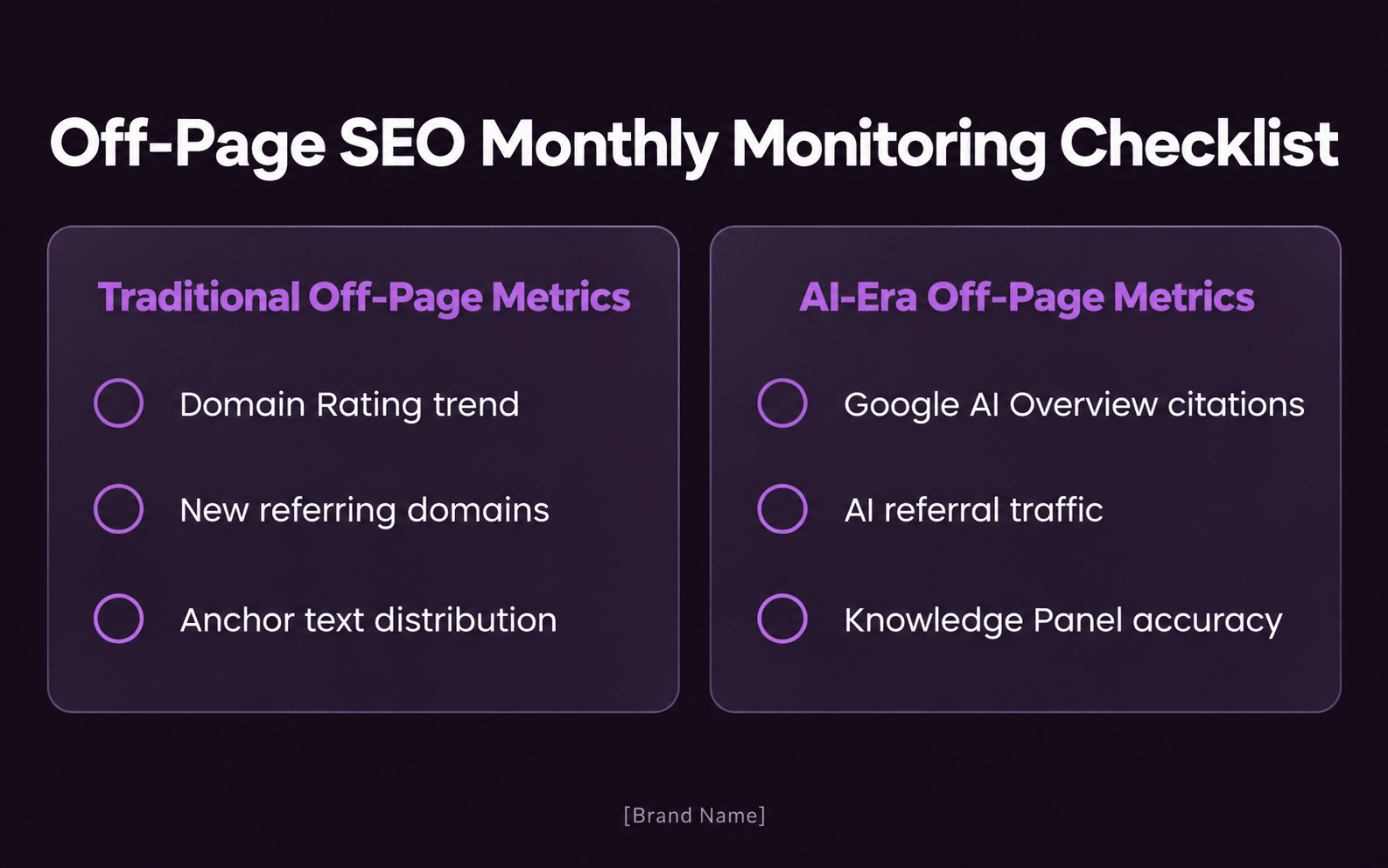
Measure off-page performance through a combination of traditional authority metrics and AI-era visibility signals monitored monthly.
MetricWhat It MeasuresToolReview Cadence
Domain Rating (DR) trendOverall domain authority growth from link acquisitionAhrefs Site ExplorerMonthly
New referring domainsNumber of unique new sites linking to your domainAhrefs Referring Domains reportMonthly
Anchor text distributionRatio of branded to commercial to generic anchorsAhrefs Anchors reportQuarterly
Google AI Overview citationsWhether your content appears in AI Overview sourcesGSC Performance, AI Overviews filterMonthly
AI referral trafficSessions from ChatGPT, Perplexity, CopilotGA4 Traffic Acquisition by sourceMonthly
Knowledge Panel accuracyWhether Google's entity model of your brand is correctManual Google search for brand nameQuarterly

Ready to Earn the Backlinks Your Competitors Have?

Our link building specialists identify the highest-value opportunities in your niche, create the content that earns them, and execute the outreach that converts opportunities into editorial links.

Start Your Link Building Programme

Frequently Asked Questions

Q.1 What is off-page SEO?

A: Off-page SEO refers to all actions taken outside your own website that influence its search engine rankings. It primarily involves earning backlinks from authoritative external websites, building brand mentions, establishing entity signals in Google's Knowledge Graph, and creating the external credibility signals that tell search engines your site is trusted and worth ranking. Off-page SEO is distinct from on-page SEO (what is on your pages) and technical SEO (your site's infrastructure).

Q2. What is the difference between on-page and off-page SEO?

A: On-page SEO covers everything you control on your own website, content quality, title tags, headings, internal links, and schema markup. Off-page SEO covers everything outside your website, backlinks from other sites, brand mentions, digital PR coverage, and entity recognition in Google's Knowledge Graph. On-page SEO establishes relevance for your target keywords. Off-page SEO builds the authority that determines whether you rank above equally relevant competitors.

Q3.How many backlinks do I need to rank?

A: There is no specific number required, what matters is whether your backlink profile is stronger and more relevant than the sites currently ranking above you. Check the referring domain count and quality of pages ranking in the top 5 for your target keyword in Ahrefs. Their profile sets your benchmark. In low-competition niches, 10 to 20 high-quality backlinks may be sufficient. In highly competitive niches, hundreds of authoritative referring domains are needed. Quality and relevance always matter more than raw count.

Q4.Are backlinks still important for SEO in 2026?

A: Yes. Despite the rise of AI-powered search and multiple algorithm updates, backlinks remain one of the strongest ranking signals. Pages with more high-quality, topically relevant backlinks consistently rank better than equivalent pages without them. The shift in 2026 is that backlink quality matters more than ever (SpamBrain makes manipulative acquisition increasingly risky), and entity signals have been added alongside backlinks as essential off-page authority indicators for AI citation selection.

Q5. What is a toxic backlink and how do I handle it?

A: A toxic backlink comes from a site signalling manipulation to Google: DR 0 to 5 sites with no real content, gambling or adult sites linking to unrelated businesses, link farms with identical outgoing link patterns, or sites generating unnatural exact-match commercial anchor concentrations. Handle toxic backlinks by requesting removal first, then submitting a Google Search Console disavow file for links that cannot be removed. Monitor your backlink profile quarterly in Ahrefs for new toxic acquisitions.

Q6. How does digital PR help with off-page SEO?

A: Digital PR earns editorial backlinks from major publications through genuinely newsworthy content. These links carry far more authority than links from typical outreach campaigns because they represent genuine editorial endorsements from high-authority domains. A single link from a national publication provides more ranking benefit than dozens of mid-tier blog links. Digital PR also builds brand awareness, drives referral traffic, and creates the brand mentions that contribute to Knowledge Graph entity recognition.

Q7. What is the fastest way to build backlinks?

A: The fastest legitimate strategies are: brand mention reclamation (finding unlinked mentions and requesting link conversion), broken link building (replacing dead links with your content), and Connectively or HARO responses (earning media citations through expert commentary). These work because you provide genuine value to the other party. Speed must never compromise quality, high volumes of low-quality links acquired quickly produce worse long-term outcomes than gradual high-quality acquisition.

Build the Brand Authority That Both Google and AI Systems Trust

At Futuristic Marketing Services, we build off-page authority across editorial backlinks, brand entity signals, and E-E-A-T establishment, creating the external credibility that dominates both traditional and AI-era search.

Talk to an Off-Page SEO Specialist

Conclusion

Off-page SEO is the external validation layer that transforms on-page relevance into ranking authority. Without strong off-page signals, quality backlinks, entity recognition, brand credibility, even excellent on-page content struggles to outrank established competitors in competitive niches. The most durable off-page programmes are built on genuine value: content worth linking to, brands worth mentioning, and expertise worth citing.
Start with the strategies most appropriate for your current authority level (broken link building and brand mention reclamation for new sites; digital PR and original research for established ones), and measure both traditional metrics (DR, referring domains) and AI-era signals (AIO citations, AI referral traffic) monthly. Our link building guide provides the detailed tactical execution for every strategy covered in this guide.
Share this post :
Picture of Devyansh Tripathi
Devyansh Tripathi

Devyansh Tripathi is a digital marketing strategist with over 5 years of hands-on experience in helping brands achieve growth through tailored, data-driven marketing solutions. With a deep understanding of SEO, content strategy, and social media dynamics, Devyansh specializes in creating results-oriented campaigns that drive both brand awareness and conversion.

All Posts