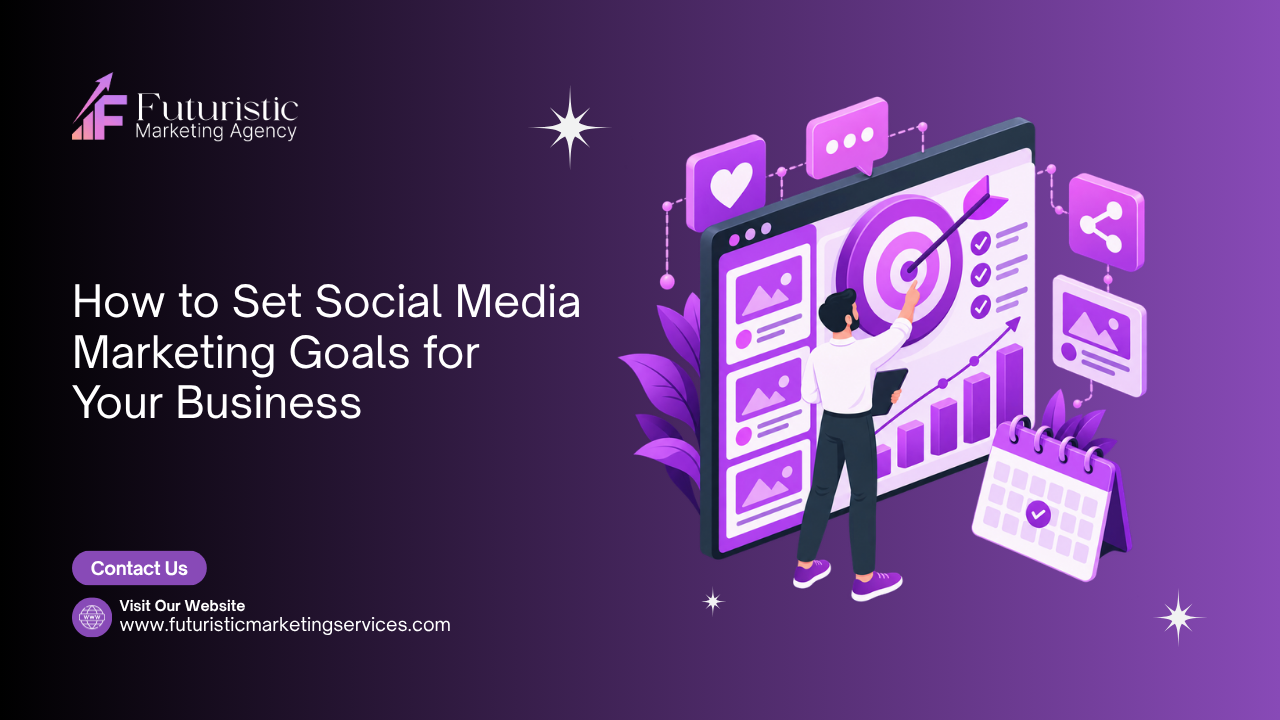
How to Set Social Media Marketing Goals for Your Business

social media marketing goals

<!– ═══ INTRODUCTION: PART 1, DIRECT ANSWER (55 words) ═══ –>

Social media marketing goals are specific, measurable objectives that define what your business wants to achieve through its social media activity and within what timeframe. Setting them using the SMART framework, Specific, Measurable, Achievable, Relevant, and Time-bound, connects every post, campaign, and paid advertisement to a business outcome rather than allowing activity to continue without a clear standard of success or failure.


<!– ═══ INTRODUCTION: PART 2, ARTICLE SUMMARY (105 words) ═══ –>

This guide explains how to set social media marketing goals that produce real business results, covering the seven most important goal types every business should understand, how to apply the SMART framework to each one, which key performance indicators correspond to which goals, and how to avoid the vanity metrics that mislead most businesses into thinking their social media is working when it is not. You will also find a complete goal-setting framework, worked examples for businesses of different sizes, a goal-to-KPI mapping table, and a review cadence that keeps your goals connected to performance data throughout the campaign period.

Key Takeaways

  • Social media marketing goals must connect to a specific business outcome, brand awareness, lead generation, website traffic, community building, customer retention, thought leadership, or revenue, not just platform activity.
  • The SMART framework transforms vague intentions such as "grow our following" into specific, trackable objectives tied to a defined timeline and measurable outcome.
  • According to Sprout Social, the top business priorities for social media are building brand reputation (66%), understanding customers better (65%), and improving competitive positioning (63%).
  • Each goal type has a corresponding set of KPIs. Tracking the wrong metrics for a given goal produces misleading data that leads to poor decisions.
  • Focus on a maximum of three goals per quarter. Attempting too many simultaneously dilutes effort and prevents any single goal from receiving sufficient resource and attention.
  • Goals must be reviewed monthly and formally assessed quarterly to determine whether the strategy is on track or requires adjustment.
  • According to the Sprout Social ROI Report, 65% of business leaders now want to see direct, data-backed connections between social media campaigns and specific business goals.

Not Sure Which Goals Are Right for Your Business?

Let Our Team Define Your Social Media Goals and Build Your Strategy

Futuristic Marketing Services works with businesses across India to identify the right goals, select the matching KPIs, and build complete social media strategies designed to produce measurable, reportable results.

Get a Free Goals Consultation

Why Setting Social Media Marketing Goals Matters for Every Business

 Social media marketing without defined goals produces activity, not results. Businesses that post consistently without documented objectives spend time and money on content that may be generating followers or likes while producing no measurable impact on revenue, lead volume, or brand recognition. The absence of goals is the most common reason social media investments fail to justify their cost.

 Research published by The Small Business Expo found that 50% of businesses admit to operating without a formal social media strategy. That figure includes the majority of small and medium businesses that are present on social media but have never defined what they are trying to achieve beyond maintaining a presence. Without goals, there is no benchmark for success, no framework for deciding which content to create, and no data to inform where resources should be redirected when results are weak.
The business case for goal-setting extends beyond marketing. According to the Sprout Social ROI Report, 65% of business leaders want to see direct, data-backed connections between social media campaigns and specific business goals, and 52% want quantifiable evidence of cost savings delivered through social channels. Leaders at every level are increasingly demanding that social media justify its budget with business outcomes rather than platform-level metrics. Clear goals are what make that justification possible.
Understanding what social media marketing is and what it can achieve for your business is the essential starting point before setting goals. Our guide on what is social media marketing covers the full definition, types, and business applications that inform which goal types are most relevant to your specific situation.

The SMART Framework for Social Media Marketing Goals

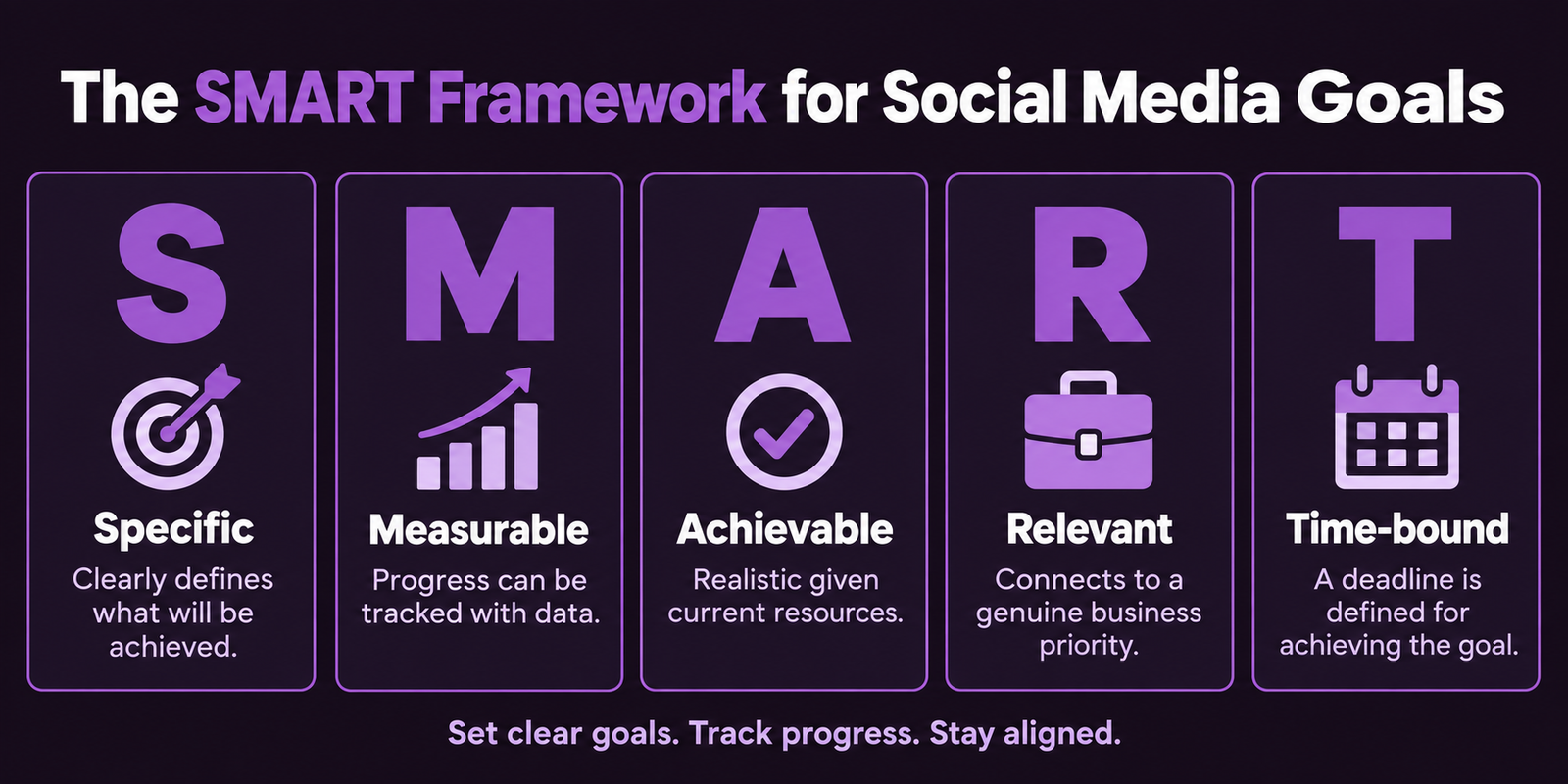
 The SMART framework is the most reliable method for setting social media goals that can be tracked, reported, and improved over time. Each element of SMART removes a specific type of vagueness that typically causes goals to fail, either because they cannot be measured, because they are not realistically achievable with available resources, or because they are not connected to a meaningful business outcome.

 Every social media marketing goal your business sets should pass all five SMART criteria before it is finalized. A goal that fails any single criterion will produce unreliable data, unclear accountability, or missed expectations that damage confidence in the social media investment. Working through each SMART component in sequence forces the strategic thinking that separates high-performing social media teams from those that stay permanently busy without producing measurable growth.

Specific: Define Exactly What You Want to Achieve

A specific social media goal names the exact outcome you are working toward, on which platform, and through which type of activity. Vague goals such as "improve our social media presence" or "post more content" cannot be tracked because they offer no clear definition of what success looks like. A specific goal removes all ambiguity by stating the platform, the metric, and the direction of change.
The test for specificity is whether two different members of your team would independently understand the goal in exactly the same way. If your goal can be interpreted in multiple ways, it is not yet specific enough. Rewrite it until there is only one possible interpretation of what you are trying to achieve and how you will achieve it.

Measurable: Attach a Number to Your Goal

A measurable goal includes a specific number or percentage that defines the target. Without a number, you can never determine whether the goal has been reached or how close you are to reaching it. Measurable goals also make it possible to track progress during the campaign rather than waiting until the end to assess whether the effort was worthwhile.
Every social media platform provides native analytics data that can be used to track measurable goals, including reach, follower count, engagement rate, click-through rate, and video views. Third-party tools such as Google Analytics track the downstream impact of social activity on website traffic, lead form submissions, and revenue attribution. Measurability requires that you identify, before the goal period begins, exactly which tool you will use to track the number and how frequently you will review it.

Achievable: Ground the Goal in Current Reality

An achievable goal is ambitious enough to require focused effort but realistic enough to be reached with the resources your business currently has or plans to commit. Goals that are set too high result in demoralization and eventual abandonment. Goals that are set too low produce no meaningful improvement and fail to justify the investment in tracking and reporting them.
Achievability is assessed against your current baseline performance, your available budget, your team capacity, and the realistic growth rates typical for your industry and platform. If your Instagram account currently averages 200 organic reach per post, setting a target of 50,000 reach within 30 days through organic activity alone is not achievable. Setting a target of 800 to 1,200 organic reach per post within 90 days through consistent Reels publishing is both ambitious and grounded in what organic growth rates typically look like for accounts at that starting point.

Relevant: Connect Every Goal to a Real Business Priority

A relevant social media goal connects directly to a broader business priority that matters to the organization beyond marketing metrics. If your business's primary growth objective for the quarter is generating new client enquiries, a relevant social media goal focuses on driving enquiries through social channels rather than growing followers on a platform that is not used by your target buyer. Platform metrics that do not connect to a business priority are vanity metrics regardless of how impressive the numbers appear.
Relevance is tested by asking a simple question for every proposed goal: if this goal is achieved, which specific business outcome does it advance? If the answer is unclear or requires several steps of indirect logic to arrive at, the goal is either not relevant to current priorities or needs to be restated in terms that connect more directly to the business outcome it is designed to support.

Time-Bound: Set a Deadline for Every Goal

A time-bound goal has a specific end date by which the target will be assessed. Without a deadline, goals drift indefinitely with no urgency and no accountability. Deadlines create the structure that makes regular progress reviews meaningful and that gives the team a clear point at which to assess whether the strategy has succeeded, needs adjustment, or requires a fundamentally different approach.
Most social media marketing goals work best within 30-day, 60-day, or 90-day timeframes. Short-term goals allow for rapid learning and adjustment. Longer-term goals, such as six-month or annual objectives, are appropriate for brand awareness and thought leadership goals where compounding activity over time produces the result rather than a single campaign or content push.

Social Media Marketing Goals Every Business Should Know
Social media marketing can advance seven distinct categories of business outcomes. Most effective strategies focus on two or three of these goal types at any one time, with the selection driven by where the business is in its growth cycle, which business challenges are most pressing, and what resources are available to commit to achieving them. Understanding all seven categories helps you select the combination most relevant to your specific situation before writing your SMART goals.
According to Sprout Social's research, the three most common business priorities that social media goals are designed to advance are building brand reputation (cited by 66% of business leaders), understanding customers more deeply (65%), and improving competitive positioning (63%). All three can be pursued simultaneously through a well-structured goal framework, but they require different content approaches, different platforms, and different KPIs to measure effectively.

Goal 1: Build Brand Awareness

Brand awareness goals focus on increasing the number of people who know your business exists, what it does, and what it stands for. This is the broadest category of social media goal and the one that requires the most patience because results accumulate gradually through consistent content activity rather than producing immediate, easily attributable outcomes.
Brand awareness is the correct primary goal for businesses launching on social media for the first time, entering a new market, or introducing a new product or service to an existing audience that may not yet associate the brand with that offering. It is also an ongoing secondary goal for established businesses because Sprout Social data shows that 5.66 billion people now use social media globally, and new potential customers enter those platforms every day who have never encountered your brand before.
The primary KPIs for brand awareness goals are reach (the number of unique users who see your content), impressions (total times your content is displayed), follower growth rate, share of voice relative to competitors, and branded search volume trends measured through Google Search Console or Google Trends. Social media platforms reward consistent, quality publishing with expanding reach over time, which is why the strategy for brand awareness goals is volume combined with quality rather than paid amplification alone.

Goal 2: Generate Leads and Enquiries

Lead generation goals connect social media activity directly to the business development pipeline. They are appropriate for service businesses, B2B companies, professional services firms, and any business where the path from awareness to sale requires the prospect to make direct contact before a transaction occurs. Lead generation goals are typically the highest-priority goal type for businesses that need to justify social media investment with revenue-connected outcomes.
Achieving lead generation goals through social media requires content that moves the audience from passive consumption toward taking a specific action, such as clicking through to a contact page, submitting a form, sending a direct message, or booking a consultation. Our social media advertising services combine paid lead generation campaigns with organic content designed to warm audiences before they see the paid offer, which significantly reduces cost per lead compared to cold advertising alone.
The primary KPIs for lead generation goals are click-through rate on posts and paid ads, website sessions attributed to social media referral traffic, lead form submission volume, cost per lead for paid campaigns, and the conversion rate of social media leads into paying customers tracked through CRM data.

Goal 3: Drive Website Traffic

Website traffic goals treat social media as a referral channel that consistently sends qualified visitors to specific pages on your website. This goal type is particularly valuable for businesses that convert visitors through their website, including e-commerce stores, businesses with detailed service pages, and content-driven businesses that use blog articles or resources to demonstrate expertise before a sale.
Social media platforms present a deliberate challenge for this goal because most algorithms are designed to minimize link clicks that take users off the platform. Overcoming this requires strategic placement of links in content, effective use of link-in-bio tools on Instagram, Story swipe-up features, and paid traffic campaigns that are specifically designed to drive clicks rather than in-platform engagement. Combining SEO and social media marketing services creates a compounding effect where social content drives traffic to pages that are simultaneously optimized to rank on Google, maximizing the return from both channels.
The primary KPIs for website traffic goals are monthly social media referral sessions in Google Analytics, pages per session for social visitors, bounce rate of traffic from social sources, and goal completions (purchases, enquiries, sign-ups) attributed to social referral traffic using UTM parameters on every shared link.

Goal 4: Build Community and Increase Engagement

Community building goals focus on deepening the relationship between the brand and its existing audience rather than primarily reaching new people. This goal type is the correct priority for businesses that have already established a social media presence but want to improve the quality of their audience relationships, increase the frequency of meaningful interactions, and build the kind of loyalty that generates referrals and repeat purchases.
Engagement is not just a vanity metric when it is connected to a community-building goal. Research from Synup shows that 65% of customers who receive a response to their comment or direct message on social media would recommend that brand to others. The act of responding, engaging, and acknowledging the audience directly produces word-of-mouth referrals that have measurable business value beyond the platform activity itself.
The primary KPIs for community building goals are average engagement rate per post (likes, comments, shares, and saves as a percentage of reach), comment volume and quality, response rate and response time on comments and messages, and the growth rate of active community participants such as Facebook Group members or LinkedIn followers who regularly interact with content rather than simply seeing it.
Our social media management services include active community management as a core component, ensuring that every comment and message receives a timely, professional response that builds the audience relationship rather than allowing interactions to go unacknowledged.

Goal 5: Support Customer Retention and Loyalty

Customer retention goals use social media as a channel for maintaining ongoing relationships with existing customers rather than focusing exclusively on acquisition. This goal type is most relevant for businesses with repeat purchase cycles, subscription models, service retainers, or any model where the lifetime value of a retained customer significantly exceeds the value of a single transaction
Social media supports retention by giving existing customers a reason to remain engaged with the brand between purchases, by providing fast and accessible customer service through social channels, and by making customers feel like part of a community rather than simply a transaction. Behind-the-scenes content, exclusive announcements for followers, early access to new products or services, and direct acknowledgment of loyal customers through social media all contribute to reducing churn and increasing the frequency of repeat engagement.
The primary KPIs for retention goals are customer satisfaction scores gathered through social listening tools, average response time to customer service enquiries received through social channels, sentiment analysis scores for brand mentions, and the repeat purchase rate of customers who are active social media followers compared to those who are not.

Goal 6: Establish Thought Leadership

Thought leadership goals position the business or its founders as recognized experts within a specific industry or topic area. This goal type delivers its strongest results on LinkedIn for B2B businesses and on YouTube or Instagram for consumer-facing businesses. Thought leadership content builds the trust and authority that makes an audience choose your business when they are ready to buy, rather than researching competitors who have been less visible and less educational throughout the consideration period.
Achieving thought leadership on social media requires consistent publication of original perspectives, informed commentary on industry developments, educational content that demonstrates genuine expertise, and visible engagement with other recognized voices in the field. It is a long-form goal that compounds in value over months and years as a body of content builds, rather than delivering immediate measurable returns that justify short-term budget allocation.
The primary KPIs for thought leadership goals are profile views and follower growth among target audience segments on LinkedIn, article or video views and saves on published educational content, media mentions or collaboration invitations generated through social visibility, and the volume of inbound enquiries that reference specific pieces of content as the reason for making contact.

Goal 7: Increase Sales and Revenue Directly

Direct revenue goals connect social media activity to product or service sales with measurable attribution. This goal type is most immediately applicable to e-commerce businesses using social commerce features on Instagram Shop, Facebook Marketplace, and similar tools, but it also applies to any business running paid social advertising campaigns with clear conversion tracking and cost per acquisition targets.
Direct revenue goals require the most sophisticated tracking setup because the attribution path from social media content to completed sale often involves multiple touchpoints across several days or weeks. Using UTM parameters on all links, setting up conversion events in Google Analytics and platform-specific pixels such as the Meta Pixel, and establishing clear attribution windows before the campaign begins are all necessary prerequisites for accurately reporting against a revenue goal.
The primary KPIs for direct revenue goals are social commerce sales volume, revenue attributed to social media traffic using multi-touch attribution in Google Analytics, return on ad spend for paid campaigns, cost per acquisition, and the average order value of customers acquired through social media channels compared to other acquisition sources.

Social Media Marketing Goals and Their Corresponding KPIs
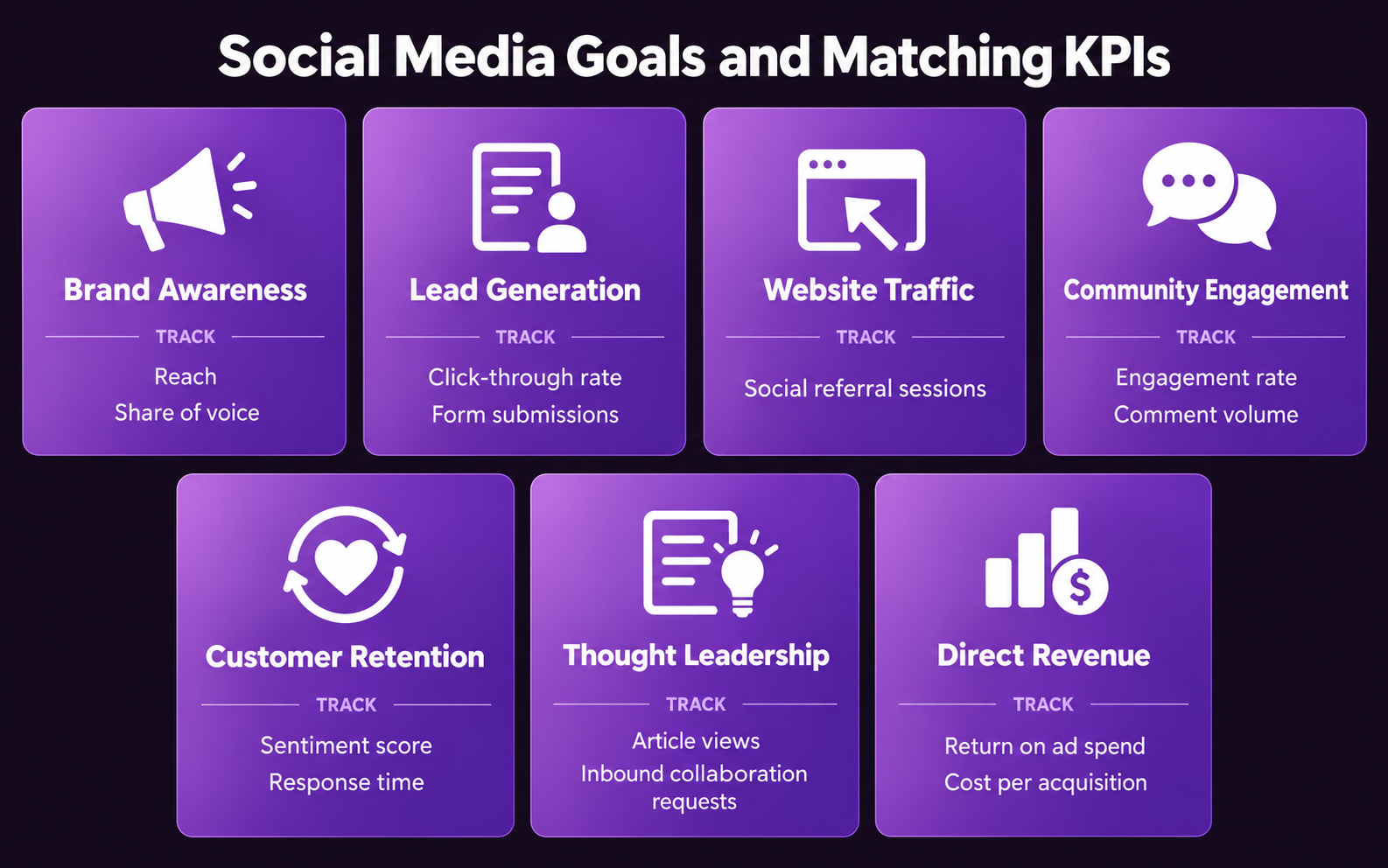
One of the most common and costly mistakes in social media goal-setting is tracking the wrong metrics for a given goal. A business focused on lead generation that tracks follower count as its primary success metric is measuring activity that has no direct relationship to the outcome it is trying to achieve. Matching the right KPIs to each goal type is what makes your measurement framework actionable rather than decorative.
Goal Type Primary KPIs to Track Vanity Metrics to Avoid Review Frequency
Brand Awareness Reach, impressions, follower growth rate, share of voice, branded search volume Total likes, total follower count without growth context Monthly trend review, quarterly goal assessment
Lead Generation Click-through rate, social referral sessions, lead form submissions, cost per lead, lead-to-customer conversion rate Comments, saves, and shares unless directly correlated to enquiry volume Weekly for paid campaigns, monthly for organic
Website Traffic Social referral sessions in Google Analytics, pages per session, bounce rate, goal completions via UTM tracking In-platform link clicks that do not match GA4 referral traffic data Weekly traffic review, monthly conversion analysis
Community and Engagement Engagement rate by reach, comment volume and quality, response rate, direct message volume, active community member count Total likes as a standalone metric without engagement rate context Weekly post-level review, monthly account-level review
Customer Retention Social customer service response time, brand sentiment score, repeat purchase rate of social followers, churn rate comparison New follower count, reach from non-existing audience Monthly sentiment review, quarterly retention data review
Thought Leadership Profile views from target audience, article or video saves and shares, inbound collaboration requests, content-attributed enquiries Generic impressions from outside target audience segment Monthly content performance review, quarterly influence assessment
Direct Sales and Revenue Revenue attributed to social via GA4, return on ad spend, cost per acquisition, average order value of social-acquired customers Click volume without conversion data, reach without revenue attribution Weekly for paid campaigns, monthly for organic attribution

How to Write SMART Social Media Marketing Goals: Worked Examples

Writing SMART social media goals for the first time is significantly easier when you have worked examples to reference for your specific business context. The following examples demonstrate how to convert a common but vague social media intention into a fully formed SMART goal with a corresponding KPI and tracking method. Use these as templates and replace the numbers and timeframes with figures appropriate to your current baseline and resource level.
Goal Type Vague Version SMART Version Tracking Method
Brand Awareness "Get more people to know about our brand" Increase average post reach on Instagram from 1,200 to 4,000 within 90 days by publishing 4 Reels per week and 3 carousel posts per week Instagram Insights: average reach per post, reviewed weekly
Lead Generation "Use social media to get more clients" Generate 25 qualified enquiries per month from LinkedIn through 3 educational posts per week and a lead magnet shared in the link-in-bio, achieved within 60 days Google Analytics goal completions with LinkedIn UTM, CRM lead source tagging
Website Traffic "Send more people to our website from social" Increase monthly website sessions from social referral from 320 to 900 within 90 days through link-in-bio optimization, Story links, and weekly blog promotion posts Google Analytics 4 acquisition report filtered by social referral, reviewed monthly
Engagement "Improve engagement on our posts" Increase average engagement rate by reach on Instagram from 1.4% to 3.2% within 60 days by responding to all comments within 2 hours and publishing 2 question-led posts per week Instagram Insights engagement rate per post, calculated weekly average
Thought Leadership "Become known as an expert in our field" Publish 3 long-form LinkedIn articles per month and achieve an average of 500 article views per piece within 90 days, targeting a LinkedIn newsletter subscriber base of 300 within 6 months LinkedIn Creator analytics: article views, newsletter subscribers, profile visit growth
Direct Revenue "Make more sales through social media" Achieve INR 1,50,000 in monthly revenue directly attributed to social media traffic and paid campaigns within 90 days, maintaining a minimum return on ad spend of 3x across Meta campaigns GA4 revenue attribution by channel, Meta Ads Manager ROAS report reviewed weekly

A Step-by-Step Process for Setting Your Social Media Marketing Goals
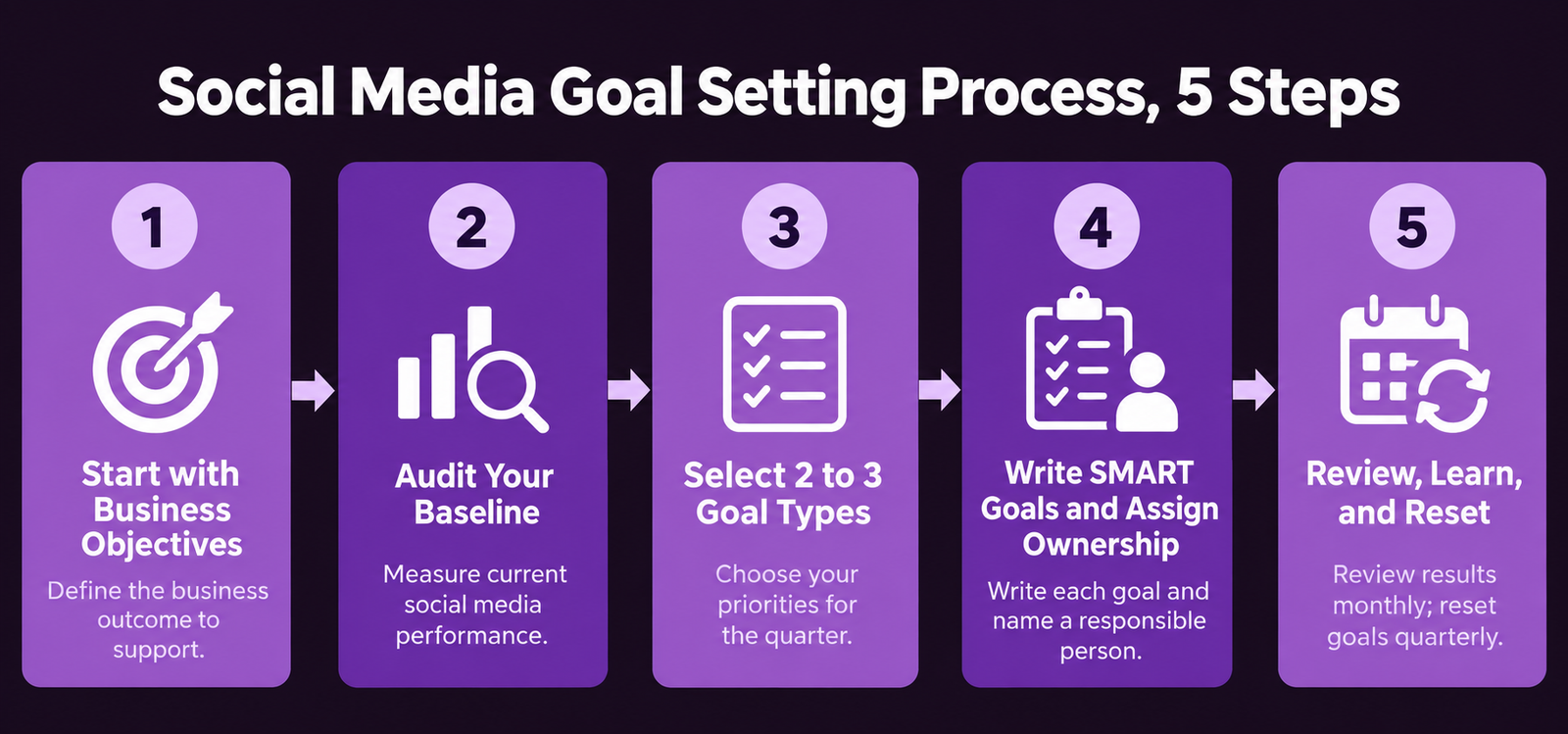
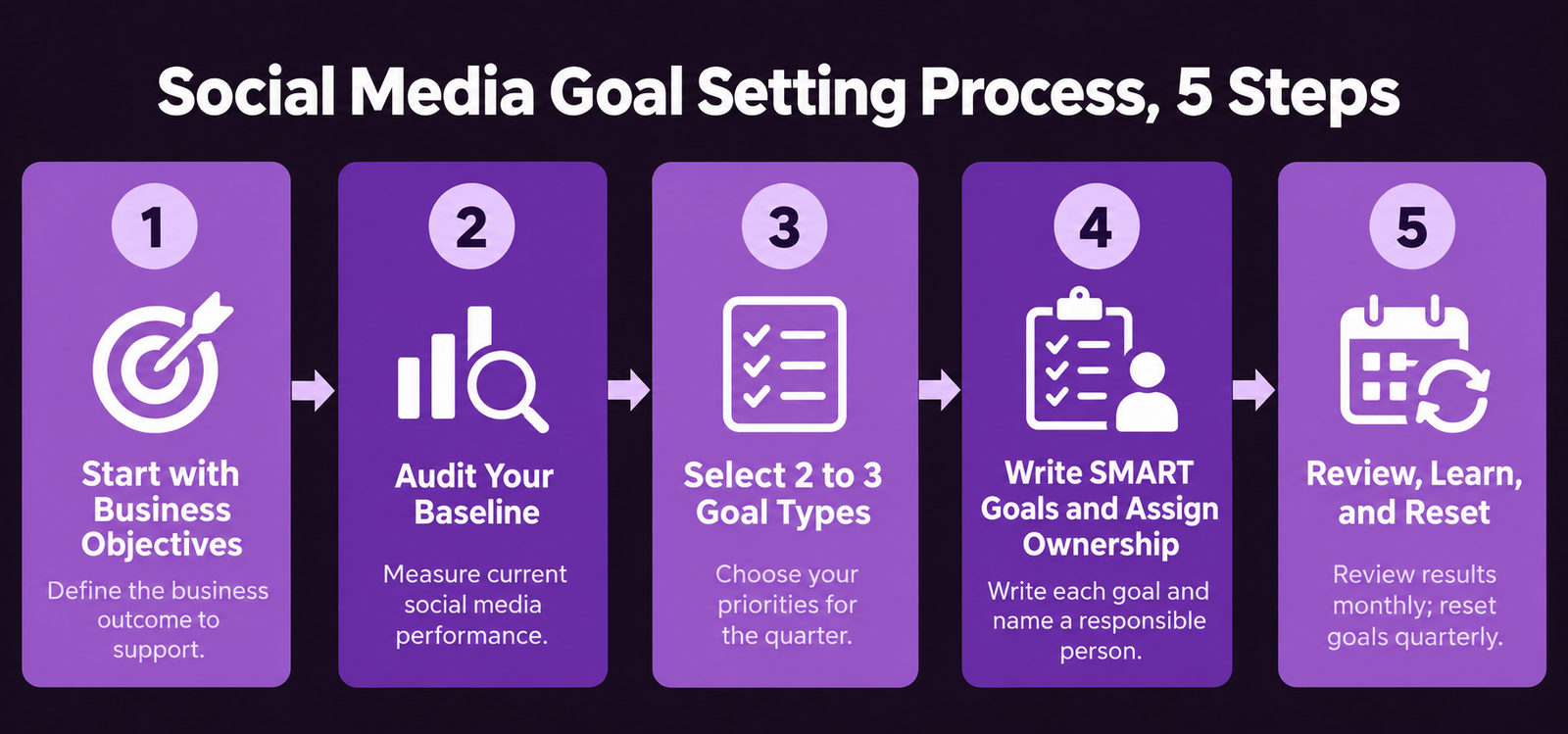
Setting social media marketing goals is a structured process that should be completed before any content is planned or any advertising budget is allocated. The sequence matters because each step informs the next, and jumping to goal-writing before completing the earlier steps typically produces goals that are not grounded in realistic baseline data or aligned with genuine business priorities.

Step 1: Start with Your Business Objectives

Every social media marketing goal must trace back to a specific business objective. Begin by identifying the two or three most important things your business needs to achieve in the next 90 days. These might include growing revenue by a specific amount, increasing the number of new client enquiries per month, launching a new service to an existing audience, or improving customer satisfaction scores. Social media goals that connect to these business objectives have organizational support, clear justification for their budget, and a natural path to measuring their contribution to business outcomes.
If your business objective is growing monthly revenue, the corresponding social media goals will focus on lead generation, direct sales, or paid advertising performance. If your business objective is improving brand credibility in a new market, the corresponding social media goals will focus on thought leadership content, reach among new audience segments, and share of voice relative to established competitors in that market. The business objective sets the direction; the social media goal defines the route.

Step 2: Audit Your Current Social Media Baseline

Before writing any goals, document the current performance baseline across every active platform. This means recording current follower counts, average post reach, average engagement rate, website sessions from social referral, and any other metrics relevant to the goal types you are considering. Goals that are written without baseline data are guesses rather than plans, and they typically land somewhere between too ambitious to be achievable and too conservative to justify the investment in tracking them.
The baseline audit also reveals which platforms are already producing the strongest results, which content types your existing audience responds to most actively, and what growth rates your accounts have achieved organically over the past 90 days. These data points directly inform the achievability assessment in the SMART framework and prevent the common error of setting targets that bear no relationship to the growth trajectory your account has actually demonstrated.

Step 3: Select Two to Three Goal Types for the Quarter

Once you have identified your business objectives and documented your baseline, select the two or three goal types from the seven categories covered earlier that most directly connect to your current business priorities. The constraint of two to three goals is important. More than three goals simultaneously creates a situation where no single goal receives sufficient resource, attention, or content focus to be achieved well.
For most businesses starting out with a focused social media presence, the recommended combination is one brand awareness goal to build reach and recognition, paired with one lead generation goal to connect that awareness to business enquiries. As the strategy matures and baseline metrics improve, additional goal types can be introduced in subsequent quarters when the foundational reach and engagement infrastructure is in place to support more sophisticated objectives.

Step 4: Write Your SMART Goals and Assign Ownership

Write each goal in full using the SMART criteria, then assign a specific person or team responsibility for achieving it. Every goal must have one owner who is accountable for tracking progress, reporting results at the agreed review intervals, and escalating problems when the strategy is not on track to meet the target within the defined timeframe.
Document each SMART goal in a shared location that the full team can access, including the goal statement, the specific KPIs that will be tracked, the tools and data sources used for tracking, the owner's name, and the review dates for monthly progress checks and the quarterly final assessment. This documentation converts goals from intentions into formal commitments that have accountability and visibility within the organization.

Step 5: Review, Learn, and Reset

Social media marketing goals are not set-and-forgotten. Monthly reviews assess whether the strategy is on track and identify which specific content types, platforms, or posting schedules are advancing the goal most effectively and which are underperforming relative to expectations. These reviews produce the data-driven adjustments that compound improvement over time and prevent six months of effort being wasted on an approach that showed early warning signs of underperformance that went unaddressed.
Quarterly goal resets are the opportunity to formally assess whether each SMART goal was achieved, by how much it was exceeded or missed, and what the primary contributing factors were in either direction. This review informs the goal-setting process for the next quarter, giving you progressively more accurate baseline data, more realistic targets, and a clearer understanding of what content strategy and resource allocation actually produces results for your specific business and audience. Our social media consulting services include structured quarterly reviews that turn performance data into specific, actionable recommendations for the next goal period.

Common Mistakes When Setting Social Media Marketing Goals

Even businesses that understand the SMART framework in theory make predictable mistakes when applying it in practice. Recognizing these errors before you begin your goal-setting process helps you avoid the most common reasons social media goals fail to produce the business outcomes they were designed to advance.
Setting follower count as a primary goal is the most widespread mistake in social media marketing. Total followers is a vanity metric because it tells you nothing about the quality of your audience, how many of those followers are potential customers, or whether your content is advancing any business objective. Businesses with 50,000 followers and no engagement strategy consistently generate fewer leads than businesses with 5,000 highly targeted, actively engaged followers who regularly interact with content and click through to enquiry pages. Replace follower count goals with engagement rate goals and audience quality metrics that connect to business outcomes.
Tracking too many metrics is a related problem that creates data overload without producing actionable insights. Monitoring 20 or more metrics simultaneously means that no single metric receives the focused attention required to understand what is driving changes in its value and what interventions would improve it. The research from XPOZ AI confirms that only four to six KPIs actually correlate with revenue growth for most businesses, yet the average social media dashboard displays more than 20 data points. Select the three to five metrics that correspond directly to your chosen goal types and focus all reporting and optimization effort on those figures.
Setting goals in isolation from the broader social media marketing strategy is a structural error that produces goals that cannot be connected to specific content activities or resource allocations. A goal without a strategy is a target without a plan. Always set goals within the context of a documented strategy that specifies which content types, platforms, posting frequencies, and engagement activities are the planned vehicles for achieving each specific goal.

Goals Set. Now You Need the Right Execution Partner.

We Manage Your Social Media Strategy from Goals to Results

From setting the right goals and selecting the matching KPIs, through content creation, community management, paid advertising, and monthly performance reporting, Futuristic Marketing Services manages the complete system so you can focus on running your business.

Get a Free Strategy Call

Frequently Asked Questions About Social Media Marketing Goals

What are social media marketing goals?

Social media marketing goals are specific, measurable objectives that define what a business wants to achieve through its activity on social platforms within a defined timeframe. They connect social media activity to business outcomes such as brand awareness, lead generation, website traffic, community building, customer retention, thought leadership, or direct revenue. Goals provide the standard against which every content decision, platform choice, and resource allocation is evaluated and justified to business leadership.

How do you set SMART goals for social media marketing?

Set SMART social media goals by ensuring each goal is Specific about the platform and metric, Measurable with a defined number or percentage target, Achievable given your current baseline and available resources, Relevant to a specific business priority, and Time-bound with a defined deadline for assessment. For example, instead of "grow our Instagram following," write "increase Instagram followers from 1,500 to 3,500 within 90 days by publishing 4 Reels per week and responding to all comments within 2 hours." This version passes all five SMART criteria and can be tracked and reported without ambiguity.

How many social media goals should a business set at once?

A maximum of two to three social media marketing goals per quarter is the recommended limit for most businesses. Attempting to achieve more than three goals simultaneously dilutes resource across too many objectives and typically results in none being achieved well. For businesses starting out, beginning with one brand awareness goal and one lead generation goal gives a focused starting combination that produces the foundational reach and engagement infrastructure needed to support more sophisticated objectives in future quarters.

What is the difference between a social media goal and a KPI?

A social media goal is the outcome your business wants to achieve, such as generating 30 qualified leads per month from LinkedIn. A KPI (Key Performance Indicator) is the specific metric you track to measure progress toward that goal, such as click-through rate on posts, website sessions from LinkedIn referral traffic, and lead form submissions attributed to LinkedIn. The goal defines the destination; the KPI is the compass that shows whether you are moving in the right direction. Every goal needs at least two or three corresponding KPIs to track effectively.

What social media goals should a small business prioritize?

Small businesses typically achieve the best initial results by prioritizing brand awareness goals to build recognition within their target market, followed by lead generation goals that connect that awareness to direct enquiries or sales. These two goal types in combination produce the clearest path from social media investment to measurable business outcome without requiring the sophisticated attribution infrastructure that direct revenue goals need to track accurately. As the social media presence grows and baseline metrics improve, community building and thought leadership goals become valuable additions to the strategy.

How long should a social media marketing goal run before being assessed?

Most social media marketing goals perform best within 60 to 90-day assessment windows. This timeframe is long enough for organic content strategies to accumulate sufficient data for meaningful trend analysis, while short enough to allow course corrections before significant resources are wasted on an approach that is clearly underperforming. Paid social advertising campaigns can be assessed in shorter windows of two to four weeks because campaign data accumulates much faster than organic activity. Set monthly progress check-ins within the goal period rather than waiting until the end to discover whether you are on track.

What is a vanity metric in social media marketing?

A vanity metric is a social media measurement that looks impressive in isolation but does not connect to any meaningful business outcome. Total follower count, total likes received, and total impressions are common vanity metrics when tracked without context. A follower count of 50,000 is a vanity metric if those followers never engage with content, visit the website, or become customers. The same follower count becomes a meaningful metric when tracked alongside engagement rate, referral traffic, and lead volume to demonstrate that the audience quality connects to business outcomes, not just platform scale.

Can social media marketing goals change during a campaign period?

Goals should not be changed mid-quarter without a significant, documented reason such as a major shift in business priorities or the emergence of clear evidence that the original goal was set with fundamentally incorrect baseline assumptions. Changing goals frequently in response to short-term performance fluctuations prevents the accumulation of long-term trend data and creates a moving target that cannot be meaningfully reported against. Monthly check-ins can trigger adjustments to tactics, content mix, or posting frequency within the same goal framework. The goal itself should remain fixed until the formal quarterly review.

How does audience size affect which social media goals are realistic?

Audience size directly affects the achievability component of SMART goal-setting. Accounts with smaller followings should set lead generation, engagement, and conversion goals with numbers that reflect realistic performance from their actual reach rather than aspirational figures based on what larger accounts achieve. An account with 800 followers that generates consistent 3% to 4% engagement rate and 20 website clicks per post is performing strongly for its size. Setting a goal of 5,000 monthly website clicks from social for that same account in 30 days without a paid advertising budget is not achievable and will undermine confidence in goal-setting as a practice when it is inevitably missed.

Should social media goals be different for each platform?

Social media goals are best set at the business level with platform-specific KPIs rather than creating entirely separate goal frameworks for each platform. Your primary business goal, such as generating 30 leads per month, applies across all channels. However, the specific KPIs you track to measure progress toward that goal will differ by platform. On LinkedIn you track connection request acceptance rates, post click-throughs, and direct message enquiries. On Instagram you track link-in-bio clicks, Story swipe-ups, and DM enquiries. Platform-specific KPIs give granular data on where each channel is contributing while keeping the overarching business goal clear and consistent.

How do you prove social media marketing ROI to business leadership?

Proving social media ROI requires connecting platform activity data to business outcomes through a clear attribution system established before campaigns begin. Use UTM parameters on every link shared through social channels to trace website sessions and conversions back to specific posts or platforms in Google Analytics. Track lead source data in your CRM so that every enquiry and sale can be attributed to the channel that generated it. Present leadership with data that shows the direct path from social media investment to leads generated and revenue attributed, supported by cost per lead and return on ad spend figures for paid campaigns. The Sprout Social ROI Report confirms that 65% of business leaders specifically want this type of direct attribution data rather than platform-level engagement summaries.

How do brand awareness goals connect to revenue over time?

Brand awareness goals connect to revenue through a compound process that unfolds over months rather than immediately. As reach and recognition increase, a larger pool of potential customers becomes familiar with the brand before they have a specific purchase need. When a need emerges, the business that is already known through consistent social media presence is significantly more likely to be contacted first or considered alongside fewer competitors than a brand that the prospect has never encountered. This is why brand awareness goals require the longest timeframe to demonstrate revenue impact and why they should always be pursued in combination with lead generation or conversion goals that capture demand from the audience the awareness activity has already been building.

Futuristic Marketing Services

Set Clear Goals. Build a Winning Strategy. Measure Real Results.

Our social media marketing specialists work with businesses across India to define the right goals, select the matching KPIs, and build the content and advertising strategies that deliver measurable outcomes every single month.

Talk to a Specialist Today


Conclusion

Setting clear social media marketing goals is the single step that separates businesses that grow consistently on social media from those that remain perpetually active without producing measurable results. Without goals, every post is a guess. With well-constructed SMART goals connected to specific business outcomes and tracked through the right KPIs, every piece of content serves a defined purpose and every performance review produces actionable insights rather than confusing data.
The seven goal types covered in this guide, brand awareness, lead generation, website traffic, community building, customer retention, thought leadership, and direct revenue, give every business the vocabulary and framework to choose the right objectives for their specific growth stage and resource level. The goal-to-KPI mapping table ensures that the data you track actually corresponds to the outcomes you care about, rather than monitoring metrics that look impressive but tell you nothing about real business impact.
If you are ready to set the right goals and build the social media marketing strategy that achieves them, Futuristic Marketing Services helps businesses across India define their objectives, select their KPIs, build their content strategy, and report on results with the clarity that business leaders need to justify and expand their social media investment over time.
Share this post :
Picture of Devyansh Tripathi
Devyansh Tripathi

Devyansh Tripathi is a digital marketing strategist with over 5 years of hands-on experience in helping brands achieve growth through tailored, data-driven marketing solutions. With a deep understanding of SEO, content strategy, and social media dynamics, Devyansh specializes in creating results-oriented campaigns that drive both brand awareness and conversion.

All Posts