The AI versus traditional video editing comparison is most commercially useful when framed as a task allocation question rather than a replacement debate. The correct question is not “should I use AI editing or human editing?”, it is “which specific editing tasks should be handled by AI tools, and which require human judgment to deliver commercial value?” AI video editing tools excel at mechanical, pattern-based tasks: transcription, silence removal, caption generation, colour normalisation, and batch export variant production. These represent 30–50% of total human editor time on most projects.</p>
Key Takeaways
- AI video editing tools automate 30–50% of a human editor's time on mechanical tasks, transcription, silence removal, caption generation, colour normalisation, at near-zero marginal cost per video
- The commercially significant limitation of AI editing is that it cannot replicate hook engineering, brand voice application, or commercial intent structure, the judgment-dependent decisions that determine whether a video converts; the ad creative editing guide covers why this matters for paid social performance
- The hybrid workflow, AI for mechanical efficiency, human for judgment decisions, reduces per-video editing time by 40–60% while preserving commercial performance on the elements that drive revenue
- Paid social ad creative is the highest-stakes context where human expertise is most commercially essential: a Meta ad with 14% hook rate vs 8% hook rate represents a 75% ROAS improvement that far exceeds any production cost saving from AI editing
- For content types where conversion performance is the primary metric, paid ads, VSL, hero brand video, the VSL video editing service guide covers the direct-response expertise that AI tools cannot replicate
- Total cost of a hybrid workflow: £80–600/month depending on content type and volume, vs £1,000–4,000/month for traditional agency-only production at equivalent output volume
Want a Hybrid AI + Human Video Editing Workflow Built for Your Business?
Futuristic Marketing Services designs and manages hybrid production workflows, AI for mechanical efficiency at scale, specialist human editing for commercial performance.
Build Your Hybrid WorkflowWhat AI Video Editing Can Do
Current AI video editing tools perform the following tasks with genuine accuracy and commercial efficiency, understanding precisely what they do well is the foundation for deploying them where they create value.
<strong>Caption generation and styling:</strong> AI caption generation produces synchronised subtitle tracks in 3–5 minutes for content that would require 45–90 minutes of manual work. Advanced tools (CapCut, Opus Clip) apply brand-consistent caption styling, font, colour, animation, positioning, automatically from a saved template.
strong>Clip selection and highlight extraction:</strong> AI highlight detection tools (Opus Clip, Vidyo.ai) analyse long-form recordings for audio volume peaks, speech patterns, and engagement signals to generate ranked lists of clip candidates, substantially reducing the manual identification time while requiring a human editorial review pass for final selection.
strong>Colour normalisation:</strong> AI colour tools in DaVinci Resolve and Adobe Premiere automatically normalise exposure, white balance, and basic colour treatment across multiple clips from different sources, handling the mechanical consistency work that would otherwise require a colourist’s time. Specialist brand grading and cinematic looks still require human expertise.
What AI Video Editing Cannot Do
The commercially significant limitations of current AI video editing tools are consistent across platforms and define where human expertise remains essential.
| Editing Task | AI Capability | Why Human Expertise Is Required |
|---|---|---|
| Hook engineering | None, applies generic "hook first" rules only | Audience-specific psychology requires human judgment of what will arrest attention for a specific viewer profile at a specific moment |
| Brand voice application | Template-consistent only, cannot develop voice | Brand voice is accumulated through consistent editorial judgment; templates maintain visual mechanics but cannot develop or protect creative identity |
| Commercial intent structure | Cannot evaluate VSL or ad narrative arc | Conversion psychology requires contextual judgment about offer, audience state, and persuasion sequence, all beyond current AI capability |
| Performance selection | Audio-based only, cannot evaluate presence or energy | Selecting the highest-energy, most credible take requires human perception of performance quality and authenticity |
| Emotional pacing | No emotional evaluation capability | The silence used for emphasis, the music shift that lands a moment, these are felt judgments, not algorithmic calculations |
The 7-Dimension Comparison Matrix
| Dimension | AI Editing Only | Human Editing Only | Hybrid Approach |
|---|---|---|---|
| Speed | Minutes to hours | 2–7 business days | Hours + human QA time |
| Cost per video | £5–150 | £200–2,000+ | £80–600 |
| Scalability | Near-unlimited | Linear cost increase | High, 3–5x output vs human-only |
| Hook engineering | Rule-based only, no audience insight | Expert audience-specific judgment | Human layer adds this where needed |
| Brand voice | Template-consistent mechanics only | Fully developed over time | Human maintains voice at judgment layer |
| Commercial structure | None, no VSL or conversion expertise | Expert, direct-response specialist | Human handles commercial structure |
| Quality ceiling | Commercial standard | Broadcast + specialist | Commercial to broadcast range |
When AI Editing Is the Right Choice
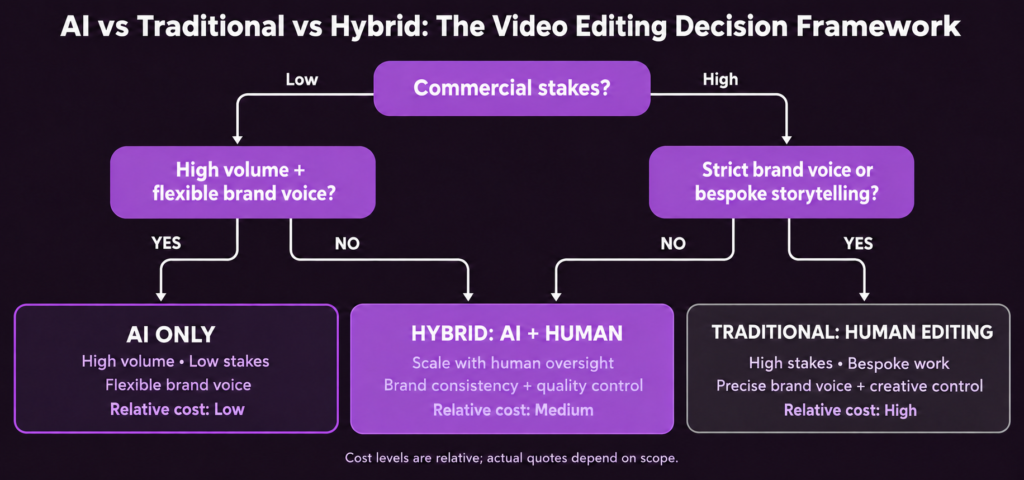
<strong>High-volume social media clip production:</strong> Producing 10–20 short-form clips per week from podcast episodes, live streams, or long-form recordings is precisely what AI editing tools are built for. Opus Clip and Descript handle clip selection, silence removal, and caption generation at speeds no human editor can match at equivalent cost.
strong>Internal and training content at scale:</strong> Employee onboarding videos, compliance training, and internal communications are low-stakes for brand expression. AI avatar tools and AI editing produce commercially sufficient quality for internal distribution at 80% lower cost than traditional production.
When Traditional Editing Is the Right Choice
<strong>Hero brand content:</strong> Flagship commercial pieces that define brand identity require the creative judgment and brand understanding that only an experienced specialist editor provides. The commercial stakes of getting these wrong far exceed any production cost saving from AI editing.
Full Cost Comparison by Content Type
| Content Type | AI Only | Hybrid (AI + Human) | Traditional Only | Recommended Approach |
|---|---|---|---|---|
| Social clip pack (10/week) | £50–150/mo | £200–400/mo | £1,000–3,000/mo | Hybrid |
| YouTube long-form (4/mo) | £80–200/mo | £400–800/mo | £800–2,000/mo | Hybrid |
| Podcast full package (4/mo) | £100–300/mo | £400–900/mo | £1,200–3,000/mo | Hybrid |
| Paid ad creative (4/mo) | Not recommended | £300–700/mo | £600–2,000/mo | Hybrid with human on hooks |
| VSL production | Not suitable | £800–1,500 project | £1,500–4,000 project | Specialist human / hybrid |
| Corporate training (4/mo) | £80–200/mo | £300–600/mo | £800–2,000/mo | AI or Hybrid |
Need a Professional Hybrid Video Editing Service?
Futuristic Marketing Services provides hybrid AI + human video editing, AI handles mechanical scale and speed, specialist editors handle hook engineering and commercial judgment.
Get Your Hybrid Editing QuoteFrequently Asked Questions
Will AI replace professional video editors?
Is AI video editing quality sufficient for YouTube?
How quickly can an AI video editing service deliver?
What is the best first step toward a hybrid workflow?
Start Your AI + Human Hybrid Editing Workflow Today
Futuristic Marketing Services designs and manages hybrid production workflows, AI efficiency for scale, human expertise for commercial performance across every content type.
Get Started with Hybrid EditingConclusion
The AI versus traditional editing decision is a workflow design challenge, not a competition. Deploying AI for mechanical tasks at scale and human expertise for commercial judgment tasks produces better content at lower cost than either approach used exclusively. The three questions that determine the right approach for any specific piece of content: does it have direct measurable commercial impact? Does it require brand voice? Is the volume high enough that AI efficiency creates a meaningful operational advantage?