Organic vs Paid Social Media Marketing: Key Differences Explained

organic vs paid social media marketing

Organic social media marketing uses unpaid content to build audience, brand trust, and long-term reach through consistent publishing and engagement. Paid social media marketing uses advertising budgets to reach specific, targeted audiences immediately through promoted posts, display ads, and lead generation campaigns. The most effective social media strategies combine both, using organic content to build trust and paid campaigns to accelerate reach and generate faster results.


This guide explains exactly how organic and paid social media marketing differ, what each approach costs, what business outcomes each is best positioned to deliver, and when to use each one given your current goals and resources. You will find a complete side-by-side comparison table, a decision guide for choosing the right approach at each stage of business growth, the most effective strategies for combining both channels into a single system that compounds results over time, and the most common mistakes businesses make when allocating effort and budget between organic and paid. By the end, you will have a clear framework for making the organic versus paid decision for your specific business situation.

Key Takeaways

  • Organic social media builds long-term brand trust and audience loyalty at no direct platform cost but requires consistent time investment and produces results over months rather than days.
  • Paid social media delivers immediate, targeted reach and measurable lead volume, with an average return of $5.28 for every $1 spent according to mysocial.io's 2026 analysis.
  • Organic reach has declined significantly across all major platforms. Facebook brand pages now reach approximately 2% to 5% of their followers organically per post, making paid amplification increasingly important for consistent visibility.
  • According to SQ Magazine's social media research, 86% of social media marketers currently combine both paid and organic tactics in their strategies rather than relying on either one exclusively.
  • Paid campaigns without organic content foundations produce higher cost per lead because cold audiences who have never encountered the brand require more ad spend to convert than warm audiences already familiar with it.
  • The strongest integration strategy uses organic content to test what resonates with the audience, then applies paid budget to amplify the content types and messages that organic testing has already validated.
  • Over 70% of marketers identify measuring ROI from organic social as their biggest challenge, highlighting why clear goal-setting and the right metrics matter before committing to either approach.

Not Sure How to Balance Organic and Paid?

We Build Integrated Organic and Paid Social Media Strategies for Your Business

Futuristic Marketing Services designs and manages complete social media strategies that combine organic content and paid advertising in the right proportion for your specific business goals and budget.

Get a Free Strategy Consultation

What is Organic Social Media Marketing

Organic social media marketing is all activity on social media platforms that does not involve paying the platform directly for distribution. It includes every post, Story, Reel, video, and comment your business publishes and engages with without a paid advertising budget attached. Organic social builds audience, brand recognition, and community trust through the consistent delivery of content that the platform's algorithm distributes based on relevance, engagement quality, and posting consistency rather than budget size.
The foundational advantage of organic social media is that it costs no direct money to reach your existing audience. A business with 5,000 Instagram followers can publish content daily and reach a portion of that audience at zero platform cost. This makes organic social the primary investment for businesses in early growth stages with limited marketing budgets and for established businesses focused on deepening relationships with an audience they have already built. Understanding what organic and paid social are each capable of delivering begins with the broader definition of what social media marketing is and how the two approaches fit within the complete channel picture.

How Organic Social Media Marketing Works

Organic social media works through a platform algorithm that evaluates each piece of content and determines how widely to distribute it based on signals including early engagement rate, content format relevance to current platform preferences, posting consistency, and the account's prior performance history. Content that generates strong engagement in the first 30 to 60 minutes after publication is distributed to more of the account's followers. Content that generates very high engagement is occasionally distributed beyond followers to non-followers in similar interest categories, which is the primary organic growth mechanism on platforms like Instagram Reels and LinkedIn.
The critical reality of organic reach in the current platform environment is that it has declined substantially across all major platforms over the past several years. According to SQ Magazine's social media statistics research, Facebook organic reach for brand accounts now averages approximately 1.37% for small accounts, meaning a page with 10,000 followers reaches roughly 137 people per post without paid amplification. Instagram organic reach is somewhat higher at approximately 3.5% for small accounts. These figures make it clear that organic reach alone is insufficient for rapid audience growth or consistent lead generation at scale for most businesses.

What Organic Social Media Marketing is Best For

Organic social media is most effective for building long-term brand authority and audience trust, maintaining ongoing relationships with an existing follower base, demonstrating expertise through consistent educational content, and creating the brand familiarity that makes paid advertising to that same audience significantly more cost-effective. Businesses that invest in organic content consistently for six to twelve months build a warm audience that converts at a meaningfully higher rate when they encounter paid campaigns, because they already recognize and trust the brand before the ad appears in their feed.
Organic is also the correct primary investment for businesses testing new content formats, topics, and messaging. Before committing paid budget to a specific creative approach or audience message, publishing that approach organically reveals whether it resonates with the existing audience at zero cost. High-performing organic posts are the most reliable indicators of which paid content will generate the strongest return on ad spend when amplified. Our social media content creation services are specifically designed to produce the organic content quality that serves as both a standalone audience-building tool and a creative testing ground for paid campaign development.

What is Paid Social Media Marketing

Paid social media marketing is the practice of paying social media platforms to distribute your content to a specific, targeted audience beyond your existing followers. It includes boosted posts, image and video ads, carousel ads, lead generation ads, retargeting campaigns, and story ads across platforms including Meta (Facebook and Instagram), LinkedIn, YouTube, and Twitter X. Paid social gives businesses guaranteed distribution to a precisely defined audience regardless of organic reach limitations, making it the most reliable method for generating immediate, measurable results from social media activity.
The fundamental advantage paid social holds over organic is control. Paid campaigns allow businesses to define exactly who sees their content by age, location, interests, job title, income level, purchase behavior, and dozens of other targeting parameters. This targeting precision means paid social spend reaches potential customers rather than the general public, making it significantly more efficient per impression than traditional advertising channels for businesses with well-defined target audience profiles.

How Paid Social Media Marketing Works

Paid social media campaigns function through an auction system where businesses bid to have their content displayed to a targeted audience. The platform takes into account the bid amount, the quality and relevance score of the ad, and the predicted likelihood that the targeted user will respond to the content before determining whether and how frequently the ad is shown. Higher-quality ads with stronger audience relevance signals typically achieve lower cost per result than lower-quality ads with higher bids, which is why creative quality and audience targeting precision matter as much as budget size for paid social performance.
According to Sprout Social's ROI statistics research, a 5:1 return is the standard performance expectation for paid social campaigns, meaning every INR 1 spent on ads produces approximately INR 5 in revenue. E-commerce businesses running retargeting campaigns, which show ads specifically to people who have already visited the website or engaged with the brand, regularly achieve return on ad spend of 4x to 8x or higher because the audience is already warm and has demonstrated purchase intent before seeing the ad.

What Paid Social Media Marketing is Best For

Paid social media is most effective for generating leads and enquiries on a predictable, scalable timeline, launching new products or services to audiences that do not yet know the brand, reaching highly specific audience segments that organic content cannot reach without first building a large following, and retargeting audiences who have already interacted with the business online but have not yet converted. XtendedView's research confirms that 83% of marketers now use paid social advertising regularly, and 87% of marketing leaders expect their paid social spend to increase, reflecting the industry-wide recognition that organic reach alone is insufficient for achieving predictable business growth from social media.
Paid social is also the correct primary investment for businesses under time pressure to generate results. A business launching a new service, running a limited-time offer, or needing to fill a specific number of client spots within a defined timeframe cannot wait three to six months for organic reach to build sufficient audience to produce that lead volume. Paid campaigns can generate qualified leads within days of launch, making them the essential component of any social media strategy that must produce business results on a short timeline. Our social media advertising services manage complete paid campaign cycles from targeting strategy and creative development through budget optimization and performance reporting.

Organic vs Paid Social Media Marketing: Complete Comparison

The comparison table below presents the key operational, financial, and performance differences between organic and paid social media marketing across every major dimension that matters for business decision-making. Use this table to identify which approach aligns with your current goals, timeline, and resources before deciding how to allocate your social media investment.
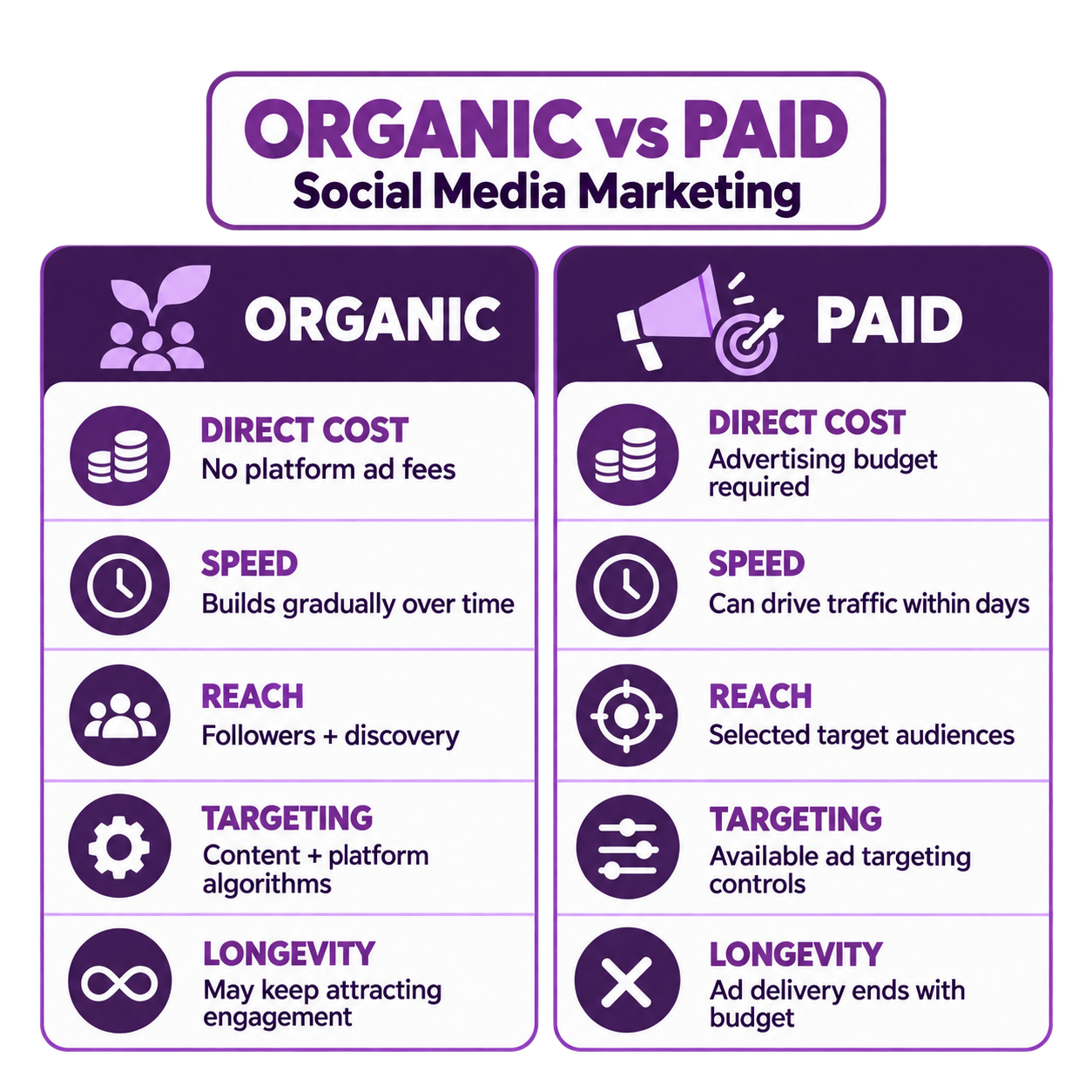
DimensionOrganic Social MediaPaid Social Media
Direct CostNo platform fees. Cost is the time and creative resources required to produce and manage content consistentlyDirect platform advertising spend required. Budget ranges from INR 5,000 to several lakhs per month depending on goals and audience size
Speed of ResultsSlow. Meaningful results typically take 3 to 6 months of consistent activity to accumulateFast. Results can appear within hours or days of campaign launch with the right targeting and creative
Audience ReachLimited to existing followers plus algorithm-driven distribution to non-followers. Facebook page reach: 2% to 5% of followers organicallyUnlimited. Budget determines reach. Can target any defined audience segment regardless of whether they follow the account
Targeting ControlIndirect. Algorithm determines distribution based on content quality and engagement signalsPrecise. Target by demographics, interests, behaviors, job title, location, custom audiences, and lookalike audiences
Longevity of ContentHigh. Quality organic content continues attracting engagement and building brand authority for weeks or months after publicationLimited to campaign duration. Visibility stops the moment the advertising budget is exhausted or the campaign is paused
Trust and CredibilityHigh. Audiences perceive organic content as authentic and non-promotional, building stronger long-term trust than advertisingLower initially. Audiences know they are seeing an ad, which creates additional persuasion work compared to content they choose to consume
MeasurabilityModerate. Engagement, reach, and follower growth are trackable, but direct revenue attribution from organic activity requires sophisticated tracking setupHigh. Paid campaigns provide detailed cost per click, cost per lead, conversion rate, and return on ad spend data in real time
ScalabilityLimited by content production capacity. Cannot scale reach rapidly without proportionally increasing creative outputHighly scalable. Increasing budget increases reach and lead volume predictably once campaign performance baselines are established
Best Business StageAll stages, but especially early-stage businesses building brand awareness and community before having budget for paid campaignsAny stage where predictable lead volume is needed on a defined timeline; most effective when the brand already has organic brand recognition
Primary RiskInconsistency. Organic results collapse quickly when posting cadence drops. Algorithm changes can reduce reach without warningBudget dependency. Visibility stops when budget stops. Rising platform costs can reduce ROI over time without ongoing creative optimization

The Real Cost of Organic and Paid Social Media Marketing

Comparing the costs of organic and paid social media requires accounting for all inputs, not just the obvious ones. Organic social media is commonly described as "free" because it carries no direct platform advertising fee. This description is misleading for any business that values its time or employs staff to create and manage content. Paid social media is commonly described as expensive, when in practice the cost-per-lead it produces is often lower than the cost-per-lead from channels businesses consider cheaper.

What Organic Social Media Marketing Actually Costs

The true cost of organic social media marketing for a business managing two platforms with a four-post-per-week schedule typically includes the following elements. Content creation time, covering planning, writing, graphic design, video production, and editing, typically requires six to ten hours per week for a solo business owner or small team without dedicated creative resources. At an owner's or marketer's time value of INR 1,000 to 2,000 per hour, this represents a real weekly investment of INR 6,000 to 20,000 even before any software tools are considered.
Community management, covering comment responses, direct message replies, and proactive engagement with audience content, adds two to four hours per week. Scheduling and analytics tools such as Buffer, Later, or Hootsuite cost INR 500 to 3,000 per month at starter tiers. Graphic design tools such as Canva Pro cost approximately INR 3,500 per year. A realistic total monthly cost for self-managed organic social media for one business ranges from INR 15,000 to 60,000 in time value plus INR 500 to 3,000 in tools, even though the platform itself charges nothing for publishing. Understanding this true cost is what makes the comparison between organic and paid social media accurate rather than misleadingly tilted toward organic on the grounds that it appears to be cheaper.

What Paid Social Media Marketing Actually Costs
The cost of paid social media advertising in India varies significantly by platform, industry, and audience targeting parameters. Meta advertising (Facebook and Instagram) has a minimum daily budget of INR 50 to 100, making it technically accessible to very small budgets, but campaigns typically need a minimum of INR 5,000 to 10,000 per month to gather sufficient data for meaningful optimization. According to mysocial.io's 2026 budget analysis, small businesses globally typically spend between the equivalent of INR 55,000 to 2,10,000 per month on paid social ads, with the average return reaching $5.28 (approximately INR 440) for every $1 (approximately INR 83) spent.
In addition to the advertising spend itself, effective paid social campaigns require investment in creative production for ad assets, campaign management time for setup, optimization, and reporting, and often professional agency or specialist fees when in-house expertise is not available. The total cost of a professionally managed paid social campaign in India ranges from INR 15,000 to 50,000 per month in management fees plus the advertising budget, placing a realistic fully-loaded starting investment at INR 25,000 to 75,000 per month for a properly executed campaign. The critical distinction from organic is that this investment produces measurable, attributable leads and revenue rather than the brand awareness and trust that organic primarily delivers.

When to Use Organic, When to Use Paid, and When to Use Both

The decision between organic and paid social media is rarely an either-or choice. The question for most businesses is not which one to use but which combination of the two is appropriate given the current business stage, available resources, and the specific outcomes needed within a defined timeframe. The table below provides a decision guide for each common business scenario.
Business SituationRecommended ApproachWhy This Approach Fits
Starting out with zero social presence and limited budgetOrganic firstBuild a content library, establish posting rhythm, and develop audience understanding before investing ad budget that cold audiences will convert at low rates without prior brand familiarity
Need leads within 30 days for a specific service or offerPaid primaryOrganic cannot produce predictable lead volume in 30 days. Paid campaigns with lead generation objectives can produce qualified enquiries within days of launch when audience and creative are well-targeted
Growing brand with existing audience and moderate budgetOrganic plus paid combinedOrganic maintains ongoing audience relationships and provides creative testing data; paid amplifies proven organic content and runs targeted lead generation campaigns to new audience segments simultaneously
Launching a new product or service to an existing audienceOrganic warmup followed by paid launchOrganic content in the weeks before launch creates anticipation and familiarity. Paid campaigns at launch reach new audiences beyond existing followers with a message the existing organic audience has already validated
Established business focused on customer retentionOrganic primary with retargeting paidOrganic content keeps existing customers engaged and loyal between purchases. Retargeting campaigns keep the brand in front of previous buyers and website visitors who have shown purchase intent but not yet converted
B2B business targeting specific company types or rolesLinkedIn organic plus LinkedIn paidLinkedIn organic thought leadership builds credibility with the target decision-maker audience over time; LinkedIn paid campaigns use company size, job title, and industry targeting to reach decision-makers in specific organizations directly

How to Combine Organic and Paid Social Media for Maximum Results

The most effective social media strategies treat organic and paid not as alternatives but as integrated components of a single system where each one strengthens the other. According to SQ Magazine's research, 86% of social media marketers already combine both paid and organic tactics, reflecting broad industry recognition that neither approach alone produces the full range of outcomes that businesses need from social media marketing.
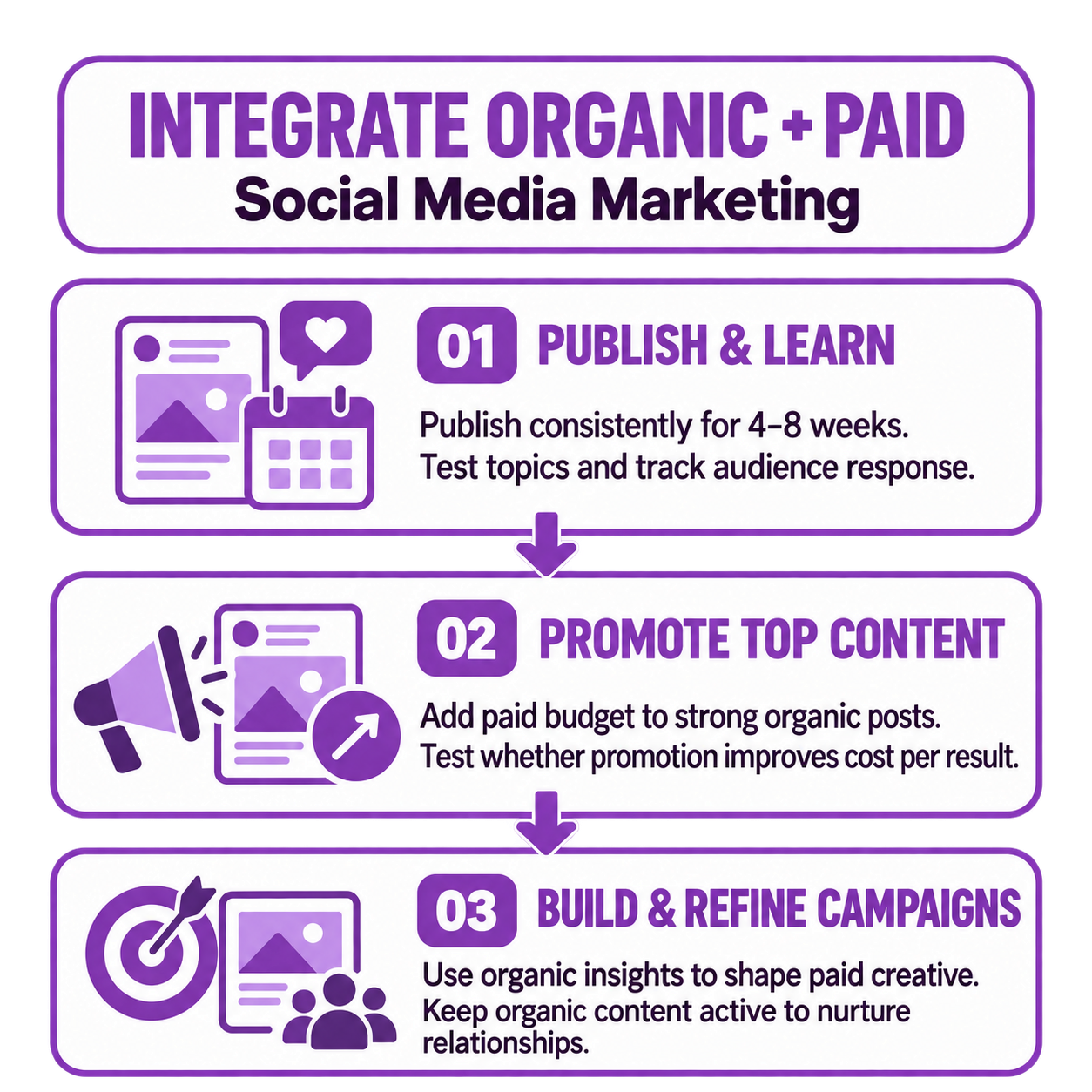
The integration framework that produces the strongest combined results follows a three-stage process. In the first stage, organic content is published consistently according to a structured social media content calendar with no paid amplification. This builds a baseline library of content across multiple topics and formats, establishes posting rhythm and audience data, and reveals which content types generate the highest organic engagement within the specific target audience. This organic testing phase typically runs for four to eight weeks before any paid budget is introduced.
In the second stage, paid budget is applied specifically to the posts and content themes that organic testing has already validated as resonant with the target audience. Boosting a post that already achieved strong organic engagement produces significantly better paid results than boosting a post that generated no organic engagement, because the existing engagement signals tell the platform's algorithm that the content is valued by the intended audience. This approach typically reduces cost per result by 20% to 40% compared to running paid campaigns on fresh creative that has received no organic validation.
In the third stage, paid campaigns are expanded beyond organic content boosting into dedicated ad creative built specifically for the formats and messages that the organic testing phase identified as highest-performing. Lead generation campaigns, retargeting campaigns, and lookalike audience campaigns are developed using the audience understanding built through months of organic engagement data. The organic content calendar continues running in parallel, maintaining the brand relationship with the existing audience while paid campaigns work to expand reach and generate enquiries from new, untapped audience segments. This three-stage integration approach is what our social media marketing agency builds for every client engagement rather than treating organic and paid as separate services with separate goals.

Common Mistakes When Choosing Between Organic and Paid

The most costly mistakes businesses make in the organic versus paid decision are not usually about choosing the wrong option. They are about misapplying a correct option to the wrong situation, or expecting an outcome from one approach that only the other can realistically deliver.
Expecting organic social media to produce immediate lead volume is a near-universal beginner mistake. Business owners who start publishing organic content and expect leads within the first two to four weeks are setting an expectation the approach cannot meet in that timeframe, regardless of content quality. Organic social produces leads through the compounding effect of audience trust built over months of consistent valuable content. The correct expectation for organic social in the first 90 days is growing reach, improving engagement rate, and building audience familiarity, not direct enquiries. If immediate leads are needed, paid campaigns must be the primary investment from day one.
Running paid campaigns without any organic content foundation is the inverse error, and it consistently produces higher cost per lead than campaigns run alongside an active organic presence. When a potential customer sees a paid ad from a brand and clicks through to a social media profile with no posts, no engagement, and no evidence of an active business, the trust signal required to convert that ad click into an enquiry is absent. Organic content is the trust evidence that makes paid advertising credible. Businesses that maintain both an active organic presence and run paid campaigns alongside it consistently achieve lower cost per acquisition than those that use paid advertising in isolation.
Abandoning organic content entirely once paid campaigns are running is another mistake that increases long-term cost structure. Organic content maintains ongoing audience relationships and creates the warm retargeting pool that produces the highest-converting, lowest-cost paid campaign results. A business that stops organic publishing becomes entirely dependent on paid budget for every impression it generates, making the cost structure vulnerable to platform price increases and audience fatigue from repeated ad exposure without organic relationship content in between. Effective social media marketing strategy always accounts for both channels running simultaneously at proportions appropriate to the business's goals and budget.

Get the Right Organic and Paid Balance for Your Business

We Manage Both Organic Content and Paid Campaigns Under One Strategy

Futuristic Marketing Services builds integrated organic and paid social media strategies designed around your specific business goals, budget, and timeline, so you get both long-term brand growth and near-term lead generation from a single coordinated approach.

Book Your Free Strategy Session

Frequently Asked Questions About Organic vs Paid Social Media Marketing

What is the main difference between organic and paid social media marketing?

Organic social media marketing uses unpaid content to reach and engage audiences through platform algorithm distribution, building brand trust and community over time at no direct platform cost. Paid social media marketing uses advertising budgets to reach specifically targeted audiences immediately, with full control over who sees the content and the ability to generate leads on a predictable timeline. Organic builds long-term credibility. Paid delivers short-term reach and measurable conversions. The strongest strategies use both simultaneously.

Is organic social media marketing still effective?

Organic social media remains effective for building brand authority, maintaining audience relationships, and developing the content quality signals that make paid advertising more efficient when applied alongside it. However, organic reach has declined significantly across all major platforms. Facebook organic reach now averages 2% to 5% of page followers per post. Instagram averages approximately 3.5% for small accounts. Organic social is no longer a reliable standalone channel for rapid lead generation, but it remains an essential complement to paid advertising for businesses that want sustainable, cost-efficient social media marketing results over time.

How much should a business spend on paid social media advertising?

Most guidance recommends allocating 15% to 25% of the total marketing budget to social media, with 25% to 35% of that social budget directed toward paid advertising. For Indian small businesses, a realistic starting paid social budget is INR 5,000 to 15,000 per month for a single platform campaign, scaling to INR 30,000 to 1,00,000 or more per month as campaigns are validated and return on ad spend is established. Start with a budget you can sustain for at least 60 days, as most campaigns require four to six weeks of optimization before reaching their best performance levels.

Can a small business succeed with only organic social media?

A small business can build meaningful brand awareness and community through organic social media alone, but the timeline to achieving meaningful lead volume without paid advertising is typically six to twelve months for most industries. Businesses with strong short-form video capabilities on Instagram or YouTube Shorts can accelerate organic growth through Reels-driven distribution that reaches non-followers without paid budget. Businesses in competitive markets or those needing leads within a specific short timeframe will find organic-only strategies insufficient for meeting business development targets and should introduce at least a modest paid advertising budget within the first 90 days.

What is a good ROI for paid social media advertising?

A 5:1 return on ad spend is considered the standard benchmark for healthy paid social media performance, meaning every rupee invested in advertising produces five rupees in revenue. According to Sprout Social's ROI research, this 5:1 expectation represents the baseline performance threshold below which campaigns should be reviewed and optimized before scaling budget. E-commerce businesses running well-optimized retargeting campaigns regularly achieve return on ad spend of 4x to 8x or higher. B2B businesses using LinkedIn advertising typically see lower return on ad spend figures but higher lead quality and larger average deal sizes that justify the higher cost per acquisition.

Which is better for brand awareness, organic or paid social media?

Organic social media builds deeper, more credible brand awareness over time because audiences encounter the brand through content they choose to consume rather than advertising they are served. This self-directed discovery produces stronger trust associations and longer memory retention than ad exposure alone. Paid social builds broader initial awareness faster by reaching defined audience segments at scale. The most effective brand awareness approach uses paid advertising to introduce the brand to new audiences quickly, then sustains that awareness with ongoing organic content that reinforces the brand's value and personality through non-promotional posts that audiences actively engage with.

How long does organic social media take to show results?

Organic social media marketing typically requires three to six months of consistent, quality posting before producing meaningful, measurable results against business goals. The first month establishes the brand's posting rhythm and platform presence. Months two and three reveal which content types and topics resonate most strongly with the target audience. Months four through six begin producing compounding reach and engagement growth as the algorithm rewards consistency and the audience grows through organic discovery. Businesses that expect organic results within the first four to six weeks consistently underestimate the timeline and abandon effective strategies before they have produced sufficient data to inform meaningful optimization.

Should beginners start with organic or paid social media?

Most beginners should start with organic social media for the first 30 to 60 days to establish a content library, develop posting rhythm, and understand which content topics and formats their specific audience responds to before committing paid budget to a creative approach that has not been validated. After 30 to 60 days of organic activity, the performance data gathered provides the audience insights and proven creative signals needed to build paid campaigns that are significantly more cost-efficient than campaigns launched without any prior organic testing. The exception is businesses under time pressure to generate leads, which should launch paid campaigns from day one alongside organic activity.

Does organic social media help paid advertising performance?

Yes. An active organic social media presence directly improves paid advertising performance through several mechanisms. Audiences who have already encountered the brand organically convert at higher rates when they see paid ads because they recognize the brand and have existing trust associations with it. Paid ads that boost existing organic posts benefit from social proof in the form of existing likes, comments, and shares that increase perceived credibility. Platform algorithms also reward advertisers who maintain active organic presences with slightly better ad delivery efficiency. The combined presence across both organic and paid channels creates multiple touchpoints in the customer journey that compound to produce better conversion rates than either channel achieves independently.

What happens to visibility when you stop paying for paid social ads?

Paid social media visibility stops immediately when a campaign is paused or the budget is exhausted. Unlike organic content that continues to accumulate engagement and build brand authority over time, paid campaign visibility has no residual effect after the budget runs out. This is the primary risk of building a social media strategy that depends entirely on paid advertising without a parallel organic content foundation. Businesses that stop paid campaigns without an organic presence lose all social media visibility until campaigns are restarted, creating the kind of on-off brand presence that prevents the sustained audience familiarity needed for cost-efficient paid advertising over time.

How do you measure the ROI of organic social media?

Measuring organic social media ROI requires connecting platform-level engagement data to downstream business outcomes using proper tracking infrastructure. Use UTM parameters on every link shared through organic social media to track website sessions and goal completions attributable to social traffic in Google Analytics. Track CRM lead source data to identify enquiries and sales that originated through organic social media discovery or referral. Calculate the total time and tool cost of organic social media management per month and compare it against the attributable lead value and revenue generated. Over 70% of marketers identify this measurement process as their biggest challenge, which is why establishing the tracking infrastructure before beginning the strategy is a critical first step.

Can paid social media work without good creative content?

Poor-quality creative is the most common reason for paid social media underperformance, regardless of targeting precision or budget size. Platforms determine ad distribution efficiency partly based on how audiences respond to the creative, meaning low-engagement ads are shown to fewer people at higher cost than high-engagement ads with equivalent budgets. Paid social platforms reward creative that stops scrolling, communicates clearly, and drives the intended action. Businesses that treat paid advertising as a simple budget allocation exercise without investing in quality ad creative consistently achieve cost-per-lead figures two to three times higher than businesses that prioritize creative quality as the foundation of their paid campaign strategy.

Futuristic Marketing Services

Stop Choosing Between Organic and Paid. Use Both, the Right Way.

We build and manage complete social media strategies that combine organic content, community management, and paid advertising in the precise balance your business needs to achieve brand growth, lead generation, and measurable ROI simultaneously.

Talk to a Social Media Specialist

Conclusion

The organic versuertising efficient. Paid social delivers the immediate reach, targeting precision, and predictable lead volume that organic content alone cannot produce within meaningful business timelines. Used together in a structured integration framework, they produce results neither channel can achieve independently.
The practical decision for any business is not which one to choose but what proportion of each approach is right for the current business stage, available resources, and primary goal. Businesses in early growth stages with limited budgets should invest primarily in organic with a small paid budget for amplification. Businesses needing immediate lead volume should lead with paid campaigns while building organic foundations in parallel. Established businesses should maintain both channels at proportions that reflect the balance between long-term brand building and near-term revenue generation their business model requires.
If you want a professional team to determine the right organic and paid social media balance for your specific business and manage both channels with the consistency and quality needed to produce measurable results every month, Futuristic Marketing Services builds and manages complete integrated social media strategies for businesses across India.
Share this post :
Picture of Devyansh Tripathi
Devyansh Tripathi

Devyansh Tripathi is a digital marketing strategist with over 5 years of hands-on experience in helping brands achieve growth through tailored, data-driven marketing solutions. With a deep understanding of SEO, content strategy, and social media dynamics, Devyansh specializes in creating results-oriented campaigns that drive both brand awareness and conversion.

All Posts