Core Web Vitals are Google’s three standardised page experience metrics that function as direct search ranking signals: LCP (Largest Contentful Paint, measuring loading speed with a target of under 2.5 seconds), INP (Interaction to Next Paint, measuring interactivity responsiveness with a target of under 200 milliseconds), and CLS (Cumulative Layout Shift, measuring visual stability with a target of under 0.1). Pages with Poor scores face a systematic ranking disadvantage in competitive search results.
Key Takeaways
- Core Web Vitals are direct Google ranking signals, not just performance suggestions, making them an SEO priority, not only a developer concern
- LCP measures how quickly the largest visible element loads, target: under 2.5 seconds for 75% of real Chrome user page loads
- INP replaced FID in March 2024 and measures responsiveness to all user interactions throughout the page session, target: under 200 milliseconds
- CLS measures how much content unexpectedly shifts during loading, target: under 0.1 for 75% of real user page loads
- Field data from the Chrome User Experience Report (CrUX) is what Google uses for rankings, check it in Google Search Console under Experience, not only in PageSpeed Insights lab simulation
- According to Google Web Almanac 2024, pages with Good CWV scores have 24% lower abandonment during loading compared to pages with Poor scores
Are Poor Core Web Vitals Costing You Rankings and Revenue?
Futuristic Marketing Services diagnoses and fixes Core Web Vitals failures across every page type, from LCP image compression and preloading to INP JavaScript optimisation and CLS layout shift elimination.
Get a Core Web Vitals Audit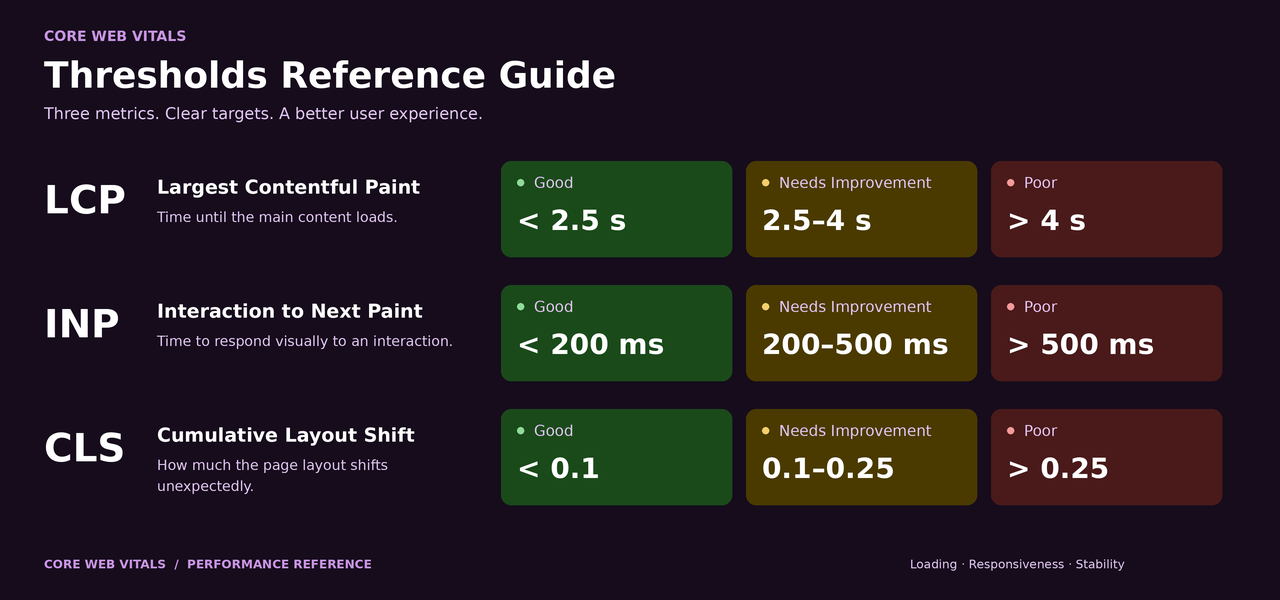
Why Core Web Vitals Are a Direct Ranking Signal
| Metric | What It Measures | Good Target | Needs Improvement | Poor |
|---|---|---|---|---|
| LCP (Largest Contentful Paint) | How quickly the largest visible content element loads, hero image, large text block, or video poster | Under 2.5 seconds | 2.5 to 4.0 seconds | Over 4.0 seconds |
| INP (Interaction to Next Paint) | How quickly the page responds to all user interactions, clicks, taps, keyboard input, throughout the session | Under 200 ms | 200 to 500 ms | Over 500 ms |
| CLS (Cumulative Layout Shift) | How much visible content unexpectedly moves or shifts during loading and interaction | Under 0.1 | 0.1 to 0.25 | Over 0.25 |
LCP, Largest Contentful Paint: Diagnosis and Fixes
| LCP Issue | Root Cause | Specific Fix | Expected Impact |
|---|---|---|---|
| Slow server response (TTFB over 600ms) | Unoptimised server, shared hosting with no caching, no CDN | Enable server-side caching with appropriate TTL settings; use a CDN with edge servers near your audience; upgrade hosting tier if TTFB exceeds 1 second | Very High, TTFB is the most fundamental LCP factor |
| Unoptimised hero image | Large JPEG or PNG without compression or modern format conversion | Convert to WebP format (25 to 35% smaller at equivalent quality); compress with Squoosh or Imagemin; target under 150KB for hero images | Very High, images are the LCP element on the majority of pages |
| LCP image not preloaded | Browser discovers LCP image late in the load sequence after CSS is parsed | Add link rel=preload as=image href=LCP-image-URL in HTML head; advances image discovery to the earliest possible point | High, moves image discovery from after CSS parse to immediate |
| Render-blocking resources | CSS and JavaScript files loading before content can render | Move non-critical CSS to async loading; add defer attribute to non-critical JS files; inline critical above-fold CSS | High, unblocking the render path allows content to appear sooner |
INP, Interaction to Next Paint: Diagnosis and Fixes
CLS, Cumulative Layout Shift: Diagnosis and Fixes
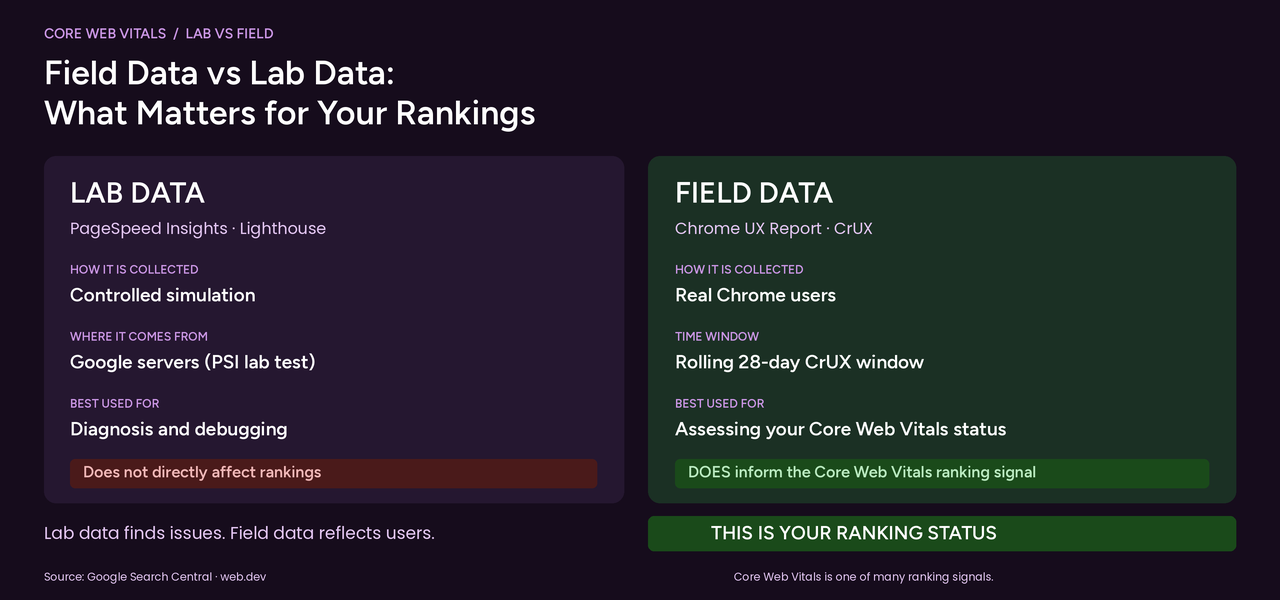
Field Data vs Lab Data, What Determines Your Ranking Status
Core Web Vitals Monthly Monitoring Programme
Fix Your Core Web Vitals Before Your Next Ranking Review
Our technical SEO team provides specific, implementable fix recommendations for every CWV failure, exact code changes, compression settings, and configuration updates your developer can action immediately.
Start Your Performance OptimisationFrequently Asked Questions
What are Core Web Vitals?
Do Core Web Vitals directly affect SEO rankings?
What is the difference between LCP, INP, and CLS?
What replaced First Input Delay (FID)?
How do I check my Core Web Vitals scores?
What is a Good Core Web Vitals score?
How do I fix LCP issues?
Faster Pages Rank Higher and Convert Better, Fix Both Problems at Once
At Futuristic Marketing Services, Core Web Vitals optimisation improves both your Google ranking signals and your user experience, because the same fixes that satisfy Google's metrics produce faster, more stable pages that convert at higher rates.
Talk to a Technical Performance ExpertConclusion

Devyansh Tripathi is a digital marketing strategist with over 5 years of hands-on experience in helping brands achieve growth through tailored, data-driven marketing solutions. With a deep understanding of SEO, content strategy, and social media dynamics, Devyansh specializes in creating results-oriented campaigns that drive both brand awareness and conversion.