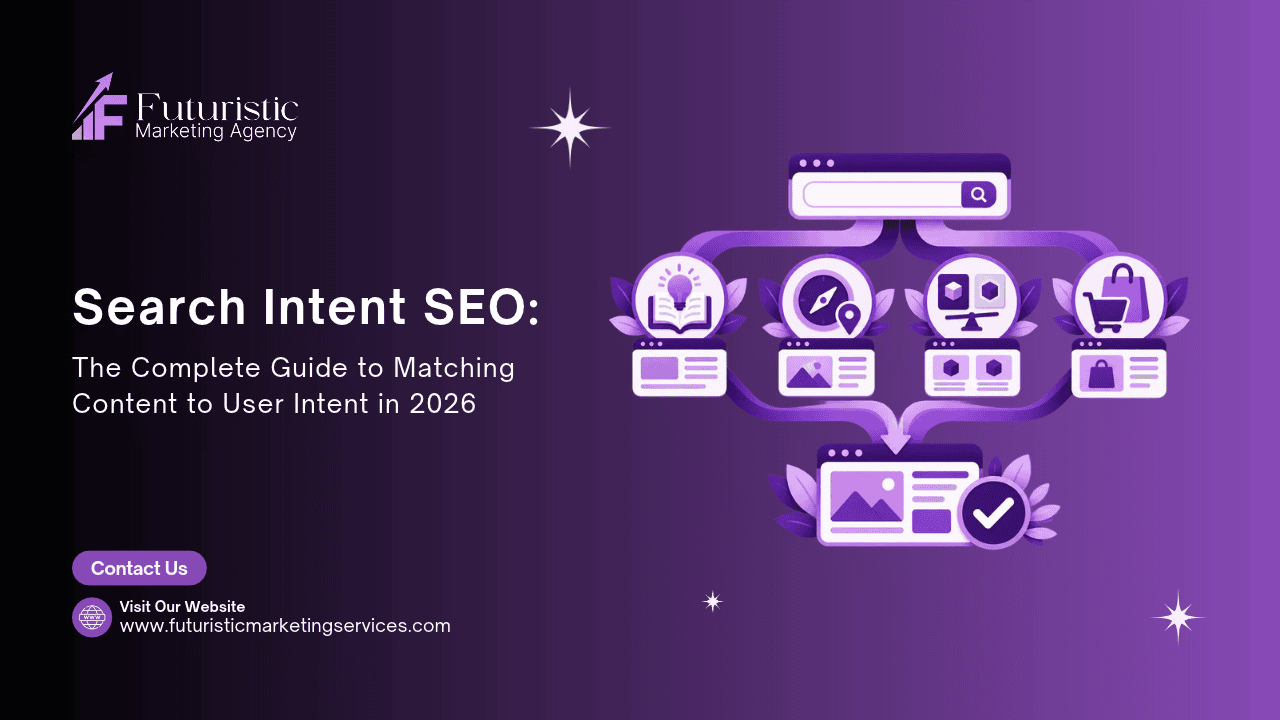
Search Intent SEO: The Complete Guide to Matching Content to User Intent in 2026

search intent seo

Search intent is the underlying reason a user types a query into Google, what they actually want to find, accomplish, or understand. It is the most important ranking signal in modern SEO because Google’s AI systems are specifically designed to evaluate whether a page satisfies the intent behind a query rather than simply whether it contains the right keywords. A page that targets the right keyword but serves the wrong intent will not rank regardless of how technically optimised it is.

This guide covers the complete search intent SEO framework: the four intent types and how to identify each from SERP signals, how to analyse the top 10 results to determine the dominant intent for any keyword, how to match your content type and format to intent, how intent affects title tag formulas and content structure, how mismatched intent suppresses rankings even for well-optimised content, and how search intent analysis integrates with keyword research, content strategy, and on-page SEO. Correctly matching intent is the single most impactful on-page decision for any piece of content.

Key Takeaways

  • According to Google, RankBrain evaluates how well content matches the search intent behind each query, making intent match a primary ranking signal evaluated continuously through user engagement
  • According to Ahrefs, intent mismatch is one of the primary reasons good content fails to rank on page one, the correct keyword paired with the wrong content format produces consistently poor rankings
  • The four search intent types are: Informational (user wants to learn), Commercial Investigation (user is researching before buying), Transactional (user wants to act or buy), and Navigational (user wants a specific site)
  • The only reliable way to confirm intent for any keyword is to search it in Google incognito and analyse what types of pages dominate the top 10 results, the SERP is Google's revealed intent classification for that query
  • The 3Cs of intent are Content Type (blog, product page, landing page), Content Format (guide, list, tutorial, comparison), and Content Angle (what specific perspective the top results take), all three must align with your target keyword's dominant SERP pattern
  • Search intent analysis must precede every brief, our how to write SEO blog posts guide covers how to embed this analysis into your standard pre-writing process

Want Content That Ranks Because It Perfectly Matches What Searchers Actually Want?

Futuristic Marketing Services builds every piece of content from a thorough SERP intent analysis, ensuring each page targets the correct content type, format, and angle that Google has confirmed works for that specific query.

Get Intent-Matched Content Created

hello@futuristicmarketingservices.com  |  +91 8518024201
The Four Types of Search Intent

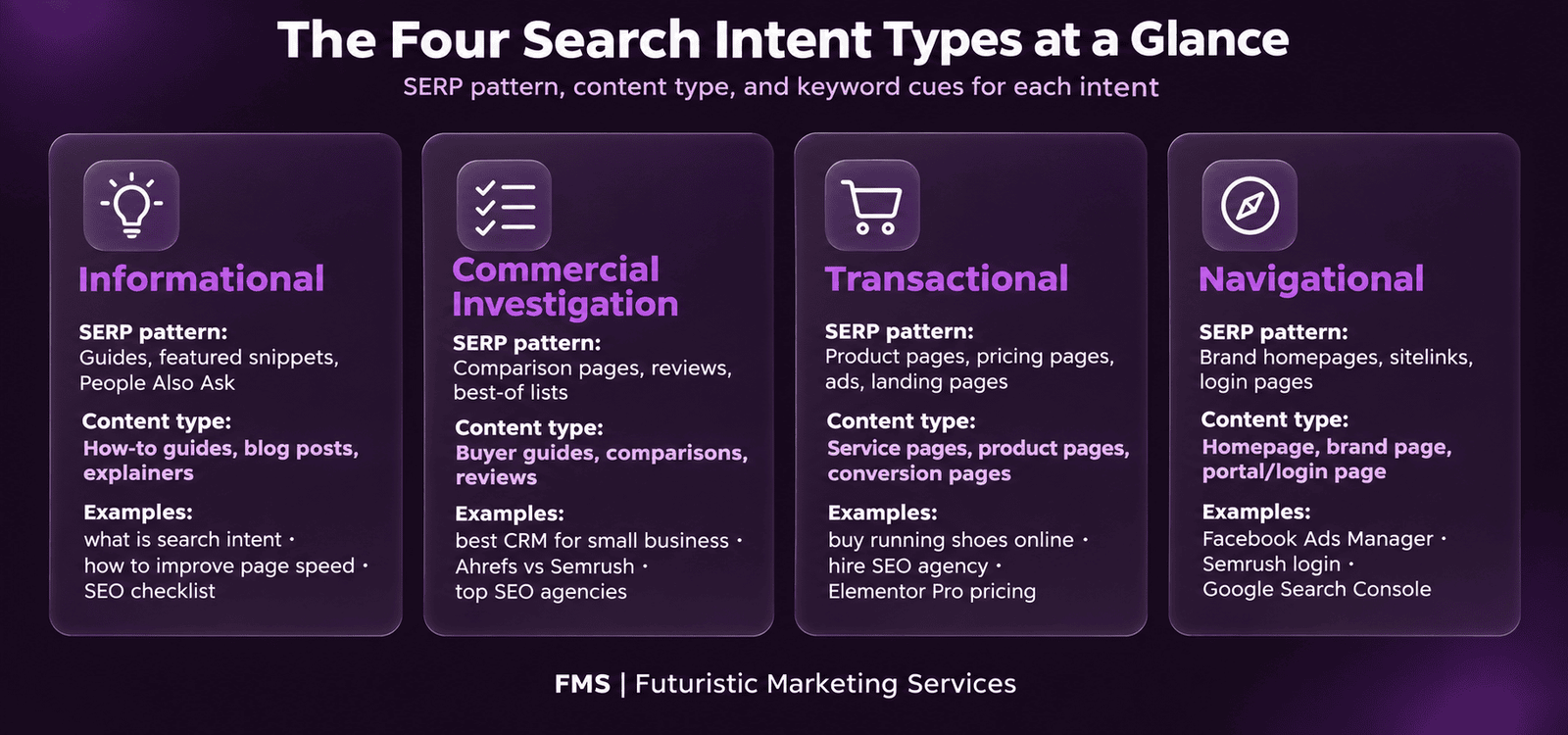
Every search query can be classified into one of four intent types. Understanding which type applies to your target keyword determines every content decision that follows, the page type to create, the format to use, the depth of coverage required, and even the tone and CTAs appropriate for the content.
Intent TypeWhat the User WantsDominant SERP PatternContent to CreateExample Keywords
InformationalTo learn something, understand a topic, or find an answerBlog posts, guides, how-to articles, definition pages, Wikipedia-style entriesComprehensive educational content: guides, tutorials, explainers, FAQswhat is SEO, how does link building work, what causes keyword cannibalization
Commercial InvestigationTo research and compare options before making a purchase decisionComparison articles, best-of lists, review articles, product roundupsComparison content: best X for Y, X vs Y, top 10 X, reviews with pros and consbest keyword research tools, ahrefs vs semrush, top SEO agencies in India
TransactionalTo complete a specific action, buy, sign up, download, bookProduct pages, pricing pages, landing pages, signup formsConversion-focused pages: product listings, pricing, service pages, signup flowshire SEO agency, buy ahrefs subscription, SEO services pricing
NavigationalTo reach a specific known website, brand, or pageThe target site or page itself; brand knowledge panelsThe actual brand or resource page the user is looking forahrefs login, Google Search Console, Futuristic Marketing Services blog

How to Identify Search Intent From SERP Analysis

The authoritative method for identifying search intent is direct SERP analysis, search your target keyword in Google using an incognito browser window and analyse what types of pages dominate the top 10 results. Google has algorithmically determined the dominant intent for every query based on billions of user interactions. The SERP pattern is Google's revealed classification of what users actually want when they type that keyword.
Apply the 3Cs framework to every SERP you analyse. The three Cs are: Content Type (what category of page dominates, blog posts, product pages, category pages, landing pages), Content Format (the dominant structural format, step-by-step guide, numbered list, comparison table, definition article, tool or calculator), and Content Angle (the specific perspective or unique value proposition the top results emphasise, for example, 'for beginners', 'with real examples', 'in 5 minutes', 'without paid tools'). Your content must align with all three Cs of the dominant SERP pattern to rank competitively for that keyword.
Three signals in the SERP that directly reveal intent: if the top results are all long-form educational articles, the intent is informational and your content should match that format regardless of how commercially valuable the keyword appears. If the top results are product pages and landing pages, the intent is transactional and a blog post targeting that keyword will not rank. If the top results include listicle format with numbered recommendations, your content should adopt the same format. According to Ahrefs research, intent mismatch between your content format and the SERP's dominant pattern is one of the primary reasons well-optimised content with strong backlinks fails to rank on page one.

How Intent Affects Content Type and Format

Every intent type requires a different content approach. Publishing the wrong content type for an intent, a blog post for a transactional keyword, or a product page for an informational keyword, produces poor user engagement signals that RankBrain interprets as intent mismatch and gradually suppresses in rankings. The format must also match, informational queries expecting numbered step guides will not rank a wall-of-text narrative article even if the content covers the same information.
Intent TypeRequired Content TypeRequired Content FormatTitle Tag PatternCTA Approach
InformationalBlog post, guide, explainerHow-to steps, definition + explanation, FAQ, numbered listWhat Is X, How to Do Y, The Complete Guide to ZSoft CTA: learn more, download guide, related articles
Commercial InvestigationComparison article, review, best-of listComparison table, pros/cons, numbered rankings with descriptionsBest X Tools, X vs Y Compared, Top 10 X for Y in 2026Decision-support CTA: compare plans, see pricing, request demo
TransactionalService page, product page, landing pageFeatures and benefits, pricing, testimonials, clear conversion pathX Services, Buy X, Get X Now, Hire X for YDirect conversion CTA: contact today, book now, get a quote, start free trial
NavigationalThe actual page the user is looking forClean navigation, clear brand identity, easy access to intended destinationBrand Name, Brand Name + Feature, Brand Name LoginNo required CTA, user already intends to engage

Intent Mismatch: Why Good Content Fails to Rank

Intent mismatch is the most common cause of ranking failure for technically well-optimised content with strong backlinks. It occurs when a page targets the right keyword but serves a different intent than what the SERP's dominant pattern reveals Google users actually want. The page may have excellent E-E-A-T signals, strong on-page optimisation, and substantial backlinks, and still fail to break into the top 10 because its content type or format does not match what users expect when they search that keyword.
The most common intent mismatch patterns: publishing an educational blog post for a transactional keyword (users want to buy, not learn), publishing a listicle for a query where users want a step-by-step tutorial, publishing a generic overview for a query where users want a specific comparison, or publishing a short definition page for a keyword where the SERP reveals users want comprehensive depth. In each case, RankBrain measures that users are not satisfied with the page's response to their actual need and gradually adjusts rankings downward. Our how to write SEO blog posts guide covers how to build intent analysis into every brief before writing begins.

Search Intent and AI Overviews

Search intent alignment is equally critical for AI Overview citation selection as it is for traditional organic rankings. Google's Gemini system that powers AI Overviews evaluates whether a page comprehensively addresses the full intent behind a query, not just whether it contains the right keywords. Pages that serve informational intent with complete, well-structured direct answers are the most frequently cited in AI Overviews because their content format (direct answer paragraphs, FAQ sections, numbered processes) matches what AI extraction systems prefer to cite.
Structure informational content with the AI intent layer in mind: lead every major section with a direct answer sentence that fully addresses the section's question in 40 to 60 words (the Featured Snippet and AI Overview extraction target length), follow with comprehensive explanation and supporting evidence, and add a FAQ section with standalone 40 to 60 word answers to related questions. This structure serves traditional informational intent rankings and AI Overview citations simultaneously from the same content investment. Our eeat guide covers the complete AI citation optimisation framework.

Is Intent Mismatch Preventing Your Best Content From Ranking?

Our SEO content team runs SERP intent analysis before every brief, ensuring every page we create targets the correct content type, format, and angle that Google has confirmed works for that specific keyword and query.

Get Intent-Aligned SEO Content

hello@futuristicmarketingservices.com  |  +91 8518024201

Frequently Asked Questions About Search Intent SEO

What is search intent in SEO?

Search intent is the underlying reason a user types a query into Google, what they actually want to find, learn, or accomplish. Google's AI systems, particularly RankBrain and BERT, evaluate how well a page satisfies the intent behind a query rather than just whether it contains the right keywords. According to Google, understanding and matching user intent is fundamental to earning rankings. A page with perfect keyword optimisation but the wrong intent format consistently underperforms a well-matching page with average keyword signals.

What are the four types of search intent?

The four search intent types are: Informational (the user wants to learn something, dominated by blog posts, guides, and definition articles in the SERP), Commercial Investigation (the user is researching before making a decision, dominated by comparison articles, best-of lists, and reviews), Transactional (the user wants to complete an action or buy, dominated by product pages, pricing pages, and landing pages), and Navigational (the user wants a specific website or page, the target site itself dominates the SERP).

How do I identify the search intent for a keyword?

The most reliable method is direct SERP analysis: search your target keyword in Google incognito and analyse the top 10 results for Content Type (are the results blog posts, product pages, or landing pages?), Content Format (guides, lists, comparisons, or definitions?), and Content Angle (what specific perspective do the top results take?). This 3Cs framework reveals the dominant intent Google has determined for that query based on real user behaviour. Match all three dimensions for competitive ranking.

Why does search intent matter more than keyword density?

Search intent matters more than keyword density because Google's AI systems, RankBrain, BERT, MUM, evaluate user satisfaction signals rather than keyword frequency. A page can include a keyword 20 times but if its content type does not match what users expect for that query, RankBrain measures the resulting poor engagement and suppresses the ranking. According to Ahrefs, intent mismatch is one of the primary reasons well-optimised content fails to rank on page one despite strong technical signals.

Can the same keyword have mixed intent?

Yes, many keywords have mixed or ambiguous intent where the SERP shows multiple content types. A keyword like 'SEO services' might show service pages (transactional) and comparison articles (commercial investigation) in the top results. For mixed-intent keywords, analyse which intent type has the most top-5 positions and build your content to serve that dominant intent while incorporating elements of the secondary intent. A service page for a mixed-intent keyword might include comparison content and educational sections to satisfy the full intent range.

How does search intent affect content length?

Search intent determines appropriate content length because different intents require different information depths. Transactional pages (product pages, landing pages) typically require 300 to 800 words of persuasive content focused on benefits and conversion. Informational guides for complex topics require 1,500 to 3,000 words to comprehensively cover the user's learning need. Simple informational definitions require 500 to 800 words. The correct length for any page is whatever fully satisfies the user's intent, check the average length of current top-5 results for your target keyword as your length benchmark.

What is the 3Cs framework for search intent?

The 3Cs framework analyses three dimensions of search intent from SERP data: Content Type (the category of page that dominates, blog post, product page, category page, landing page), Content Format (the dominant structural approach, step-by-step guide, numbered list, comparison table, definition article, tool), and Content Angle (the specific perspective or value proposition the top results emphasise, beginner-focused, cost-focused, quick-result-focused, data-driven). Aligning your content with all three Cs of the dominant SERP pattern is the most reliable predictor of ranking success for a given keyword.

How does search intent affect title tags and meta descriptions?

Search intent directly determines the title tag formula to use. Informational intent: Keyword + What the Guide Covers (e.g. Keyword Cannibalization: How to Find and Fix Competing Pages). Commercial Investigation intent: Best/Top + Keyword (e.g. Best SEO Tools for Small Business). Transactional intent: Service + Location + Benefit (e.g. SEO Services in Mumbai for Organic Growth). The meta description CTA also changes by intent, informational gets Learn how, commercial gets Compare options, transactional gets Contact today. Our meta tags guide covers the complete formula library for every intent type.

Build Every Piece of Content Around the Intent That Actually Drives Rankings

At Futuristic Marketing Services, search intent analysis is the first step of every content brief, ensuring every page we create targets the correct type, format, and angle that the SERP confirms Google rewards for that specific query.

Talk to Our SEO Content Specialists

hello@futuristicmarketingservices.com  |  +91 8518024201
Conclusion

Search intent is the primary filter Google applies to every ranking decision. Content that matches the dominant intent revealed by SERP analysis consistently outperforms content that targets the right keywords but serves the wrong intent. The 3Cs framework, Content Type, Content Format, and Content Angle, provides a systematic method for ensuring every piece of content you create aligns with what Google has confirmed works for each specific query.
Apply intent analysis as the first step in every content brief before any writing begins. Use the intent classification to select the correct title tag formula from our meta tags guide, the correct content structure from our how to write SEO blog posts guide, and the correct depth and format from the SERP analysis. Embed this process into your SEO content strategy workflow so intent alignment is systematic rather than ad hoc.
Share this post :
Picture of Devyansh Tripathi
Devyansh Tripathi

Devyansh Tripathi is a digital marketing strategist with over 5 years of hands-on experience in helping brands achieve growth through tailored, data-driven marketing solutions. With a deep understanding of SEO, content strategy, and social media dynamics, Devyansh specializes in creating results-oriented campaigns that drive both brand awareness and conversion.

All Posts