
How to Create a Social Media Marketing Strategy from Scratch

social media marketing strategy

A social media marketing strategy is a documented plan that defines your business goals on social media, identifies your target audience, specifies which platforms you will use, outlines the type of content you will create, and establishes how you will measure results. Building one from scratch requires eight structured steps that transform random posting into a system that produces consistent, measurable business growth.

This guide walks through every step of creating a social media marketing strategy from scratch, including how to audit your current presence, set SMART goals that align with business outcomes, define and research your target audience, select the right platforms, establish content pillars and brand voice, build a content calendar, and set up a performance measurement framework that guides ongoing improvement. Each step is explained in practical terms with examples relevant to businesses of every size. Whether you are starting a brand new social media presence or rebuilding a strategy that has stalled, this guide gives you a complete, actionable roadmap to follow from the first day.

Key Takeaways

  • A social media marketing strategy is a documented plan covering goals, audience, platforms, content, and measurement, without one, activity rarely translates into results.
  • SMART goals connect your social media activity to specific business outcomes such as lead generation, website traffic, or revenue growth.
  • Audience research and competitor analysis are completed before platform selection, because the right platforms depend entirely on where your specific audience is most active.
  • Content pillars organize your publishing around three to five consistent themes that reflect your audience's needs and your business expertise.
  • According to Sprout Social, 73% of consumers say they will switch to a competitor if a brand does not respond to them on social media, making engagement a non-negotiable strategy element.
  • A content calendar prevents the most common failure point in social media: inconsistency caused by last-minute content decisions.
  • Strategy without measurement is guessing. Tracking the right metrics at defined intervals is what separates improving businesses from stagnating ones.

Need a Strategy Built for Your Business?

Let Our Team Build Your Complete Social Media Strategy

Futuristic Marketing Services creates custom social media strategies for businesses across India, combining audience research, platform selection, content planning, and performance reporting into one complete system.

Get a Free Strategy Call

Why Every Business Needs a Social Media Marketing Strategy
Posting on social media without a strategy is one of the most common and costly mistakes businesses make. Without a documented plan, content decisions are made based on guesswork, resources are wasted on platforms that do not reach the target audience, and there is no standard for measuring whether the effort is producing any business value at all.
The data confirms how significant this gap is. According to the HubSpot 2026 State of Marketing Report, 34.6% of marketers identify creating content that receives high engagement as their biggest challenge. That challenge is not primarily a creativity problem. It is a strategy problem. Businesses that produce engaging content consistently have a documented plan that tells them what to create, who it is for, and what outcome it is designed to produce.
A documented social media marketing strategy also gives your business a measurable framework for proving return on investment. Without one, you can report on metrics such as followers and likes, but you cannot demonstrate how those numbers connect to leads, website traffic, or revenue. Strategy creates that connection and gives your entire team a shared direction to work toward.

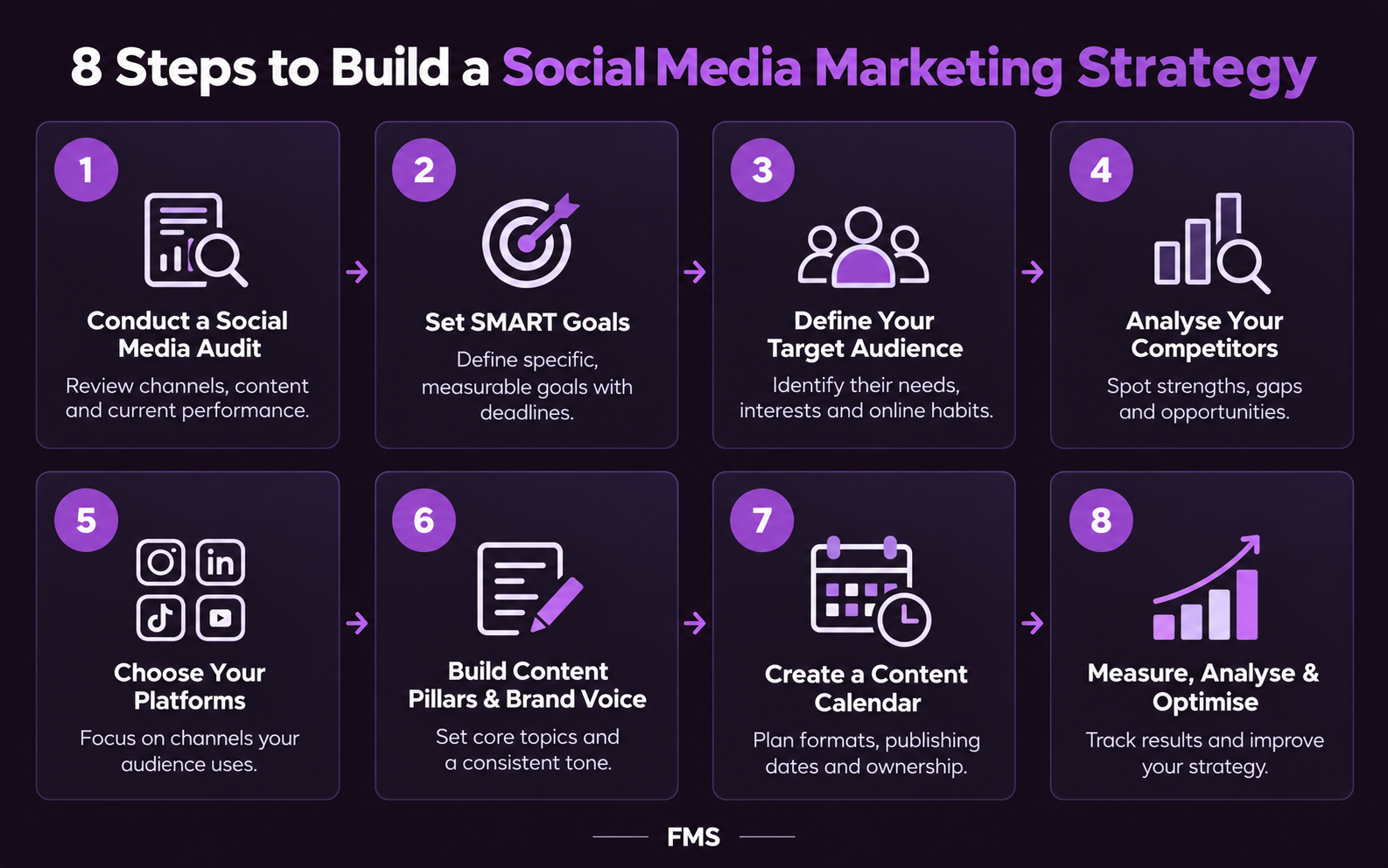
8 Steps to Build Your Social Media Marketing Strategy from Scratch

Building a social media marketing strategy from scratch follows a logical sequence. Each step depends on the one before it, which is why skipping any stage typically results in decisions made without the right information. Work through these steps in order and document every output. The completed document becomes the operational guide your team uses every day.

Step 1: Conduct a Social Media Audit

A social media audit is the foundation of any strategy because it tells you exactly where your business stands before you decide where it needs to go. If you already have social media accounts, an audit reveals which platforms are working, which content formats generate the most engagement, and where your current presence has gaps or inconsistencies that undermine credibility.
For each existing account, document the following information: current follower count and growth trend over the past three months, average engagement rate per post, the top five best-performing posts and what they have in common, posting frequency, and whether the profile information, bio, and profile image are complete and consistent across every platform. If you are starting from zero with no existing accounts, replace the self-audit with a competitor audit, which is covered in Step 4.
The audit also reveals whether your brand presents consistently across platforms. Inconsistent logos, outdated bios, or mismatched tones between profiles are signals to the audience that the brand is not professionally managed. Correcting these before building any new content strategy gives your new activity a credible foundation to build from. Our social media consulting services include a structured audit process that delivers a clear picture of your current position and a prioritized list of improvements to make before the strategy launch.

Step 2: Set SMART Goals That Connect to Business Outcomes

Every social media marketing strategy must be built around goals that connect directly to business outcomes. Goals that are vague, such as "grow our following" or "post more often," cannot be measured and therefore cannot be improved. SMART goals provide the structure that makes your social media activity accountable.
SMART stands for Specific, Measurable, Achievable, Relevant, and Time-bound. A SMART social media goal identifies exactly what you want to achieve, how you will measure it, whether it is realistic given your current resources, how it connects to a broader business objective, and by when you expect to reach it. The difference between a vague goal and a SMART goal determines whether your social media activity produces outcomes or just produces activity.
Business Goal Vague Version SMART Version
Brand Awareness Get more followers on Instagram Grow Instagram followers from 800 to 2,000 within 90 days by publishing 5 Reels per week
Lead Generation Use social media to get more enquiries Generate 30 qualified leads per month from LinkedIn through 3 weekly posts and 2 direct outreach messages per day
Website Traffic Drive people to our website from social Increase social media referral traffic to the website from 400 to 900 monthly sessions within 60 days through link-in-bio optimization and Story CTAs
Community Building Build a better community around our brand Increase average post engagement rate from 1.2% to 3.5% within 90 days by responding to every comment within 2 hours and posting 3 conversation-focused posts per week
Revenue Growth Sell more through social media Achieve INR 2,00,000 in monthly revenue attributable to social media channels within 6 months through a combination of organic content and paid retargeting campaigns
Set a maximum of three SMART goals per quarter to keep your strategy focused. Trying to achieve too many objectives simultaneously dilutes effort across all of them and typically results in none being achieved well. Once you have confirmed your three primary goals, every subsequent decision in the strategy should connect back to at least one of them.

Step 3: Define and Research Your Target Audience

Your target audience definition determines every content decision that follows, from which platforms you use to what topics you cover, which formats you create, and what language you use in your captions and posts. A well-defined audience profile is the single most important input into a social media strategy because it replaces guesswork with research at every decision point.
Start by documenting the demographic profile of your ideal customer. This includes age range, gender, location, occupation or job title, and income level where relevant to your offering. Then go deeper into psychographics: what problems do they face that your business solves, what do they want to achieve, what content formats do they prefer, and which platforms do they use most actively and at what times of day.
Three research methods produce the most useful data for audience definition. First, review your existing customer base and identify the common characteristics of your best customers, the ones who buy most frequently, spend the most, or refer others. Second, use platform analytics from any active accounts to review demographic breakdowns, active hours, and which content types drive the most engagement. Third, spend time reading comments, community forum discussions on platforms like Reddit and Quora, and reviews in your industry to understand exactly how your target audience describes their own problems in their own words. That language becomes the foundation of your content voice and messaging.

Step 4: Analyze Your Competitors on Social Media

A competitor analysis on social media reveals what is already working in your industry, where the gaps in your competitors' strategies create opportunities for your business, and what content formats and topics your target audience responds to most positively. This analysis is conducted before you finalize platform selection because competitor performance often reveals where your shared audience is most engaged and most likely to respond to new content.
Select three to five direct competitors and analyze each one across the following dimensions. Document which platforms they are active on and which ones appear to drive the most engagement. Note their posting frequency, the content formats they use most often (video, static images, carousels, text posts), the topics and themes they cover regularly, how they engage with comments and messages, and what their most shared or most commented posts have in common.
The goal of this analysis is not to copy what competitors do. The goal is to identify where their strategy has gaps your business can fill. If your competitors publish primarily promotional content and rarely answer audience questions, there is an opportunity to build authority through educational content that their audience is clearly not getting. If competitors are inactive on a platform where your shared audience is active, that platform becomes a priority for your strategy because the competitive landscape there is currently uncontested.

Step 5: Choose the Right Platforms for Your Business

Platform selection is the decision most businesses make first and most often get wrong by choosing based on personal preference or where competitors happen to be rather than where their specific target audience is most active. The correct approach is to let your audience research and competitor analysis from Steps 3 and 4 drive this decision rather than industry convention or trend-following.
According to Digital Applied's 2026 Social Media Statistics research, 5.24 billion people now use social media globally, but their attention is distributed very differently across platforms depending on age, profession, income level, and interest area. Knowing where your specific audience concentrates is far more valuable than knowing which platform has the most total users.
Platform Primary Audience Best Content Types Best Business Types
Instagram 18 to 44 year olds, lifestyle-focused consumers Reels, Stories, carousels, product images Fashion, food, fitness, beauty, travel, retail, D2C brands
Facebook 25 to 55 year olds, broad demographic, local communities Video, Groups, events, long-form posts, paid ads Local businesses, services, B2C brands, healthcare, education
LinkedIn Professionals, business decision-makers, B2B buyers Articles, thought leadership posts, case studies, carousels B2B services, recruitment, software, consulting, agencies
YouTube All age groups seeking education, entertainment, how-to content Long-form tutorials, Shorts, product reviews, vlogs Education, software, finance, home improvement, tech, coaching
Twitter X News-focused users, tech community, opinion leaders Real-time updates, threads, news commentary, industry opinions Media, technology, finance, public figures, thought leaders
WhatsApp Business Existing customers and warm leads across all demographics in India Broadcast messages, catalogs, direct conversations, updates All local businesses, retail, services, coaching, e-commerce
The most effective rule for platform selection is to start with two platforms and build genuine competence on both before expanding. One platform optimized for discovery where new audiences find you, such as Instagram Reels or YouTube Shorts, combined with one relationship-building platform where you deepen connections with your existing audience, such as LinkedIn or Facebook Groups, gives most businesses the best starting combination. Add platforms only when the first two are producing consistent, measurable results.

Step 6: Build Your Content Pillars and Define Your Brand Voice

Content pillars are the three to five core topic areas around which all of your social media content is organized. They replace the exhausting daily question of "what should we post today?" with a structured framework that keeps content consistent, on-brand, and genuinely useful to the target audience. Businesses with clearly defined content pillars produce more content with less decision fatigue and achieve stronger topical authority over time.
Content pillars are derived from the intersection of three inputs: what your audience wants to learn about based on the research from Step 3, what your business has genuine expertise in, and what topics connect directly to the services or products you offer. Each pillar represents a theme that could generate dozens of individual posts without ever becoming repetitive, because the topic is broad enough to approach from multiple angles, formats, and audience perspectives.
For example, a social media marketing agency might organize their content around five pillars: social media strategy tips, platform-specific growth tactics, client case studies and results, behind-the-scenes content showing how campaigns are built, and industry news with expert commentary. Every post published connects to one of these five pillars, giving the audience a consistent, predictable experience that builds expertise associations over time. Our social media content creation services include a content pillar development process tailored specifically to your industry, audience, and business goals.
Brand voice is the consistent personality and communication style your business maintains across all social media platforms. It covers the tone you use (professional, conversational, or a blend of both), the level of formality in your language, whether you use humour, how you address your audience, and the values you communicate in every post. The Sprout Social 2026 Content Strategy Report found that consumers rank authenticity and relatability as two of the three most important qualities they want from brands on social media. A clearly defined brand voice is what makes authenticity sustainable rather than accidental.
A useful rule for content distribution is the 80/20 framework: 80% of content delivers genuine value to the audience through education, entertainment, inspiration, or useful information, and 20% is promotional content that highlights your services or products. Audiences disengage quickly from accounts that primarily broadcast promotional messages without giving anything of value in return.

Step 7: Create a Content Calendar and Publishing Schedule

A content calendar is the operational document that converts your strategy into a daily execution plan. It specifies what content will be published, on which platform, in which format, on which date, and with what primary goal or call to action. Businesses with a documented content calendar consistently outperform those that make daily posting decisions reactively because they can plan higher-quality content with appropriate lead time and maintain consistency even during busy periods.
Build your content calendar at a minimum one month in advance. For each post, document the platform, content pillar it falls under, format (Reel, carousel, static image, Story, article), the core message or headline, the call to action, and the scheduled publication date and time. Plan for platform-appropriate posting frequencies: Instagram benefits from four to five posts per week including Reels and Stories, LinkedIn performs best with two to three posts per week, and YouTube grows fastest with at least one video per week published consistently.
The content calendar also identifies the resources required to produce each planned piece before the week begins, including photography, videography, graphic design, or copywriting. This advance planning eliminates the scenario where a post day arrives with nothing prepared and either quality is sacrificed or posting simply does not happen. Inconsistency caused by last-minute content decisions is the most common reason social media strategies fail to produce results, not lack of creative ideas.
According to Sprout Social, 80% of marketing leaders plan to shift budget from other channels to social, and 87% expect their paid social spend to increase. That level of investment requires the operational discipline that a content calendar provides to ensure every planned post is executed at the quality level the brand requires.

Step 8: Measure Performance, Analyze Results, and Optimize

Measurement transforms social media from a creative activity into a managed business channel. Without it, you cannot determine whether your strategy is working, which specific elements are driving the results you want, or where resources should be redirected to improve return on investment. Measurement is not a final step that happens at the end of a campaign; it is an ongoing process embedded into the strategy from the beginning.
Establish a measurement cadence at three levels. Weekly reviews track publishing consistency and immediate content performance such as reach, impressions, and engagement rate. Monthly reviews analyze trend data across all platforms, identifying which content pillars and formats are consistently outperforming others and whether goals are being progressed toward on schedule. Quarterly reviews assess overall strategy performance against the SMART goals set in Step 2 and determine whether goals need to be adjusted, platforms need to be reconsidered, or the content mix needs to shift.
The metrics you track should match the goals you set. If your primary goal is lead generation, the most important metrics are click-through rate, website sessions from social referral traffic, and form submissions attributed to social. If your primary goal is brand awareness, track reach, follower growth rate, and share of voice. Tracking every available metric simultaneously creates data overload that leads to no action. Focusing on the three to five metrics that connect directly to your primary goals leads to actionable insights that improve results.
Professional social media management services typically include monthly performance reporting that consolidates all of this data into a format your team can review and act on without spending hours manually compiling reports from multiple platform dashboards.

"Strategy without measurement is guessing. Measurement without strategy is noise. The businesses that grow consistently on social media combine both from day one."

Principle from Sprout Social's 2026 Social Media Content Strategy Report

Social Media Marketing Strategy Mistakes That Prevent Results

Even businesses that complete all eight steps of strategy development often make specific mistakes in execution that prevent the strategy from delivering its potential results. Knowing these mistakes before you begin saves significant time and resources during the execution phase when corrections are more costly and disruptive.
Selecting platforms based on where a business owner personally spends time rather than where the target audience is most active is among the most common execution errors. A business targeting corporate decision-makers that invests primarily in Instagram while neglecting LinkedIn is systematically reaching the wrong audience regardless of how good the content quality is. Platform decisions must be driven by audience research, never personal preference.
Treating social media as a broadcast channel rather than a two-way communication platform consistently underperforms. Businesses that post content but never respond to comments, ignore direct messages, or fail to engage with their audience's content miss the relationship-building function that drives brand loyalty and referral behavior. Research from Sprout Social confirms that 73% of consumers say they will switch to a competitor if a brand does not respond to them on social media. Response time and engagement quality are strategic assets, not optional extras.
Short form video avoidance is a strategy risk that becomes more costly over time. According to Sprout Social research, short form video delivers the highest return on investment among all video formats, cited by 41% of marketers. Businesses that continue relying exclusively on static image posts while competitors build short form video libraries are building a compounding disadvantage because video content accumulates views over time while static posts have a much shorter engagement window.
Changing strategy before giving it enough time to produce data is another common error. Organic social media strategies typically require three to six months of consistent execution before meaningful performance trends are visible. Businesses that abandon a well-constructed strategy after four or five weeks because results are not immediately dramatic typically restart from zero repeatedly rather than building the compounding authority that consistent strategy execution produces. Our social media marketing agency helps businesses maintain strategic direction through the early months when consistency is most critical and results feel slowest.

How to Combine Organic Strategy with Paid Social Advertising

A complete social media marketing strategy uses both organic and paid activity together rather than treating them as separate or competing approaches. Organic content builds long-term brand authority, audience trust, and a library of content that continues attracting engagement over time. Paid social advertising generates faster reach, immediate lead volume, and precise targeting of audience segments that organic content takes longer to reach consistently.
The most effective integration begins with organic content that identifies what resonates with your audience before any paid budget is committed. When specific posts consistently generate high engagement, strong click-through rates, or meaningful comments organically, those posts are the strongest candidates for paid amplification because they have already demonstrated their ability to connect with the target audience. Putting paid budget behind proven organic content significantly outperforms creating separate ad creative from scratch without this organic testing foundation.
Our social media advertising services are designed to work in conjunction with organic strategy rather than replacing it. For businesses exploring the combination of search and social marketing together, our guide on SEO and social media marketing services explains how both channels reinforce each other across the full customer discovery journey. For smaller businesses looking to understand the right starting point for their investment level, our overview of social media marketing companies for small business covers the key considerations when selecting the right external support.

Skip the Trial and Error

Get a Professional Social Media Strategy for Your Business

Our team builds complete, data-driven social media strategies covering platform selection, content pillars, posting schedules, and performance measurement, so your business grows from day one without the months of costly guesswork.

Book Your Free Strategy Session

Frequently Asked Questions About Social Media Marketing Strategy

What is a social media marketing strategy?

A social media marketing strategy is a documented plan that defines what your business wants to achieve on social media, who your target audience is, which platforms you will use, what content you will create and how often, and how you will measure success. Without a documented strategy, social media activity is reactive rather than intentional and rarely produces consistent, measurable business outcomes. The strategy serves as the operational guide that connects every content decision to a specific business goal.

How do you start building a social media strategy from scratch?

Start by conducting a social media audit if you have existing accounts, or a competitor audit if you are starting from zero. Then set SMART goals, define your target audience, analyze competitors, choose platforms based on where your audience is most active, build content pillars, create a content calendar, and establish a measurement framework. Each step must be completed in order because later decisions depend on the information gathered in earlier stages. Rushing past the research steps typically leads to a strategy built on assumptions rather than data.

How many social media platforms should a small business use?

Small businesses should start with two platforms and maintain genuine competence on both before expanding. One discovery platform such as Instagram or YouTube to reach new audiences, and one relationship-building platform such as Facebook or LinkedIn to deepen connections with existing followers, gives most small businesses the best starting combination. Attempting to maintain an active presence on five or six platforms simultaneously without adequate resources typically results in inconsistent, low-quality activity across all of them rather than strong performance on any one.

What are content pillars in a social media strategy?

Content pillars are the three to five core topic areas around which all of your social media content is organized. They replace reactive, last-minute posting decisions with a structured framework that keeps content consistent, on-brand, and genuinely useful to your target audience. Each pillar represents a broad theme that can generate dozens of individual posts across different formats without becoming repetitive. Content pillars are derived from the intersection of what your audience wants to learn, what your business has genuine expertise in, and what topics connect to your products or services.

How long does it take for a social media strategy to show results?

Organic social media strategies typically produce meaningful, measurable results after three to six months of consistent execution. The first month is primarily foundational, establishing a consistent posting rhythm and beginning to accumulate audience data. Months two and three reveal which content types and topics generate the strongest engagement. Months four through six begin producing compounding results as the algorithm rewards consistency and the audience grows through organic reach. Paid social advertising campaigns can generate leads within days, but still require two to four weeks of optimization to reach peak performance.

How do you measure whether a social media strategy is working?

Measure performance against the SMART goals you set at the beginning of the strategy rather than against generic industry benchmarks. If your goal is lead generation, track click-through rate, website sessions from social referrals, and form submissions attributed to social channels. If your goal is brand awareness, track reach, impressions, and follower growth rate. Conduct weekly reviews of content performance, monthly reviews of trend data, and quarterly reviews of overall goal progress. The metrics you track should always connect directly to the specific business outcomes the strategy is designed to produce.

What is the 80/20 rule in social media marketing?

The 80/20 rule in social media marketing is a content distribution framework where 80% of posts deliver genuine value to the audience through educational content, how-to guides, industry insights, entertainment, or inspiration, and 20% of posts are promotional content about your products or services. Audiences disengage quickly from accounts that primarily broadcast promotional messages, while accounts that consistently deliver value first build the trust that makes promotional posts far more persuasive when they do appear. The 80/20 split is a starting guideline that can be adjusted based on your specific audience's tolerance for promotional content.

Should a small business hire someone to manage social media strategy?

Whether to hire internally or work with an agency depends on the resources available and the level of expertise required to compete in your specific industry. Businesses in highly competitive markets where professional content quality and paid advertising expertise are needed to stand out typically see faster and stronger returns from professional social media management than from DIY approaches. Businesses in less competitive niches with clearly defined audiences and straightforward content needs can often build effective strategies internally. A professional agency adds the most value when strategy, content production, paid advertising, and performance analysis are all required simultaneously.

How do competitor analysis findings change a social media strategy?

Competitor analysis reveals the content topics your shared target audience responds to most actively, which platforms are generating the strongest results in your industry, where gaps in competitor strategies create opportunities for your business to differentiate, and what benchmarks are realistic for performance in your niche. If all major competitors are using similar content formats and covering the same topics, that analysis reveals both what the baseline expectation is and where publishing original angles on underserved topics can drive disproportionate attention and engagement from an audience that is already following those competitors.

What is brand voice and why does it matter in a social media strategy?

Brand voice is the consistent personality, tone, and communication style a business uses across all social media platforms. It covers the level of formality in language, whether humour is used and how, how the audience is addressed, and what values are communicated through every post. A consistent brand voice makes the business recognizable and builds trust over time because audiences know what to expect from the content. The Sprout Social 2026 Content Strategy Report identified authenticity and relatability as two of the three most important qualities consumers want from brands on social media, both of which are products of a well-defined and consistently applied brand voice.

How often should a business post on social media for best results?

Sustainable consistency matters more than posting frequency. A realistic schedule that maintains content quality every week produces better results than burst activity followed by long gaps. Instagram performs best with four to five posts per week combining Reels, Stories, and feed posts. LinkedIn benefits from two to three posts per week focused on professional value and thought leadership. Facebook sees strong results from three to four posts per week. YouTube grows most effectively with at least one high-quality video per week published on a predictable schedule. Start with a frequency you can sustain with quality, then scale up as systems and resources allow.

How is a social media marketing strategy different from a content strategy?

A social media marketing strategy is the broader business framework covering goals, audience research, platform selection, measurement, and budget allocation. A content strategy is a component within the broader social media strategy that specifically addresses what content will be created, what topics it will cover, which formats will be used, and how frequently it will be published. A content strategy without a social media marketing strategy lacks the goal alignment and measurement framework that connects content activity to business outcomes. Both are needed, and the social media marketing strategy must be built first because it defines the parameters within which the content strategy operates.

Futuristic Marketing Services

Build a Social Media Strategy That Drives Real Business Growth

From initial audit and goal setting through content pillar development, calendar planning, and monthly performance reporting, our team manages the complete strategy so your business grows with consistency and measurable results.

Talk to a Strategy Specialist

Conclusion

Building a social media marketing strategy from scratch is the single most valuable investment a business can make before publishing its first post or spending its first rupee on advertising. Without a strategy, social media is an unpredictable cost center. With one, it becomes a measurable, optimizable channel that compounds results over time as the audience grows, the algorithm rewards consistency, and the brand builds genuine authority in its market.
Share this post :
Picture of Devyansh Tripathi
Devyansh Tripathi

Devyansh Tripathi is a digital marketing strategist with over 5 years of hands-on experience in helping brands achieve growth through tailored, data-driven marketing solutions. With a deep understanding of SEO, content strategy, and social media dynamics, Devyansh specializes in creating results-oriented campaigns that drive both brand awareness and conversion.

All Posts