Logo Design: The Complete Guide to Creating a Logo That Works (2026)

logo design

A logo is a business’s most repeatedly deployed visual asset. It appears on every business card, website, social media profile, product, packaging item, vehicle, sign, and advertisement the brand produces. No other single design decision is seen by more people, more often, over a longer period of time. According to <a href=”https://www.marketingltb.com/branding-statistics/” target=”_blank” rel=”noopener”>Marketing LTB’s branding statistics</a>, colour increases brand recognition by up to 80%, and a well-designed logo is the primary vehicle through which that colour recognition is built. According to <a href=”https://www.lucidpress.com/pages/resources/report/the-impact-of-brand-consistency” target=”_blank” rel=”noopener”>Lucidpress’s Brand Consistency Report</a>, consistent brand presentation, anchored by a recognisable logo, increases revenue by an average of 23%.

This guide covers the complete logo design process for 2026: the 7 logo types and which is right for each business context, the 5 principles every effective logo must satisfy, the psychology of shape, colour, and typeface in logo design, the complete design process from strategic brief to final file delivery, the responsive logo system that ensures the logo works at every scale and in every context, and the 10 tests every logo must pass before it is considered complete. For the broader brand identity design system that the logo anchors, see our complete brand identity guide.

Key Takeaways

  • A logo is not a brand, it is the visual anchor of a brand identity system that also includes colour palette, typography, imagery style, and brand voice; a logo without the surrounding system produces limited commercial value
  • The 7 logo types (wordmark, lettermark, brandmark, combination mark, emblem, mascot, dynamic) each communicate different things and suit different business contexts, the choice of type is a strategic decision, not an aesthetic one
  • Every effective logo must pass 5 principles: scalability (legible from 16px to billboard scale), distinctiveness (immediately differentiated from all competitors), appropriateness (communicates the right personality for the brand's positioning), timelessness (designed to remain relevant for 10+ years), and versatility (works in colour, black, white, and single colour)
  • According to Creative Bloq's logo design research, 60% of consumers avoid brands with logos that look outdated or unprofessional, logo quality is a direct commercial signal
  • Professional logo design in India ranges from INR 15,000 (basic professional logo) to INR 5,00,000+ (full brand identity system with responsive logo and complete style guide)
  • Every logo delivery should include: SVG (web), PNG (transparent background at multiple sizes), AI or EPS (print-ready vector), and a PDF brand guidelines document, see our brand identity design guide for the complete style guide requirements

Need a Professional Logo That Builds Your Brand From Day One?

Futuristic Marketing Services designs logos and complete brand identity systems for Indian businesses, from strategic discovery and competitive audit through to final vector files, responsive logo system, and a brand style guide.

Get a Free Logo Design Consultation

What a Logo Actually Is, and What It Is Not
Key Takeaways

  • A logo is not a brand, it is the visual anchor of a brand identity system that also includes colour palette, typography, imagery style, and brand voice; a logo without the surrounding system produces limited commercial value
  • The 7 logo types (wordmark, lettermark, brandmark, combination mark, emblem, mascot, dynamic) each communicate different things and suit different business contexts, the choice of type is a strategic decision, not an aesthetic one
  • Every effective logo must pass 5 principles: scalability (legible from 16px to billboard scale), distinctiveness (immediately differentiated from all competitors), appropriateness (communicates the right personality for the brand's positioning), timelessness (designed to remain relevant for 10+ years), and versatility (works in colour, black, white, and single colour)
  • According to Creative Bloq's logo design research, 60% of consumers avoid brands with logos that look outdated or unprofessional, logo quality is a direct commercial signal
  • Professional logo design in India ranges from INR 15,000 (basic professional logo) to INR 5,00,000+ (full brand identity system with responsive logo and complete style guide)
  • Every logo delivery should include: SVG (web), PNG (transparent background at multiple sizes), AI or EPS (print-ready vector), and a PDF brand guidelines document, see our brand identity design guide for the complete style guide requirements

Need a Professional Logo That Builds Your Brand From Day One?

Futuristic Marketing Services designs logos and complete brand identity systems for Indian businesses, from strategic discovery and competitive audit through to final vector files, responsive logo system, and a brand style guide.

Get a Free Logo Design Consultation

What a Logo Actually Is, and What It Is Not

A logo is a distinctive visual mark, comprising a symbol, text, or a combination of both, that identifies a brand. Its primary function is identification: when a customer sees the logo, they should immediately and unambiguously know whose brand they are looking at. A logo does not, by itself, communicate the brand's values, build emotional connection, or create trust. Those functions belong to the complete brand identity system, the colour palette, typography, imagery style, brand voice, and the consistency with which all of these elements are applied.
This distinction matters practically: Nike's famous Swoosh works as a logo because it is backed by decades of brand experience, advertising, athlete endorsements, and cultural presence. A new business cannot expect its logo to carry the same weight. The logo's job is to be consistently visible, recognisably associated with the brand, and communicative of the brand's positioning at a first impression. The brand identity system does everything else. For the complete brand identity framework, see our brand identity design guide.

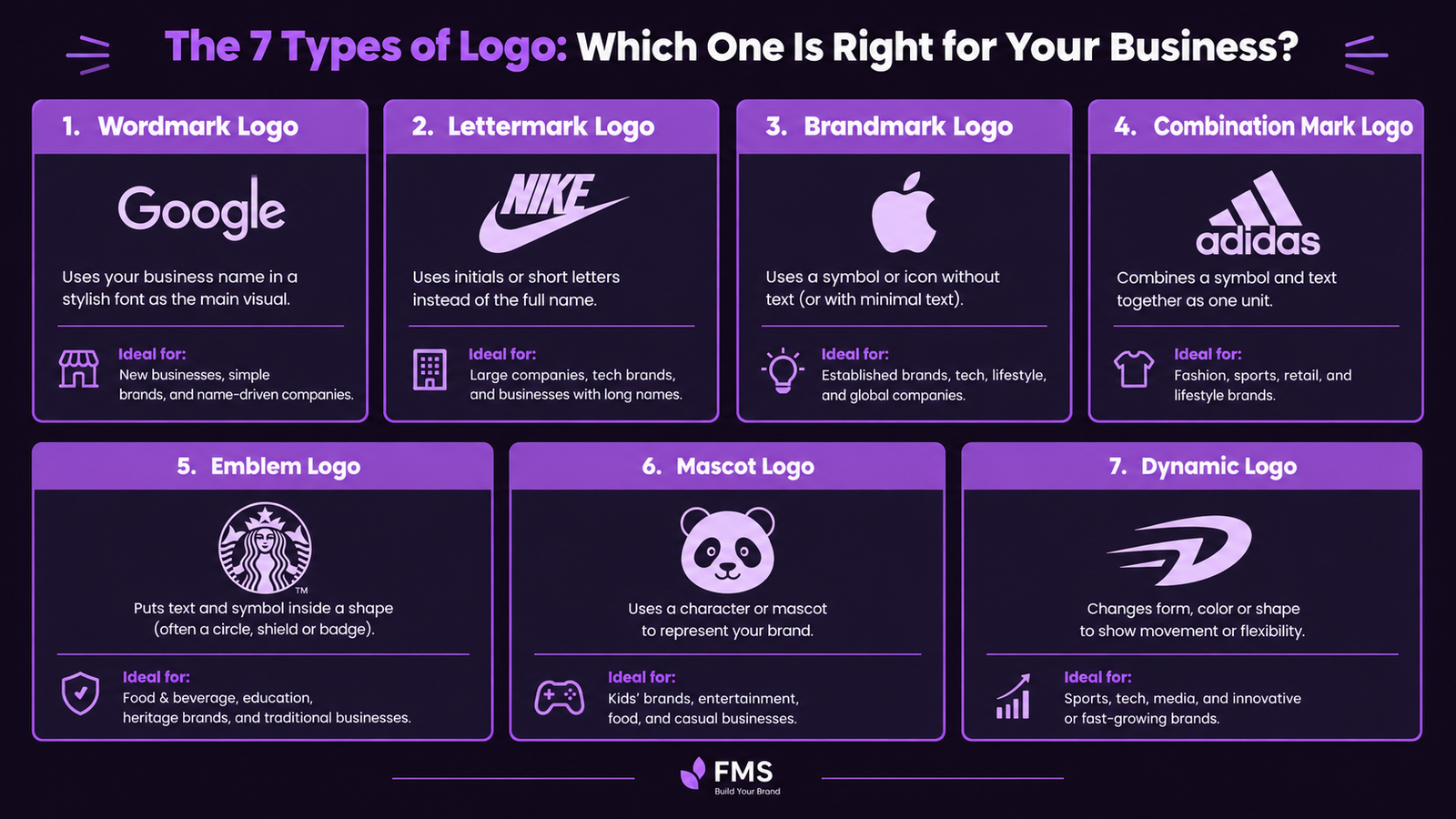
The 7 Types of Logo: Which One Is Right for Your Business?

The type of logo you choose is one of the most strategically significant decisions in brand design. Each type has different communication characteristics, different scalability properties, and different use-case suitability. Understanding the 7 types allows a strategic choice rather than an aesthetic one
TypeWhat It IsBest ForExamplesKey Limitation
WordmarkThe brand name typographically styled as the complete logoBrands with short, distinctive names; new businesses building name recognitionGoogle, Coca-Cola, FedEx, VisaLong names become unwieldy; no compact icon version
LettermarkThe brand's initials styled as the primary visual markEstablished brands with long names; professional services; B2B companiesIBM, NASA, HBO, LG, HPRequires brand awareness to be meaningful; generic initials may conflict with competitors
BrandmarkA purely visual symbol with no text, icon onlyEstablished global brands with strong visual recognition; app iconsApple, Twitter/X, Nike Swoosh, ShellRequires significant brand investment before the symbol alone carries meaning; not suitable for new businesses
Combination MarkA symbol/icon combined with a wordmark or lettermarkMost businesses, the most versatile type; the icon and text can be separated for different contextsAdidas, Amazon, Burger King, LacosteMore complex design challenge; requires a designer who can make symbol and wordmark feel unified
EmblemText and symbol integrated within a single contained shape (badge or seal style)Educational institutions, government bodies, automotive brands, heritage brands, sports teamsHarvard, Harley-Davidson, Starbucks, BMWLimited scalability at very small sizes; complex detail can disappear when reduced
MascotAn illustrated character that represents the brandConsumer brands targeting families, children, or sports audiences; food and beverage brands; brands requiring strong personalityKFC Colonel, Amul girl, Michelin Man, Kellogg's TonyCan feel childish for premium or professional brands; illustration style risks dating quickly
Dynamic / AdaptiveA logo with a variable element that changes contextually while the core mark remains constantDigital-first brands; cultural institutions; brands with multiple sub-brands or seasonal contextsGoogle Doodle, MTV, Nickelodeon, City of MelbourneRequires a strong core identity before variation is introduced; complex design and governance requirements

The 5 Principles of Effective Logo Design

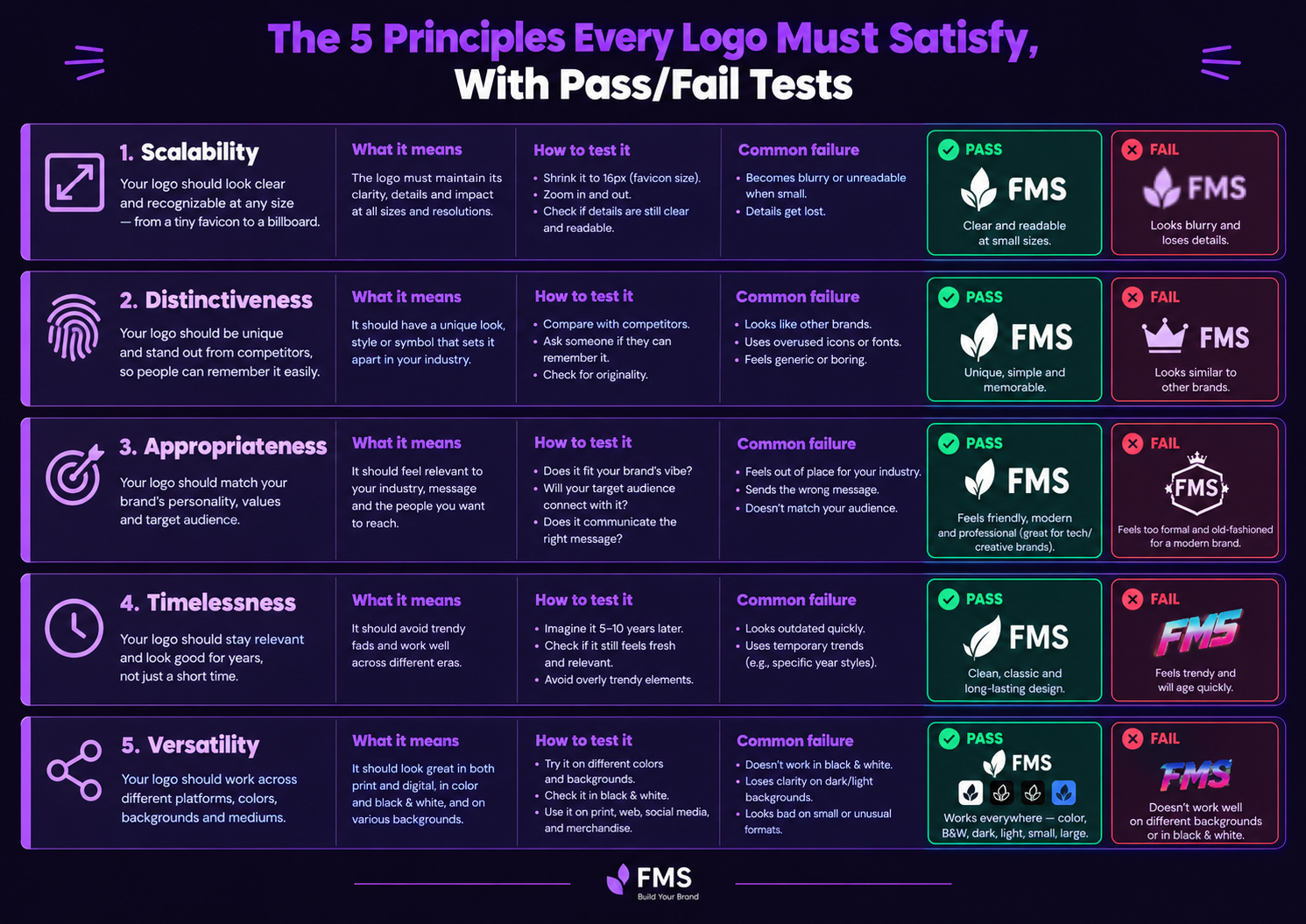
These five principles define what separates functional, enduring logo design from designs that look attractive in a presentation but fail commercially over time. Every professional logo must satisfy all five, not four, not three. A logo that fails on any single principle has a structural weakness that will produce commercial costs over time.

Principle 1: Scalability. The logo must be legible and recognisable at any size, from a 16×16px browser favicon to a 10-metre outdoor banner. Test every logo at 32×32px. If any element becomes illegible or merges with another element at this size, the logo needs to be simplified. This is the most frequently violated principle in logo design for Indian small businesses

Principle 2: Distinctiveness. The logo must be immediately differentiated from every direct competitor's logo and from the visual conventions of the category. Conduct a category audit before finalising any logo direction: collect the logos of the 10 most direct competitors and map them visually. Is the proposed logo clearly differentiated? If it could plausibly belong to any of 5 businesses in the same industry, it lacks distinctiveness.
Principle 3: Appropriateness. The logo must communicate the correct brand identity design guide
Principle 4: Timelessness. The logo must be designed to remain commercially effective for 10+ years without requiring a major redesign. Avoid design elements that are specific to current trends: gradient styles that are fashionable this year, illustration techniques that reference a specific cultural moment, or typefaces so closely associated with the current era that they will look dated in 5 years.
Principle 5: Versatility. The logo must work in full colour, reversed white on dark backgrounds, black on white, and single colour. Design the logo in black and white first, if it does not communicate clearly without colour, the underlying design is not strong enough. Every logo should be produced in these versions: full colour, reversed (white), monochrome (black), and single brand-colour versions.
Principle 5: Versatility. The logo must work in full colour, reversed white on dark backgrounds, black on white, and single colour. Design the logo in black and white first, if it does not communicate clearly without colour, the underlying design is not strong enough. Every logo should be produced in these versions: full colour, reversed (white), monochrome (black), and single brand-colour versions

Logo Psychology: How Shape, Colour, and Typeface Signal Meaning

Every visual element in a logo, its overall shape, the geometry of individual design elements, the typeface selected for the wordmark, the colour palette, communicates specific psychological associations before any text is read or any brand context is processed. Understanding these associations enables strategic design choices rather than aesthetic guesse
Shape psychology: Circles and curves communicate continuity, community, warmth, and approachability. Sharp angles and geometric precision communicate innovation, modernity, efficiency, and authority. Triangles communicate direction, movement, and ambition. Horizontal lines communicate stability and calm. Vertical lines communicate strength, growth, and confidence. Asymmetry communicates dynamism and creativity; symmetry communicates stability and tradition
Colour psychology in logos: Deep navy communicates trust, authority, and professional expertise. Red communicates energy, urgency, and power, and carries specific auspiciousness associations in Indian cultural contexts. Purple communicates luxury, creativity, and wisdom. Green communicates growth, health, and prosperity. Black communicates sophistication and premium quality. For the complete colour psychology framework with Indian cultural context, see our colour theory in design guide
Typeface psychology in logos: Serif typefaces (those with small horizontal strokes at letterform ends) communicate authority, tradition, and established expertise. Geometric sans-serif typefaces communicate modernity, precision, and innovation. Humanist sans-serif typefaces communicate approachability, warmth, and accessibility. Script typefaces communicate personality, creativity, and artisanal quality. For the complete typography framework, see our typography in design guide

The Complete Logo Design Process

Professional logo design is a structured problem-solving process, not a creative session. The following 6-phase process produces logos that are strategically grounded, commercially effective, and built to last.
Phase 1: Strategic Discovery. Document the brand's positioning, target audience, personality attributes, and competitive landscape before any design begins. The single most common cause of logo design failure is beginning visual work without a documented strategic brief. The discovery phase answers: what must this logo communicate, to whom, and what must it differentiate from?
Phase 2: Competitive Audit. Collect the logos of the 8–12 most direct competitors. Map them visually, which colour families dominate? Which visual approaches are overused? Which types of logos are absent from the competitive landscape? This audit defines the visual territory available for distinctive differentiation and prevents accidentally designing a logo that resembles a competitor's.
Phase 3: Concept Development. Produce 2–3 distinct visual directions, each representing a coherent, internally consistent expression of the brand strategy. Each direction should be meaningfully different, not variations on the same idea. Present each direction with a brief explanation of the design rationale connecting visual choices to strategic objectives.
Phase 4: Refinement. Develop the selected direction across all required versions: symbol refinement, typeface selection, colour palette application, positive and negative versions, proportional relationships between elements. At this stage, test the logo against the 5 principles and at multiple scales including 32px favicon scale.
Phase 5: System Building. Produce the complete responsive logo system (see the following section). This includes the primary logo, secondary lockup, icon-only version, colour variations, and dark/light mode versions.
Phase 6: File Delivery and Style Guide. Deliver all logo files in the formats below, accompanied by a usage guide (minimum: logo clear space rules, approved backgrounds, prohibited uses, and colour values).

Building a Responsive Logo System

A single logo design cannot optimally serve every context it will be used in. A combination mark (symbol + wordmark) that works beautifully on a website header becomes illegible when used as a 40×40px social media profile image. A responsive logo system provides pre-designed, officially approved variants for different contexts.
  • Primary Logo (Full Lockup): the complete logo as designed, typically a combination mark with symbol and wordmark in the approved arrangement. Used on website, print materials, and any context with sufficient space
  • Secondary Logo (Alternative Lockup): the same elements in an alternative arrangement (e.g. stacked vs horizontal) for contexts where the primary arrangement does not fit
  • Compact Logo / Icon: the symbol or initial(s) isolated as a standalone mark, used at small sizes, social media profile images, app icons, favicons, watermarks on photography
  • Colour Variations: for each configuration: full colour (primary palette), reversed white (for dark backgrounds), monochrome black (for single-colour print), single brand-colour version
  • Dark and Light Mode Versions: with dark mode now the default setting for over 60% of mobile users, every logo system must include a version optimised for dark backgrounds

Logo File Formats: The Complete Delivery Package

One of the most consequential and most frequently mishandled aspects of logo delivery is the file format. Receiving only a PNG logo from a designer is not a complete delivery, it is the minimum viable output that prevents the business from using its own logo correctly in most professional contexts
FormatTypePrimary UseWhy It Matters
SVGVector (scalable)Web embedding, responsive design, social mediaInfinitely scalable with no quality loss; small file size; the most important format for web use
PNG (transparent)Raster (fixed resolution)Social media profiles, email signatures, presentations, websiteTransparent background allows placement on any colour; provide at 2× and 3× sizes (e.g. 800px, 1600px, 2400px)
AI (Adobe Illustrator)Vector (editable)Future design work, brand extensions, agency useThe master design file; required by any future designer or agency that produces brand materials
EPSVector (universal)Commercial printers, signage suppliers, merchandise manufacturersUniversal vector format; required by most commercial printers and sign companies in India
PDF (vector)Vector (portable)Print production, business cards, letterheads, any commercial printUniversally accessible vector format; always attach to print-ready files for production

How Much Does Logo Design Cost in India?

Logo design investment in India spans an enormous range. Understanding what is included at each price point enables an informed decision about where to invest based on commercial need.
Investment RangeWhat Is Typically IncludedSuitable ForKey Limitation
Free (AI generators)Auto-generated logo from template; PNG download; no vector filesPre-launch idea validation onlyNo strategic input; generic output identical to thousands of other businesses; no print-ready files
INR 3,000–15,0002–3 logo concepts; limited revisions; PNG and some vector files; freelancer on Fiverr or similarEarly-stage businesses with very limited budgetsNo strategic discovery; no competitive audit; inconsistent quality; no responsive system
INR 15,000–50,000Strategic brief; 2–3 concepts; structured revisions; all vector and raster files; basic usage guideEstablished small businesses ready to professionaliseUsually no brand identity system; no full responsive logo system; limited style guide
INR 50,000–1,50,000Full discovery + competitive audit; responsive logo system; brand colour and typography; brand style guideGrowth-stage businesses and companies pitching enterprise clientsMay not include full social media template system or packaging design
INR 1,50,000–5,00,000+Complete brand identity system: logo, colour, typography, imagery, voice, full style guide, and application templatesCompanies with significant market presence; brands launching with premium positioningRequires significant time investment from both client and agency
According to MTHD Marketing's ROI of branding research, businesses that invest in professional branding typically see payback on that investment within 6–18 months through improved conversion rates, reduced discounting, and higher-quality lead generation. The commercial framing: a professional logo that enables 15% higher conversion rates pays for itself in months for most established Indian SMEs.

The 7 Tests Every Logo Must Pass Before Launch

Professional logo designers do not consider a logo complete until it has passed a rigorous practical evaluation. These 7 tests should be conducted before any logo is approved for use.
  • The Favicon Test: scale the logo to 32×32px, all elements must remain legible and the logo must be recognisable as a brand identifier at this size
  • The Monochrome Test: convert the logo to pure black on white, if the design depends on colour to work, it fails; a strong logo communicates its form without colour
  • The Reverse Test: display the logo reversed (white on the brand's primary dark colour), this will be needed for every dark background application
  • The Squint Test: squint at the logo until details blur, the primary shape and visual impression should remain clear; if the design dissolves into visual noise, it is too complex
  • The Competitive Test: place the logo in a grid with the 10 closest competitors' logos, is it immediately differentiated, or does it blend into the competitive visual landscape?
  • The Audience Test: show the logo without brand context to 5 members of the target audience; ask them to describe the business behind it, their descriptions should align with the brand's intended positioning
  • The Reproduction Test: produce the logo on the 3 most important physical applications (business card, pen, tote bag), many logos look perfect on screen but fail on embroidery, screen printing, or engraving

Need Your Logo Design Evaluated Against These 7 Tests?

Futuristic Marketing Services offers a free 30-minute logo review for Indian businesses, assessing your current logo against all 5 principles and 7 tests, and identifying specific improvements that would increase its commercial effectiveness.

Book a Free Logo Review

Frequently Asked Questions

Q. What makes a good logo design?

A. A good logo design satisfies all 5 commercial principles simultaneously: scalability (legible from favicon to billboard), distinctiveness (immediately differentiated from all competitors), appropriateness (communicates the right personality for the brand's positioning and price point), timelessness (designed to remain relevant for 10+ years), and versatility (works in full colour, monochrome, reversed, and single colour). According to Creative Bloq's logo design research, 60% of consumers avoid brands whose logos look outdated or unprofessional, logo quality is a direct commercial signal affecting acquisition rates.

Q. What are the 7 types of logos?

A. The 7 primary logo types: (1) Wordmark, the brand name typographically styled as the complete logo (Google, Coca-Cola); (2) Lettermark, the brand's initials as the primary visual mark (IBM, NASA); (3) Brandmark, a purely visual symbol with no text (Apple's apple, Nike's Swoosh); (4) Combination Mark, symbol combined with a wordmark (Adidas, Amazon); (5) Emblem, text and symbol integrated within a contained shape (Starbucks, Harvard); (6) Mascot, an illustrated character representing the brand (KFC Colonel, Amul girl); (7) Dynamic/Adaptive, a logo with a variable element that changes contextually while the core mark remains constant (Google Doodles). Combination marks are the most common choice for Indian businesses because they provide both an iconic symbol and a name-identifying wordmark, with the flexibility to use each independently.

Q. How much does logo design cost in India?

A. Logo design investment in India ranges from free (AI generators with significant quality limitations) to INR 5,00,000+ (complete brand identity system with responsive logo system). The practical benchmark for a professional logo with commercial effectiveness: INR 15,000–50,000 from an experienced designer for a strategic logo with full vector file delivery. For a complete brand identity system (logo, colour palette, typography, imagery direction, and style guide), expect INR 50,000–1,50,000 from a professional agency. The framing: a professional logo investment typically pays back within 6–18 months through improved conversion and premium pricing ability, according to MTHD Marketing's branding ROI research.

Q. What file formats should a logo be delivered in?

A. A complete professional logo delivery package includes: SVG (for web embedding, infinitely scalable, small file size), PNG with transparent background at 2× and 3× sizes (for social media, email signatures, presentations), AI or EPS (the editable vector master file required by any future designer or commercial printer), PDF vector (for print production files), and a brand guidelines PDF (documenting colour values, clear space rules, approved uses, and prohibited uses). Receiving only a PNG file from a designer is not a complete delivery and will prevent the logo from being used correctly in most professional contexts.

Q. What is a responsive logo system?

A. A responsive logo system is a set of pre-designed, officially approved logo variations for different contexts and sizes: the primary logo (full combination mark with symbol and wordmark), a secondary lockup (alternative arrangement for different aspect ratio contexts), a compact icon (symbol or initials only for small-size applications like favicons and social profile images), and colour variations (full colour, reversed white, monochrome black, single brand colour) for each configuration. A responsive logo system ensures that the brand is represented correctly at every touchpoint rather than having the single logo awkwardly scaled or cropped to fit different contexts.

Q. When should I rebrand my logo?

A. Consider rebranding your logo when: (1) the logo visually positions the business below its current pricing level, a logo designed for a startup stage business can hold back a growth-stage company; (2) the business has pivoted significantly and the logo communicates the wrong category or positioning; (3) a major competitor has adopted a similar visual identity, creating confusion; (4) the logo fails the 7 tests above, particularly the favicon test or the competitive differentiation test; (5) the business is about to pursue enterprise clients or significant investment where brand professionalism is evaluated; or (6) the logo uses design elements (specific gradients, illustration styles, typefaces) that have dated in the 10 years since it was designed.

Far far away, behind the word mountains, far from the countries Vokalia and Consonantia, there live the blind texts. Separated they live in Bookmarksgrove right at the coast

Should businesses use Instagram Stories for customer service?

Yes. Instagram Stories are one of the most natural entry points for customer service conversations because the casual, conversational format of Stories creates a lower barrier to reaching out via DM than a formal contact form or email. Question box Stories that invite followers to ask anything about the business's products or services generate both content ideas and genuine customer service interactions that can be addressed directly and then reshared as FAQ-style content for future viewers. Businesses that use Stories as an accessible customer service channel and respond to DMs within 24 hours build the responsiveness reputation that 76% of Instagram users say they actively consider when evaluating whether to engage with or purchase from a brand.

What are Instagram Story Highlights and how should businesses use them?

Story Highlights are curated collections of past Stories that remain permanently visible on a business profile below the bio, accessible to any visitor regardless of when the original Stories were published. For businesses, Highlights function as a permanent information architecture that new profile visitors explore before deciding whether to follow. The most effective business Highlights categories are Services (what the business offers with links to each), Results (client testimonials and outcome evidence), Process (how working with the business works from enquiry to delivery), About (team introduction and brand story), and FAQ (common pre-purchase questions addressed in individual frames). Custom-designed cover images using brand colors tie the Highlights row into a cohesive visual brand identity.

How do Instagram Stories interactive stickers work for business?

Interactive stickers are embedded within Story frames and prompt specific viewer responses: polls require a single tap to select between two options, question boxes accept text input that sends directly to the account's DM inbox, quiz stickers present multiple choice questions with a reveal of the correct answer, emoji sliders invite opinion ratings on a sliding scale, and countdown stickers display a live countdown to a specific date or time with a "Remind me" option that sends an automatic notification to the viewer when the time arrives. Each interaction generates an engagement signal that Instagram uses to prioritize the account's Stories position in followers' queues, making interactive stickers both a conversion tool and an algorithmic advantage for accounts that use them consistently.

How do you measure Instagram Stories performance for business?

Measure Stories performance through four key metrics in Instagram Insights. Reach shows how many unique accounts viewed the Story sequence. Tap-forward rate shows what proportion of viewers skipped to the next frame, a high tap-forward rate suggests the frame was not compelling enough to hold attention. Exit rate shows where viewers left the Story sequence entirely, high exit rates on specific frames indicate that frame lost the audience's interest. Link clicks measure how many viewers tapped through to the destination URL on link Story frames. Review these metrics weekly rather than daily to identify trends across Story types and make specific adjustments to which formats and topics generate the strongest engagement and conversion outcomes.

Do Instagram Stories affect the performance of feed posts and Reels?

Yes. Instagram Stories contribute to overall account health signals that the algorithm considers when distributing feed posts and Reels. An account that publishes daily Stories maintains a higher baseline engagement rate from its existing audience, because daily Stories interaction keeps the account relationship active between feed post publications. This higher baseline engagement rate tells the algorithm that the account's audience is genuinely interested in its content, which improves the initial distribution the algorithm provides to newly published Reels and feed posts. Additionally, resharing a newly published Reel to Stories within the first 30 minutes of publication amplifies the early engagement signals that determine the Reel's broader algorithmic distribution, making Stories reshares a meaningful component of every Reel's launch strategy.

Q. Can I trademark my logo in India?

A. Yes. Logos are one of the most common forms of registered trademark in India. The process: file a trademark application with the Trademark Registry of India (part of the Office of the Controller General of Patents, Designs and Trade Marks). Include a clear reproduction of the logo, specify the goods and services classes it covers, and pay the filing fee (currently INR 4,500 per class for individuals and small businesses; INR 9,000 for others). The registration process typically takes 18–24 months but rights are established from the filing date. Using a professional designer who can confirm originality (no copied elements from other logos) is a prerequisite for successful registration.

Build a Logo That Passes All 7 Tests and Grows With Your Business

At Futuristic Marketing Services, we design logos within a complete strategic framework, competitive audit, discovery, 2–3 concept directions, full responsive system, and delivery in all professional file formats with a brand style guide.

Start Your Logo Design Project
Conclusion

A logo is the most repeatedly deployed visual decision a business makes. Getting it right, designing it to pass all 5 principles and all 7 tests, delivering it in the correct file formats, building it into a responsive system, and positioning it within a complete brand identity design system, produces a compounding commercial return over the full lifespan of the brand. Getting it wrong costs the business every day it is in use.
For most Indian SMEs, the highest-ROI starting point is a professional combination mark logo (INR 15,000–50,000) with a full file delivery package and a basic usage guide. As the business scales, the complete brand identity system (logo + colour + typography + imagery + voice + style guide) becomes the next investment that unlocks enterprise client access and premium pricing ability. Our graphic design services in Indore cover both stages of this journey.
Share this post :
Picture of Devyansh Tripathi
Devyansh Tripathi

Devyansh Tripathi is a digital marketing strategist with over 5 years of hands-on experience in helping brands achieve growth through tailored, data-driven marketing solutions. With a deep understanding of SEO, content strategy, and social media dynamics, Devyansh specializes in creating results-oriented campaigns that drive both brand awareness and conversion.

All Posts