
Topical Authority SEO: How to Become the Go-To Expert Source in Your Niche in 2026

topical authority seo

Topical authority is the state of being recognised by Google as a comprehensive, expert source for a specific topic area. It is earned when a website systematically covers every important aspect of a subject through interconnected content, so that Google’s AI systems evaluate the site as a reliable, complete resource rather than a partial or inconsistent one. Sites with strong topical authority rank faster for new content, recover from algorithm updates more quickly, and earn higher AI Overview citation rates than sites without it.

This guide covers the complete topical authority building framework for 2026: how Google's AI systems evaluate topical coverage, the content cluster architecture that builds authority systematically, how to identify topic gaps suppressing your authority signals, the internal linking system that communicates cluster relationships to Google, entity signals that amplify topical authority for AI citation, and the topical authority audit process that measures your current coverage depth against competitors. Use alongside our SEO content strategy guide, keyword research guide, and internal linking strategy guide for the complete content architecture programme.

Key Takeaways

  • According to Ahrefs, sites with comprehensive topical coverage rank higher and faster for new content in the same topic area, each new article benefits from the authority already built by the surrounding cluster
  • According to Google, MUM and Neural Matching AI systems evaluate comprehensive topic coverage as a quality signal when determining which pages best satisfy complex queries
  • Topical authority requires covering the entire topic landscape, not just popular keywords, including informational, commercial, and transactional intent variations across every subtopic
  • The content cluster architecture (pillar page + cluster articles + internal links forming a network) is the structural mechanism through which topical authority is communicated to Google's crawlers
  • Entity signals, Organization schema with sameAs links, Knowledge Panel presence, and consistent brand mentions across authoritative publications, amplify topical authority signals for AI system citation selection
  • A topical authority gap audit comparing your content coverage to competitors who rank for your target keywords reveals the specific topics whose absence is suppressing your authority signals most severely

Want to Become the Definitive Authority Source in Your Niche?

Futuristic Marketing Services builds complete topical authority programmes, topic landscape mapping, cluster architecture design, content production scheduling, and internal linking implementation, that establish your site as the go-to resource Google trusts for your subject area.

Get Your Topical Authority Programme Built

hello@futuristicmarketingservices.com  |  +91 8518024201
How Google Evaluates Topical Authority

Google's topical authority evaluation operates through three interconnected AI systems. Neural Matching identifies the semantic concepts and entity relationships within your content and determines whether your coverage is comprehensive or partial for your topic area. MUM (Multitask Unified Model) evaluates whether your site can authoritatively answer the full range of questions a user might have about a topic across different formats and from different angles. The Helpful Content System classifies sites based on their overall content quality and whether they demonstrate genuine expert knowledge of their topic area across all published pages.
The practical implication is that topical authority is a site-wide and topic-wide signal, not a per-page ranking factor. A single excellent article does not build topical authority. A systematic library of interlinked articles covering all important aspects of a topic, maintained to a consistent quality standard, does. According to SEMrush, topical authority is the most durable competitive SEO advantage available because it takes sustained, consistent investment to build and is extremely difficult for competitors to replicate quickly.

The Content Cluster Architecture

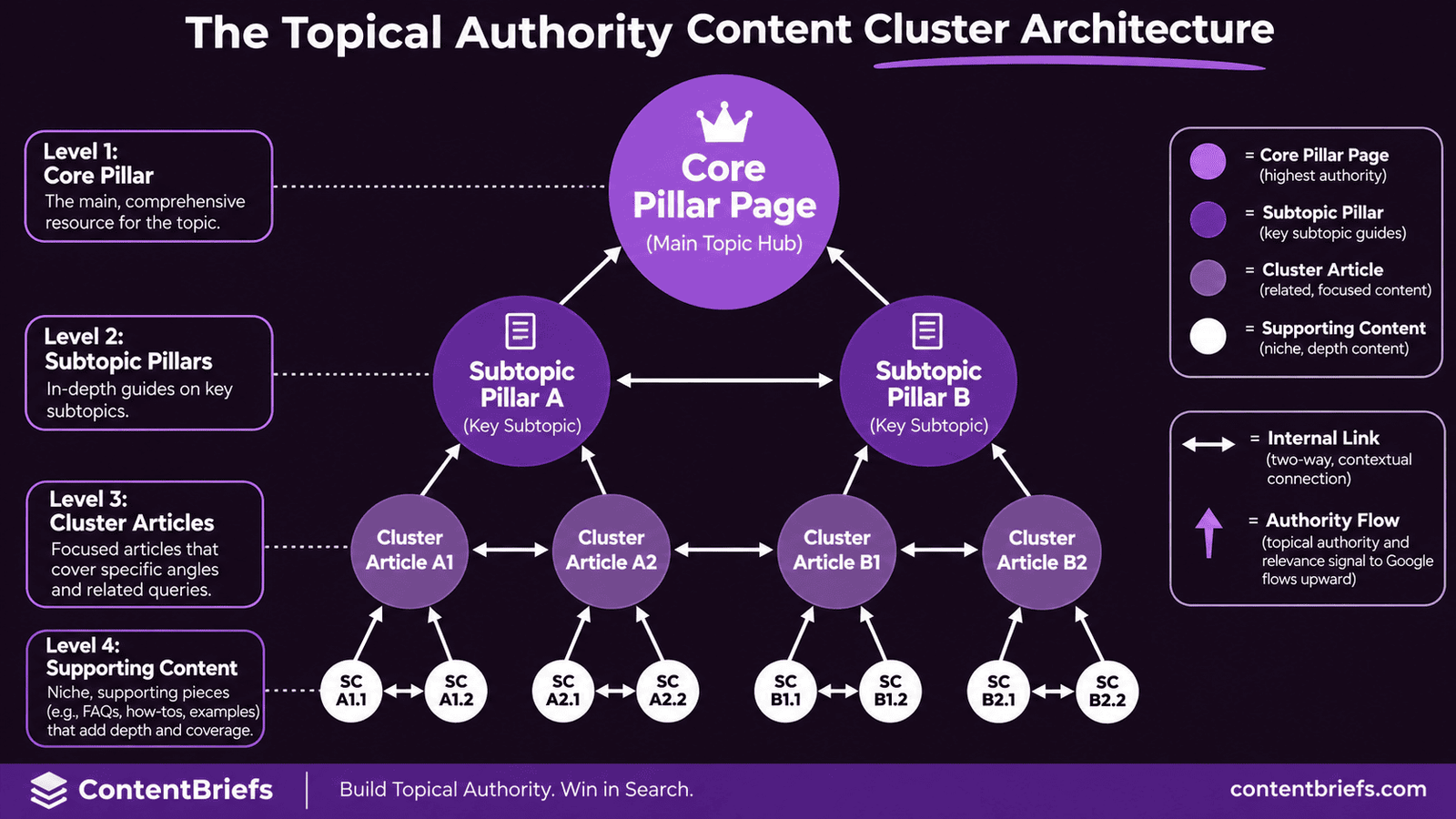
The content cluster is the structural mechanism for building topical authority. Every cluster has three levels: a pillar page (a comprehensive overview of the subtopic area), cluster articles (specific deep-dives into individual questions, processes, or comparisons within that subtopic), and supporting content (short definitions, FAQs, and glossary entries that cover peripheral questions). All three levels are interconnected through systematic internal linking that communicates the cluster relationship to Google's crawlers.
Cluster LevelContent TypePrimary Keyword TypeWord Count RangeInternal Linking Role
Core PillarSingle comprehensive overview of entire topic areaShort head term, high volume3,000 to 5,000 wordsReceives links from all cluster articles; links to subtopic pillars
Subtopic PillarComprehensive overview of one major category within the core topicMedium-tail keyword, moderate volume2,000 to 3,500 wordsReceives links from cluster articles; links to core pillar and related cluster articles
Cluster ArticleDeep-dive on a specific question, process, or comparisonLong-tail keyword, specific intent1,200 to 2,500 wordsLinks to parent subtopic pillar and core pillar; receives links from related cluster articles
Supporting ContentShort definition, FAQ expansion, or glossary entryQuestion keyword, very specific400 to 800 wordsLinks to parent cluster article and subtopic pillar

How to Map Your Topical Landscape

Mapping your topical landscape means identifying every question, subtopic, format, and intent variation that users search for within your core topic area. This map becomes the complete specification for your content cluster architecture, every item on the map is a content opportunity that either already exists on your site or needs to be created to close a coverage gap suppressing your authority signals.
Use four sources to map your topical landscape comprehensively: Ahrefs Keywords Explorer (enter your core topic and export all keyword variations, sorted by topic cluster using the Topics report), Google's People Also Ask boxes (reveal the specific questions users ask about your topic area in natural language), competitor content libraries (Ahrefs Content Gap tool with 3 competitor domains reveals topics they cover that you do not), and AI query testing (ask ChatGPT and Perplexity what subtopics and questions an expert should cover for your topic area, their responses reflect the questions real users ask these systems). Our keyword research guide covers the complete discovery process for each source.

Identifying and Closing Topical Coverage Gaps

A topical coverage gap is any important question, subtopic, or intent variation within your topic area that your site does not currently address. Coverage gaps are the primary structural cause of plateaued topical authority, Google cannot evaluate you as a comprehensive expert on a subject when significant aspects of that subject are absent from your content library.
Run a coverage gap audit using three steps: export your complete content inventory (all indexed pages from Screaming Frog), compare against your topical landscape map to identify missing topics, and prioritise gaps by their search volume and the average KD of competitor pages covering that gap. Topics with high search volume and competitor pages at moderate KD that you completely lack are the highest-priority gap closures, they represent significant authority gaps that are also achievable ranking opportunities given your current domain authority.
After identifying gaps, add them to your content production calendar in cluster batches rather than randomly. Closing all gaps within one subtopic cluster before moving to the next builds concentrated authority faster than spreading gap closure across multiple subtopics simultaneously. Google's topical evaluation responds more strongly to comprehensive coverage of one area than to partial coverage across many areas.

Internal Linking for Topical Authority

Internal linking is the mechanism through which topical authority is communicated to Google. A cluster of articles covering related topics becomes a topical authority signal only when those articles are systematically linked to each other, creating the network structure that allows Google's crawlers to map the relationships between content pieces and evaluate the coverage depth of the cluster as a whole.
The internal linking rules for topical authority: every cluster article must link to its parent subtopic pillar page (reinforcing the topic relationship), every subtopic pillar must link to the core pillar (reinforcing the site's central topic focus), and related cluster articles must link to each other where genuinely contextually relevant (creating the network density that signals comprehensive coverage). Use descriptive partial-match anchor text for all internal links, the anchor text is an additional relevance signal that reinforces topical relationships. Our complete internal linking strategy guide covers the full architecture and anchor text framework.

Entity Signals That Amplify Topical Authority

Topical authority is strengthened by entity signals, the external recognition of your brand as an authoritative source on specific topics. For AI systems like Google Gemini, ChatGPT, and Perplexity, entity recognition through schema markup and external mentions is a prerequisite for citation selection on topically relevant queries.
Build entity signals for topical authority through three actions: implement Organization schema with sameAs links and a knowsAbout property listing your specific topic areas (our schema markup guide covers the full implementation), establish author Person schema with sameAs links to professional profiles for every named author contributing expert content, and earn external coverage in industry publications that describe your brand specifically in your topic area's terminology, these external brand-topic associations are how AI systems learn to associate your entity with your subject matter expertise. Our eeat guide covers the complete entity establishment framework.

Build the Topical Authority That Makes Every New Article Rank Faster

Our content strategy team maps your complete topical landscape, designs your cluster architecture, creates the production schedule that closes coverage gaps systematically, and implements the internal linking structure that communicates your authority to Google.

Start Your Topical Authority Programme

hello@futuristicmarketingservices.com  |  +91 8518024201

Frequently Asked Questions About Topical Authority SEO

What is topical authority in SEO?

Topical authority is the state of being recognised by Google as a comprehensive, expert source for a specific topic area. It is earned through systematic, interconnected content coverage of every important aspect of a subject, so Google's AI systems (particularly MUM and Neural Matching) evaluate the site as a reliable, complete resource. According to Ahrefs, sites with strong topical authority rank higher and faster for new content in the same topic area because each new article benefits from the authority already built by the surrounding cluster.

How do I build topical authority for SEO?

Build topical authority through four parallel actions: (1) map your complete topical landscape using Ahrefs Keywords Explorer, PAA boxes, and competitor content gap analysis; (2) structure content in clusters with a pillar page and multiple cluster articles covering every subtopic question; (3) implement systematic internal linking connecting all cluster articles to each other and to their pillar page; (4) build entity signals through Organization and Person schema with sameAs links and earned coverage in industry publications describing your brand in your topic's terminology.

What is a content cluster and how does it build topical authority?

A content cluster is a group of interlinked articles comprehensively covering one topic area: a pillar page (comprehensive overview), multiple cluster articles (specific questions and subtopics), and supporting content (short definitions and FAQs). All articles link systematically to each other through the internal linking architecture. The cluster structure tells Google that your site covers the topic comprehensively from multiple angles and at multiple depth levels, the pattern that characterises genuine expert sources rather than sites with isolated articles on popular topics.

How long does it take to build topical authority?

Building meaningful topical authority typically takes 6 to 18 months of consistent content production. The timeline depends on three factors: the number of articles required to achieve comprehensive coverage (more complex topics require more content), the publishing frequency (more articles per month build authority faster), and the starting domain authority (higher DR sites see topical authority benefits emerge faster as new content ranks more quickly). Early signals, new content ranking faster than initial articles did, typically appear between months 4 and 8 for consistently publishing sites.

How many articles do I need for topical authority?

The number of articles needed for topical authority varies by topic complexity. A simple topic area might require 15 to 25 articles across a pillar page and two or three subtopic clusters. A complex, broad topic area might require 50 to 100 or more articles to achieve comprehensive coverage. The benchmark is coverage completeness rather than a specific article count, audit your content against your topical landscape map and continue producing until every significant query in your topic area has a dedicated page targeting it. Competitor content libraries provide the most reliable benchmark for the coverage depth required in your specific niche.

Is topical authority the same as domain authority?

Topical authority and domain authority are related but distinct signals. Domain authority (DR in Ahrefs) is a measure of your site's overall backlink strength, how many authoritative sites link to you across all topics. Topical authority is a measure of how comprehensively and expertly you cover a specific topic area through content, regardless of total backlink volume. A site with DR 25 but comprehensive, expert coverage of a narrow niche can outrank a DR 60 site with thin coverage of the same niche for queries within that topic area.

How do I measure my topical authority?

Measure topical authority through four signals: (1) average ranking position trend for your target topic keywords in Ahrefs rank tracker (improving positions as content library grows indicate building authority); (2) keyword coverage breadth, how many unique keywords your domain ranks for within your topic area (expanding coverage indicates growing topical recognition); (3) new content ranking speed, how quickly newly published articles in your cluster achieve page-one positions compared to earlier content (faster ranking indicates established topical authority); (4) GSC impressions for your core topic queries (growing impressions indicate Google is increasingly surfacing your content for topic-related queries).

What is the difference between topical authority and keyword ranking?

Keyword ranking is the position your specific page holds for a specific query. Topical authority is the broader signal that makes your entire site rank faster and more consistently across all queries within your topic area. A page can rank for a specific keyword without its site having topical authority, but this ranking will be fragile, requiring continuous effort to maintain against competitors with stronger topical signals. Topical authority makes individual keyword rankings more stable, helps new content rank faster, and extends ranking reach to long-tail variations without additional optimisation effort. Our SEO strategy guide covers how to build topical authority as a component of the broader organic growth programme.

Become the Definitive Expert Source in Your Niche, Not Just Another Website

At Futuristic Marketing Services, we build topical authority programmes that transform content libraries from collections of isolated articles into interconnected expert systems that Google recognises and trusts as comprehensive sources on your subject area.

Talk to Our Topical Authority Specialists

hello@futuristicmarketingservices.com  |  +91 8518024201
Conclusion

Topical authority is the most durable competitive advantage in SEO because it cannot be replicated quickly. Once a site has established comprehensive, expert coverage of a topic area with strong internal linking and entity signals, new entrants to the same niche must invest months or years to match that coverage depth, giving established topical authorities a compounding structural advantage that deepens with every new article published.
Build topical authority by first mapping your complete topical landscape using the tools covered in our keyword research guide, then designing your cluster architecture and content calendar using our SEO content strategy guide, implementing the internal linking framework from our internal linking strategy guide, and adding the entity signals covered in our schema markup guide and eeat guide. Execute this programme consistently over 12 to 18 months and measure authority growth monthly through keyword coverage expansion and new content ranking velocity.
Share this post :
Picture of Devyansh Tripathi
Devyansh Tripathi

Devyansh Tripathi is a digital marketing strategist with over 5 years of hands-on experience in helping brands achieve growth through tailored, data-driven marketing solutions. With a deep understanding of SEO, content strategy, and social media dynamics, Devyansh specializes in creating results-oriented campaigns that drive both brand awareness and conversion.

All Posts