WooCommerce and Shopify are the two most widely evaluated eCommerce platforms globally, WooCommerce powers 28% of all eCommerce stores and Shopify powers 21%, according to BuiltWith data. They represent fundamentally different philosophies: WooCommerce is open-source, self-hosted software built on WordPress that offers unlimited flexibility with no platform fees; Shopify is a managed SaaS platform that offers speed and simplicity at the cost of code ownership and ongoing subscription fees. Neither is universally better, the correct choice depends entirely on your growth strategy, technical resource, and commercial priorities.
Key Takeaways
- According to BuiltWith, WooCommerce powers 28% and Shopify powers 21% of all global eCommerce stores. WooCommerce is the market leader because it combines 0% platform transaction fees, complete data ownership, superior SEO ceiling, and unlimited flexibility on a platform already powering 43% of all websites.
- WooCommerce charges 0% platform transaction fees, you pay only your payment gateway processing fee (Stripe UK: 1.4% plus 30p for European cards). Shopify charges an additional 0.5 to 2% per transaction if you do not use Shopify Payments. On £500,000 annual revenue, the 2% fee difference is £10,000 per year, a significant ongoing cost advantage for WooCommerce at volume.
- WooCommerce on managed WordPress hosting achieves 75 to 90 or higher on mobile Lighthouse, enabling Good Core Web Vitals status. Shopify on standard themes typically achieves 65 to 80. The performance gap matters because Core Web Vitals are confirmed Google ranking signals, better performance directly contributes to organic ranking advantage over Shopify competitors.
- Shopify is significantly easier to launch and manage without technical resource. Its managed infrastructure handles hosting, security, and software updates. WooCommerce requires: a WordPress hosting account; plugin and theme management; regular updates and maintenance; and server-level configuration for performance. This technical overhead is the primary reason many businesses choose Shopify.
- WooCommerce is the stronger platform when: organic search is the primary customer acquisition channel; subscription or B2B pricing is complex; 0% platform fees matter at revenue volume; or complete code and data ownership is required. Shopify is stronger when: fastest time to a live store is the priority; the team has no technical resource for ongoing management; or the product range is straightforward with standard checkout requirements.
- Migrating from Shopify to WooCommerce (or vice versa) after the store has established organic rankings requires professional website migration SEO management, redirect mapping, canonical architecture, and 90-day post-migration monitoring. The cost and disruption of migration makes the initial platform choice commercially significant beyond the build cost.
- Both platforms support the same payment gateways (Stripe, PayPal, Klarna, Worldpay). The practical payment gateway difference: Shopify has a financial incentive to push Shopify Payments (their own gateway) through lower transaction fees; WooCommerce has no payment gateway preference, choose the best gateway for your business.
Platform Decision
Get an Honest Platform Assessment for Your eCommerce Project
Futuristic Marketing Services provides eCommerce platform consultations, matching WooCommerce or Shopify to your specific growth strategy, technical resource, and commercial requirements.
Get Your Platform AssessmentWooCommerce vs Shopify: The Head-to-Head Comparison
| Factor | WooCommerce | Shopify | Winner |
|---|---|---|---|
| Platform cost | Free, pay only hosting and extensions | $39 to $399/month subscription | WooCommerce (no platform fee) |
| Transaction fees | 0%, gateway fee only (~1.4% + 30p with Stripe) | 0% with Shopify Payments; 0.5 to 2% with third-party gateway | WooCommerce (0% always) |
| Code and data ownership | Complete, all files, database, customer data fully owned | None, hosted on Shopify infrastructure | WooCommerce (full ownership) |
| Setup and launch speed | Moderate, hosting, WordPress, WooCommerce setup required | Fast, account to live store in hours | Shopify (significantly faster) |
| Ongoing technical management | Required, updates, hosting management, plugin configuration | Managed by Shopify, minimal technical overhead | Shopify (lower maintenance burden) |
| SEO ceiling (mobile Lighthouse) | 75 to 90 or higher on managed hosting | 65 to 80 on standard themes | WooCommerce (better performance) |
| eCommerce feature depth | Unlimited via 400 or more WooCommerce extensions | 8,000 or more apps, some features built-in natively | Draw, both have deep ecosystems |
| B2B and wholesale pricing | Full support via WooCommerce B2B plugins | Limited, B2B apps required; less mature | WooCommerce (more flexible) |
| Subscription products | WooCommerce Subscriptions (£20/month) | Recharge app or native subscriptions | Draw, both support subscriptions |
| Content marketing and blog | Full WordPress CMS, unmatched content capability | Functional blog, adequate but less capable | WooCommerce (WordPress CMS advantage) |
| Support | Community, extension developers, hosting provider | 24/7 Shopify support; dedicated support for Plus | Shopify (more structured support) |
| Scalability | Scales to very large catalogues on correct infrastructure | Scales natively, Shopify Plus for enterprise | Draw, both scale with correct investment |
True Cost Comparison: 5-Year Total Cost of Ownership
| Cost Element | WooCommerce (5 years) | Shopify Basic (5 years) | Shopify Advanced (5 years) |
|---|---|---|---|
| Platform subscription | £0 | ~£2,340 (£39/month) | ~£11,940 (£199/month) |
| Hosting and infrastructure | £1,500 to £9,000 (managed WordPress) | Included in plan | Included in plan |
| Premium extensions and apps | £1,500 to £4,000 | £2,000 to £6,000 | £2,000 to £6,000 |
| Transaction fees (£200k/year revenue) | £0 (gateway fee only) | 0% with Shopify Payments OR £2,000/year (2% fee) without | 0% with Shopify Payments OR £1,000/year (1% fee) without |
| Maintenance and care plan | £4,800 to £18,000 (£80 to £300/month) | Minimal, Shopify managed (£0 to £1,200) | Minimal, Shopify managed |
| Developer support (ongoing) | £1,200 to £6,000/year (estimated) | £600 to £3,000/year (estimated) | Lower need, Shopify native features |
| Estimated 5-year total | £10,000 to £37,000 | £7,000 to £23,000 (with Shopify Payments) | £18,000 to £35,000 |
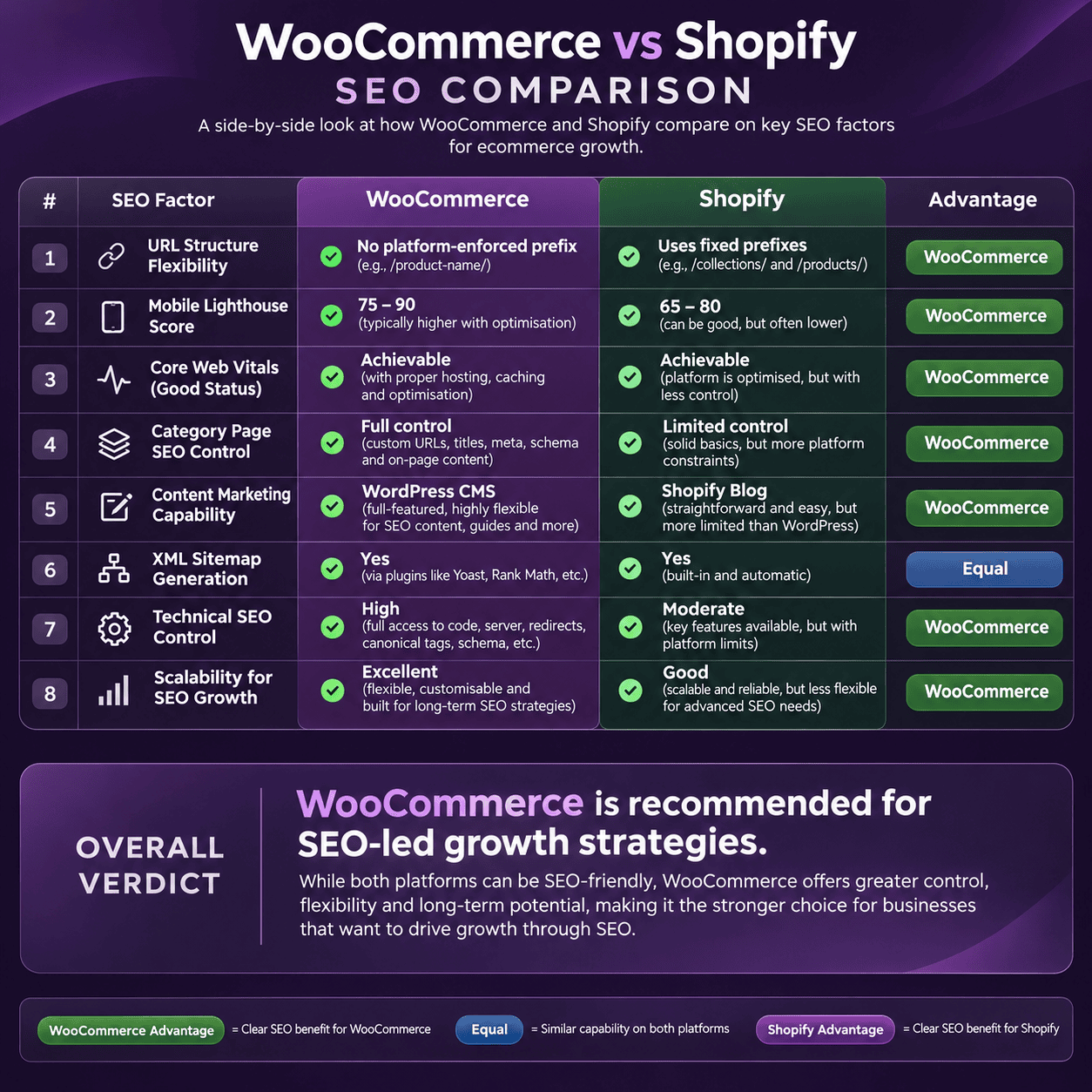
SEO Comparison: WooCommerce vs Shopify
| SEO Factor | WooCommerce | Shopify |
|---|---|---|
| URL structure | Complete control, any URL structure possible | Good, clean URLs but /collections/ and /products/ prefix enforced by platform |
| Mobile Lighthouse score | 75 to 90 or higher on managed hosting | 65 to 80 on standard Shopify themes |
| Core Web Vitals Good status | Consistently achievable with correct stack | Possible but constrained, platform adds third-party script overhead |
| Product schema markup | Automated by Rank Math Pro or Yoast Premium | Available via apps or theme code, less systematic |
| Category page SEO | Full control, custom copy, breadcrumbs, meta data, schema | Limited, Shopify collection pages have structural constraints |
| Canonical tags | Complete control via Rank Math or Yoast | Automatic but limited manual control |
| XML sitemap | Automatic, submit to GSC | Automatic, submit to GSC |
| Content marketing | Full WordPress blog with complete editorial control | Shopify blog, functional but less capable |
The WooCommerce SEO Advantage Explained
Which Platform Should You Choose?
Platform Decision Framework
Choose WooCommerce when
Organic search is your primary customer acquisition strategy; 0% platform transaction fees matter at your revenue volume (over £100,000/year); you need complete data portability and code ownership; B2B or subscription pricing is complex; content marketing is central to your growth plan; or you have a WordPress developer available for ongoing maintenance.
Choose Shopify when
Fastest path to a live, professionally functioning store is the priority; your team has no technical resource for WordPress hosting and plugin management; the product range is straightforward with standard checkout; international sales require Shopify multi-currency and international domain features; or Shopify Payments is available in your primary sales market and eliminates the transaction fee concern.
Choose neither when
Your requirement is a large custom web application with unique business logic that neither platform can implement, in which case custom eCommerce development is the correct path. Both WooCommerce and Shopify are eCommerce platforms designed for standard online retail models; requirements outside this scope are better served by custom development.
Migration risk
If you are considering migrating from Shopify to WooCommerce (or vice versa) on an established store, factor in: the development cost of rebuilding on the new platform (£8,000 to £30,000); the SEO risk of migrating all URLs and requiring a website migration SEO programme; and the 3 to 6 month ranking stabilisation period. Migration is justified when the structural commercial advantages of the new platform outweigh these costs, typically at £200,000 or more annual revenue where 0% transaction fees or SEO ceiling differences become materially significant.
eCommerce Advice
WooCommerce or Shopify, Get an Honest Recommendation for Your Business
Futuristic Marketing Services provides free platform consultations, we build on both WooCommerce and Shopify and recommend the platform that serves your specific commercial goals.
Book a Free Platform Consultation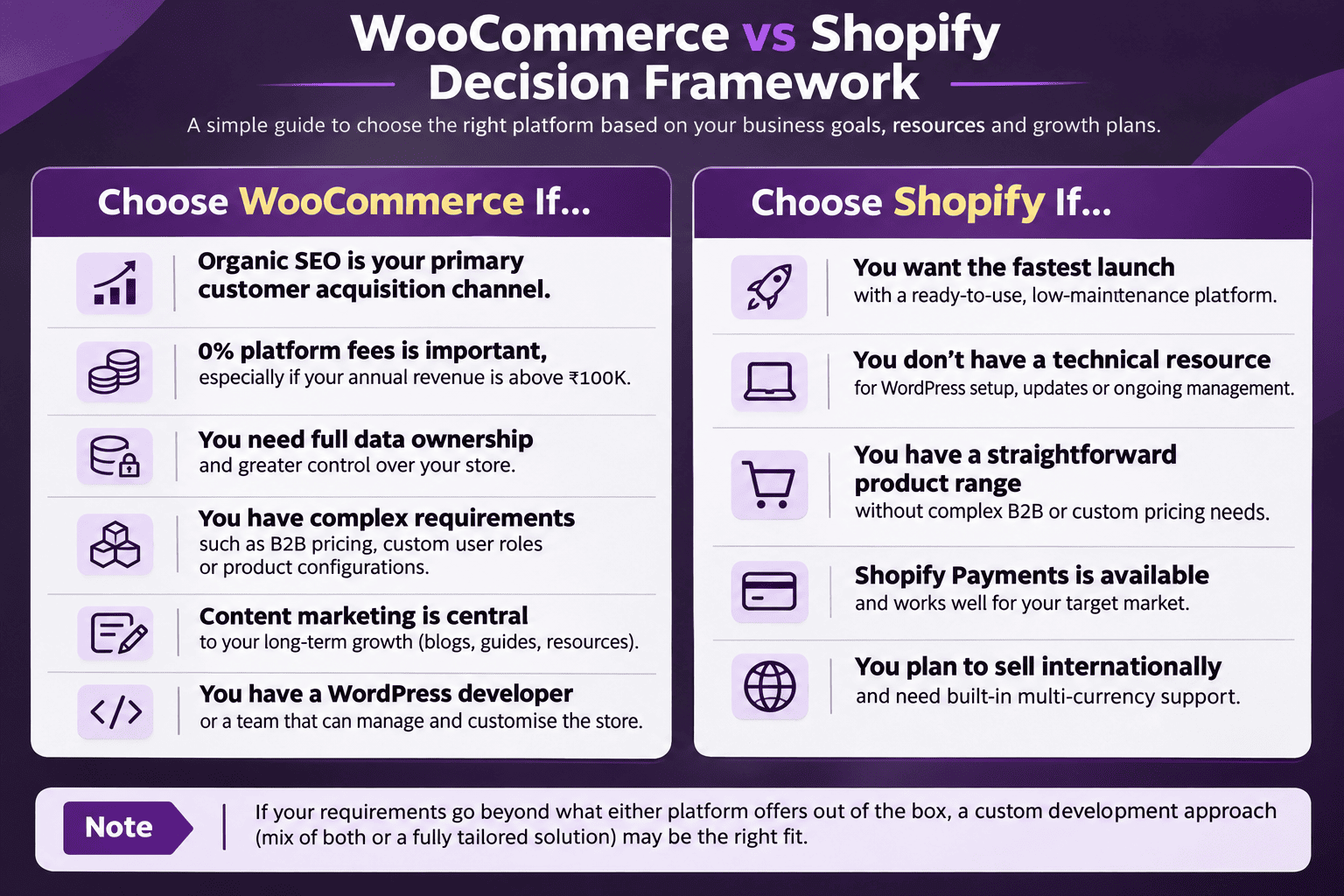
Frequently Asked Questions: WooCommerce vs Shopify
Is WooCommerce better than Shopify?
What are Shopify transaction fees?
Can WooCommerce handle large product catalogues?
Can Shopify do subscriptions?
Is WooCommerce free?
Is Shopify better for beginners?
Which platform is better for SEO: WooCommerce or Shopify?
How do I migrate from Shopify to WooCommerce?
Does WooCommerce or Shopify have better apps?
Which is better for dropshipping: WooCommerce or Shopify?
Can I switch from WooCommerce to Shopify?
What payment gateways do WooCommerce and Shopify support?
Futuristic Marketing Services
Build Your eCommerce Store on the Right Platform
Futuristic Marketing Services builds professional eCommerce stores on WooCommerce and Shopify, recommending the platform that best serves your specific commercial strategy, not the platform easiest for us to sell.
Start Your eCommerce Project