Facebook Ads for Small Business: Complete Beginner’s Guide

Facebook ads for small business

Facebook ads for small businesses work by targeting a defined audience with paid content across Facebook, Instagram, Messenger, and the Audience Network through Meta Ads Manager. Beginners should start with a daily budget of INR 500 to INR 1,000, use Meta Advantage+ campaign type, run Lead Generation or Traffic objectives, and commit to at least 14 days of consistent spending before evaluating whether a campaign is working.

This guide covers everything a small business owner needs to run their first successful Facebook advertising campaign, including how the Meta advertising auction works, the six campaign objective types and which one suits each business goal, the five most important ad formats for small businesses, a complete India-specific cost benchmark table covering CPC, CPM, and CPL across major business categories, how to build targeting audiences starting from scratch, the 70-20-10 budget architecture that professional advertisers use, how to structure and launch the first campaign in Meta Ads Manager, and the most common beginner mistakes that waste advertising budget before the campaign has had time to produce meaningful results.

Key Takeaways

  • India has some of the lowest Meta advertising CPMs globally. According to ProductGrowth.in's 2026 India benchmarks, Facebook CPCs range from INR 2 to INR 25, and Facebook CPMs average INR 50 to INR 400, making Meta ads one of the most cost-effective digital advertising channels available to Indian small businesses.
  • Meta Advantage+ campaigns convert 25% to 35% better than manually configured campaigns because the AI optimizes creative, audience, and placements simultaneously using signals that human targeting cannot match in precision.
  • Facebook Reels ad placements deliver 25% to 40% lower CPM than standard feed placements, making short-form video creative the most cost-efficient ad format available in Meta's advertising ecosystem.
  • Meta Lead Ads, which display a short contact form directly within Facebook, cost 30% to 50% less per lead than campaigns that send traffic to an external landing page, primarily because users do not need to leave the app or trust an unknown website.
  • Retargeting audiences (people who have visited the business website or engaged with the Facebook or Instagram page) convert at 3x to 5x lower cost per lead than cold prospecting audiences, making the Facebook Pixel installation a prerequisite for cost-efficient advertising.
  • A realistic ROAS (return on ad spend) for Indian small businesses running well-structured Meta campaigns is 3:1 to 5:1, according to CreazionMedia's 2026 India advertising analysis.
  • Never increase an active ad set's budget by more than 20% within a 48-hour period. A larger budget increase resets Meta's learning algorithm, throwing the campaign back into an expensive and unstable testing phase that wastes the optimization data already accumulated.

Want Expert Help Running Your First Facebook Ads?

We Set Up, Manage, and Optimize Facebook Ad Campaigns for Businesses Across India

Futuristic Marketing Services handles everything from pixel installation and audience setup through creative development, campaign launch, daily optimization, and monthly reporting, so your advertising budget generates maximum leads at minimum cost from the very first campaign.

Get a Free Facebook Ads Consultation

Why Facebook Ads Work for Small Businesses in India

Facebook advertising gives small businesses in India access to an audience reach and targeting precision that was previously available only to large brands with significant marketing budgets. With over 400 million Facebook and Instagram users in India, a small business owner in Indore can now target precisely defined audience segments, by age, location, interests, behaviors, income level, job title, and dozens of other parameters, at CPCs as low as INR 2 to INR 8 for broad awareness campaigns. This combination of reach and precision at low cost makes Meta ads the most commercially accessible paid advertising channel available to Indian small businesses of any size or category.
The platform's integration means a single campaign setup in Meta Ads Manager can run across Facebook feeds, Instagram feeds, Instagram Stories, Facebook Stories, Facebook Reels, Instagram Reels, Messenger, and the Audience Network simultaneously, reaching the target audience across multiple touchpoints through one managed campaign rather than requiring separate platforms and separate budgets for each. For a more complete picture of how paid Facebook advertising fits alongside organic content and community strategies in an integrated approach, our Facebook marketing strategy guide covers the complete six-component framework that connects advertising with the organic foundation that makes paid campaigns more cost-efficient.

How the Meta Advertising Auction Works

Meta advertising does not have a fixed price list. Every ad placement is determined in real time through an auction system where advertisers compete for the opportunity to show their ad to a specific user at a specific moment. The auction winner is not simply the highest bidder, Meta's auction evaluates three factors: the advertiser's bid amount, the estimated action rate (how likely the specific user is to take the desired action based on past behavior), and the ad quality score (how relevant and well-received the ad is among the target audience based on engagement history). An advertiser with a lower bid but a high-quality, highly relevant ad consistently beats a higher-bidding advertiser with poor creative quality.
This auction mechanics have a direct practical implication for small businesses: creative quality matters as much as budget. A well-produced, relevant ad that generates strong click-through rates, high watch time, and positive engagement signals from the target audience achieves lower cost per result than a larger-budget campaign with mediocre creative, because the ad quality score reduces the effective cost per placement throughout the campaign. This is the reason that professional ad management focuses as intensively on creative development and testing as on targeting and bidding strategy.

Meta Advantage+, The Default Campaign Type for Small Businesses
Meta Advantage+ is the AI-powered campaign type that has become the standard for Facebook advertising in the current environment, replacing the manually configured campaigns that dominated Meta advertising in earlier years. According to CreazionMedia's 2026 Facebook ads analysis, Advantage+ campaigns convert 25% to 35% better than manually configured alternatives because the AI simultaneously optimizes creative selection, audience matching, placement distribution, and bidding decisions using behavioral signals that human targeting configuration cannot replicate in precision or speed.
For small business beginners, Advantage+ simplifies the setup process significantly: provide the campaign objective, upload three to four creative variations, set the budget, and let Meta's AI handle the distribution optimization. The AI tests different creative combinations against different audience segments across different placements and automatically allocates more budget to the combinations that are producing the strongest results. Small businesses that have previously struggled with manual campaign configuration typically see substantially better results from Advantage+ than from their earlier manual setups, because the AI removes the need for the expert-level understanding of bidding strategies, placement optimization, and audience overlap management that effective manual campaigns require.

Facebook Ad Campaign Objectives: Which One to Choose

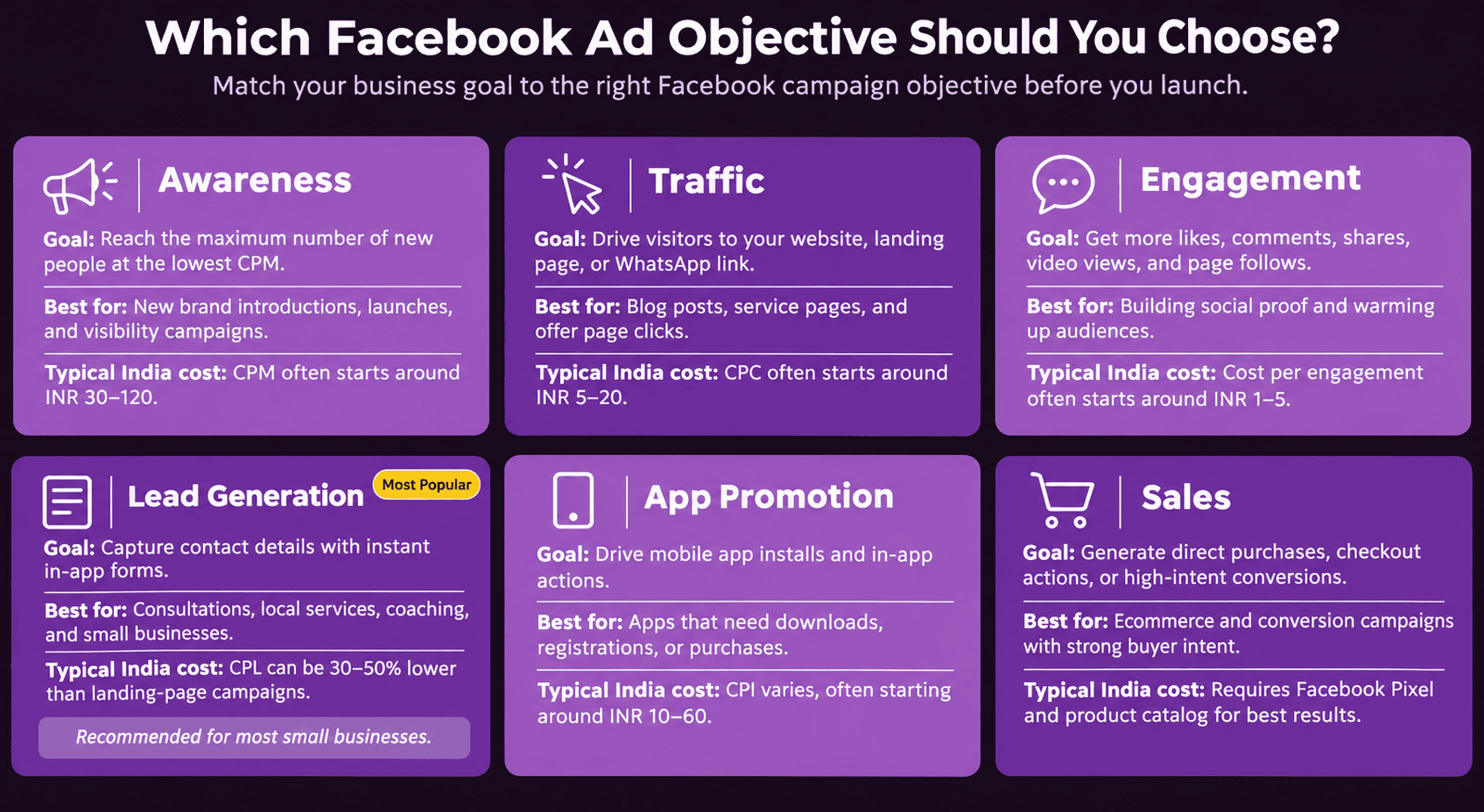
Meta Ads Manager organizes campaigns around objectives that correspond to the specific business outcome the advertiser wants to achieve. Selecting the wrong objective is one of the most consequential beginner mistakes in Facebook advertising because the entire campaign optimization system is directed toward producing the outcome corresponding to the chosen objective, selecting the wrong one means the AI is optimizing for the wrong goal, producing results that look active but do not advance the actual business need.

The Six Campaign Objectives and When to Use Each

Awareness campaigns optimize for maximum reach and impressions at the lowest CPM, making them the right choice for businesses with brand recognition goals rather than immediate conversion targets. They are most effective for new businesses introducing themselves to a specific geographic market, for businesses launching new products or services that the audience is not yet aware of, and for supporting higher-funnel content that needs broad distribution before any conversion campaign is introduced. Awareness campaigns in India deliver CPMs starting from INR 50 to INR 90 for broad audiences, the most cost-effective cost per impression available across any digital advertising channel.
Traffic campaigns optimize for clicks to a website or landing page, directing the algorithm to find users most likely to click through to the specified destination. They work best for businesses with strong, fast-loading landing pages that are designed to convert the traffic the campaign delivers. Traffic campaigns in India average CPCs of INR 5 to INR 20 for most business categories, making them a cost-efficient option for businesses that have validated their website conversion rates and need to drive volume to pages that are already proven to convert visitors into enquiries or purchases.
Lead generation campaigns using Meta Lead Ads are the highest-priority objective for most Indian service businesses. Lead Ads display a short, pre-filled contact form directly within Facebook or Instagram, users complete the form without leaving the app, dramatically reducing the friction that causes drop-off on external landing page campaigns. According to VGraple's India Meta Ads cost analysis, Lead Ads cost 30% to 50% less per lead than campaigns sending traffic to external landing pages, because the in-app friction elimination produces significantly higher form completion rates from the same ad spend. For most Indian small businesses offering services, Lead Generation campaigns are the correct starting objective.
Engagement campaigns optimize for likes, comments, shares, and page follows, making them useful for businesses focused on growing their Facebook or Instagram audience or boosting specific posts that have already generated strong organic engagement. Sales campaigns optimize for direct purchase conversions and require a fully configured Facebook Pixel, a product catalog for dynamic ad formats, and a website with a functioning checkout, making them more appropriate for ecommerce businesses than for most service-based small businesses in their initial advertising phase. App Promotion campaigns are relevant only for businesses with a mobile app they want to drive installs or in-app purchases for.

Facebook Ad Formats for Small Businesses: What Performs Best

Meta Ads Manager supports multiple creative formats that perform differently for different campaign objectives, audience types, and industry categories. Small businesses do not need to master every format simultaneously. Starting with the two or three highest-performing formats for the specific business type and campaign objective and building creative quality and testing volume within those formats consistently produces stronger results than spreading creative effort across too many format types without achieving excellence in any of them.
Ad Format Best Objective Cost Advantage Production Requirement Best For
Reels Video Ad (9:16 vertical) Awareness, Lead Generation, Traffic 25-40% lower CPM than feed placements, best cost per impression available Short-form video 15 to 60 seconds; 9:16 vertical format; captions essential as most viewed without sound All business types; highest priority for any business with video production capability
Lead Ad (Instant Form) Lead Generation 30-50% lower cost per lead vs landing page campaigns; CPL INR 100-400 for most industries Single image or short video; 2 to 4 qualification questions in the form; privacy policy page on website required Service businesses, professional services, consultants, any business whose first conversion step is a contact form or enquiry
Single Image Ad Traffic, Awareness, Engagement Low production cost; fast to test and iterate; CPM INR 80-200 for standard feed placement 1080x1080px square image or 1080x1350px portrait; minimal text on image (under 20% of image area) Local businesses, product launches, promotional announcements; fastest to produce and test
Carousel Ad Traffic, Sales, Engagement Multiple products or features in a single ad; higher click-through rate for product ranges; cost-efficient per product featured 2 to 10 cards; each card needs a unique image and headline; best with consistent visual style across all cards eCommerce, service businesses showcasing multiple offerings, portfolio-based businesses
WhatsApp Click-to-Message Ad Lead Generation, Engagement Cheapest high-intent leads for many Indian businesses; removes friction by connecting to familiar WhatsApp channel Standard image or video; WhatsApp Business number connected to Business Page; pre-filled message optional Local businesses, high-consideration purchases, real estate, education, healthcare, any business where customers prefer direct WhatsApp communication

How to Build Facebook Ad Targeting Audiences for Small Business

Audience targeting is the variable that most directly determines the cost-efficiency of a Facebook advertising campaign. An ad shown to a precisely targeted audience that matches the target customer profile generates better engagement, higher conversion rates, and lower cost per result than the same ad shown to a poorly defined broad audience. In the current Meta Ads Manager environment, audience building has shifted from manual precision targeting toward providing high-quality signals that allow the AI to find the right audience, a change that requires a different approach from what worked in earlier manual targeting models.

The Three Audience Types Every Small Business Should Build

Cold audiences are people who have never encountered the business before, targeted based on demographic parameters and interest signals. For small businesses starting from zero with no existing audience data, interest-based targeting using Facebook's interest categories provides a reasonable starting point. A social media marketing agency targeting small business owners might use interests including "small business," "entrepreneurship," "digital marketing," and "business management," combined with age targeting of 25 to 50 and location targeting of the specific cities or regions where clients are sought. Meta Advantage+ will then use these signals as starting inputs and expand beyond them to find users whose behavioral patterns match the target profile even if they have not expressed the exact interests specified.
Warm audiences are built from people who have already interacted with the business in some way but have not yet become customers. The most valuable warm audiences are website visitors tracked by the Facebook Pixel, video viewers who watched 50% or more of any business video on Facebook or Instagram, Instagram or Facebook page engagers from the past 30 to 60 days, and people who previously submitted a Lead Ad form. According to VGraple's research, retargeting these warm audiences produces cost-per-lead figures 3x to 5x lower than cold audience campaigns because the audience has already demonstrated genuine interest before the ad reaches them.
Lookalike audiences are the third type, new cold audiences that Meta builds by analyzing the characteristics of a seed audience (typically existing customers, website visitors, or email lists uploaded as Custom Audiences) and finding Facebook and Instagram users who share the behavioral and demographic patterns of that seed group. Lookalike audiences built from the business's best existing customers, those who purchased most recently, most frequently, or at highest average value, consistently outperform interest-based targeting for established businesses with sufficient customer data because the AI identifies subtle behavioral signals that manual interest targeting cannot capture. According to Mocaup.in's Meta Ads cost analysis, Lookalike audience campaigns in India typically deliver stronger conversion rates than broad interest targeting because the audience quality is significantly higher.

Installing the Facebook Pixel Before Running Any Campaigns

The Facebook Pixel is a small piece of code installed on the business website that tracks visitor behavior, which pages they visit, what actions they take, and whether they convert, and sends this data back to Meta's advertising system. Installing the Pixel before running any campaigns is the single most important pre-campaign technical setup because it enables retargeting campaigns, conversion tracking, lookalike audience building from website visitors, and the AI optimization signals that allow Advantage+ campaigns to improve continuously over time.
Install the Pixel through Meta Business Suite's Events Manager section. Navigate to the Pixel creation option, copy the generated code, and paste it into the header section of the business website. If the website uses WordPress, a free plugin called "Meta Pixel for WordPress" handles this without requiring manual code editing. If using Shopify, the Pixel connects through the Shopify Facebook channel integration. Once installed, verify the Pixel is firing correctly using the Meta Pixel Helper browser extension before launching any campaigns. Install standard event codes on key pages including the contact form thank-you page, the checkout confirmation page, and any booking confirmation page, these event codes tell Meta which specific actions on the website represent the conversions the campaigns should optimize toward. For the Facebook Business Page setup that must be completed before any advertising campaign is launched, the page creation guide covers the full prerequisite setup in detail.

Facebook Ads Cost Benchmarks for India: What to Expect in 2026

Setting realistic cost expectations before launching campaigns prevents the most common small business advertising mistake: concluding that Facebook ads do not work because the initial results do not match unrealistic expectations formed without reference to actual India-specific benchmarks. The data below represents current market averages across optimized campaigns. New campaigns in the learning phase will see costs 30% to 50% higher than these figures while Meta's AI accumulates the data needed to optimize effectively, which is why maintaining campaigns for at least 14 to 30 days is essential before drawing performance conclusions.
Business Category Avg. CPC (INR) Avg. CPM (INR) Avg. CPL, Lead Ads (INR) Recommended Monthly Budget
Social Media and Digital Marketing INR 5 to 15 INR 80 to 200 INR 150 to 400 INR 15,000 to 40,000
Local Services (Salon, Clinic, Restaurant) INR 2 to 8 INR 50 to 120 INR 80 to 250 INR 10,000 to 25,000
eCommerce and Fashion INR 3 to 12 INR 80 to 250 INR 100 to 350 per sale/lead INR 30,000 to 1,00,000+
Education and Coaching INR 5 to 18 INR 100 to 250 INR 120 to 350 INR 20,000 to 60,000
Real Estate INR 8 to 25 INR 150 to 400 INR 300 to 1,200 INR 40,000 to 1,50,000+
Healthcare and Medical INR 6 to 20 INR 100 to 300 INR 200 to 600 INR 20,000 to 75,000
Tier 1 cities including Bangalore, Mumbai, and Delhi consistently see CPMs 20% to 40% higher than Tier 2 cities like Indore, Nagpur, and Bhopal, because the more competitive advertising environments in metros drive auction prices higher. For businesses in Tier 2 and Tier 3 cities, the lower competition landscape produces materially better cost efficiency at equivalent budget levels, a meaningful competitive advantage for local businesses in non-metro markets. Strong creative consistently beats these benchmarks; weak creative with poor relevance scores significantly underperforms them.

The Budget Architecture: How to Allocate Facebook Ad Spend Correctly

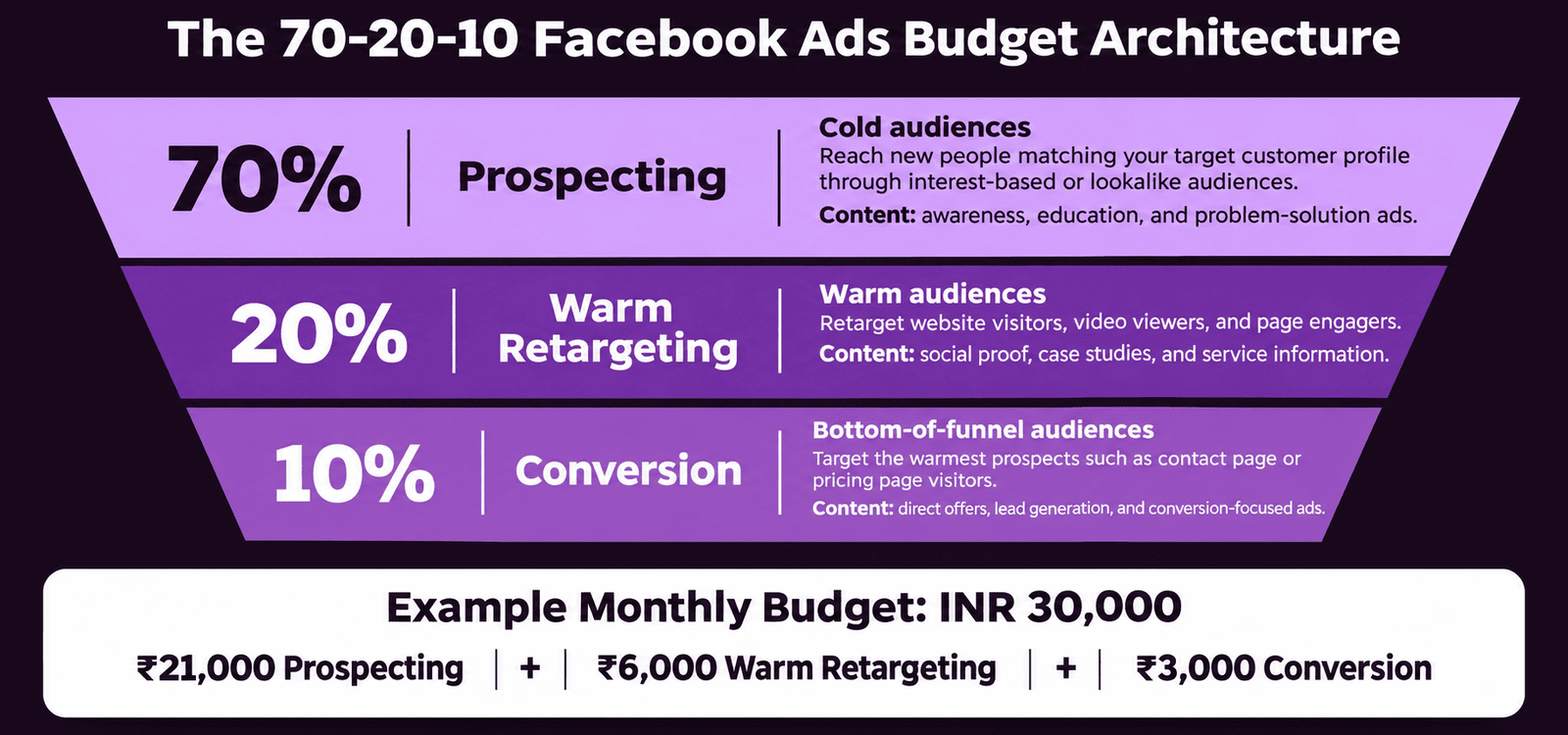
Most beginners allocate their Facebook advertising budget to a single campaign type and evaluate its performance in isolation, missing the compounding efficiency that comes from structuring budget across the full customer journey. Professional advertisers use a staged budget architecture that allocates spend proportionally across three audience temperature levels, each serving a different stage of the buying process and feeding into the next. Mocaup's Meta Ads strategy guide describes the industry-standard framework as the 70-20-10 architecture.

The 70-20-10 Facebook Ads Budget Architecture

70%

Prospecting (Cold Traffic)

Reach new audiences who match the target customer profile but have never encountered the business. Uses interest-based targeting, lookalike audiences, or Advantage+ broad targeting. Goal: awareness and first-touch lead generation. This is the pipeline-filling investment that feeds the rest of the funnel.

20%

Warm Audience Retargeting

Re-engage people who have interacted with the business: website visitors, video viewers (50%+ completion), page engagers from the past 30 to 60 days. Show them social proof, case studies, and more detailed service information. Goal: move interested prospects from consideration to enquiry intent.

10%

Bottom-of-Funnel Conversion

Target the warmest audiences: people who visited the contact page or pricing page but did not convert, people who started filling a Lead Ad form but abandoned it, or people who have engaged multiple times across multiple touchpoints. Show a direct offer with urgency. Goal: convert the most interested prospects into actual enquiries or purchases.

Example: INR 30,000/month total → INR 21,000 prospecting + INR 6,000 warm retargeting + INR 3,000 bottom-of-funnel conversion

The budget architecture shifts as campaigns mature and the retargeting pools grow. In the first 30 days of a new campaign, prospecting needs to be 80% to 90% of budget because the retargeting audience is too small to support significant spend. As the Pixel accumulates data and the retargeting pool builds, the warm and bottom-of-funnel allocations can grow proportionally while maintaining prospecting spend to continuously feed the top of the funnel. The 70-20-10 split is a mature campaign steady state, not a launch configuration.
The minimum effective daily budget per ad set for meaningful Meta algorithm optimization is INR 300 to INR 500, with INR 500 to INR 1,000 per day the recommended starting point for the testing phase. Below INR 300 per day per ad set, the algorithm enters and remains in the learning phase indefinitely, making too few auction entries per day to accumulate sufficient data to optimize effectively. This is the specific budget threshold issue that causes most small business Facebook advertising experiences to produce no meaningful results: the budget is technically active but too small for the AI to learn from. Our social media advertising services include complete Facebook Ads setup and management with daily monitoring and monthly reporting for businesses across India.

Common Facebook Ads Mistakes That Waste Small Business Budget

Stopping campaigns too early is the single most common Facebook advertising mistake for small businesses. Meta's AI-powered campaigns require a learning phase of typically 7 to 14 days and 50 conversion events (clicks, leads, or purchases depending on the objective) before the algorithm has enough data to optimize effectively. Campaigns paused or assessed before this learning phase completes are evaluated on the most expensive, least optimized phase of their lifecycle, producing the misleading conclusion that Facebook ads do not work when in fact the campaign was stopped before it had a chance to demonstrate its actual performance potential.
Sending all paid traffic to the business homepage rather than a dedicated landing page is a conversion structure mistake that wastes a large proportion of the budget generated by otherwise effective ads. A homepage serves many audiences and many purposes. A landing page serves one audience with one clear message and one specific call to action, the combination that produces the highest conversion rates from paid advertising traffic. If the business website does not yet have dedicated landing pages for each service or campaign type, Meta Lead Ads (which keep users within Facebook rather than sending them to an external page) are the most effective alternative while landing page infrastructure is being developed.
Scaling budget too aggressively when a campaign starts performing is a common reaction to early positive results that resets the algorithm's learning and temporarily produces worse performance. Never increase an active ad set's daily budget by more than 20% within any 48-hour period, as larger increases reset the algorithm's optimization model and force the campaign back into the expensive learning phase. Scale slowly and steadily, allowing the algorithm to re-stabilize at each new budget level before adding the next increment. For businesses using the organic and paid combined strategy, understanding how organic content quality affects paid campaign performance is covered in the complete organic vs paid guide, including why pages with active, high-quality organic content consistently produce lower cost per conversion in paid campaigns than pages that rely on paid advertising in isolation.

Ready to Run Facebook Ads That Actually Generate Leads?

We Set Up and Manage Your Complete Facebook Advertising System

From Pixel installation and audience building through creative development, Advantage+ campaign setup, daily budget optimization, and monthly performance reporting, our team handles every component of a Facebook ads strategy that produces consistent, measurable leads at the right cost for your business.

Book Your Free Ads Strategy Call

Frequently Asked Questions About Facebook Ads for Small Business

How much does it cost to run Facebook ads for a small business in India?

Facebook ads cost in India start as low as INR 100 per day at the technical minimum, but the practical minimum for a campaign to exit the algorithm's learning phase and produce optimized results is INR 300 to INR 500 per day per ad set. For a small business testing its first lead generation campaign, a realistic monthly budget is INR 15,000 to INR 30,000 in ad spend, sufficient to generate meaningful lead data and identify what works before scaling. Industries vary significantly: local service businesses achieve CPLs of INR 80 to INR 250, while competitive categories like real estate see CPLs of INR 300 to INR 1,200.

Do Facebook ads actually work for small businesses in India?

Yes. Facebook and Instagram ads remain among the most cost-effective digital advertising channels in India because the country has some of the lowest Meta advertising CPMs globally, and the platform's AI-driven targeting, particularly through Meta Advantage+, delivers audience matching precision that small businesses could not previously access without large budgets. A realistic return on ad spend of 3:1 to 5:1 is achievable for well-structured e-commerce and lead generation campaigns. The key conditions for success are adequate budget to exit the learning phase, strong creative, a Facebook Pixel installed before campaigns launch, and at least 30 days of consistent campaign running before performance conclusions are drawn.

What is Meta Advantage+ and should small businesses use it?

Meta Advantage+ is Facebook's AI-powered campaign type that automatically optimizes creative selection, audience targeting, placement distribution, and bidding based on the campaign objective and real-time performance data. It converts 25% to 35% better than manually configured campaigns for most business categories and is the recommended starting point for small business beginners because it reduces the complexity of campaign setup while typically outperforming manual configurations that require expert-level understanding to set up correctly. Most small businesses running their first Facebook campaigns should use Advantage+ rather than manual campaign structures.

What type of Facebook ad works best for service businesses?

Meta Lead Ads (Instant Form campaigns) are the highest-performing ad type for most Indian service businesses because the in-app form format eliminates the friction of external landing page navigation, pre-fills user details from their Facebook profile, and produces cost-per-lead figures 30% to 50% lower than equivalent traffic campaigns sending users to external websites. WhatsApp Click-to-Message ads are a strong alternative for businesses where direct conversation is the preferred first step in the sales process, as they connect interested prospects directly to WhatsApp without requiring form completion. Reels video ads work well for driving awareness and warm audience building that supports Lead Ad campaigns through retargeting.

How long should I run Facebook ads before seeing results?

Allow a minimum of 14 days before making any assessment of a new Facebook campaign, and ideally 30 days for a full initial evaluation. The first 7 to 14 days are the algorithm's learning phase, during which Meta's AI is collecting data to optimize campaign delivery, costs during this period are typically 30% to 50% higher than post-learning-phase performance. After the learning phase concludes and the campaign has accumulated at least 50 conversion events, the algorithm can optimize effectively and performance typically improves meaningfully. Small businesses that pause campaigns after 3 to 5 days of high learning-phase costs consistently miss the optimized performance that would have followed if the campaign had been allowed to complete the learning phase.

What is the Facebook Pixel and do I need it?

The Facebook Pixel is a piece of code installed on the business website that tracks visitor behavior and sends that data to Meta's advertising system. It is not optional for any business planning to run Facebook ads beyond basic awareness campaigns. The Pixel enables retargeting campaigns that show ads to people who have visited the website, the audience type that converts at 3x to 5x lower cost than cold traffic. It enables conversion tracking that attributes leads and sales to specific campaigns. It enables lookalike audience building from website visitors. And it provides the behavioral signal data that allows Meta Advantage+ to optimize campaign delivery effectively. Install the Pixel before running any campaigns because the data it collects from the first day of installation is what makes subsequent campaigns more efficient.

How do I target the right audience for my Facebook ads?

For small businesses without existing customer data, start with interest-based targeting using Meta Advantage+ and provide relevant interest categories, age range, and location parameters as starting signals for the AI. Upload existing customer email lists as Custom Audiences to enable lookalike audience campaigns targeted at people who share the behavioral profile of known buyers. Install the Facebook Pixel and begin building website visitor retargeting audiences from day one. As each campaign runs, the algorithm develops an increasingly accurate model of who responds best to the business's advertising based on actual behavioral data rather than assumed interest alignment. Within 60 to 90 days of consistent campaign running, the algorithm typically produces better audience targeting than most manual configurations because it evaluates thousands of signals that human targeting parameters cannot capture.

What budget should a small business start with for Facebook ads?

Start with a minimum of INR 500 per day per ad set for the testing phase, INR 15,000 to INR 30,000 per month total. This budget level allows the Meta algorithm to exit the learning phase within 7 to 14 days and begin optimizing delivery effectively. Below INR 300 per day per ad set, the algorithm makes too few auction entries daily to accumulate sufficient optimization data, causing campaigns to remain in the learning phase indefinitely and produce consistently high costs without improvement. Once a campaign exits the learning phase and shows stable performance, scale the budget gradually by no more than 20% every 48 hours to avoid resetting the algorithm's learning and returning to the expensive learning-phase performance level.

Should I run Facebook ads to my homepage or a specific landing page?

Always send paid Facebook traffic to a specific landing page designed for the campaign's target audience and objective rather than the business homepage. A homepage serves multiple audiences with multiple messages and typically produces conversion rates of 1% to 3%. A dedicated landing page with a single clear message, a specific offer, one CTA, and no navigation distractions typically produces conversion rates of 3% to 10% or higher for the same traffic. If building a dedicated landing page is not immediately feasible, Meta Lead Ads are the preferred alternative, they keep users within Facebook (eliminating the need for an external landing page entirely) and consistently produce lower cost-per-lead than traffic campaigns to any landing page due to the zero-friction in-app form completion experience.

Can I run Facebook and Instagram ads together?

Yes, and this is recommended for most small businesses. Meta Ads Manager allows a single campaign to run across Facebook feeds, Instagram feeds, Facebook Reels, Instagram Reels, Facebook Stories, Instagram Stories, Messenger inbox, and the Audience Network through the same campaign setup. Using Advantage+ Placements (Meta's automatic placement selection) allows the AI to determine which specific placements deliver the best results for the specific objective and audience and allocates spend accordingly. Most small businesses achieve better results from Advantage+ Placements than from manually restricting to specific placements, because the AI has access to placement-level performance data across millions of campaigns that manual selection cannot match.

How do I measure whether my Facebook ads are working?

Track these five metrics in Meta Ads Manager to assess campaign performance. Cost Per Lead (CPL) for lead generation campaigns shows the average cost of each enquiry form submission, compare against the industry benchmarks in this guide to assess relative efficiency. Click-Through Rate (CTR) for traffic campaigns shows what proportion of people who saw the ad clicked through, above 1% CTR is generally positive for Indian campaigns. Frequency shows how many times on average each person in the target audience has seen the ad, above 3 to 4 frequency signals audience fatigue requiring creative refresh. Cost Per Result is the headline metric for any objective, track its trend week over week to assess whether the campaign is improving as it accumulates optimization data. Return on Ad Spend (ROAS) for sales campaigns compares revenue generated to ad spend, above 3:1 is a positive benchmark for most Indian categories.

Is there a GST applicable on Facebook ads in India?

Yes. Meta charges 18% GST on top of the advertising spend for Indian businesses. If the business is GST registered and provides its GSTIN in the Meta Business Manager billing settings, this GST can be claimed as Input Tax Credit (ITC). For example, a monthly ad spend of INR 30,000 incurs an additional INR 5,400 in GST charges, making the total billing INR 35,400 before any management fees. For businesses spending above INR 5 lakhs per month, an Equalization Levy or TDS may also apply, consult with a CA before scaling spend to this level. Account for GST when planning advertising budgets, as failing to include it in the budget calculation results in reduced effective ad spend compared to what was planned.

Futuristic Marketing Services

Facebook Ads That Generate Real Leads at the Right Cost for Your Business.

We install the Pixel, build your audiences, create your ad creative, launch your Advantage+ campaigns, optimize daily, and report monthly, delivering Facebook advertising results that make every rupee of ad spend count toward your business growth.

Start Your Facebook Ads Campaign Today

Facebook advertising remains one of the most commercially effective and cost-efficient paid marketing channels available to Indian small businesses in the current environment. With CPCs starting from INR 2 to INR 5, CPLs achievable at INR 100 to INR 400 for most service categories through Meta Lead Ads, and a 3:1 to 5:1 ROAS realistic for well-structured campaigns, the platform offers both scale and precision at cost points that are genuinely accessible for businesses of any size. The key to realizing these results is not budget size but strategic structure: the right campaign objective, adequate budget per ad set to exit the learning phase, strong creative tested across at least three hook variations, the Facebook Pixel installed before any campaign launches, and the discipline to allow campaigns at least 14 to 30 days before drawing performance conclusions.
The 70-20-10 budget architecture, the India-specific cost benchmarks, and the ad format selection guide in this article give small businesses everything needed to allocate their advertising investment correctly from the first campaign rather than discovering the optimal structure through months of expensive trial and error. Combined with the organic Facebook marketing strategy covered in the companion guides in this series, Facebook advertising becomes the paid acceleration layer that scales the results the organic foundation has already built, rather than an isolated paid channel that must carry the full weight of generating trust, awareness, and conversion without the organic support that makes every ad click more efficient.
If you want professional support setting up, launching, and optimizing Facebook ad campaigns for your business, Futuristic Marketing Services provides complete Meta advertising management for businesses across India, from initial Pixel setup and audience building through daily campaign optimization and monthly performance reporting that keeps every rupee of ad spend directed toward the results your business actually needs.
Share this post :
Picture of Devyansh Tripathi
Devyansh Tripathi

Devyansh Tripathi is a digital marketing strategist with over 5 years of hands-on experience in helping brands achieve growth through tailored, data-driven marketing solutions. With a deep understanding of SEO, content strategy, and social media dynamics, Devyansh specializes in creating results-oriented campaigns that drive both brand awareness and conversion.

All Posts