
Writing an SEO blog post that ranks requires more than including the right keywords. It requires structuring your content so that Google’s AI systems can extract and evaluate its quality, matching the search intent of the query precisely, demonstrating genuine expertise through specific detail only a practitioner would know, and formatting the article so both search engines and mobile readers can efficiently navigate and extract its value.
Key Takeaways
- According to Orbit Media, the average blog post that earns strong organic results is 1,427 words, but the right length is whatever fully satisfies the user's search intent for that specific query
- The introduction is the most critically evaluated section, Google's AI Overviews and Featured Snippets are almost exclusively selected from well-structured introductions with direct answers
- Every H2 heading should follow the Immediate Answer Method: the first sentence below every H2 must directly answer the question that heading asks, this mirrors how Google's Featured Snippet algorithm selects content
- E-E-A-T signals must appear throughout the content, not only in an author bio, our E-E-A-T guide covers how to embed experience, expertise, authority, and trust signals naturally in every section
- Paragraphs must be a maximum of 4 lines, over 60% of search traffic arrives on mobile devices where long paragraphs cause immediate abandonment
- Internal links placed naturally within body sentences (minimum 3 per article) distribute authority and help Google understand your topical cluster architecture
Want Professionally Written SEO Blog Posts That Rank?
Futuristic Marketing Services creates fully optimised SEO blog posts, from keyword-mapped briefs and structured outlines to E-E-A-T-compliant content with schema markup and internal linking, ready to publish directly.
Get SEO Blog Content Written for YouStep 1, Write the Brief Before Writing a Word
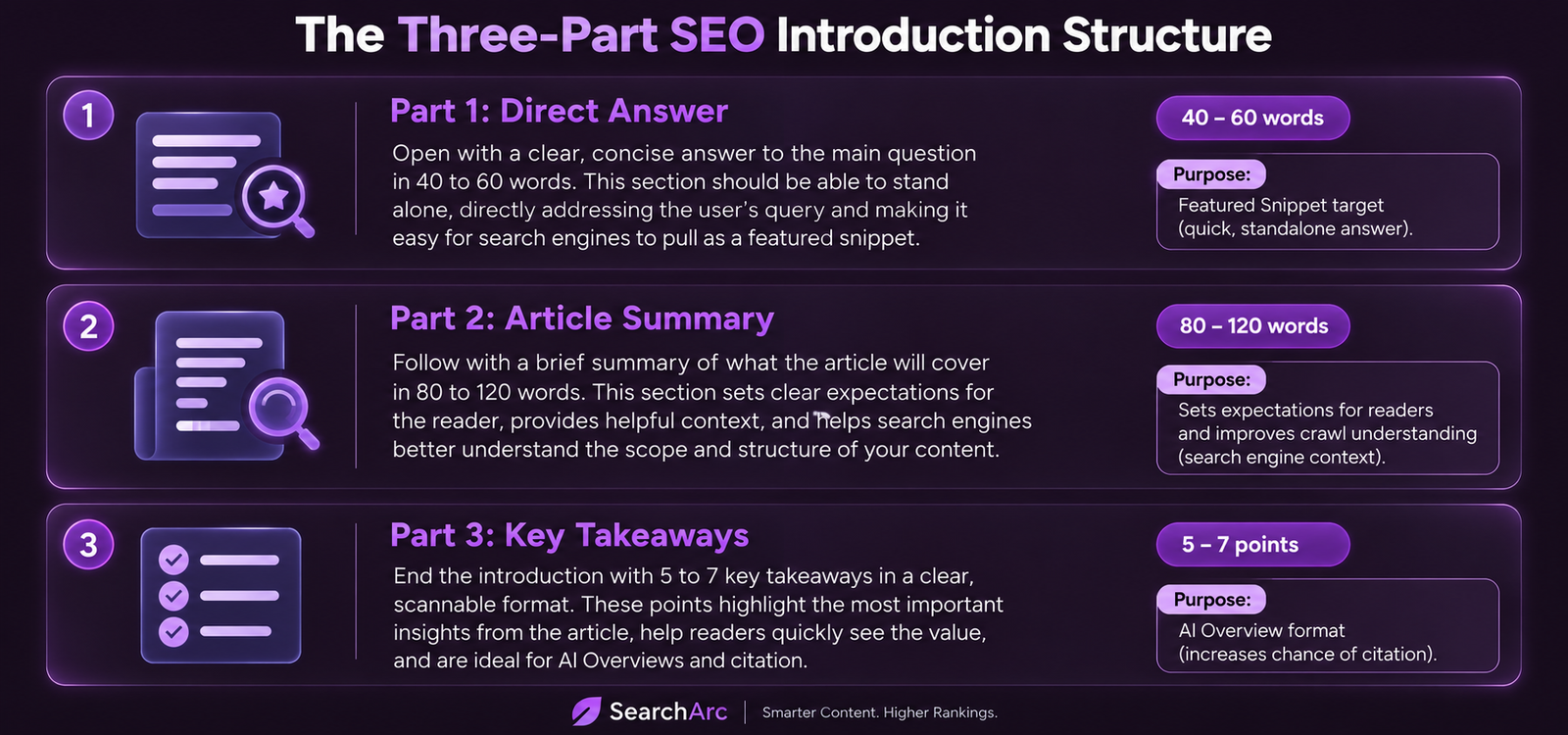
Step 2, Write a Three-Part Introduction That Earns Featured Snippets
>Part 1, The Direct Answer (40 to 60 words)
Part 2, The Article Summary (80 to 120 words)
Part 3, Key Takeaways (5 to 7 points)
Step 3, Structure Headings for Search Intent and Snippet Capture
| Heading Rule | What It Requires | Why It Matters | Common Mistake to Avoid |
|---|---|---|---|
| One H1 per page | H1 contains the primary keyword; appears only once | Strongest topical relevance signal for the page topic | Using H1 for a decorative banner or section header rather than the article title |
| H2 introductory text | 2 to 3 sentences of context below every H2 before any list or H3 | Google quality raters specifically evaluate whether sections have explanatory context | Jumping from H2 heading directly to bullet points with no explanatory paragraph |
| Question-format H2s | Structure H2s as natural language questions where appropriate | Directly targets People Also Ask positions and Featured Snippet selection | Using heading fragments like 'Benefits' instead of 'What Are the Benefits of X?' |
| H3 for sub-points only | H3 used only for specific sub-points within an H2 section | Maintains clear hierarchy that helps Google understand content structure | Using H3 for design purposes or to create visual variety rather than structural hierarchy |
Step 4, Write Body Content That Passes Google's Quality Evaluation
Step 5, Embed E-E-A-T Signals Throughout Every Section
Step 6, Formatting, Images, and Pre-Publish Checklist
- Title tag: 50 to 60 characters, primary keyword included, clear benefit stated, see our meta tags guide
- Meta description: 140 to 155 characters, primary keyword included once naturally, call-to-action phrase included
- URL slug: primary keyword only, lowercase, hyphens between words, no stop words, no date
- H1: contains primary keyword, appears once only, matches the article's direct answer topic
- Introduction: all three parts present (direct answer, summary, key takeaways)
- Every H2: has 2 to 3 introductory sentences before any list or H3 subheading
- Keyword density: primary keyword at 0.8% to 1.2% of total word count
- Internal links: minimum 3, placed naturally in body sentences with descriptive anchor text, see our internal linking guide
- External links: minimum 3, all to primary authoritative sources, open in new tab
- Images: descriptive file names, alt text with keyword where natural, width and height attributes set, WebP format
- Schema markup: Article schema with named author, FAQPage schema on FAQ section, our schema markup guide covers implementation
- Author attribution: named author byline linking to bio page with credentials visible
- No hyphens in body content, no emojis, no AI filler phrases
Want Your Blog Posts Written to This Standard Without the Effort?
Our SEO writers produce fully optimised blog posts to the complete 2026 quality standard, E-E-A-T compliant, schema-marked, internally linked, and ready to publish directly into your CMS.
Start Your Content Production ProgrammeFrequently Asked Questions
Q. How long should an SEO blog post be?
Q. What is the correct structure for an SEO blog post?
Q. How do I make a blog post rank in Google?
Q. What is the Immediate Answer Method for SEO writing?
Q. How do I add E-E-A-T signals to a blog post?
Q. What keyword density should I aim for in a blog post?
Q. Should I add a FAQ section to every blog post?
Get Blog Posts That Rank, Build Authority, and Convert Readers
At Futuristic Marketing Services, every blog post we produce follows the complete 2026 SEO writing standard, from keyword-mapped briefs and three-part introductions to E-E-A-T signals, schema markup, and pre-publish quality checks.
Talk to Our SEO Content Team