Best Podcast Editing Services: What to Look for Before You Hire

best podcast editing service

The podcast editing services market has no regulated quality standard, no industry benchmark, and no universal definition of what “professional podcast editing” includes. A £50/episode freelancer and a £600/episode specialist agency both describe their service as professional podcast editing, but the deliverables, the audio quality, the clip production volume, and the show notes standard are completely different products that happen to use the same label. Without a clear evaluation framework, most podcasters hire based on price or marketing copy rather than the factors that actually determine whether a service will grow their show.

According to Edison Research, audio quality problems are the top reason podcast listeners stop following a show, above content quality, publishing frequency, or episode length. This makes the audio quality of a podcast editing service the non-negotiable quality floor, before any other evaluation criteria are considered. This guide provides the complete framework for choosing the right podcast editing service at the right stage of your podcast's growth.

Key Takeaways

  • Audio quality is the non-negotiable quality floor, according to Edison Research, audio quality problems are the single most common reason podcast listeners stop following a show, making this the first and most important evaluation criterion
  • The full 5-deliverable standard (YouTube video + 10–15 clips + audio master + show notes + thumbnail) produces 30+ content assets from each recording session; services delivering only a video file and a few clips are providing a fraction of the available content value
  • Services producing fewer than 10 clips per episode are not optimising for podcast reach, the standard for growth-focused podcast editing is 10–15 clips per episode, providing enough material for daily social publishing for 10–15 days from each recording
  • A weekly podcast requires guaranteed 3–5 business day turnaround committed in writing, services without a stated SLA create operational risk for publishing schedules that compounds into audience expectation problems over time
  • The three samples to request from any podcast editing service before hiring: a full episode video with chapters and lower thirds, five short-form clips from a conversation episode (not a highlight reel), and one show notes page, these three samples reveal more about capability than any amount of marketing copy
  • For the complete comparison of podcast editing service options across all evaluation criteria, the best podcast editing agencies comparison provides the detailed platform-by-platform analysis

Want to Evaluate Futuristic Marketing Services for Your Podcast?

Futuristic Marketing Services provides full 5-deliverable podcast editing: YouTube-ready video, 10–15 clips with kinetic captions, audio master, SEO show notes, and thumbnail, with a dedicated editor and SLA-backed delivery.

Request a Sample Edit
Why the Podcast Editing Market Lacks Quality Standards

The podcast editing services market has expanded rapidly with the growth of podcasting as a content format, but without the quality standards and professional certifications that exist in other creative services markets. A freelancer who has edited 5 podcasts and a specialist agency that has edited 5,000 both present their services as "professional podcast editing", the label is not regulated and carries no quality guarantee.
This creates a systematic information disadvantage for podcasters. Without a clear evaluation framework, most hiring decisions are based on price, portfolio attractiveness, or referral, none of which reliably predict whether the service will deliver what a growing podcast actually needs. The result is a market where podcasters frequently pay for services that look professional but deliver below the quality standard their show requires.

THE EVALUATION PROBLEM

The most expensive podcast editing service is not always the best, and the cheapest is almost never sufficient for a show with growth ambitions. The right service is the one best matched to your podcast's current stage, publishing frequency, and growth objectives, evaluated against specific, objective criteria rather than price or marketing copy.
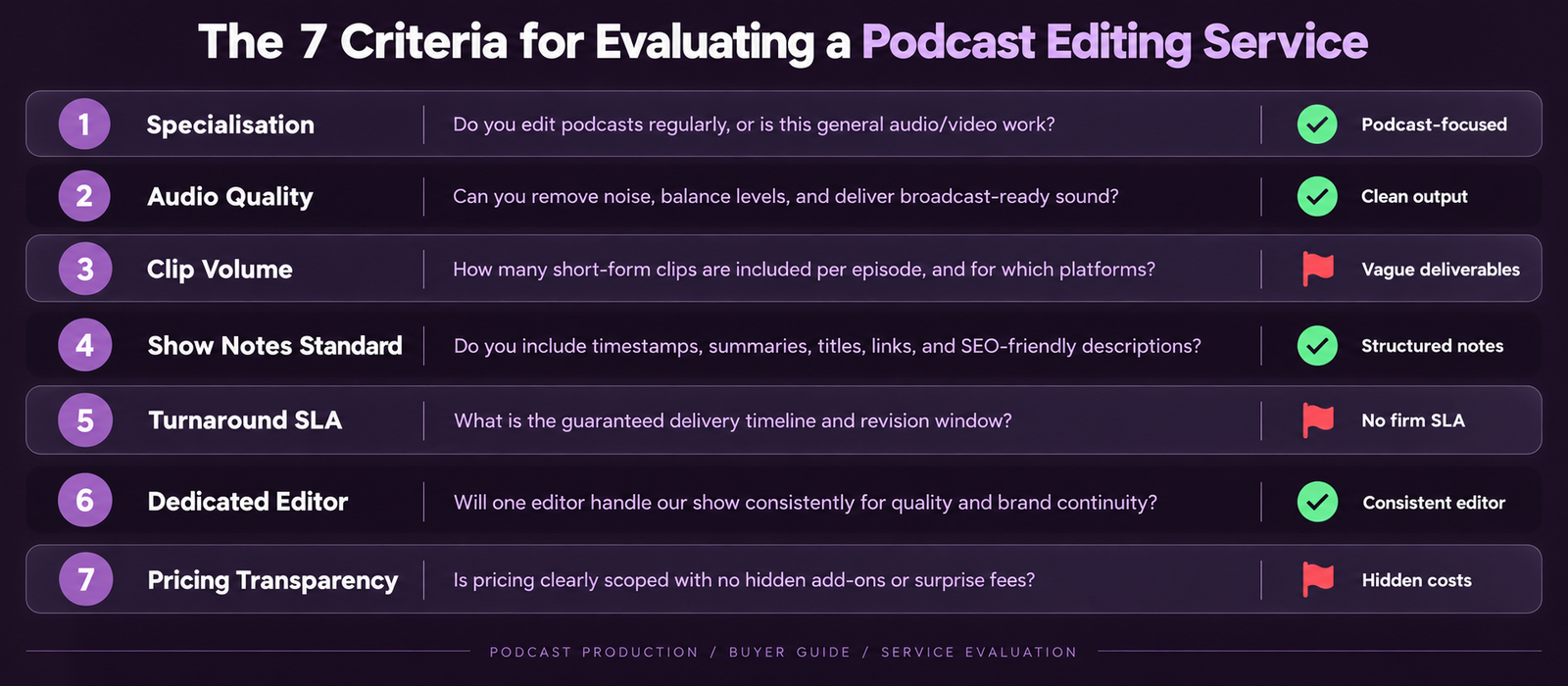
The 7 Criteria for Evaluating Any Podcast Editing Service

CriterionWhat to AssessWhy It MattersRed Flag
Podcast specialisationPrimary service or one of many offered?Specialists understand clip selection, show notes SEO, and audio standardsNo podcast-specific portfolio samples available
Audio qualityListen to published client podcasts, not demo reelsAudio is the non-negotiable quality floor, poor audio drives listener churnAudible background noise or inconsistent levels in client samples
Clip quality and volumeRequest 5 clips from a conversation episodeClips drive growth, this is the primary capability testFewer than 10 clips per episode, or no clips from conversation content
Show notes standardRequest a sample show note from a previous client episodeSEO show notes create Google discovery, most services skip this entirelyGeneric summary without keyword structure or timestamps
Turnaround SLAIs delivery time committed to in writing?Weekly podcast needs guaranteed 3–5 day deliveryNo stated turnaround, or "it depends" without specifics
Dedicated editorSame editor for every episode?Brand consistency builds over time, rotating teams undermine voiceRotating team with no continuity guarantee
Pricing transparencyListed publicly without requiring a sales call?Reputable services disclose pricing, opacity signals misalignmentPricing only revealed after 30-minute consultation

The Full Deliverable Standard: What You Should Receive

A full-service podcast editing package produces five deliverable categories from each episode. Services providing only a video file and a few clips are delivering a fraction of the available content value, and typically not discounting proportionally for the missing elements.
Full episode video: 16:9 YouTube-ready edit with chapters, branded lower thirds with speaker names and titles at first appearance, intro and outro cards, and export at 1080p minimum. Dialogue-edited to remove dead air, filler words, and false starts, typically reducing raw runtime by 15–25%.
Short-form clip library: 10–15 vertical 9:16 clips with kinetic word-by-word captions, hook-optimised openings, podcast logo branding, and all platform variants (TikTok, Reels, Shorts, LinkedIn). For the complete clip editing standard, the podcast to YouTube Shorts guide covers the workflow in detail.
Audio master: -16 LUFS normalised MP3 with noise reduction, EQ presence boost, dynamic compression, and true peak limiting at -1 dB, meeting the Spotify and Apple Podcasts loudness standards.
Show notes and timestamps: SEO-targeted episode summary (150–300 words), complete chapter timestamp list, guest bio and social links, resource links for all episode mentions, and keyword-targeted headings for Google discoverability.
Thumbnail and title assets: Primary YouTube thumbnail at 1280 x 720 pixels, A/B variant with different layout or headline for CTR testing, and title card for social sharing.

Pricing Benchmarks: What Fair Market Value Looks Like

Service LevelPer EpisodeMonthly x4 EpisodesWhat Is Included
Entry-level freelancer£50–150£200–600Audio edit and transcript only, no clips, no show notes
Skilled freelancer£200–400£800–1,600Full video + 5–8 clips, basic show notes
Specialist agency (standard)£400–700£1,600–2,800Full 5-deliverable package, SLA, dedicated editor
Premium specialist agency£700–1,200£2,800–4,800Full package + audiogram + analytics reporting
White-label (for agencies)£300–600£1,200–2,400All deliverables under agency brand, no client contact

Red Flags That Signal Under-Delivery

No podcast-specific portfolio: A service showing corporate video, wedding highlights, or general YouTube content as its primary portfolio has not invested in podcast editing as a specialism. Request specifically: a full podcast episode edit with chapters and lower thirds, five short-form clips from a conversation episode, and a show notes page. If any of these are unavailable or poor quality, the service is not a podcast specialist.
Fewer than 10 clips per episode: Services producing only 3–5 clips per episode are not optimising for podcast reach. The standard for growth-focused podcast editing is 10–15 clips, enough for daily publishing across two platforms without recycling within two weeks. Services charging full-package pricing but delivering sub-10 clips are delivering below the standard the pricing implies.
No turnaround guarantee: A weekly podcast needs guaranteed delivery within 3–5 business days. Services that cannot commit to a specific delivery time in writing, stating "it depends" or giving a 3–14 day range, create operational risk for publishing schedules. Missed delivery dates compound: they disrupt audience expectations, reduce algorithmic distribution, and break the publishing consistency that podcast growth requires.0
Hidden pricing: Services requiring a 30-minute sales consultation before disclosing pricing are almost always either misaligning on scope or covering an inability to compete on price at market rates. Reputable services publish indicative pricing publicly, it is a quality signal.

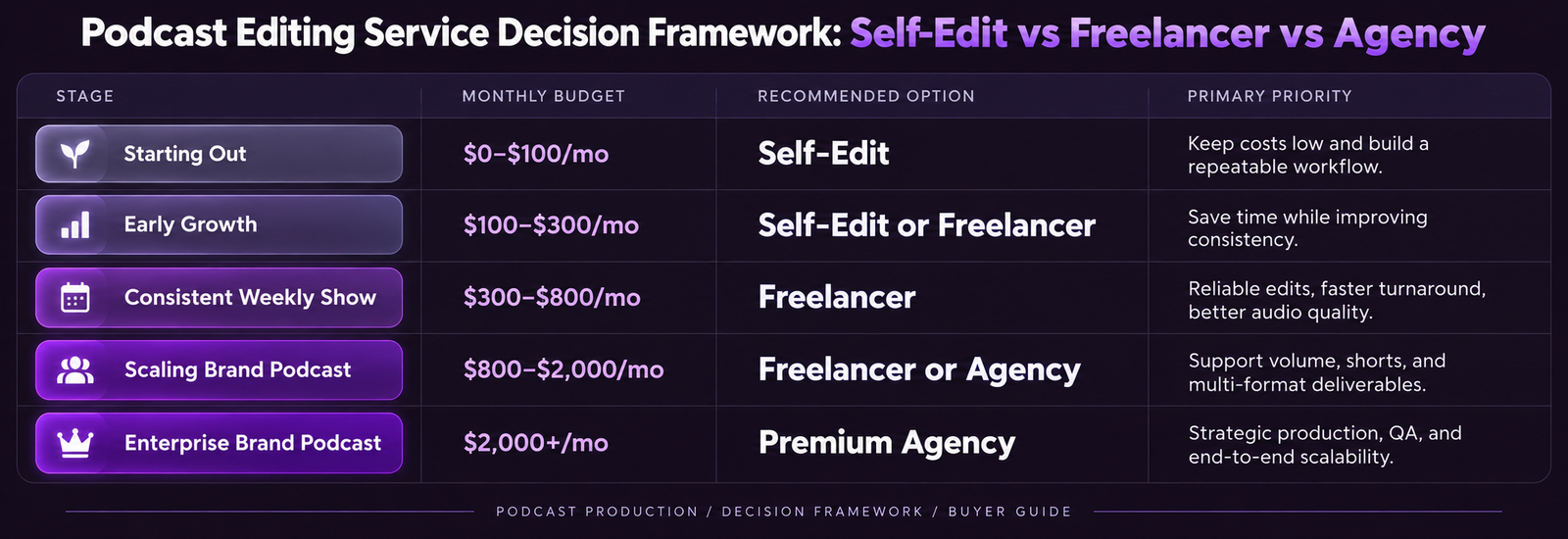
The Decision Framework: Self-Edit, Freelancer, or Agency?

Podcast StageMonthly BudgetRecommended OptionPrimary Priority
Starting out (under 20 episodes)£0–150Self-edit with Descript + AI toolsValidate concept before investing in production
Early growth (20–60 episodes)£150–400Skilled podcast freelancerConsistent quality at manageable cost
Established (60+ episodes)£400–900Specialist podcast agencyFull deliverable set and clip volume for growth
High-frequency (3+ episodes/week)£1,000+Full-service agencyTurnaround reliability and dedicated editor
Enterprise / brand podcast£2,000+Premium specialist agencyProduction quality and stakeholder approval workflow

How to Brief a Podcast Editing Service for Best Results

A complete editing brief eliminates back-and-forth that wastes production time. The brief should include: the show's brand identity assets (logo file, colour hex codes, font files, preferred caption style), the typical episode structure and recurring segments requiring specific treatment, the tone and register (formal vs conversational), the platforms the content will be distributed on, the turnaround requirement, the approval process (who reviews before publishing), and examples of clips or episodes representing the desired aesthetic.
A brand identity document, compiled once and provided to all future editing partners, reduces briefing time by 60–80% after the first episode. The investment of one hour in creating this document recovers itself in reduced revision requests and briefing overhead within the first month of any editing relationship.

Frequently Asked Questions

How should a podcast editing service handle remote multi-speaker audio with different microphone quality?

Professional podcast editing handles remote multi-speaker audio through individual track processing: each speaker's audio track is noise-reduced, equalised, and level-matched independently before the tracks are combined into the final mix. This produces consistent output regardless of microphone quality differences between speakers. The most common failure mode in remote podcast editing is applying a single processing chain to the combined mix rather than processing individual tracks, which cannot compensate for quality differences between speakers.

Should a podcast editing service also manage distribution and publishing?<

Some full-service agencies offer publishing management, uploading to the podcast host, publishing show notes, scheduling the YouTube video, posting social clips, as an add-on service. This is commercially valuable for podcasters who want a fully managed production and distribution pipeline. For the complete comparison of editing service options including which services offer publishing management, the best podcast editing agencies comparison covers the full evaluation framework and service tier comparison.

What is the minimum clip volume a podcast editing service should produce per episode?

The minimum clip volume for a growth-focused podcast is 10 clips per episode. This provides enough material for daily social publishing across two platforms without recycling clips within two weeks. Services producing 3–5 clips per episode are operating to a lower standard and are not using the available content multiplier effect of full clip extraction. Services producing 10–15 clips per episode are operating to the growth standard.

Get Professional Podcast Editing That Meets All 7 Criteria

Futuristic Marketing Services provides full 5-deliverable podcast editing: YouTube video, 10–15 kinetically captioned clips, audio master, SEO show notes, thumbnail, dedicated editor, and SLA-backed turnaround.

Get Podcast Editing Started


Conclusion

The right podcast editing service is not the cheapest or the most expensive, it is the one best matched to your podcast's current stage, publishing frequency, and growth objectives. The 7-criteria evaluation framework in this guide provides an objective basis for selection that goes beyond marketing copy and pricing to assess the deliverables, quality standards, and operational reliability that determine whether an editing service will actually help the podcast grow.
For the complete production standard that professional podcast editing should meet, covering the technical requirements for each of the five deliverables, the podcast video editing service guide provides the detailed technical and editorial framework. For the specific Shorts editing workflow that drives podcast subscriber growth through YouTube, the podcast to YouTube Shorts guide covers the complete clip production standard.
Share this post :
Picture of Devyansh Tripathi
Devyansh Tripathi

Devyansh Tripathi is a digital marketing strategist with over 5 years of hands-on experience in helping brands achieve growth through tailored, data-driven marketing solutions. With a deep understanding of SEO, content strategy, and social media dynamics, Devyansh specializes in creating results-oriented campaigns that drive both brand awareness and conversion.

All Posts