How to Conduct a Social Media Audit for Your Business

A social media audit is a structured review of every social media account your business owns, evaluating profile completeness, content performance, audience demographics, engagement quality, and goal alignment across all active platforms. Conducting one reveals exactly what is working, what is wasting resources, and which specific changes will produce the strongest improvement in results before any new content is created or budget is spent.

This guide walks through every step of conducting a complete social media audit for your business, from finding and cataloguing all your accounts through profile review, content performance analysis, audience assessment, engagement quality evaluation, competitor benchmarking, and goal alignment checking. You will also find a complete audit checklist, a key metrics reference table, a guide to building an actionable post-audit improvement plan, and the most common audit mistakes that cause businesses to draw wrong conclusions from their data. Whether you are running your first audit or making the process more systematic after years of intuition-based social media management, this guide gives you the complete framework to execute it thoroughly and act on what you find.

Key Takeaways

  • A social media audit should be conducted quarterly for full strategy review and supported by lighter monthly benchmarking checks between major audits.
  • According to Sprout Social's Impact of Social Media Report, 58% of teams that are expert-rated at measuring social media business impact rely on dedicated social media management tools to conduct audits efficiently.
  • The average social media dashboard shows over 20 data points, but research from Marketing Agent confirms that only 4 to 6 KPIs actually correlate with revenue growth for most businesses, making focused metric selection the most important audit discipline.
  • Engagement quality, specifically saves, shares, and comments, signals algorithm-worthy content far more reliably than impressions or total follower count.
  • Competitor benchmarking is a required audit component, not an optional one. Without knowing where you stand relative to competitors, there is no meaningful context for interpreting your own performance numbers.
  • Every audit must produce a prioritized action plan. An audit that produces a data report but no specific, ranked list of improvements to implement is an incomplete audit that will not change results.
  • Platform-specific benchmarks are essential because auditing Instagram and LinkedIn against identical KPI expectations produces misleading conclusions. Each platform has distinct algorithm behavior, engagement norms, and content performance patterns that require separate evaluation criteria.

Want a Professional Social Media Audit?

We Audit Your Social Media Presence and Build Your Improvement Plan

Futuristic Marketing Services conducts complete social media audits for businesses across India, delivering a detailed performance analysis, competitor benchmark, and a prioritized 30-day action plan for improving results on every active platform.

Get a Free Social Media Audit
What is a Social Media Audit and Why Your Business Needs One

A social media audit is a systematic evaluation of every social media account your business owns across every platform. It examines whether your profiles are complete and consistent, whether your content is producing the engagement and business outcomes it is designed to generate, whether your audience demographics match your target customer profile, and whether your social media activity is advancing the goals defined in your broader social media marketing strategy.
Most businesses that have been active on social media for more than six months are operating with at least some misalignment between their social media activity and their intended business outcomes. Content types that were generating results twelve months ago may be underperforming now due to algorithm changes. Platforms that seemed promising at launch may have revealed audience mismatches through months of low engagement data. Profile information that was accurate when first published may now be outdated, incomplete, or inconsistent with the current brand identity. A social media audit surfaces all of these misalignments and ranks them by business impact so the team knows exactly where to focus improvement effort first.

What a Social Media Audit Reveals for Your Business

A thorough social media audit reveals seven categories of insight that cannot be reliably identified through day-to-day social media management. The first is profile inconsistency: variations in logo quality, bio messaging, contact information, and brand voice across platforms that collectively create a less professional impression than any individual platform would suggest. The second is content performance patterns: which specific content types, topics, formats, and posting times consistently drive the strongest engagement and which are consuming creative resources while delivering minimal returns.
The third insight is audience alignment: whether the people actually following and engaging with your accounts match the demographic profile of your target customer, or whether the content strategy has attracted an audience that is unlikely to convert into buyers. The fourth is engagement quality signals: the ratio of saves, shares, and comments (high-quality engagement that signals genuine audience value) to likes and impressions (passive engagement that shows less about content effectiveness). The fifth is platform goal alignment: whether each active platform is genuinely serving a defined business goal or is being maintained for the sake of presence rather than performance.
The sixth category is competitive position: where your brand's content performance, posting frequency, and audience engagement rates stand relative to direct competitors on the same platforms. The seventh is lost accounts: inactive, duplicate, or unofficial accounts associated with your brand name that you may not know exist but that are actively creating confusion or damage to brand reputation without your knowledge. Together, these seven categories of insight give businesses a complete picture of where their social media investment is and is not producing value.

How Often Should You Audit Your Social Media

According to Digital Applied's social media audit research, the most effective audit cadence is a deep quarterly audit for strategy updates supported by monthly lightweight benchmarking between major audits. The quarterly audit covers every dimension of this guide in full, producing an updated action plan with ranked priorities for the following 90 days. The monthly benchmark review tracks five to six core metrics per platform against the baseline established in the most recent quarterly audit to identify whether performance is on track, improving, or showing early warning signs that require investigation before the next full audit.
Businesses should also conduct an unscheduled audit whenever a significant event occurs that may have materially affected social media performance. These triggers include a major platform algorithm change that affects reach or engagement across the industry, a rebranding or significant change to the business's products or services, a period of posting inconsistency such as a gap of two or more weeks without published content, unusually high or unusually low performance in a short period that differs significantly from established baseline trends, or the launch of a new platform account that needs integration with the existing strategy. Our social media consulting services include quarterly audit delivery and monthly performance reporting as standard components of ongoing client engagements.

How to Conduct a Social Media Audit in 8 Steps

The eight-step audit process below is designed to be completed in a single session of two to four hours for businesses with two to three active platforms, or in a structured half-day session for businesses active across four or more platforms. Work through each step in sequence, documenting every finding in a shared spreadsheet or document as you go. The documentation is what converts the audit from a discovery exercise into an actionable improvement plan at the end of the process.

Step 1: Find and List Every Social Media Account Your Business Owns

The first step is creating a complete inventory of every social media account associated with your business name, brand name, or product names. This step surprises many businesses because it regularly surfaces accounts they did not know existed, including old accounts created during an earlier phase of the business that were abandoned without being closed, unofficial accounts created by staff or former employees, and duplicate accounts created on the same platform under slightly different username variations.
Search for your business name, common abbreviations, and product names on every major platform including Instagram, Facebook, LinkedIn, YouTube, Twitter X, Pinterest, and WhatsApp Business. Document every account you find, whether you manage it actively or not. Flag any account you do not recognize or control for immediate investigation and, where appropriate, formal removal through the platform's brand protection or impersonation reporting process. Unofficial or abandoned accounts that appear in search results when potential customers look for your business actively damage the professional impression your brand makes before a customer has ever visited your primary account. This inventory becomes the foundation for every subsequent step in the audit.

Step 2: Review and Audit Profile Completeness on Every Platform

For each active account in your inventory, review every profile element against a completeness and brand consistency standard. According to Hootsuite's social media audit guide, profile auditing should confirm that brand styling and voice guidelines are reflected consistently across all platforms, that the information presented is current and accurate, and that every available profile field has been completed rather than left blank.
Check each of the following profile elements for every platform: profile photo quality and brand consistency, header or cover image quality and current relevance, bio or about section completeness and clarity of the value proposition, website link accuracy and destination page relevance, contact information completeness including phone, email, and location where applicable, username consistency with the brand name across platforms, and whether the account has accessed and completed any platform-specific business features such as Instagram's professional account tools, Facebook's business page categories, or LinkedIn's company page product listings.
Rate each profile element as Complete, Needs Updating, or Incomplete, and add the incomplete and outdated items directly to the action plan that will be built in Step 8. Profile optimization is typically the highest-leverage, lowest-effort improvement available at any audit because it affects every first impression made on a new visitor regardless of how they discovered the account. A fully optimized profile converts a significantly higher proportion of new visitors into followers than an incomplete one, making every subsequent content investment more efficient.

Step 3: Analyze Your Content Performance Data

Content performance analysis is the core of the social media audit and the step that requires the most time and careful interpretation. For each active platform, access the native analytics dashboard and export or document the performance data for every post published in the audit period, which is typically the past 90 days for a quarterly audit. For each post, record the format (Reel, carousel, static image, video, text post, Story), the content pillar or topic category it belongs to, reach, impressions, engagement rate, saves, shares, comments, and any clicks or link clicks generated.
Once you have the full post-level data set, identify your five highest-performing posts and your five lowest-performing posts on each platform. Look specifically for patterns across the top-performing group: are they all the same format, are they covering a specific topic category, were they published at a particular time of day, and do they have structural similarities in how the caption is written or how the call to action is framed? These patterns reveal the content formula that your specific audience responds to most strongly, which should directly influence the content strategy and social media content calendar going forward.
Apply the same pattern analysis to the lowest-performing posts to identify the content types and topics that are consuming creative resources without producing proportional results. These underperforming content categories are candidates for reduction or elimination in the next 90-day content plan unless there is a strategic reason to maintain them regardless of current engagement performance. The content audit findings are often the most valuable output of the entire process because they give specific, data-backed creative direction rather than the general improvement suggestions that most social media reviews produce.

Assess Your Audience Demographics and Growth

Audience assessment answers the question of whether the people following and engaging with your social media accounts actually match the profile of your target customer. This matters because an audience of the wrong demographic profile, regardless of its size or engagement level, is unlikely to convert into buyers regardless of how good the content is. Many businesses discover during this audit step that their social media content has attracted an audience that is enthusiastic but commercially unaligned with the business's actual customer profile.
For each platform, access the audience insights section and document the demographic breakdown by age, gender, and top locations. Compare this breakdown against the target customer profile documented in your marketing strategy. If the actual social media audience skews significantly younger, older, or geographically different from the intended target, flag this as a strategic finding that requires content strategy adjustment to attract a more commercially aligned audience over time.
Also document the follower growth trend over the audit period by recording the follower count at the start and end of the 90-day window and calculating the net growth and growth rate. A declining growth rate over consecutive quarters is an early warning signal that the content strategy is losing relevance with the target audience and requires review. A strong growth rate combined with low engagement rate per post suggests the audience is growing in quantity but not in the quality of interest in the brand, which typically indicates that growth-oriented tactics such as giveaways or trend-riding content are attracting followers who are not genuinely interested in the business's value proposition.

Evaluate Your Engagement Quality

Engagement quality analysis goes deeper than the summary engagement rate figure that most analytics dashboards display prominently. Research from Marketing Agent's 2026 social media audit guide confirms that saves, shares, and substantive comments are the engagement signals that most reliably indicate algorithm-worthy content and genuine audience value, while likes and impressions reflect passive exposure that carries limited signal about how much the audience actually values what they saw.
For each platform, calculate the average save rate per post (saves divided by reach), the average share rate per post (shares divided by reach), and the comment-to-like ratio for the audit period. A post that generates 500 likes and 2 comments tells a very different story from a post that generates 200 likes and 45 comments. The second post is producing genuine audience conversation that the algorithm interprets as strong quality signal, while the first is producing passive appreciation that carries much weaker distribution implications. Document these three quality metrics alongside standard engagement rate in your audit output and use the patterns to guide which content types should be prioritized in the next content cycle.
Also evaluate your response time and response rate for comments and direct messages during the audit period. If the audit reveals that fewer than 50% of substantive comments received a response, or that direct message response time regularly exceeds 24 hours, these are community management gaps that should be elevated to the top of the action plan because platform algorithms across all major platforms now factor brand responsiveness into the organic distribution decisions they make for that account's content.

Step 6: Conduct a Competitor Benchmark Analysis

Competitor benchmarking provides the external reference point that makes your own performance data interpretable. Without knowing how comparable brands in your market are performing on the same platforms, there is no way to determine whether your engagement rate of 2.8% represents strong performance or significant underperformance for your specific industry and audience size. Industry context transforms a raw number from an ambiguous data point into a meaningful competitive signal.
Select three to five direct competitors who are active on the same platforms as your business. For each competitor, document their follower count, approximate posting frequency, the content formats they use most frequently, their approximate engagement rate on recent posts (calculated as total engagements divided by follower count for each post, averaged across their last 10 posts), the topics and themes they cover consistently, and any content types or topic areas where their audience generates notably high engagement. Note where your performance exceeds theirs, where it falls short, and, most valuably, which topics and content formats their audience engages with that your current content strategy is not addressing.
According to Marketing Agent's audit guide, category leaders in most markets command 25% to 40% of total industry share of voice on social media, while challenger brands should target consistent quarterly growth of 2% to 3% in their share of voice as a realistic improvement trajectory. Use this benchmark to set a share of voice target in the action plan produced at the end of the audit. Our social media marketing agency uses professional competitive intelligence tools to conduct this analysis with greater depth and precision than is possible through manual platform browsing alone.

Step 7: Review Platform-Specific Goal Alignment

For each active platform, assess whether the activity on that platform is clearly advancing one of the social media marketing goals defined in the business strategy. Every platform in the active account inventory should have a clearly defined primary goal: brand awareness, lead generation, website traffic, community building, customer retention, thought leadership, or direct sales. If a platform cannot be connected to a specific business goal through the performance data, it is either being managed without strategic intent or the goal tracking infrastructure is insufficient to reveal the connection.
Document the primary goal for each platform and then evaluate the performance data specifically against that goal. If the goal of a LinkedIn account is lead generation, the relevant audit metrics are click-through rate on posts, website sessions from LinkedIn referral traffic in Google Analytics, and direct message enquiries received through the platform. The number of LinkedIn followers and total impressions are secondary context, not the primary performance indicators for that goal. Applying goal-specific metrics to each platform rather than the same generic engagement metrics across all platforms is what separates a useful audit from a data collection exercise that confirms activity without evaluating effectiveness.
Identify any platform where the goal alignment is unclear, where the performance data shows no meaningful progress toward the stated goal over the audit period, or where the resources being invested produce returns significantly below what the same effort would produce on a different platform. These findings form the strategic recommendations section of the final action plan.

Step 8: Build Your Prioritized Post-Audit Action Plan

The action plan is the output that determines whether the audit produces any actual improvement in results. An audit that generates a comprehensive data report without a prioritized list of specific, scheduled actions produces insight without change. The action plan converts every significant audit finding into a concrete, time-bound task assigned to a specific person with a defined completion date.
Prioritize audit findings into three tiers based on a combination of business impact and implementation effort. Tier One actions are high-impact, low-effort improvements that should be completed within the first two weeks after the audit: updating incomplete profile elements, removing or archiving inactive accounts, adjusting posting frequency to better match platform-specific recommendations, and correcting content mix imbalances where promotional content is exceeding the recommended 20% ceiling. Tier Two actions are high-impact but moderate-effort changes that should be completed within 30 days: content format adjustments based on performance patterns, audience targeting refinements for paid campaigns, and engagement practice improvements such as implementing a daily comment response routine.
Tier Three actions are strategic changes that require planning, resources, or extended implementation timelines of 30 to 90 days: content pillar revisions based on competitor gap analysis, platform additions or removals based on goal alignment findings, goal reset for platforms where the current objective is not being served by the existing activity, and production system improvements such as a batch creation workflow or scheduling tool upgrade. Attach a success metric and a review date to every action across all three tiers so that the next quarterly audit can assess whether each action produced the improvement it was designed to deliver. Our social media management services are built around exactly this kind of structured quarterly review and action planning cycle for every client we work with.

Social Media Audit Checklist for Your Business

The checklist below covers every element that should be reviewed during a complete social media audit. Use it as a working document during the audit session by marking each item as Complete, Needs Action, or Not Applicable for each platform being audited. Items marked as Needs Action feed directly into the prioritized action plan built in Step 8.
Audit CategoryChecklist ItemWhat to Look For
Account InventoryAll active accounts listedEvery platform where a business account exists under any brand name variation
Inactive accounts identifiedAccounts with no activity in the past 90 days; flag for archiving or reactivation decision
Unofficial or duplicate accounts foundAny account using the brand name not managed by the business; flag for reporting or removal
Access credentials confirmedLogin access verified for all accounts; no accounts managed exclusively by former staff
Profile CompletenessProfile photo quality and brand alignmentHigh resolution, correct logo or professional founder photo, consistent across all platforms
Bio or about section completenessClearly states what the business does, who it serves, and what a new follower gains; includes primary keyword
Website link is active and correctLink leads to the correct landing page; not broken or pointing to an outdated URL
Username consistency across platformsUsername matches or closely reflects the brand name on all platforms for consistent discoverability
Business category and contact fields completeAll available contact and category fields completed on platforms like Facebook and Instagram business profiles
Content PerformanceTop 5 posts identified per platformRanked by engagement rate or reach; patterns identified across format, topic, and timing
Bottom 5 posts identified per platformRanked by lowest engagement; patterns identified for elimination or significant revision
Content mix balance reviewedProportion of educational, community, social proof, behind-the-scenes, and promotional content calculated
Posting frequency consistency checkedAny weeks with no posts identified; gap between intended and actual posting frequency calculated
Short-form video proportion assessedPercentage of posts that are Reels, Shorts, or video content versus static formats; benchmark against platform algorithm preferences
Audience and EngagementAudience demographics match target customer profileAge, gender, and location distribution from audience insights compared to target customer profile
Comment response rate and time reviewedPercentage of substantive comments receiving a response; average response time calculated
Engagement quality metrics calculatedAverage save rate, share rate, and comment-to-like ratio calculated for the audit period
Strategy and GoalsEach platform has a defined primary goalClear statement of which business goal each active platform is designed to advance
Goal-specific KPIs tracked for each platformPerformance measured against the metrics that correspond to the stated goal, not generic engagement summaries
Competitor benchmark completedThree to five direct competitors reviewed; performance gaps and content opportunity areas identified

Key Metrics to Include in Your Social Media Audit

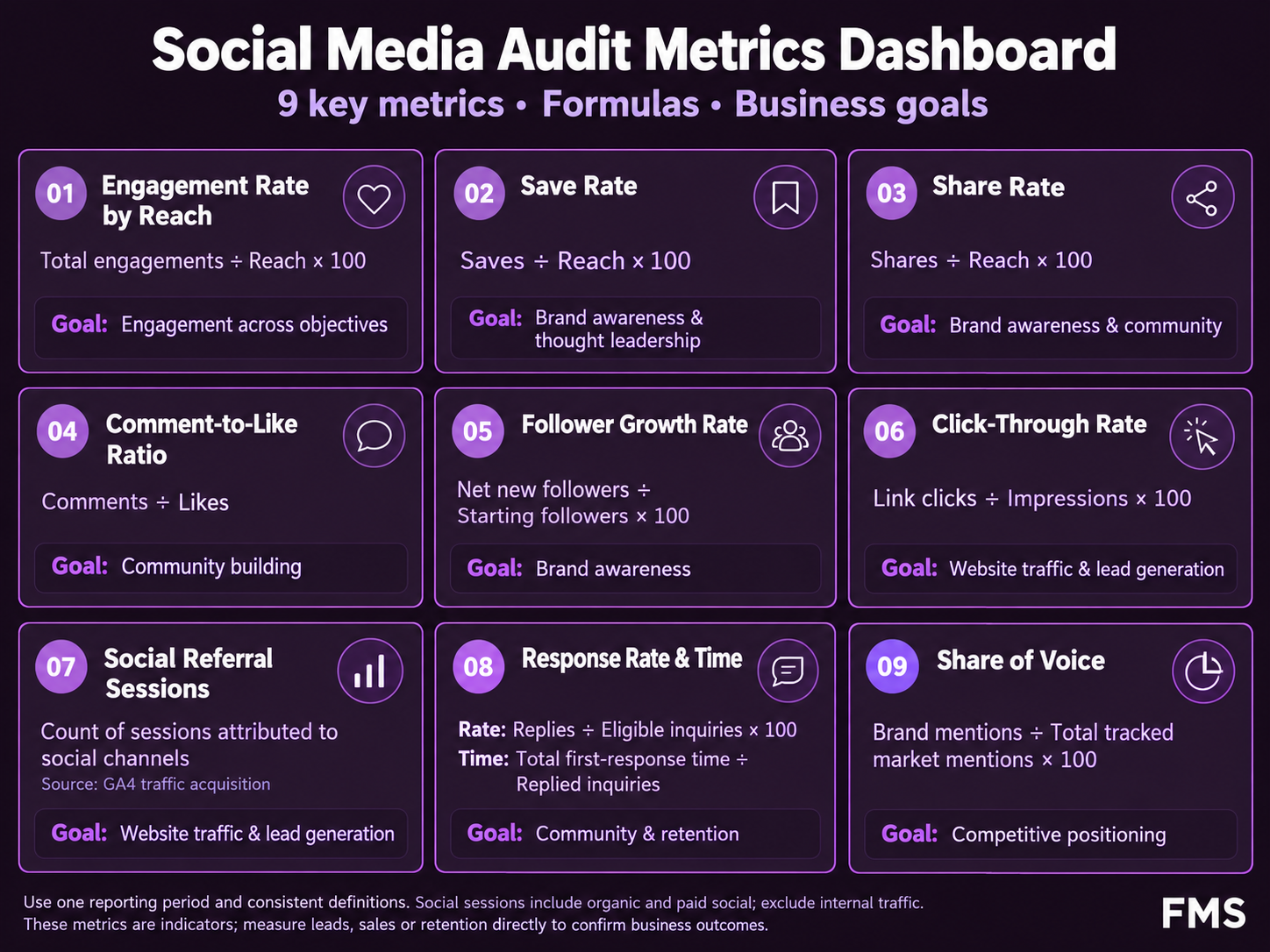
Selecting the right metrics for your audit prevents the most common analytical error in social media performance review: measuring everything and concluding nothing. Research from Marketing Agent confirms that the average social media dashboard displays more than 20 data points, but only four to six of those data points actually correlate with revenue growth for most businesses. The metrics table below identifies the highest-value audit metrics by goal category and explains what each one reveals about the quality of your social media activity.
MetricHow to Calculate ItWhat It RevealsGoal It Serves
Engagement Rate by ReachTotal engagements divided by reach, multiplied by 100How well your content resonates with the audience that actually saw it, regardless of follower countAll goals
Save RateTotal saves divided by reach, multiplied by 100Whether your content delivers enough perceived value for the audience to want to return to it; strongest algorithm signal on InstagramBrand awareness, thought leadership
Share RateTotal shares divided by reach, multiplied by 100Whether your content is valuable enough for your existing audience to distribute to their own network; the strongest organic reach multiplierBrand awareness, community
Comment-to-Like RatioTotal comments divided by total likes per post, averaged across the audit periodWhether your content sparks genuine conversation or only passive appreciation; high ratios indicate deep audience connectionCommunity building, engagement
Follower Growth RateNew followers gained minus unfollows, divided by starting follower count, multiplied by 100The net momentum of audience growth; negative or stagnant growth despite regular posting signals content-audience misalignmentBrand awareness
Click-Through RateTotal link clicks divided by reach or impressions, multiplied by 100How effectively content motivates the audience to move from social platform to the business website or landing pageWebsite traffic, lead generation
Social Referral SessionsMonthly website sessions attributed to social media channels in Google Analytics 4The actual volume of qualified traffic social media is delivering to the website; more reliable than in-platform click countsWebsite traffic, lead generation
Response Rate and TimePercentage of substantive comments and messages receiving a response, and average hours to first responseThe quality of community management practice; directly affects algorithm distribution and audience trustCommunity, retention
Share of VoiceYour brand mentions divided by total brand mentions in the industry category, multiplied by 100Your brand's relative visibility in social conversations compared to competitors; indicates market awareness momentumBrand awareness, competitive position

Common Social Media Audit Mistakes That Produce Misleading Conclusions

Conducting a social media audit with the right process but making specific analytical errors produces conclusions that are as misleading as no audit at all. Recognizing these mistakes before you begin prevents the recommendations that emerge from the audit from pointing the strategy in the wrong direction based on flawed data interpretation.
Using follower count as a primary performance indicator is the most prevalent audit mistake. Total followers is a snapshot number that reveals nothing about content quality, audience alignment, engagement health, or business outcome generation. A business with 50,000 followers and 0.3% average engagement rate is underperforming its audience significantly. A business with 3,000 followers and 5.8% average engagement rate with active comment conversations is building a healthy, commercially relevant community. Follower count is contextual data that belongs in the audit alongside growth rate, engagement rate, and audience demographic alignment, never as a standalone success metric.
Applying the same benchmarks across platforms is another serious error. An engagement rate of 2% is above average on Facebook but below average on LinkedIn for a well-positioned B2B brand. A save rate of 0.5% is strong for a consumer lifestyle brand on Instagram but irrelevant as a benchmark for a Twitter X account where saving is not a primary audience behavior. Each platform requires platform-specific benchmarks derived from your own historical performance trends and the published industry averages for accounts of comparable size and category on that specific platform.
Auditing without building an action plan makes the entire process a data collection exercise rather than a strategy improvement tool. The audit findings are only valuable insofar as they inform specific changes to the content strategy, platform prioritization, engagement practices, or production systems that improve performance in the following quarter. Every audit session should allocate the final 20% to 30% of its time to converting the findings into a written, ranked action plan with owners, deadlines, and success metrics before the session concludes.
Choosing the wrong audit period introduces another source of misleading conclusions. Auditing only the most recent 30 days of data captures seasonal performance variations, recent algorithm changes, or a single viral post's influence on aggregate metrics in ways that make the period's data unrepresentative of the account's true baseline performance. A 90-day audit window provides enough data to identify genuine performance patterns rather than short-term fluctuations. For the competitor benchmark component, extend the analysis window to 90 days as well to ensure competitor performance is assessed consistently over the same period rather than being influenced by any single unusually high or low-performing week in their recent history.

Save Time with a Professional Audit

We Audit Your Social Media and Deliver a 30-Day Action Plan

Our team conducts a complete social media audit across all your active platforms, benchmarks your performance against three to five direct competitors, and delivers a prioritized improvement plan with specific actions, timelines, and success metrics, all ready to implement from day one.

Request Your Professional Audit

Frequently Asked Questions About Social Media Audits

What is a social media audit?

A social media audit is a structured review of every social media account a business owns, evaluating profile completeness, content performance, audience demographics, engagement quality, competitor positioning, and alignment between social media activity and stated business goals. It identifies what is working, what is wasting resources, and which specific changes will produce the strongest improvement in results. A complete audit covers all active platforms and concludes with a prioritized action plan of specific improvements ranked by business impact and implementation effort.

How long does a social media audit take?

A complete social media audit covering two to three platforms with 90 days of performance data typically takes two to four hours to execute thoroughly when the auditor has direct access to all platform analytics dashboards and a prepared audit template document. Businesses active across four or more platforms should allow a half-day session of four to six hours. Monthly lightweight benchmark reviews between quarterly audits are designed to take 30 to 45 minutes per platform when focused specifically on the five to six core metrics established during the most recent quarterly audit rather than a full review of every audit dimension.

How often should a business conduct a social media audit?

Conduct a full social media audit quarterly, covering every dimension of the process from account inventory and profile review through content analysis, audience assessment, competitor benchmarking, and action plan development. Support this with a lighter monthly benchmark check that tracks five to six core performance metrics per platform against the baseline established in the most recent quarterly audit to identify any early warning signs before the next full audit. Conduct an unscheduled audit whenever a major platform algorithm change, significant brand event, rebranding, or extended posting gap occurs that may have materially affected performance.

What metrics should I include in a social media audit?

The metrics you include should be matched to the specific business goals your social media activity is designed to advance rather than selected from a generic standard list. For brand awareness goals, audit reach, follower growth rate, and share of voice. For engagement and community goals, audit engagement rate by reach, save rate, share rate, and comment-to-like ratio. For website traffic and lead generation goals, audit click-through rate and social referral sessions in Google Analytics. For customer service and retention goals, audit response rate and average response time. Select four to six metrics that directly correspond to your current primary goal rather than tracking all available data points simultaneously.

What is a good engagement rate on social media?

Engagement rate benchmarks vary by platform, account size, and industry, which is why platform-specific comparison with your own historical data and direct competitors provides more useful context than generic industry averages. As a broad reference, an engagement rate above 3% is considered strong on Instagram for most business account sizes. LinkedIn engagement rates above 2% are above average for company pages. Facebook engagement rates above 1% on organic page posts are solid given the platform's declining organic reach. Accounts with smaller followings typically achieve higher engagement rates than large accounts on all platforms, which is why comparing against accounts of similar size in the same industry is more meaningful than comparing against overall platform averages.

What tools can I use to conduct a social media audit?

Native platform analytics tools including Instagram Insights, Facebook Business Manager, LinkedIn Analytics, and YouTube Studio provide all the data needed for a basic audit at no cost. Google Analytics 4 is essential for tracking social referral traffic and on-site behavior of social media visitors. Scheduling and management tools like Sprout Social, Hootsuite, and Buffer provide consolidated multi-platform reporting that reduces the time required to gather data from individual platform dashboards. For competitor benchmarking, tools like Rival IQ, Brandwatch, and Sprout Social's listening features provide more efficient competitive analysis than manual platform browsing, though manual review of competitor accounts is a valid no-cost alternative for smaller businesses.

What should I do if I find fake or unofficial accounts during the audit?

Take immediate action on any unofficial, impersonator, or duplicate accounts found during the account inventory step. Most major platforms provide an impersonation or brand protection reporting mechanism accessible through their help center. Document the URL, username, and date of each account found for your records before reporting. Platforms typically respond to verified impersonation reports by removing or restricting the offending account, though response times vary by platform and severity of the case. For accounts that are not impersonating but simply use a name similar to your brand, assess whether they are causing active confusion before deciding whether to report them or simply monitor them.

How do I benchmark my social media performance against competitors?

Select three to five direct competitors who are active on the same platforms as your business. For each competitor, manually review their last 30 posts on their primary platform and calculate their approximate average engagement rate by adding the total engagements on each post and dividing by their follower count, then averaging across all reviewed posts. Document their posting frequency, top content formats, and the topic categories that generate their highest-engagement posts. Compare these figures against your own performance data from the same period. For more precise competitive intelligence including share of voice and follower growth rate comparisons, d

What is the most important output of a social media audit?

The prioritized action plan is the most important output of any social media audit. Every other element of the process exists to produce the informedicated social media analytics tools provide automated tracking rather than manual calculation.ation needed to build this plan. An audit that generates detailed data across every dimension but fails to conclude with a specific, ranked list of improvements to implement within defined timeframes has not completed its primary function. The action plan should contain a minimum of five specific, implementable recommendations ranked by their estimated impact on the primary business goal, with each recommendation assigned an owner, a completion deadline, and a success metric that will be reviewed at the next quarterly audit.

Can I conduct a social media audit myself or do I need an agency?

A self-conducted social media audit using native platform analytics tools and a structured template produces genuinely useful findings for most businesses. The main limitations of a self-conducted audit are the time required to gather data from multiple platform dashboards manually, the lack of access to competitive intelligence tools that provide more precise benchmarking data, and the potential for subjective bias when interpreting findings about your own content. A professional agency audit adds value through access to premium analytics tools, objective external perspective on content quality and competitive positioning, and an action plan built on broader cross-industry performance data than any single business's internal team is likely to possess. Our social media marketing agency conducts professional audits as both standalone engagements and as the opening step in ongoing strategy management relationships.

What should I do immediately after completing a social media audit?

Immediately after completing the audit, build the action plan while the findings are fresh and all data is in front of you. Sort all identified issues and opportunities into three priority tiers based on business impact and implementation effort. Assign a specific owner, deadline, and success metric to every item in the action plan before closing the audit session. Share the completed audit document and action plan with all relevant team members within 24 hours of the session. Begin implementing Tier One quick-win improvements within the first week so the audit produces visible changes before the next review cycle rather than sitting as a document that informs no immediate action.

How do I know if my social media audit found the right problems?

A well-conducted audit finds problems that, when corrected, produce measurable improvement in the performance metrics that correspond to your primary business goal within the following 60 to 90 days. If the action plan generated by the audit primarily identifies surface-level improvements such as updating a profile photo or changing posting times without addressing deeper content strategy, audience alignment, or goal tracking gaps, the audit analysis may have stopped short of the level of diagnostic depth needed to produce material improvement. The quality of an audit's conclusions can be assessed retrospectively by comparing performance at the next quarterly audit against the baseline established in the previous one and identifying which implemented actions correspond to measurable improvements in the core goal metrics.

Futuristic Marketing Services

Know Exactly What to Fix. Start Seeing Better Results This Quarter.

Our professional social media audit gives you a complete performance analysis, competitor benchmark, and a clear 30-day improvement plan, so you stop guessing and start making changes that actually move your business metrics in the right direction.

Book Your Free Audit Consultation

Conclusion

A social media audit is not a one-time exercise for businesses that feel their strategy is underperforming. It is a quarterly discipline that keeps any social media strategy aligned with business goals, audience expectations, and the constantly evolving platform algorithms that determine how widely content is distributed. Businesses that audit consistently make faster, more confident decisions, justify their social media investment with clearer data, and build social media programs that compound in effectiveness over time because every quarter's strategy is informed by the previous quarter's performance data.
The eight-step process in this guide gives any business the framework to conduct a complete, actionable audit independently using native platform analytics tools at no additional cost. The checklist ensures no critical audit dimension is missed. The metrics table ensures the right data points are measured for each specific business goal. The action plan framework ensures the audit produces change rather than just insight.
If you want a professional team to conduct a complete social media audit for your business, benchmark your performance against direct competitors with precision tools, and deliver a prioritized improvement plan ready to implement from day one, Futuristic Marketing Services is here to help businesses across India take the guesswork out of their social media strategy.
Share this post :
Picture of Devyansh Tripathi
Devyansh Tripathi

Devyansh Tripathi is a digital marketing strategist with over 5 years of hands-on experience in helping brands achieve growth through tailored, data-driven marketing solutions. With a deep understanding of SEO, content strategy, and social media dynamics, Devyansh specializes in creating results-oriented campaigns that drive both brand awareness and conversion.

All Posts