WordPress plugin development is the process of building a package of PHP code that extends or modifies WordPress functionality through the platform hook system. With over 60,000 free plugins in the WordPress repository and thousands more available commercially, custom plugin development is justified for a specific and relatively small subset of requirements, those where no existing plugin meets the business need at acceptable quality, or where a unique system integration requires bespoke code. This guide clarifies when custom development is the right answer and what to expect from the process.
Key Takeaways
- With 60,000 or more plugins in the WordPress repository, the correct first question when evaluating any custom plugin requirement is: does an existing plugin already solve this problem? Custom development is justified only when the answer is genuinely no.
- Custom plugin development is required when: the functionality needs to integrate with a proprietary internal system no plugin can know about; the business logic is unique enough that no generic plugin implements it; or the combination of required existing plugins creates unacceptable performance, security, or maintenance overhead.
- WordPress plugins work through a hook system, action hooks fire at specific events (page load, post save, user login) and filter hooks modify data before it is used. Understanding this system is the foundation of WordPress development at any level.
- Plugin security requires four non-negotiable practices: sanitise all input with WordPress sanitisation functions, escape all output with WordPress escaping functions, verify nonces on all form submissions, and check user capabilities before any privileged action. Skipping any of these creates exploitable vulnerabilities. See our WordPress security guide.
- Custom plugin development costs range from £800 for a simple single-function plugin to over £80,000 for a mission-critical enterprise workflow. The most important cost driver is specification clarity, an ambiguous brief produces scope creep that multiplies cost.
- Plugins should load their CSS and JavaScript only on pages where they are needed, not globally across every page. A contact form plugin loading its scripts on every page of a 200-page site adds unnecessary weight to 199 pages that have no form.
- After a custom plugin is built, it becomes a maintenance responsibility. Factor in ongoing maintenance costs, WordPress core updates can break plugin functionality, requiring developer time to test and update with each major release.
Need a Custom WordPress Plugin?
Bespoke Plugin Development With Security-First Engineering
Futuristic Marketing Services builds custom WordPress plugins, from simple API integrations to complex business logic applications, with security-first development and complete documentation.
Get a Free Consultation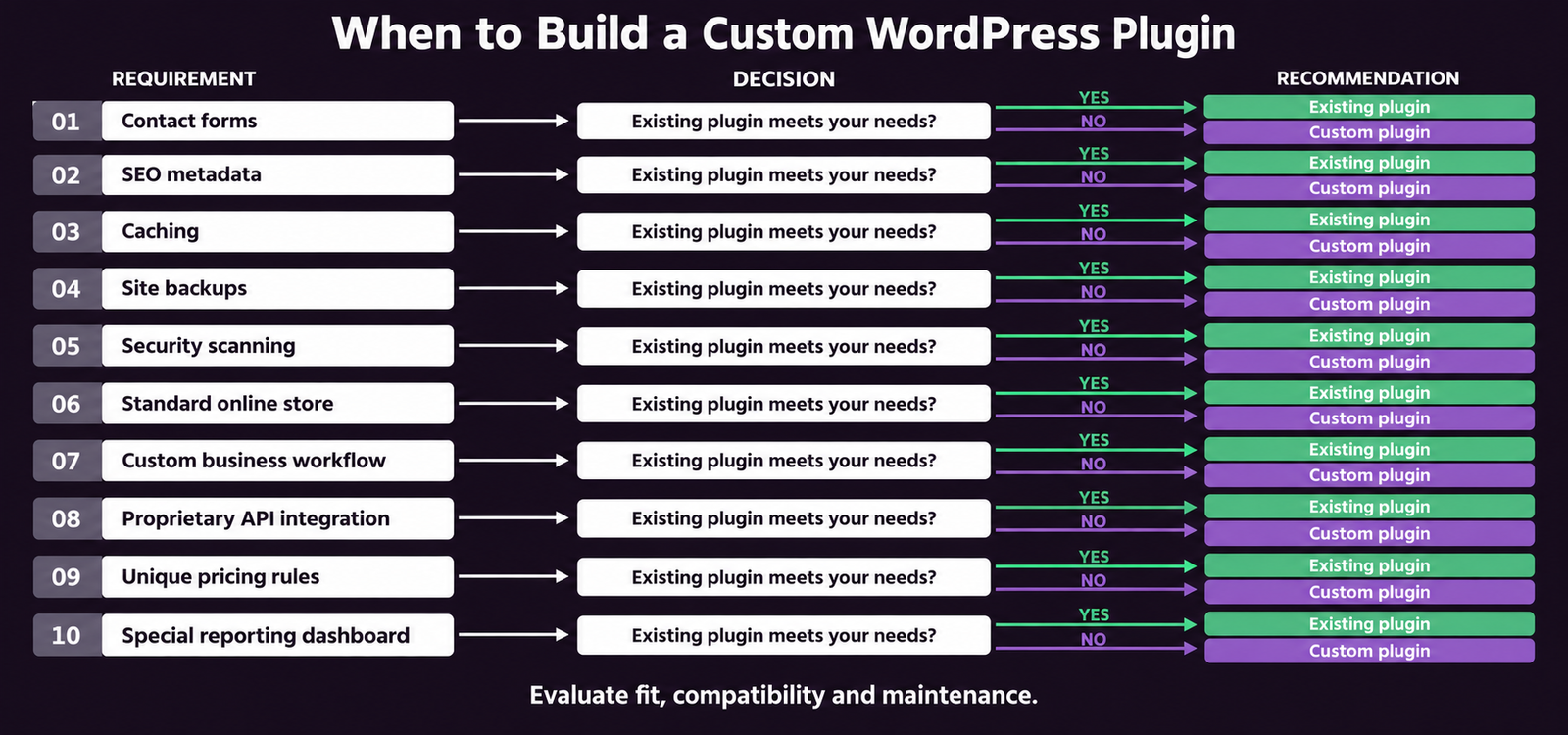
When Do You Need a Custom WordPress Plugin?
| Requirement | Custom Plugin Needed? | Better Alternative |
|---|---|---|
| Contact form with email notification | No | Gravity Forms, WPForms, or Elementor Pro Form Builder cover this completely |
| Product catalogue with standard variants | No | WooCommerce with Product Add-Ons extension handles all standard configurations |
| CRM integration (HubSpot, Salesforce, Pipedrive) | No | Official integration plugins exist for all major CRMs |
| Email marketing integration (Mailchimp, Klaviyo) | No | Official WordPress plugins for all major email platforms |
| Custom user registration and profile fields | Probably not | User Meta Manager, Ultimate Member, or ProfilePress cover most requirements |
| Complex pricing logic specific to your business | Maybe | Evaluate WooCommerce Dynamic Pricing extension first; custom if logic is genuinely unique |
| Integration with your proprietary internal ERP | Yes | No generic plugin can know your internal system API |
| Multi-step approval workflow for your specific business process | Yes | Your process is specific, no generic workflow engine implements it |
| REST API endpoints for your mobile application | Yes | Your app data contract is specific to your application |
| Custom reporting from your WordPress data model | Yes | Your data structure is unique, custom query and display logic required |
How WordPress Plugins Work
Action Hooks and Filter Hooks
Custom Post Types and Taxonomies
The REST API
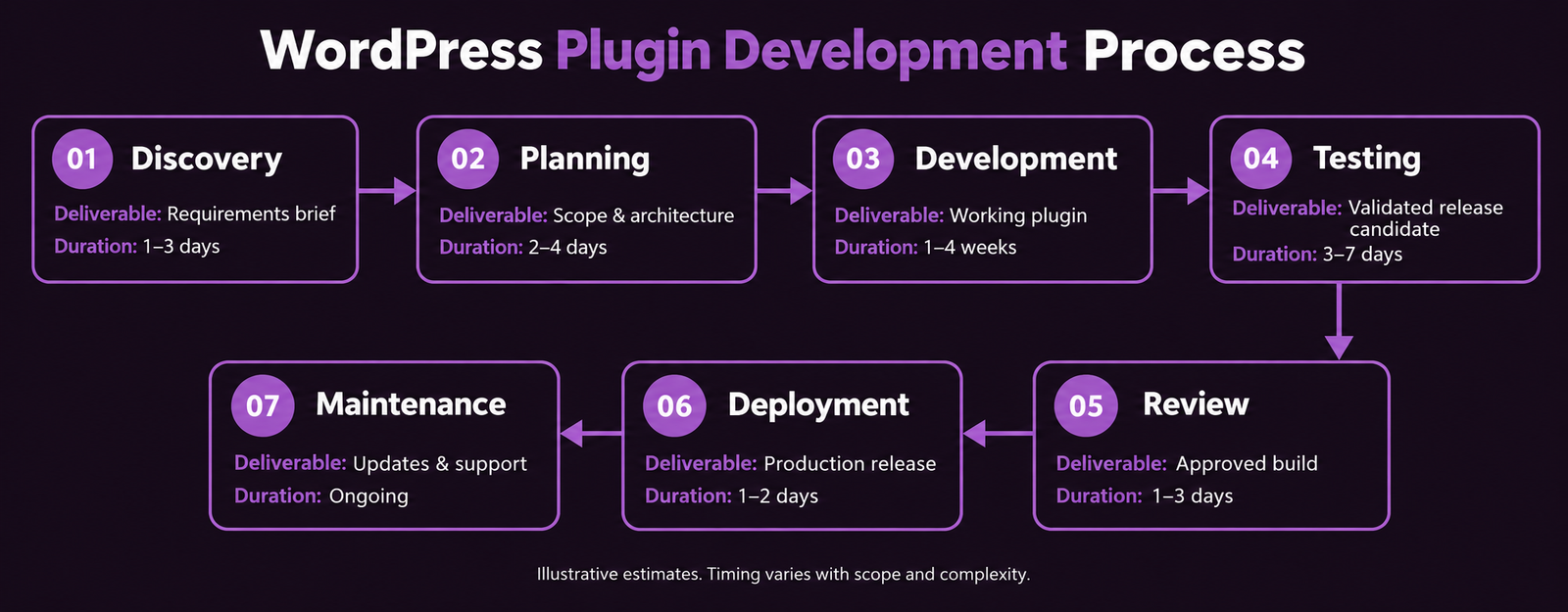
The Plugin Development Process
| Phase | Deliverables | Duration | Key Considerations |
|---|---|---|---|
| Requirements specification | Functional specification documenting all inputs, outputs, integrations, and edge cases | 3 to 10 days | Ambiguous requirements are the primary cause of cost overruns, invest time here |
| Plugin scaffold | Main plugin file with plugin header, activation and deactivation hooks, autoloader, and namespace structure | 1 to 2 days | Namespacing prevents conflicts with other plugins using identical function names |
| Database schema | Custom table creation via dbDelta() if the plugin stores data beyond WordPress default tables | 1 to 3 days | Define the schema carefully, changes require migration scripts |
| Core functionality | Hook registrations, custom post types, settings API pages, REST API endpoints, or integration code | 2 to 8 weeks | Most of the development time, complexity depends on specification scope |
| Security hardening | Nonce verification, capability checks, input sanitisation, output escaping across all endpoints | 2 to 5 days | Cannot be retrofitted cheaply, must be built in from the start |
| Testing | Unit tests with WP_UnitTestCase, integration testing, manual QA across plugin combinations | 3 to 7 days | Test with the specific theme and plugin combination of the production site |
| Documentation | PHPDoc comments, readme.txt, API endpoint documentation if applicable | 1 to 3 days | Documentation determines how maintainable the plugin is for future developers |
Plugin Security: The Four Non-Negotiable Practices
WordPress Plugin Security Requirements
Sanitise all input
Use WordPress sanitisation functions on all data received from users or external sources before storing or using it. sanitize_text_field() for text, absint() for integers, wp_kses_post() for HTML content. Never trust any input from outside the plugin.
Escape all output
Use WordPress escaping functions on all data before outputting it to the browser. esc_html() for plain text, esc_attr() for HTML attributes, esc_url() for URLs, wp_kses() for allowed HTML. Prevents cross-site scripting (XSS) attacks.
Verify nonces
Add wp_nonce_field() to all forms and verify with check_admin_referer() or wp_verify_nonce() before processing any form submission. Prevents cross-site request forgery (CSRF) attacks where a malicious site tricks users into submitting forms.
Check capabilities
Verify current_user_can('manage_options') or the appropriate capability before any admin action. A subscriber-level user must never be able to trigger actions that require administrator privileges, regardless of how the request is made.
Custom Plugin Development Cost
| Plugin Complexity | Description | Typical Cost | Timeline |
|---|---|---|---|
| Simple plugin | Single function: custom shortcode, admin settings page, basic data transformation or display | £800 to £3,000 | 1 to 3 weeks |
| Medium plugin | API integration, custom post type with admin interface, data storage in custom database tables | £3,000 to £10,000 | 3 to 7 weeks |
| Complex plugin | Multi-function, custom REST API routes, complex data model, external system integrations, admin reporting | £8,000 to £30,000 | 6 to 14 weeks |
| Enterprise plugin | Mission-critical workflow, high-volume data processing, security-sensitive operations, multi-role access | £20,000 to £80,000 or more | 3 to 6 months |
Ready to Commission a Custom Plugin?
Security-First Plugin Development With Full Documentation
Futuristic Marketing Services builds custom WordPress plugins, precise specification, security-hardened implementation, comprehensive testing, and developer documentation included.
Discuss Your Plugin RequirementsFrequently Asked Questions About WordPress Plugin Development
What is a WordPress plugin?
When should I build a custom WordPress plugin?
How much does custom WordPress plugin development cost?
How do WordPress plugins work technically?
What is the difference between a WordPress theme and a plugin?
How long does WordPress plugin development take?
What security practices are required for WordPress plugins?
Can a WordPress plugin slow down my site?
What is the WordPress REST API and can plugins extend it?
Do I need to maintain a custom WordPress plugin?
What is a WordPress shortcode and can I create custom ones?
How do I hire a good WordPress plugin developer?
Futuristic Marketing Services
Custom Plugin Built Exactly to Your Specification
Futuristic Marketing Services delivers custom WordPress plugins from precise specification, security-hardened, performance-optimised, fully documented, and supported with ongoing maintenance.
Commission Your Custom Plugin