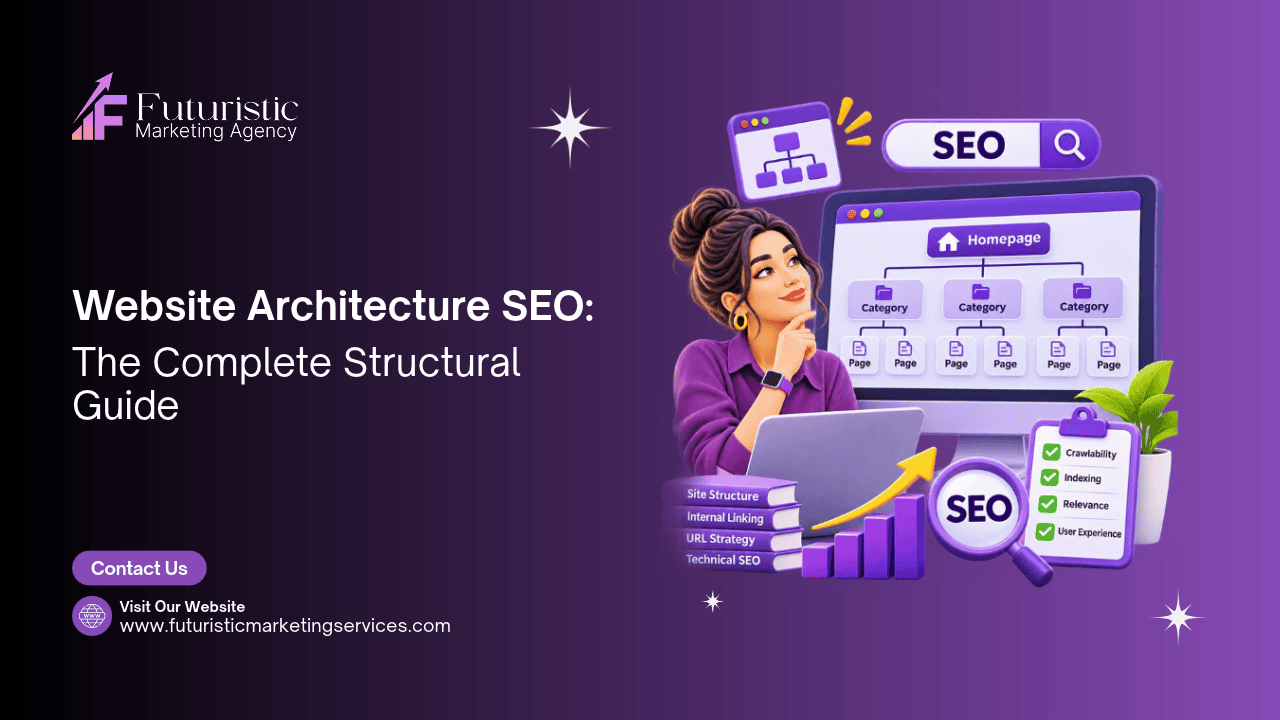
Website Architecture SEO: The Complete Structural Guide

website architecture seo

Website architecture SEO is the practice of organising a website’s URL structure, page hierarchy, and internal linking system to maximise how effectively Google can crawl, index, and understand the topical relevance of every page. Architecture determines which pages Google treats as most important, how PageRank flows between pages, how quickly Googlebot discovers new content, and how clearly the site’s topical structure communicates its expertise. Getting architecture right from the start produces compounding SEO benefits; getting it wrong creates structural problems that are expensive to remediate without risking ranking loss.

This guide covers the complete website architecture SEO framework, URL structure best practices, the silo architecture model, crawl depth and why pages buried deeply rank poorly, internal linking as a PageRank distribution tool, canonical architecture for duplicate and near-duplicate content, faceted navigation management for eCommerce, XML sitemap strategy, and the architecture decisions that must be made before any content is published. Whether you are planning a new site architecture or auditing an existing one, this guide provides the complete technical and strategic framework.

Key Takeaways

  • Site architecture is one of the highest-leverage SEO decisions because it compounds over time, correct architecture distributes PageRank efficiently to all pages continuously, incorrect architecture creates crawl budget waste and ranking suppression that grows as the site scales. Google recommends a logical hierarchy that allows Googlebot to discover all content efficiently.
  • Pages more than 4 clicks from the homepage are crawled infrequently and rank poorly, Google treats crawl distance from the homepage as a proxy for importance. Screaming Frog crawl depth analysis reveals which pages are buried and at risk of under-crawling. Priority commercial pages must be within 2 to 3 clicks of the homepage.
  • Internal linking is one of the highest-ROI SEO activities for established sites. Ahrefs research confirms internal links are among the most impactful on-page SEO factors for distributing PageRank to target pages. Every new blog post should link to 3 to 8 related internal pages with descriptive, keyword-relevant anchor text.
  • Clean, keyword-relevant URL structure is a direct ranking signal. Google URL guidelines recommend simple, descriptive slugs that reflect the page topic. /services/wordpress-development/ communicates topical relevance; /page?id=142 provides no keyword signal to Google.
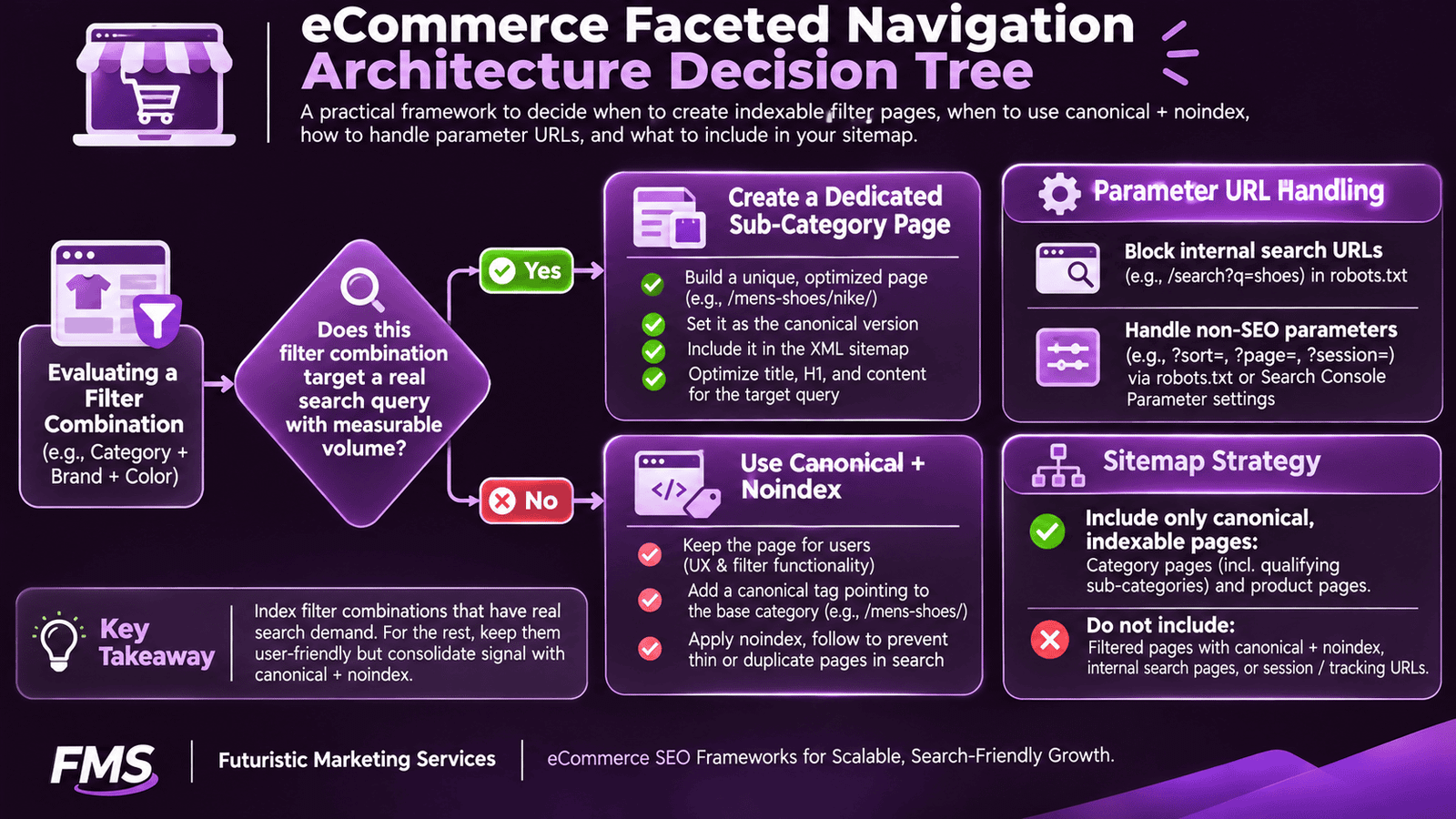
  • eCommerce faceted navigation is the most technically complex architecture challenge, each filter combination creates a new URL that can dilute crawl budget and create duplicate content at scale. See our eCommerce SEO guide for the complete faceted navigation management strategy.
  • The canonical tag architecture, which page is defined as the authoritative version when multiple near-identical URLs exist, is the most commonly misconfigured on-page technical SEO element. Missing or incorrect canonicals cause PageRank dilution across duplicate URLs rather than concentration on the target page.
  • Architecture decisions made before the first page is published are the cheapest possible SEO investment. Architecture changes on a live site with existing rankings require 301 redirects, GSC verification, and a monitoring period, all avoidable by designing the correct structure from the start. See our website migration SEO guide for the change process.
Architecture Review

Get Your Website Architecture Audited Before It Costs Rankings

Futuristic Marketing Services provides website architecture SEO audits, URL structure review, crawl depth analysis, internal linking audit, canonical architecture review, and a structural remediation plan.

Request an Architecture Audit

URL Structure Best Practices

URL structure is a direct Google ranking signal and a significant click-through rate factor in search results, users read URLs in SERPs and make relevance judgements from them before clicking. A well-structured URL also contributes to topical authority by placing pages within a logical hierarchy that mirrors the site topic structure.
URL PrincipleGood ExampleBad ExampleWhy It Matters
Use lowercase letters only/services/wordpress-development//Services/WordPress-Development/URLs are case-sensitive on most servers, mixed case creates duplicate URL variants
Use hyphens as word separators/website-speed-optimization//website_speed_optimization/ or /websitespeedoptimization/Google treats hyphens as word separators; underscores are treated as word connectors, hyphens are the SEO standard
Include primary keyword in slug/blog/wordpress-seo-guide//blog/post-1423/Keyword in URL provides relevance signal and improves SERP CTR, users see the topic before clicking
Use a logical hierarchy/web-development/wordpress/themes//post?cat=3&id=142&type=themeClean hierarchical URLs communicate topical structure to both users and Googlebot
Keep URLs concise/responsive-web-design//a-complete-guide-to-responsive-web-design-best-practices-for-2026/Shorter URLs are more shareable, display better in SERPs, and are easier to link to with anchor text
Remove stop words from slugs/wordpress-seo-guide//the-complete-guide-to-wordpress-seo/Stop words (the, a, to, for) add URL length without SEO value, remove them from slugs
Never include dates in evergreen content/wordpress-development-guide//2022/03/wordpress-development-guide/Date-based URLs make evergreen content appear outdated in SERPs, depressing CTR and signals content currency

URL Hierarchy Reflects Content Hierarchy

The URL hierarchy should mirror the topical hierarchy of the site. A WordPress agency site might use: /web-development/ as the parent; /web-development/wordpress/ as the WordPress sub-category; /web-development/wordpress/themes/ for theme-specific content; and /web-development/wordpress/themes/elementor/ for Elementor theme content. This hierarchical structure communicates topical depth to Google, enables breadcrumb navigation that appears in SERPs, and makes internal linking patterns logical. Plan the full URL hierarchy before publishing any content, changing URL structure after publishing requires 301 redirects and carries ranking transition risk. See our website migration SEO guide for the change process.

Silo Architecture: Topical Authority Through Structure

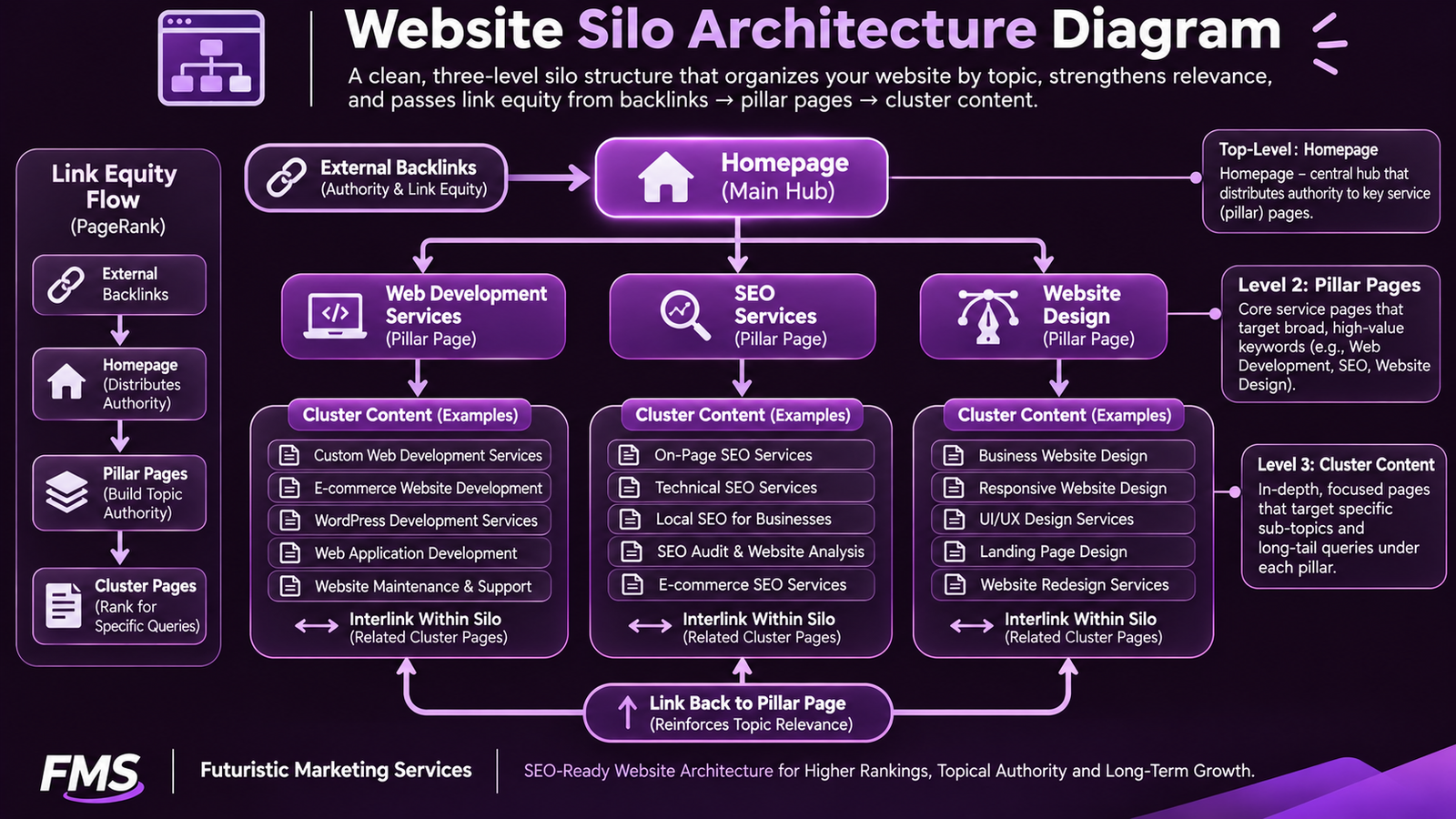
Silo architecture is the practice of organising site content into distinct topical clusters, each cluster (or silo) covering one topic comprehensively through a pillar page and supporting content pages that interlink within the cluster. The architecture concentrates topical relevance signals within each cluster, making each pillar page and its supporting content more authoritative on its topic than scattered pages on the same subjects without structural connection.

The Three-Level Silo Architecture Model

Level 1: Pillar pages (silo roots)

The top of each content cluster, comprehensive guides targeting primary category keywords. Example: this guide on website architecture SEO. Pillar pages link down to supporting cluster content and receive links up from every page in their cluster. They target the highest-volume keywords in the topic area and are the authority pages Google uses to establish topical expertise. See our WordPress SEO guide.

Level 2: Cluster content (supporting pages)

In-depth guides on specific sub-topics within the pillar topic. Example: a guide on internal linking as part of an SEO architecture cluster. Cluster content links up to its pillar page, across to related cluster content (sparingly), and never out of its topical silo to unrelated content. Each piece adds topical depth that reinforces the pillar page authority.

Level 3: Supporting detail pages

The most specific content in each cluster, covering individual techniques, tools, or questions. Example: a page on canonical tag implementation as part of the technical SEO cluster. These pages link to their cluster content parent and to the pillar page. They target long-tail keywords that their parent content does not cover.

Cross-silo contextual links

Internal links between silos should occur only when genuinely contextually relevant, when a page in one silo references a topic covered in another. These contextual cross-silo links pass authority between cluster pillar pages and signal to Google that the two topics are related. Forced cross-silo links dilute the topical focus of each cluster.

Anchor text in silo architecture

Internal links within a silo should use anchor text that contains the target page primary keyword. This provides Google with an explicit keyword signal about the linked page topic. Vary anchor text slightly across multiple links to the same page, exact match on every link can appear manipulative. Partial match and semantic variations are correct.

URL structure reflecting silo architecture

The URL hierarchy should mirror the silo structure: /category/sub-topic/specific-page/. This communicates the content hierarchy to Google through the URL structure as well as through internal links, reinforcing topical authority signals from two directions simultaneously.

Internal Linking as PageRank Distribution

Internal links pass PageRank (link authority) from one page on the site to another. High-authority pages, those with many external backlinks or strong internal link profiles, can distribute that authority to other pages through internal links. This makes internal linking a direct ranking lever for pages that need more authority to rank for their target keywords.
Internal Linking PrincipleImplementationSEO Impact
Link from high-authority pages to target pagesIdentify the most linked-to pages (Ahrefs → Site Explorer → Best by Links). Add contextually relevant internal links from these pages to priority target pages.Direct PageRank transfer to target pages, can produce ranking improvements without any external link acquisition
Use keyword-relevant anchor textAnchor text should describe the target page topic using natural variations of the target keyword. 'WordPress SEO guide' is better anchor text than 'click here'.Explicit keyword signal to Google about the target page topic, reinforces the topical relevance of the linked page
Link depth: no orphan pagesEvery page must have at least one internal link pointing to it. Orphan pages (no internal links) are under-crawled and under-ranked. Use Screaming Frog to identify orphan pages.Orphan pages are invisible to Googlebot unless discovered via sitemap, no internal links means no PageRank and minimal crawl frequency
Maximum crawl depth: 3 to 4 clicksPriority commercial pages must be reachable from the homepage in 3 clicks or fewer. Check with Screaming Frog crawl depth analysis.Pages more than 4 clicks from the homepage are crawled less frequently, Google treats click depth as a proxy for importance
Breadcrumb navigation as structured linksImplement breadcrumb navigation (Home > Category > Sub-page) and add BreadcrumbList schema. These provide structured internal links that reinforce URL hierarchy.Breadcrumbs provide additional internal links at every level of the hierarchy; schema enables breadcrumb display in SERPs
Avoid over-linking from low-authority pagesInternal links pass PageRank proportionally, a page with 100 outgoing links passes 1/100th of its authority per link. Focus internal links to target pages from pages with strong external link profiles.Fewer, higher-quality internal links to priority pages are more effective than many links from low-authority pages

eCommerce Architecture: The Faceted Navigation Challenge

eCommerce sites have the most complex architecture challenges because product filtering generates enormous numbers of URL variations, each filter combination creates a new URL that can fragment PageRank, create duplicate content, and waste crawl budget on low-value parameter pages. Faceted navigation management is the highest-priority architecture task for any eCommerce site with filtering functionality.
The correct eCommerce architecture approach: canonical all filter combination URLs to the base category page as default (/women-shoes?colour=red canonicals to /women-shoes/). Noindex all filter URLs that do not target real search queries. Create dedicated sub-category pages for filter combinations that target genuine high-volume queries, /women-red-shoes/ as a real page rather than a parameter URL. Block crawling of internal search result URLs and low-value parameter combinations via robots.txt. Submit an XML sitemap containing only canonical, indexable, non-filtered category and product URLs. For the complete implementation framework, see our eCommerce SEO guide.

XML Sitemap Architecture

The XML sitemap communicates the site structure to Google explicitly, listing every canonical, indexable URL the site owner wants Google to discover and index. A correctly architected sitemap accelerates Googlebot's discovery of new and updated content and provides the definitive list of pages the site intends to have indexed.
Sitemap architecture principles: include only canonical, indexable URLs returning a 200 status code. Exclude noindex pages, redirect destinations, parameter URLs, and any URL that should not appear in search results. For large eCommerce sites, use a sitemap index file linking to separate sitemaps for products, categories, and blog content, this enables faster partial re-submission after updates. Submit the sitemap URL to Google Search Console at launch and verify the submitted URL count against the indexed URL count in the Coverage report. Discrepancies reveal either crawlability issues (pages submitted but not indexed because they are blocked) or indexation issues (pages indexed that should not be). See our technical SEO audit guide for the full indexation audit process.

Architecture Planning

Plan Your Site Architecture Before Publishing a Single Page

Futuristic Marketing Services provides website architecture planning and audit services, URL structure design, silo planning, internal linking frameworks, and eCommerce faceted navigation strategy.

Plan Your Architecture

Frequently Asked Questions About Website Architecture SEO

What is website architecture SEO?

Website architecture SEO is the practice of organising a website URL structure, page hierarchy, and internal linking system to maximise how effectively Google can crawl, index, and understand the site. It determines which pages Google treats as most authoritative, how PageRank flows between pages, how quickly new content is discovered, and how clearly the site communicates its topical expertise. Google recommends a logical hierarchy that allows Googlebot to discover all content efficiently. Architecture decisions made at the start of a project are the cheapest possible SEO investment, architecture changes on a live site require 301 redirects and carry ranking transition risk.

How does URL structure affect SEO?

URL structure affects SEO in three ways: as a direct relevance signal (keywords in URL communicate the page topic to Google); as a CTR factor (users read URLs in SERPs and judge relevance before clicking, descriptive slugs improve click-through rate); and as a hierarchy signal (folder structure communicates content relationships). Google URL guidelines recommend simple, descriptive, hierarchical URLs using hyphens as word separators, lowercase letters, and primary keywords in the slug. Never use dates in evergreen content URLs, they make content appear dated in SERPs.

What is a silo architecture in SEO?

A silo architecture organises site content into distinct topical clusters, each cluster has a pillar page covering the topic comprehensively, supported by in-depth content on sub-topics, all interlinked within the cluster. This concentrates topical relevance signals, making each cluster authority page more credible for its topic than scattered pages without structural connection. The URL hierarchy mirrors the silo structure; internal links flow primarily within silos and between pillar pages across silos. Silo architecture is particularly effective for specialist business websites and content-driven sites where demonstrating topical authority across a defined subject area is the primary SEO strategy.

How does crawl depth affect SEO?

Crawl depth is the number of clicks from the homepage required to reach any given page. Google uses crawl distance from the homepage as a proxy for page importance, pages that are harder to reach are crawled less frequently and rank more poorly. Screaming Frog crawl depth analysis reveals pages at depth 5 or greater that are at risk of under-crawling. Priority commercial pages must be within 2 to 3 clicks of the homepage. For eCommerce sites with large catalogues, a flat architecture (product categories accessible from homepage within one click) is the correct approach to maintain shallow crawl depth at scale.

What is an internal linking strategy for SEO?

An internal linking strategy for SEO uses internal links to: distribute PageRank from high-authority pages (those with many external backlinks) to target pages that need ranking authority; signal to Google the topical relevance of linked pages through descriptive anchor text; ensure all pages are discoverable through internal links (no orphan pages); and maintain shallow crawl depth (all priority pages within 3 to 4 clicks of the homepage). According to Ahrefs research, internal links are among the most impactful on-page SEO factors, yet internal linking is the most commonly neglected SEO activity on established sites.

What is a canonical tag and how does it affect site architecture?

A canonical tag (rel=canonical) tells Google which URL is the definitive version when multiple near-identical URLs exist for the same content. It is the primary tool for managing duplicate content created by: URL parameters (filter combinations on eCommerce sites); trailing slash variants (/page/ and /page); www and non-www variants; HTTP and HTTPS variants; and pagination. Without canonical tags, PageRank is diluted across multiple URL variants rather than concentrated on the target page. Every WordPress and eCommerce site must have canonical tags correctly configured on all pages, Yoast SEO and Rank Math both automate canonical generation with correct defaults.

How do I structure URLs for a WordPress site?

WordPress URL structure: set permalink structure to Post Name in Settings, Permalinks before publishing any content. This produces /post-name/ format for posts and pages. For a multi-topic site, consider using the Category base structure, /category/post-name/, to create topical hierarchy in the URL. Category URLs themselves should be concise and keyword-relevant: /wordpress/ not /wordpress-articles-and-guides/. Avoid dates in URLs for evergreen content. Remove stop words (the, a, to, for, in) from all slugs. Never change permalink structure on a live site without a comprehensive 301 redirect mapping, see our website migration SEO guide.

What is faceted navigation and how does it affect eCommerce SEO?

Faceted navigation is the product filter system on eCommerce sites, allowing customers to filter by colour, size, brand, price, and other attributes. Each filter combination creates a new URL (/women-shoes?colour=red&size=7) that can fragment PageRank across hundreds of near-duplicate URLs, dilute the authority of category pages, and waste crawl budget on low-value parameter pages. The correct approach: canonical all filter URLs to the base category page by default; noindex filter combinations that do not target real search queries; and create real sub-category pages only for filter combinations targeting genuine high-volume keywords. See our eCommerce SEO guide for the complete framework.

How should I structure my XML sitemap for SEO?

XML sitemap structure: include only canonical, indexable, 200-status URLs. Exclude: noindex pages; redirect destinations; parameter URLs; internal search results; and any URL that should not appear in search results. For large sites (over 10,000 URLs), use a sitemap index file linking to separate sitemaps for different content types (products, categories, blog posts). Submit the sitemap URL to Google Search Console at launch and monitor the Coverage report for discrepancies between submitted and indexed URL counts. A sitemap containing 404 or noindex pages sends confusing signals to Google and wastes crawl budget on non-canonical URLs.

What is crawl budget and why does it matter?

Crawl budget is the number of pages Googlebot will crawl on a site within a given time period, determined by the site crawl rate (how fast the server can respond) and crawl demand (how important Google considers the site). For small sites (under 1,000 pages), crawl budget is rarely a constraint. For large eCommerce sites with thousands of products and filtered URLs, crawl budget management is critical, if Googlebot wastes crawl budget on low-value parameter URLs, important new product and category pages may take weeks to be indexed. Manage crawl budget by: blocking parameter URLs in robots.txt; ensuring sitemaps contain only indexable pages; and using noindex on low-value pages rather than blocking via robots.txt. See our technical SEO audit guide.

How does site architecture affect eCommerce SEO?

eCommerce site architecture is the highest-leverage SEO investment for online stores because category pages, which rank for the highest-volume commercial keywords, accumulate their authority through the architecture decisions: shallow crawl depth from the homepage; clean canonical URLs; unique category page copy; and internal links from blog content passing authority to category pages. A flat eCommerce architecture (product categories directly accessible from the homepage in one click) produces significantly better category page rankings than deep architectures where category pages are buried 3 to 5 clicks from the homepage. Combine this with faceted navigation management and correct canonical architecture for maximum SEO impact. See our eCommerce SEO guide.

What should I check in a website architecture SEO audit?

A website architecture SEO audit should check: URL structure (lowercase, hyphens, keywords, no dates, logical hierarchy); crawl depth (all priority pages within 3 to 4 clicks using Screaming Frog); canonical tags (all pages self-canonicalise; duplicate URL variants canonical correctly); internal linking (no orphan pages; priority pages receiving links from high-authority internal pages; anchor text keyword-relevant); XML sitemap (contains only canonical indexable pages; submitted to Google Search Console); robots.txt (blocking only low-value URLs; not accidentally blocking important content); and eCommerce faceted navigation if applicable. See our technical SEO audit guide for the complete audit process.

Futuristic Marketing Services

Build the Right Architecture Before Rankings Depend on It

Futuristic Marketing Services provides website architecture SEO planning and audit services, URL structure design, silo architecture planning, internal linking frameworks, and eCommerce faceted navigation strategy, for sites being built and sites needing structural improvement.

Commission Your Architecture Audit


Conclusion: Architecture Is the Foundation Every SEO Tactic Builds On

Website architecture SEO is the least visible but most structurally important layer of organic search performance. Content quality, backlink acquisition, and technical performance all operate on top of the architecture, and all are constrained by its quality. A site with excellent content and strong backlinks but poor architecture (orphan pages, deep crawl depth, diluted canonicals, wasted crawl budget) systematically underperforms its potential on every target keyword.
The most commercially significant architecture decision is timing: architecture planned correctly before the first page is published is a zero-cost SEO investment. Architecture corrected on a live site with existing rankings requires 301 redirects, GSC re-submission, and a monitoring period during which rankings may fluctuate. Invest in architecture planning proportionate to the expected scale and lifespan of the site, the larger and longer-lived the site, the more valuable the upfront architecture investment becomes. See our technical SEO audit guide and WordPress SEO guide for the implementation frameworks.
Share this post :
Picture of Devyansh Tripathi
Devyansh Tripathi

Devyansh Tripathi is a digital marketing strategist with over 5 years of hands-on experience in helping brands achieve growth through tailored, data-driven marketing solutions. With a deep understanding of SEO, content strategy, and social media dynamics, Devyansh specializes in creating results-oriented campaigns that drive both brand awareness and conversion.

All Posts