
Web Development Services: The Complete UK Business Guide

web development services

Web development services encompass the design, build, and ongoing maintenance of websites and web applications for businesses. They range from a five-page WordPress brochure site at £3,000 through to a custom enterprise web application at £200,000 or more. Professional web development services include front-end design, back-end functionality, performance engineering, SEO technical foundation, and post-launch maintenance, delivered by a freelancer, specialist agency, or in-house team.

This guide covers everything UK businesses need to know about web development services in 2026, the seven types of web development and which your project requires, the complete UK cost benchmarks by project type and provider tier, the difference between a web developer and a web designer and why both roles matter, the technology platform decision framework (WordPress, Shopify, custom code), how to brief a development project to prevent the most common overruns, the contract terms that protect your investment, how to evaluate agency portfolios using measurable performance data, and the post-launch services that determine whether the initial investment grows in value or depreciates after launch.

Key Takeaways

  • Web development services span seven distinct disciplines, from static HTML marketing sites to complex web applications with real-time data. Matching the service type to the actual project requirement is the most important decision before any brief is written or quote requested.
  • UK professional web development costs range from £3,000 for a basic WordPress site to £200,000 or more for a custom enterprise application. According to Clutch research, average UK agency rates are £75 to £150 per hour. Fixed-price project quotes are preferable to hourly billing for defined-scope projects.
  • WordPress powers 43.4% of all websites globally and is the most cost-effective platform for professional marketing sites, eCommerce, and content operations. The correct platform choice is the highest-leverage technical decision in any web development project.
  • Performance engineering, Core Web Vitals optimisation, mobile Lighthouse score, and server response time, must be part of the development specification from day one. A site launched without Good Core Web Vitals status starts ranking below its potential immediately.
  • The three non-negotiable professional development practices: a staging environment for all testing before live deployment; Git version control with a documented deployment process; and a post-launch website UX audit and performance validation process. Their absence are red flags.
  • Post-launch web development services, ongoing maintenance, performance monitoring, SEO tracking, and conversion rate optimisation, determine whether the initial build investment grows in value. A professionally built site without a maintenance programme depreciates systematically.
  • The brief is the highest-leverage document in any web development project. A precise written specification reduces quotes by 15 to 30 percent, prevents the majority of scope disputes, and produces better outcomes regardless of which provider delivers the work. Invest time in the brief before requesting any quotes.

Web Development Services

Professional Web Development Delivered to Specification

Futuristic Marketing Services provides complete web development services, from WordPress marketing sites and WooCommerce stores to custom applications, with staged delivery, Git version control, and Core Web Vitals engineering as standard.

Discuss Your Project

The Seven Types of Web Development Services

Web development is not a single service, it encompasses seven distinct disciplines, each requiring different skills, tools, and investment levels. Understanding which type your project requires determines the correct provider to hire and the correct budget to allocate.
Service TypeWhat It DeliversTypical Tech StackInvestment Range
WordPress developmentMarketing sites, blogs, content platforms, and business websites on the world's most-used CMSWordPress, PHP, MySQL, Elementor or Gutenberg, WP Rocket, Yoast or Rank Math£3,000 to £30,000
eCommerce developmentOnline stores with product catalogue, payment processing, inventory management, and order fulfilmentWooCommerce, Shopify, or custom eCommerce, depends on scale and requirements£5,000 to £80,000
Custom web applicationBespoke web-based tools, portals, SaaS products, and data applications with unique business logicNext.js, React, Node.js, Laravel, PostgreSQL, selected per project requirements£30,000 to £500,000
Landing page developmentHigh-conversion single pages for paid campaigns, lead generation, and product launchesWordPress, Webflow, or custom HTML, optimised for conversion and Core Web Vitals£800 to £8,000
Headless CMS and JamstackDecoupled architecture: CMS back-end (WordPress, Contentful, Sanity) with Next.js or Astro front-end for maximum performanceNext.js, Vercel, Contentful or Sanity, or headless WordPress REST API£20,000 to £150,000
API development and integrationBuilding or connecting to REST APIs, third-party system integrations, and data pipelinesNode.js, Laravel, Django, selected by existing system requirements£5,000 to £80,000
Website redesign and migrationRebuilding an existing site on a new platform or with a new design while preserving SEO equityPlatform depends on project, always includes 301 redirect mapping and GSC verification£5,000 to £60,000

Matching the Service to Your Project

The most expensive web development mistake is commissioning the wrong service type. A business that commissions custom web application development for a requirement that WordPress and WooCommerce handle completely pays 3 to 10 times the necessary cost for equivalent functionality. Before briefing any provider, define the primary purpose of the site (content publishing, eCommerce, lead generation, or web application), the required integrations, and the performance requirements. These three factors determine which service type and which technology platform is correct. See our custom website development guide for the platform versus custom decision framework.

UK Web Development Cost Benchmarks

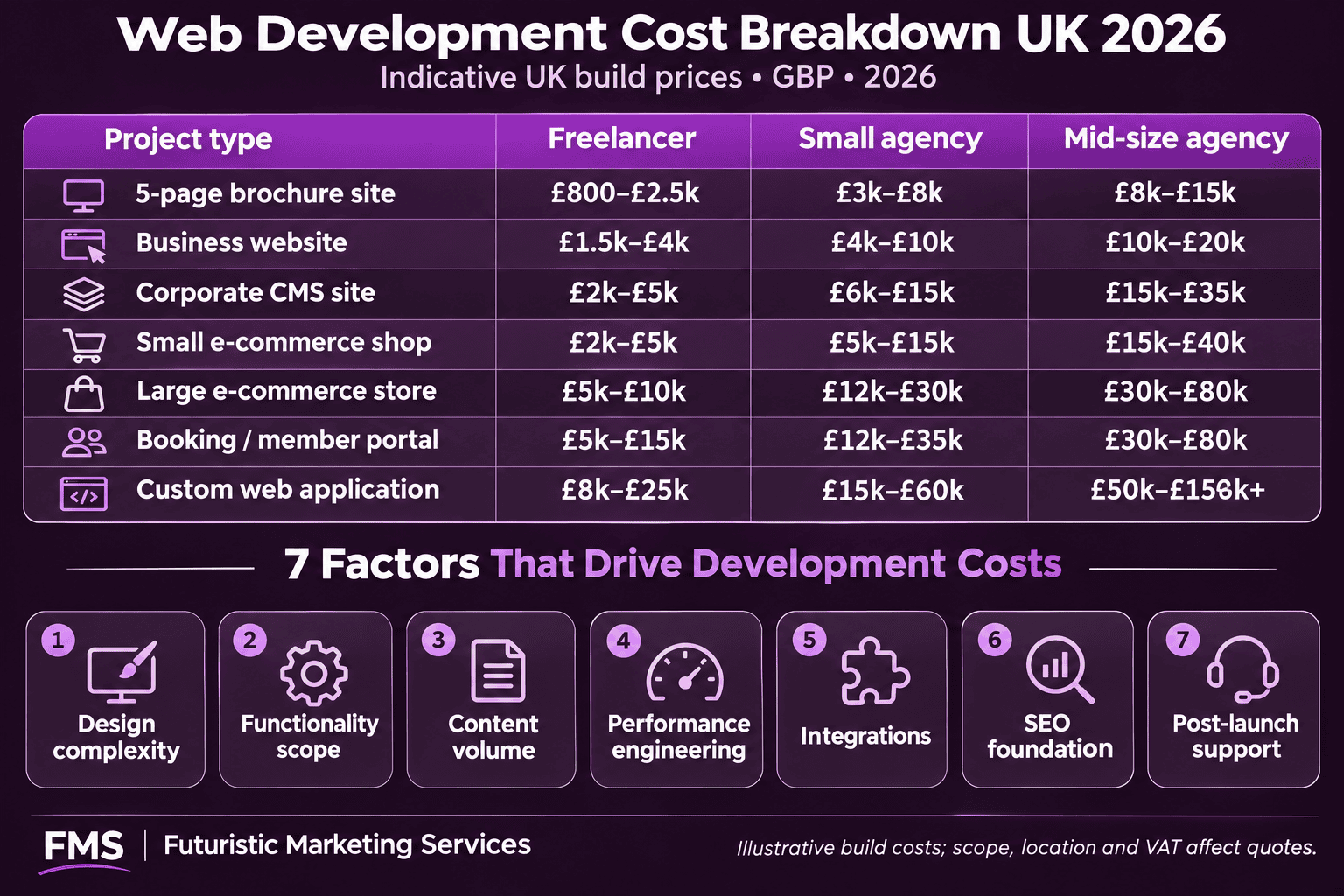
Web development costs in the UK in 2026 span an enormous range because the discipline spans enormously different complexity levels. The benchmarks below reflect professional agency and specialist freelancer rates, not offshore or budget marketplace rates, which typically produce false economy through poor quality and high remediation costs.
Project TypeFreelancer CostSmall Agency CostMid Agency CostTimeline
5-page WordPress brochure site£2,500 to £6,000£5,000 to £12,000£10,000 to £25,0004 to 8 weeks
WooCommerce store (50 to 500 products)£6,000 to £15,000£12,000 to £28,000£25,000 to £60,0006 to 14 weeks
Custom WordPress theme£8,000 to £20,000£15,000 to £40,000£30,000 to £80,0008 to 16 weeks
Headless CMS plus Next.js front-end£15,000 to £40,000£30,000 to £80,000£60,000 to £200,00012 to 24 weeks
Custom web application (small)£25,000 to £60,000£40,000 to £120,000£80,000 to £300,00016 to 32 weeks
Landing page (single page, optimised)£800 to £2,500£2,500 to £6,000£5,000 to £12,0001 to 3 weeks
Website redesign with migration£5,000 to £18,000£12,000 to £35,000£25,000 to £80,0006 to 16 weeks

What Drives Web Development Cost

The Seven Cost Drivers in Web Development

Design complexity

A site using a configured premium template costs 40 to 60 percent less than one requiring bespoke Figma designs implemented pixel-perfectly in code. Define whether the budget requires custom design or premium template customisation before requesting quotes.

Functionality scope

Every custom feature, booking systems, membership portals, complex product configurators, third-party API integrations, adds development time. Standard plugins handle most common requirements at a fraction of custom development cost. See our WordPress plugin development guide.

Content volume

A 5-page site and a 200-page site take very different amounts of development time, even using the same templates. Product descriptions, service content, and team profiles all require time to build, import, or migrate into the CMS.

Performance engineering

Achieving Good Core Web Vitals status requires deliberate engineering: WebP images, preloaded LCP element, deferred JavaScript, managed hosting with Redis. Sites where performance is specified upfront cost less to optimise than those requiring remediation after launch.

Integration requirements

CRM integrations, payment gateways, email marketing platforms, analytics, and ERP connections each add development time. Every integration listed in the specification increases the quote, define only the integrations genuinely needed at launch.

SEO technical foundation

A professionally built site includes the technical SEO foundation: correct permalink structure, XML sitemap, canonical tags, schema markup, and Google Search Console setup. Sites delivered without these require a separate technical SEO audit and remediation project.

Post-launch support

Some agencies include 30 to 90 days of post-launch support in the project fee; others invoice separately. Clarify the post-launch support scope before signing. Long-term maintenance programmes are a separate service, budget £80 to £300 per month for a professional care plan.

Choosing a Web Development Provider

The choice between a freelance developer, a small specialist agency, and a mid-size full-service agency determines the team structure, process rigour, and support capacity behind your project. Each model has genuine advantages for specific project types and budget levels.
FactorSpecialist FreelancerSmall Agency (2 to 10)Mid Agency (10 to 50)
CostLowest, no overheadMid-rangeHighest, team overhead
CommunicationDirect, one contactDirect, small teamAccount managed
SkillsetDeep in one discipline2 to 3 disciplinesFull-service capability
ContinuitySingle point of failureSmall backup capacityTeam continuity
Best forSingle-discipline, defined scopeMulti-discipline, medium complexityComplex multi-phase, ongoing relationship
Process rigourVariable, depends on individualDocumented processFormal process with SLAs
Maintenance supportBy arrangementCare plans availableStructured service

Portfolio Evaluation: The Technical Tests

Portfolio evaluation must go beyond visual assessment. Run every live URL in a provider portfolio through Google PageSpeed Insights on the mobile tab. Any professionally delivered WordPress site should score 65 or higher on mobile Lighthouse. Sites scoring below 50 indicate a developer who does not engineer for performance, a site they deliver for you will have the same problem. Also test on a real mobile device for responsiveness quality, check whether canonical tags are present using a browser extension, and verify SSL is correctly implemented. These three technical tests take five minutes per site and reveal more about technical quality than any portfolio description.

Portfolio Review

Get an Expert Assessment of Your Web Development Options

Futuristic Marketing Services provides free project consultations, honest advice on platform choice, cost benchmarks, and provider evaluation based on your specific requirements.

Book a Free Consultation
The Web Development Brief: How to Write One That Works

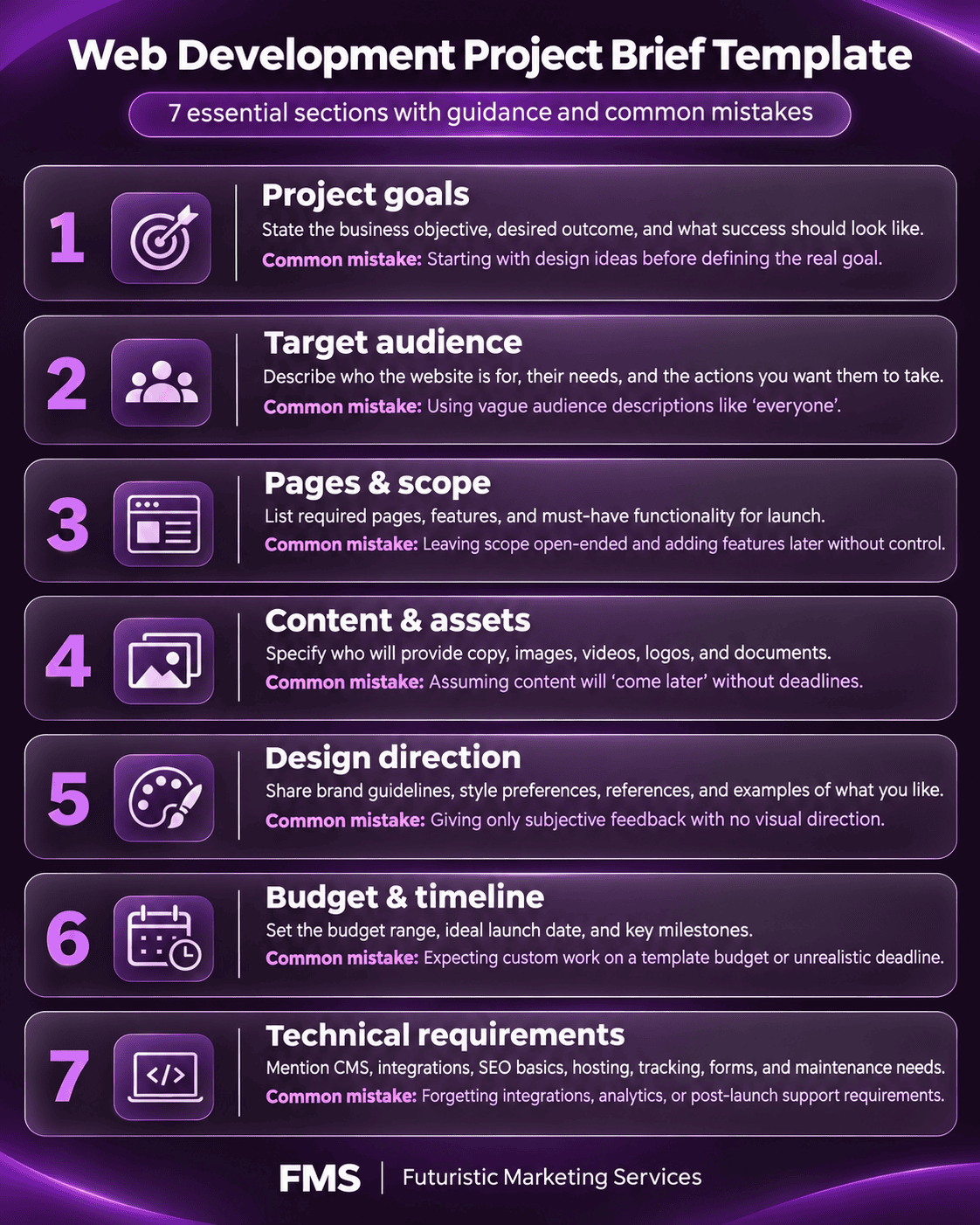
The brief is the document that determines the quality, cost, and timeline of the project you receive. A well-written brief produces accurate quotes, prevents scope disputes, and enables providers to compete on the same basis. A vague brief produces wildly different quotes that cannot be compared, scope disputes at every ambiguous decision point, and outcomes that disappoint regardless of the provider.
Brief SectionWhat to IncludeCommon Mistake
Business objectivesWhat commercial outcome the website must produce, leads, sales, bookings, downloads. Measurable targets where possible.Describing design preferences instead of business outcomes, 'we want it to look modern' instead of 'we need to generate 50 enquiries per month'
Target audienceWho visits the site, what they are trying to achieve, their technical capability, and their primary deviceDescribing the internal team's preferences rather than the actual site visitor needs
Required pagesFull list of all pages, their content hierarchy, and the primary conversion goal of eachProviding a high-level list ('services, about, contact') without specifying how many service pages or what each contains
Functionality requirementsEvery feature needed at launch, forms, eCommerce, booking, integrations, membership, searchListing features without specifying the business logic: 'a booking system' vs 'a booking system that allows customers to book specific staff members on specific days'
Content planWho provides all text, images, and media; the format it will be delivered in; and the date by which it will be availableAssuming the developer will write the content, developers build the container, not the content; content delays are the most common cause of project overruns
Performance requirementsMinimum mobile Lighthouse score; Core Web Vitals Good status required; target hosting platformOmitting performance requirements entirely, then disputing the delivered site performance after launch
Timeline and budgetThe launch date requirement (if any) and the available budget rangeAsking for quotes without a budget range, this produces quotes calibrated to assumptions rather than actual requirements

Frequently Asked Questions About Web Development Services

What are web development services?

style="color:rgba(255,255,255,0.85);font-size:15px;line-height:1.8;">Web development services cover the full range of activities involved in building and maintaining websites and web applications, from registering a domain and configuring hosting through to designing the visual interface, building the back-end functionality, integrating third-party systems, optimising for search engine performance, and maintaining the site after launch. Professional web development services in the UK typically include: platform selection and setup, custom design implementation, content management system configuration, performance engineering to Core Web Vitals Good status, SEO technical foundation, and post-launch maintenance options.

How much do web development services cost in the UK?

style="color:rgba(255,255,255,0.85);font-size:15px;line-height:1.8;">UK web development costs range from £2,500 for a basic WordPress brochure site delivered by a freelancer to £500,000 or more for a custom enterprise web application from a specialist agency. A standard professional marketing site (WordPress, custom design, full SEO setup) costs £6,000 to £20,000 at professional agency rates. A WooCommerce eCommerce store costs £10,000 to £35,000. According to Clutch, UK agencies charge £75 to £150 per hour. Fixed-price quotes are preferable for defined-scope projects.

How long do web development projects take?

style="color:rgba(255,255,255,0.85);font-size:15px;line-height:1.8;">Web development timelines in 2026: a 5-page WordPress marketing site takes 4 to 8 weeks from brief to launch. A WooCommerce store with 50 to 500 products takes 6 to 14 weeks. A custom web application takes 4 to 9 months. The most common cause of overrun is delayed content delivery, copy and images provided late by the client. Define content responsibilities and delivery dates in the project brief before any development begins.

Should I use WordPress, Shopify, or custom development?

style="color:rgba(255,255,255,0.85);font-size:15px;line-height:1.8;">WordPress is correct for most marketing sites, content operations, and eCommerce stores with complex SEO requirements. Shopify is correct for eCommerce-first stores where managed platform simplicity matters more than SEO ceiling or 0% transaction fees. Custom development is justified only when the requirement is genuinely unique, SaaS products, complex matching algorithms, or specific regulatory architecture. For 90% of business websites, WordPress or Shopify delivers the requirement at a fraction of custom development cost.

What is the difference between web design and web development?

style="color:rgba(255,255,255,0.85);font-size:15px;line-height:1.8;">Web design is the visual and UX discipline, creating wireframes, mockups, and design systems in Figma that define how the site looks and how users navigate it. Web development is the technical discipline, implementing the design in code (HTML, CSS, JavaScript, PHP), building back-end functionality, configuring the CMS, and engineering for performance. Most professional projects require both roles. Agencies typically include both; specialist freelancers may focus on one. When evaluating providers, verify that design and development are explicitly included in the quote and that portfolio examples demonstrate quality in both.

What does a professional web development agency include in their service?

style="color:rgba(255,255,255,0.85);font-size:15px;line-height:1.8;">A professional agency web development service includes: discovery and specification; UX wireframes and design mockups; front-end development with responsive design; CMS or platform setup and configuration; third-party integrations specified in the brief; SEO technical foundation (permalink structure, meta titles, schema markup, XML sitemap); performance engineering to Good Core Web Vitals status; cross-browser and device testing; launch and DNS configuration; and a post-launch bug-fix warranty period. Any agency that does not include technical SEO foundation and performance engineering is delivering an incomplete product.

What questions should I ask a web development agency before hiring?

style="color:rgba(255,255,255,0.85);font-size:15px;line-height:1.8;">The ten most important questions: (1) Do you use a staging environment for all development? (2) Who owns the code and credentials? (3) What is your approach to Core Web Vitals performance? (4) Can I see mobile Lighthouse scores from recent projects? (5) What does your update and deployment process look like? (6) What is the post-launch support arrangement? (7) What are your payment terms? (8) Is SEO technical setup included? (9) How do you handle change requests? (10) Can I speak to three recent clients? See our hire a WordPress developer guide for the complete evaluation framework.

What is included in web development after launch?

style="color:rgba(255,255,255,0.85);font-size:15px;line-height:1.8;">Post-launch web development services include: ongoing WordPress maintenance (weekly plugin updates, daily backups, security monitoring); conversion rate optimisation (A/B testing, UX improvements based on analytics data); SEO content strategy and optimisation; performance monitoring and Core Web Vitals maintenance; and feature development as the business grows. A website is not a finished product at launch, it is a living commercial asset that requires ongoing investment to grow in value. Budget £80 to £300 per month for a professional maintenance programme.

What is a staging environment and why do I need one?

style="color:rgba(255,255,255,0.85);font-size:15px;line-height:1.8;">A staging environment is a private copy of the website, identical to the live site, used for all development, testing, and update verification before changes go live. All code changes, design updates, and plugin updates are tested on staging and approved by the client before being deployed to production. Without a staging environment, every change is made directly on the live site, creating real risk of breaking production with each modification. A staging environment is the minimum viable professional infrastructure for any web development project and should be included in all agency proposals as standard.

Does my website need to be rebuilt to improve its performance?

style="color:rgba(255,255,255,0.85);font-size:15px;line-height:1.8;">Not always. Many existing sites can have their performance significantly improved through targeted optimisation rather than a full rebuild: migrating to managed WordPress hosting with Redis caching; installing WP Rocket for page caching and JavaScript optimisation; converting images to WebP with correct srcset attributes; preloading the LCP hero image; and deferring third-party scripts. These optimisations consistently move a poorly performing site from 40 to 60 on mobile Lighthouse to 75 to 90 without rebuilding. A website UX audit identifies whether optimisation or rebuild is the more cost-effective path.

What is Core Web Vitals and why does it matter for web development?

style="color:rgba(255,255,255,0.85);font-size:15px;line-height:1.8;">Core Web Vitals are Google three confirmed page experience ranking signals, LCP (Largest Contentful Paint), CLS (Cumulative Layout Shift), and INP (Interaction to Next Paint). Pages with Good status on all three have a ranking advantage in organic search over pages with Needs Improvement or Poor status. Core Web Vitals performance is determined primarily by the development quality of the site: hosting choice, image optimisation, JavaScript architecture, and caching configuration. Any professional web development service should specify target Core Web Vitals status and demonstrate Good status on delivered sites. See our Core Web Vitals guide.

How do I protect myself when commissioning web development?

style="color:rgba(255,255,255,0.85);font-size:15px;line-height:1.8;">Contractual protections that are non-negotiable: (1) Client owns all IP, code, and credentials from day one, not on final payment. (2) Git repository in the client account from the first day of development. (3) Milestone-based payment, deposit on signing, development milestone, final on launch approval. (4) Written project specification signed before development begins. (5) Staging environment included in scope. (6) 30-day post-launch bug-fix warranty. (7) Change request process defined in writing. Missing any of these protections is a negotiation point before signing. See our hire a developer guide.

Futuristic Marketing Services

Web Development That Performs From Day One

Futuristic Marketing Services delivers professional web development services, WordPress, WooCommerce, and custom builds, with Core Web Vitals engineering, Git version control, staging environments, and post-launch support as standard.

Start Your Web Development Project


Conclusion: Web Development as a Commercial Investment

Professional web development services are a commercial investment, not a procurement decision. The question is not which provider is cheapest, it is which provider delivers the outcome the business needs at a justifiable cost. A site that generates £50,000 in annual leads from organic search was worth £20,000 to build professionally. A £5,000 site that fails to rank, converts at 0.5%, and requires a rebuild 18 months later was more expensive in total.
Evaluate providers on technical process (staging, Git, performance engineering), portfolio performance (mobile Lighthouse scores from live sites), and commercial terms (IP ownership, milestone payments, written specification). Brief precisely, the brief determines the quality of what you receive more than the provider does. And plan for post-launch services from the start: maintenance, performance monitoring, and SEO growth are the services that compound the initial development investment into long-term commercial value.
Share this post :
Picture of Devyansh Tripathi
Devyansh Tripathi

Devyansh Tripathi is a digital marketing strategist with over 5 years of hands-on experience in helping brands achieve growth through tailored, data-driven marketing solutions. With a deep understanding of SEO, content strategy, and social media dynamics, Devyansh specializes in creating results-oriented campaigns that drive both brand awareness and conversion.

All Posts