
How to Build a Social Media Content Calendar for Your Brand

social media content calendar

<!– ═══ INTRODUCTION: PART 1, DIRECT ANSWER (55 words) ═══ –>

A social media content calendar is a planning document that organizes every post your business intends to publish across all platforms, specifying the date, time, platform, content format, topic, caption, visual asset, and call to action for each piece. Building one gives your team a shared publishing schedule that prevents inconsistency, eliminates last-minute content decisions, and connects every piece of content to a specific marketing goal.

This guide covers everything your business needs to build a functional, results-driven social media content calendar from scratch, including how to audit your existing content performance, how to define content pillars, how to determine the right posting frequency for each platform, and how to structure a content mix that balances education, engagement, and promotion. You will also find a recommended posting schedule by platform based on current research, a complete content calendar template structure, the most common mistakes businesses make when building calendars, and a practical review framework for refining performance month over month. Every step is explained with enough detail to execute immediately without prior experience.

Key Takeaways

  • A social media content calendar prevents the most common reason strategies fail: inconsistency caused by last-minute decisions that compromise content quality and publishing frequency.
  • According to Buffer's analysis of over 100,000 social media accounts, consistent posting drives 5 times more engagement than high-volume but irregular posting.
  • Content pillars, three to five core topic areas, are the foundation of every effective calendar. They replace daily content guesswork with a repeatable planning framework.
  • Businesses that use data-driven content strategies report 45% better ROI than those relying on intuition alone, according to ALM Corp research.
  • Short-form video must be a core calendar component for every platform, as it accounts for 58% of all time spent on social media globally.
  • The calendar should be built one month in advance at minimum, reviewed weekly for execution, and formally assessed monthly using platform analytics data.
  • A structured calendar reduces content production time by up to 40% because batching similar content types in planned production sessions eliminates the repeated setup and creative-switching that slows reactive content creation.

Want a Content Calendar Built for Your Business?

We Plan, Create, and Schedule Your Social Media Content Every Month

Futuristic Marketing Services builds and manages complete social media content calendars for businesses across India, covering platform strategy, content creation, scheduling, and monthly performance reporting.

Get a Free Content Planning Session

What is a Social Media Content Calendar and Why Your Business Needs One

A social media content calendar is the operational backbone of any organized social media marketing effort. It is a planning tool that maps every piece of content your business intends to publish, across every active platform, for a defined future period. A well-built calendar shows your full publishing schedule at a glance, identifies the resources required to execute each post, and ensures every piece of content connects to a specific goal within your broader social media marketing strategy.
The primary business case for building a content calendar is simple: businesses that post reactively, deciding what to publish each day without a plan, consistently produce lower-quality content less frequently than businesses that plan ahead. Reactive posting leads to promotional-heavy feeds, inconsistent brand voice, missed campaign opportunities, and eventually to the complete abandonment of social media activity when the daily decision-making burden becomes too heavy to sustain alongside other business responsibilities.

The Real Cost of Posting Without a Calendar

The most immediate cost of posting without a content calendar is inconsistency. According to Buffer's analysis of social media engagement data covering millions of posts, accounts that did not post in a given week consistently underperformed their own baseline follower growth rates, a pattern Buffer describes as the "no-post penalty." Every week without content actively sets back the growth trajectory your previous posts had built, not just pausing it.
Beyond follower growth, reactive content planning affects content quality because there is no lead time for proper visual creation, copywriting review, or strategic alignment. Posts created on the day they are published are almost always less polished, less strategically aligned, and less likely to include the call to action or link structure needed to connect the content to a business outcome. A content calendar eliminates this constraint by ensuring every post is planned, created, and reviewed before its scheduled publication date.
The financial cost compounds over time. Creative resources are used inefficiently when content is produced one post at a time rather than in planned batches. Approval processes take longer when there is no shared document for stakeholders to review. Campaign opportunities are missed when there is no forward-looking view of upcoming product launches, seasonal events, or industry moments that the business should be creating content around. A content calendar solves all of these problems with a single structured planning system.

What a Social Media Content Calendar Enables for Your Business

A social media content calendar enables consistent publishing, which is the single most important driver of organic social media growth. Research from Post Everywhere's 2026 Social Media Trends analysis, citing Buffer's study of over 100,000 accounts, found that consistent posting drives 5 times more engagement than high-volume but irregular activity. The calendar is the system that makes consistency achievable without requiring daily creative decisions that burn out teams and compromise quality.
Beyond consistency, a well-built content calendar enables forward-looking campaign planning. Knowing three to four weeks in advance what content is scheduled allows the business to identify gaps, plan visual production sessions in batches rather than one-off, coordinate paid advertising with organic content releases, and ensure promotional campaigns are supported by the educational and engagement content that warms the audience before the promotional message arrives.
Content calendars also provide a shared visibility tool for teams. Whether the business has one person managing social media or a team of five, a centralized calendar document gives everyone a clear view of what is planned, what is in production, what has been approved, and what has been published. This eliminates the communication gaps and duplicated effort that occur when content decisions are made informally and communicated through messages or verbal instructions.

What to Include in Every Social Media Content Calendar

The essential elements of a social media content calendar are those that give every post complete context before it is created or published. Different businesses use different tools to manage their calendars, from simple spreadsheets and Google Sheets to dedicated social media management platforms such as Buffer, Hootsuite, or Sprout Social. Regardless of which tool is used, every entry in the calendar should capture the same core fields that prevent gaps in execution and make review and optimization straightforward.
Calendar Field What to Enter Why It Matters
Publication Date The exact date the post is scheduled to go live Creates accountability and allows backward planning for asset production deadlines
Publication Time The specific time based on platform-optimized posting windows Posting at peak audience activity times increases organic reach without additional cost
Platform Instagram, LinkedIn, Facebook, YouTube, Twitter X, or WhatsApp Business Different platforms require different format specifications, caption lengths, and audience expectations
Content Format Reel, carousel, static image, Story, long-form video, text post, or article Ensures the production team knows what type of asset to create and what specifications to follow
Content Pillar The topic category this post belongs to: Education, Promotion, Community, Behind the Scenes, or Social Proof Enables a visual check that the month's content mix is balanced across all pillar categories
Topic or Headline A one-line description of what the post is about or the key message it communicates Prevents duplicate topics across the month and helps team members understand the content intent before production begins
Caption or Copy The full written caption including hashtags and any mention tags Moves copy from draft to approved status before the post date, preventing rushed writing that misses key messages or CTAs
Visual Asset A link to the image, video, or design file in the shared content library Ensures all visual assets are ready before the publication date and that everyone accesses the final approved version
Call to Action The specific action the post is designed to prompt: link click, DM, comment, save, or share Connects the post to a measurable outcome and ensures the caption includes an explicit instruction for the audience
Post Status Draft, In Review, Approved, Scheduled, or Published Gives every team member and stakeholder a real-time view of where each post sits in the production and approval workflow
Goal or Campaign Tag The social media goal this post advances and the campaign it belongs to, if applicable Enables performance reporting by goal type and campaign rather than just by post, giving strategic insight into what is working
This level of detail in the calendar is what separates a content calendar that genuinely manages the production process from a simple posting schedule that only tracks dates. When every field is completed for every planned post, the team can execute the full month's content with no ambiguity, no missed assets, and no last-minute decisions that compromise quality.

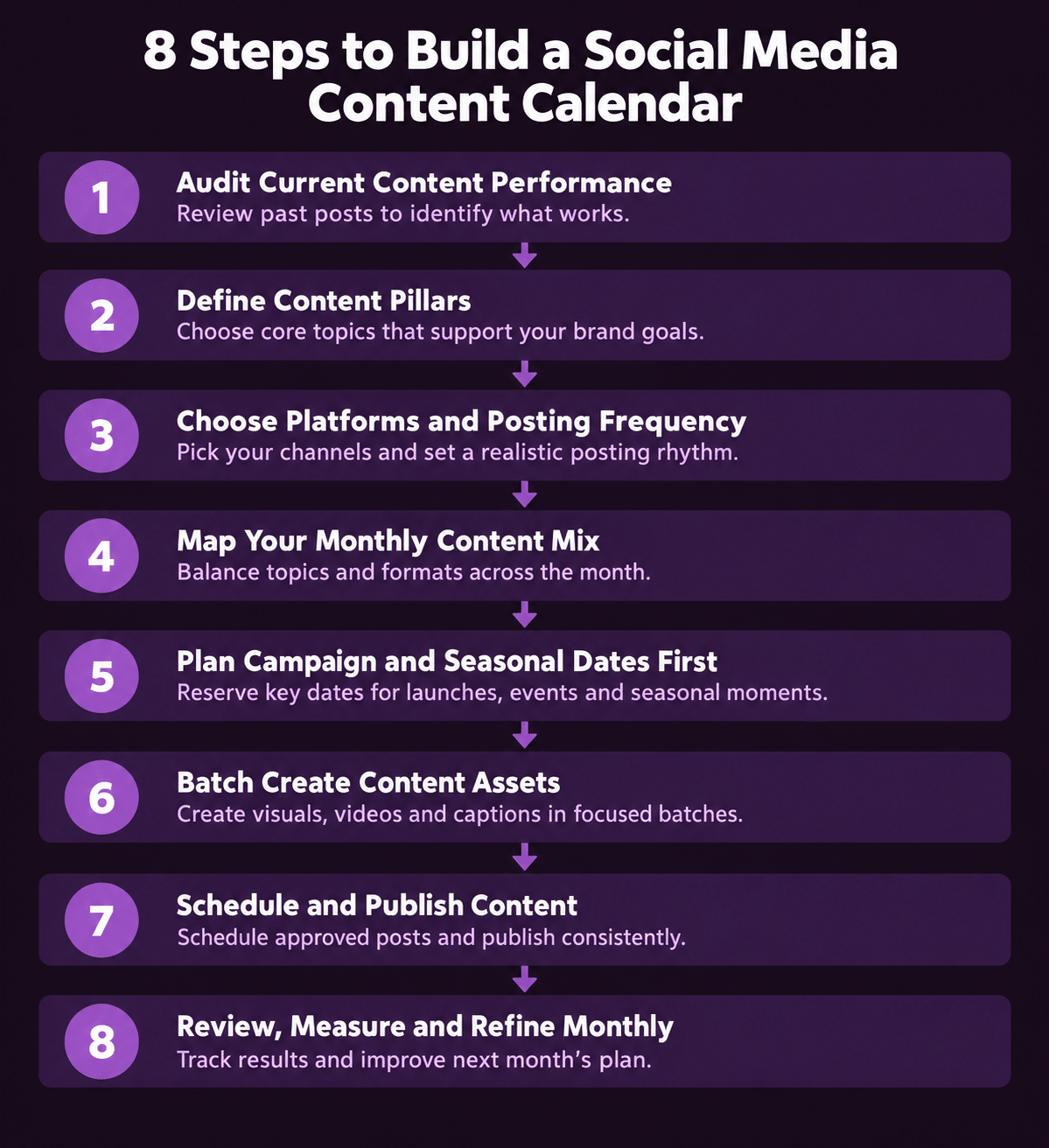
How to Build a Social Media Content Calendar in 8 Steps

Building a social media content calendar is a structured process that takes most businesses two to three hours to complete for their first monthly calendar, with subsequent months taking significantly less time once the pillars, posting frequency, and template structure are established. Work through these steps in sequence and document every decision. The output is a complete, production-ready calendar your team can begin executing immediately.

Step 1: Audit Your Current Content Performance

Before planning future content, review the last 60 to 90 days of published posts to understand what has already been working and what has not. This audit prevents you from continuing approaches that are not producing results and from accidentally abandoning content types that are performing well simply because they feel repetitive to the creator rather than the audience.
For each active platform, identify your five highest-performing posts based on reach or engagement rate, note what they have in common in terms of format, topic, length, and time of publication, and identify your five lowest-performing posts to find patterns worth eliminating. Document the average engagement rate per post for each platform, the average posting frequency you maintained over the period, and any obvious gaps such as a content type that was never tried or a topic area the audience keeps requesting in comments that has never been addressed.
If you are starting a social media presence from zero with no historical performance data, complete a competitor content audit instead. Select three direct competitors, review their last 30 posts on each active platform, and document which content types and topics generate the strongest engagement for their audience. This gives you a data-informed starting point rather than building your first calendar entirely on assumptions. Our social media consulting services include a professional content audit as part of every new strategy engagement.

Step 2: Define Your Content Pillars

Content pillars are the three to five core topic areas that all of your social media content is organized around. They are the backbone of your content calendar because they give every post a purpose within a broader content strategy, prevent the repetition and topic drift that occur when content decisions are made without a framework, and build the topical authority that makes your brand recognizable and trusted within its specific subject area over time.
Each content pillar represents a broad theme that can generate dozens of individual posts across different formats without becoming repetitive. A social media marketing agency might organize content around five pillars: social media strategy education, platform-specific tips, client results and case studies, behind-the-scenes content showing how work is done, and industry news with expert commentary. Every post planned in the calendar is tagged to one of these five pillars, giving the team a visual check that the month's content is balanced across all categories rather than skewed toward any single type.
The most effective pillar structure for most businesses is four to five pillars weighted toward delivering genuine audience value. A practical starting framework for businesses new to content pillar planning includes Education (how-to content and industry insights), Social Proof (client results, testimonials, and case studies), Community (questions, polls, and audience interaction content), Behind the Scenes (team content, process transparency, and brand personality), and Promotion (service announcements and offers). This mix naturally produces the 80/20 balance between value content and promotional content that sustains long-term audience engagement. Our social media content creation services include a complete pillar development process tailored to your specific industry and target audience.

Step 3: Choose Your Platforms and Set Your Posting Frequency

Your content calendar should only include platforms where your target audience is genuinely active and where your business has the resources to maintain consistent, quality content. Attempting to maintain a calendar presence on six platforms simultaneously without the production capacity to do so results in thin, low-quality content across all of them rather than strong performance on a focused selection. Choose two or three primary platforms and build your calendar around them before expanding further.
Posting frequency is the most important consistency variable in your calendar. The research is unambiguous on this point: consistency matters more than volume. Buffer's engagement research confirmed that overposting actively damages performance because algorithms interpret low engagement per post as a signal that content is not valuable, which suppresses future reach. Set a frequency target that your team can sustain with quality every single week without exception, not a target that requires maximum output capacity to hit and inevitably drops off after two or three weeks.
Use the platform-specific posting frequency recommendations in the table below as your starting framework. Adjust based on your current production capacity, then scale upward once the lower frequency has been maintained consistently for 60 days and the quality is strong enough to justify the additional volume.

Recommended Posting Frequency by Platform

Platform-specific posting frequency recommendations are based on current algorithm behavior, engagement data, and practical production capacity for businesses without dedicated content teams. These figures represent the range between the minimum frequency needed to maintain algorithmic favor and the maximum frequency beyond which engagement per post typically begins to decline. Every business should start at the lower end of the range and scale up as production systems improve.
Platform Recommended Weekly Frequency Best Content Formats Best Posting Times (IST)
Instagram 3 to 5 feed posts plus 2 to 4 Reels, and daily Stories where possible Reels, carousels, Stories, static images 9:00 AM to 11:00 AM and 7:00 PM to 9:00 PM on weekdays; 10:00 AM to 12:00 PM on weekends
LinkedIn 2 to 3 posts per week; articles once per month minimum Text posts, carousels, native video, articles, polls 8:00 AM to 10:00 AM and 5:00 PM to 7:00 PM on Tuesday through Thursday
Facebook 3 to 5 posts per week including a mix of organic and boosted content Video, link posts, image posts, Facebook Live, Group posts 1:00 PM to 4:00 PM on weekdays; 12:00 PM to 2:00 PM on weekends
YouTube 1 to 2 long-form videos per week plus 3 to 5 YouTube Shorts Long-form tutorials, product demos, Shorts, vlogs 12:00 PM to 4:00 PM on weekdays; 9:00 AM to 11:00 AM on weekends
Twitter X 1 to 2 posts daily for brands focused on real-time conversation and thought leadership Short text posts, threads, replies, news commentary 9:00 AM to 11:00 AM and 6:00 PM to 9:00 PM on weekdays
WhatsApp Business 2 to 3 broadcast messages per week to opted-in customer lists Broadcast messages, catalog updates, direct conversations, exclusive offers 10:00 AM to 12:00 PM and 5:00 PM to 7:00 PM on weekdays

Step 4: Map Your Monthly Content Mix

The content mix defines the proportion of posts allocated to each content pillar across the full month. Without deliberately planning the mix before filling the calendar, most businesses default to over-publishing promotional content because promotional posts feel urgent and have clear business justification, while educational and community content feels optional. The result is a feed dominated by self-promotion that drives audience disengagement and follower loss over time.
A practical content mix framework for most businesses allocates the monthly content across five categories. Educational content, covering how-to guides, tips, explanations, and industry insights, should make up 30% to 35% of all posts. Community content, including questions, polls, conversation-starting posts, and content that invites audience participation, should represent 20% to 25%. Social proof content, including client results, testimonials, reviews, and case studies, should account for 15% to 20%. Behind-the-scenes content, showing team culture, processes, values, and the human side of the business, should make up 10% to 15%. Promotional content, covering service announcements, offers, product launches, and direct CTAs, should account for no more than 20% of the total monthly post volume.
Translating this framework into a calendar with 20 posts per month means approximately 6 to 7 educational posts, 4 to 5 community posts, 3 to 4 social proof posts, 2 to 3 behind-the-scenes posts, and 3 to 4 promotional posts. This distribution naturally produces the value-first approach that sustains audience trust while still advancing commercial objectives at a frequency that does not feel intrusive to the audience.

Step 5: Plan Campaign and Seasonal Dates First

Before filling in regular content, mark every important date in the calendar month that requires specifically planned content. This includes product or service launches, promotional campaigns, industry events or conferences relevant to your audience, national holidays that your audience celebrates, and seasonal moments relevant to your business type such as financial year-end periods, festive seasons, or industry-specific awareness months.
Planning campaign dates first prevents the most common calendar-building mistake: filling all available slots with regular content and then realizing there is no room or runway for important campaign moments that require multiple coordinated posts, paid advertising support, and associated visual asset production. Major campaigns need content scheduled in the days and weeks before the launch date to warm the audience, on the launch date itself, and in the days after to capture stragglers and reinforce the message to those who saw the initial launch content but did not act on it immediately.
A forward-looking calendar view of 60 to 90 days also identifies where multiple campaign moments fall close together so that creative resources can be allocated in advance rather than scrambled at the last minute when two important campaigns coincide within the same week. This level of advance planning is one of the most practical competitive advantages a structured content calendar provides over businesses that plan reactively.

Step 6: Batch-Create Your Content Assets

Batch creation is the practice of producing multiple pieces of content in a single planned production session rather than creating each post individually on the day it needs to be published. It is the production method that makes consistent, high-quality social media output sustainable for businesses that cannot afford large dedicated content teams, because it eliminates the repeated creative-switching cost of moving in and out of content creation mode multiple times per week.
A typical batch creation approach dedicates one day per week or one full day per month to producing all written captions, selecting and editing all visual assets, recording all video content in a single session, and assembling all completed posts in the scheduling tool ready for automated publication. According to ALM Corp's research, brands using structured visual planning approaches reduce content production time by 40% compared to reactive, post-by-post creation, while simultaneously increasing engagement rates by 22% because batch-created content undergoes quality review before scheduling rather than being published in the moment without oversight.
The calendar makes batch creation possible by giving the production team a complete list of every post needed for the period, including the format, topic, visual requirements, and caption brief, before they sit down to create. Without the calendar, batch creation is impossible because there is no master list of what needs to be produced. Our social media content creation services use a batch production system that delivers a complete month of content for client review and approval before the first post of the month is published.

Step 7: Schedule and Publish Your Content

Scheduling content in advance using a social media management tool is the operational step that converts a completed content calendar into automated, consistent publishing without requiring daily manual action. Tools such as Buffer, Hootsuite, Sprout Social, and Meta Business Suite allow businesses to upload the visual asset, paste the caption, set the publication date and time, and schedule the post for automatic publishing days or weeks before it goes live.
Scheduling provides a buffer for quality review that reactive posting does not allow. A post scheduled three days in advance can be reviewed for errors, checked for broken links, and confirmed for visual quality by a second team member before it publishes. A post created and published in the same session has no such review window. Scheduling also ensures that content goes out at the optimal times identified in your research even when the team is unavailable due to weekends, public holidays, or busy business periods.
The best scheduling approach for most businesses is to schedule the full upcoming week's content every Monday morning during a dedicated calendar management block of 30 to 60 minutes. This frequency allows for adjustments based on last-minute developments such as breaking industry news, an urgent business update, or a platform-specific trend that should be addressed in real time, while still maintaining the advance scheduling buffer that prevents last-minute quality compromises. Our social media management services include full scheduling and publishing management across all active client platforms.

Step 8: Review, Measure, and Refine Your Calendar Monthly
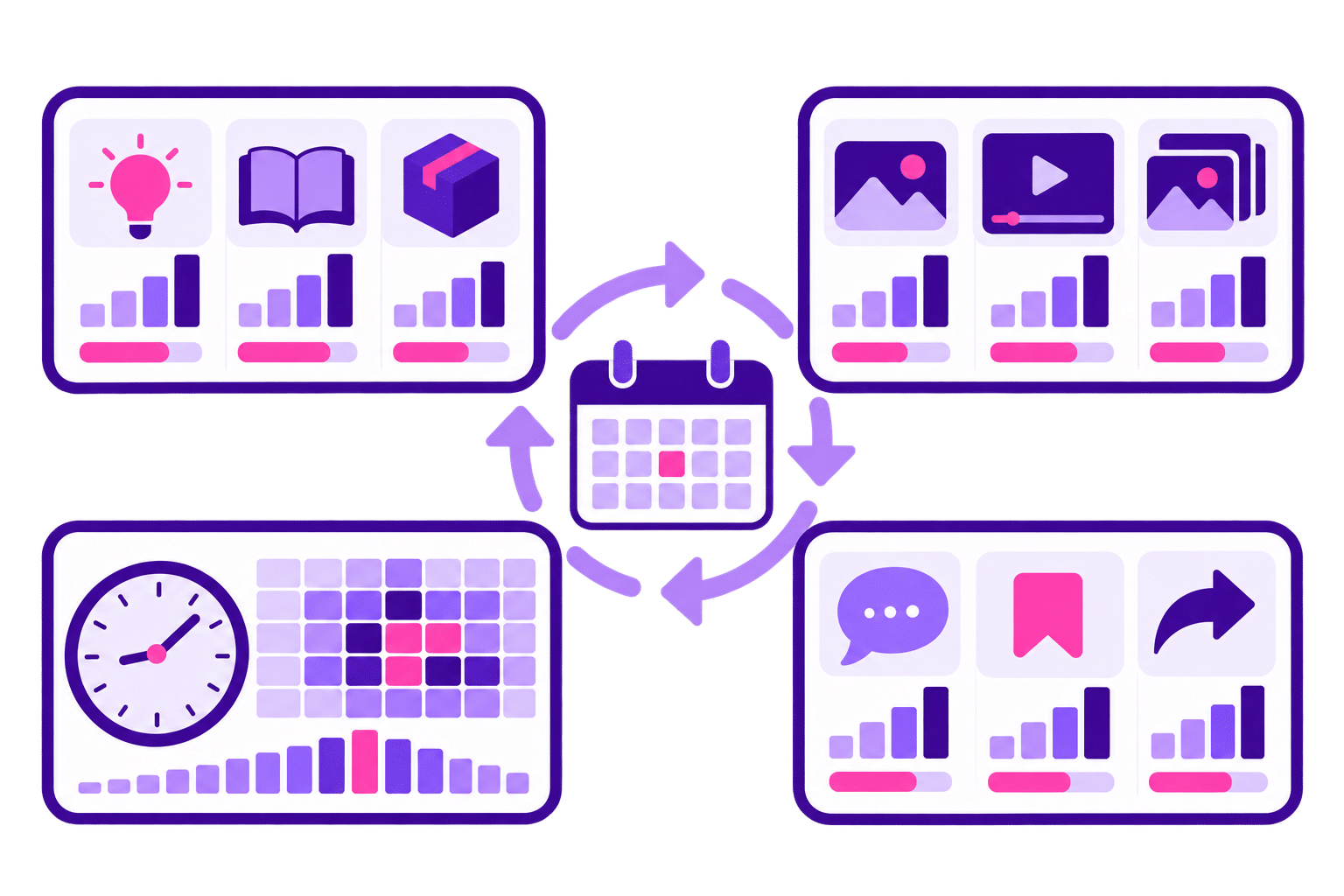
A content calendar is a living document that improves every month through data-informed refinement. At the end of each month, conduct a structured performance review that identifies which content pillars produced the highest engagement, which formats drove the most website traffic, which posts generated direct enquiries or conversation in comments, and which topics your audience engaged with but that competitors are not covering consistently.
Use this monthly review to make specific adjustments to the following month's calendar rather than vague commitments to "try harder" or "post more." Specific adjustments might include increasing the proportion of Reels from two to four per week after seeing that video posts consistently outperformed static images, replacing a content pillar that is consistently generating low engagement with a topic area that audience comments have repeatedly indicated interest in, or shifting posting times based on analytics showing the audience is most active at hours different from the initial schedule.
This continuous refinement cycle is what separates businesses whose social media performance compounds month over month from those that maintain the same results regardless of how long they have been active. Data from ALM Corp confirms that organizations using data-driven content strategies report 45% better ROI than those making content decisions based on intuition. The monthly review is the mechanism that converts your calendar from an intuition-based plan into a data-driven system that improves automatically through structured learning. Connecting your content calendar to clearly defined social media marketing goals is what gives the monthly review the business context to make every adjustment meaningful rather than arbitrary.

The 5-Category Content Mix Framework for Your Calendar

Translating the 80/20 content principle into a practical, repeatable calendar structure requires a five-category content mix framework that allocates specific post slots to each type of content before the month's planning begins. This framework prevents the natural drift toward promotional content that occurs when each week's posts are planned in isolation, and it ensures that the audience receives a consistent variety of content types that serves different stages of the customer relationship simultaneously.

The 5 Content Categories and What They Do for Your Audience

Educational Content (30 to 35%)

How-to guides, tips, explainers, and industry insights that demonstrate your expertise and give the audience actionable value they can use immediately. Builds authority and saves your content from followers.

Community Content (20 to 25%)

Questions, polls, opinion posts, and conversation-starters that invite audience participation and signal to the algorithm that your content generates genuine two-way engagement. Drives comment volume and relationship depth.

Social Proof Content (15 to 20%)

Client results, testimonials, case studies, reviews, and user-generated content that demonstrates real outcomes for real customers. Converts followers who are in the consideration stage into enquiries by addressing trust and credibility concerns.

Behind the Scenes Content (10 to 15%)

Team content, process transparency, day-in-the-life posts, and brand personality content that humanizes the business and builds the emotional connection that transforms a follower into a loyal customer who actively recommends the brand.

Promotional Content (15 to 20%)

Service announcements, product launches, offers, and direct calls to action that convert the trust and interest built by the other four content categories into enquiries, bookings, or purchases. Never the primary category; always the destination the other categories are building toward.

Mapping this five-category framework onto a monthly calendar for Instagram with 20 posts might look like: 7 educational posts across various formats including Reels, carousels, and static images; 5 community posts including polls in Stories, question posts in the feed, and conversation-starter Reels; 4 social proof posts including client testimonial graphics, results carousels, and video case studies; 3 behind-the-scenes posts including team Reels and process Story highlights; and 4 promotional posts timed around service campaigns or seasonal offers. This structure is what transforms a content calendar from a scheduling tool into a complete audience development system.

Common Social Media Content Calendar Mistakes to Avoid

Understanding the most common calendar-building mistakes before you begin prevents the errors that cause otherwise well-planned systems to produce disappointing results. Many businesses build technically complete content calendars that still fail to produce meaningful engagement or business outcomes because of specific structural or execution errors that undermine the calendar's effectiveness from within.
Planning too far in advance without regular review points is one of the most frequent mistakes. Businesses that build a full quarter of content without a monthly or bi-weekly review mechanism miss the platform algorithm changes, audience preference shifts, and emerging trend opportunities that make social media a dynamic rather than static channel. A 30-day forward plan reviewed and partially adjusted every two weeks outperforms a 90-day rigid plan every time because it balances consistency with the responsiveness that keeps content feeling current and relevant to the audience.
Neglecting short-form video is a structural mistake that compounds in cost over time. According to Digital Applied's 2026 Social Media Statistics research, short-form video accounts for 58% of all time spent on social media globally. A content calendar that allocates fewer than 30% of its posts to short-form video content on platforms where Reels or Shorts are available is systematically underinvesting in the format that produces the highest organic reach on those platforms. Every calendar built for Instagram, YouTube, Facebook, or TikTok should include short-form video as a primary format, not an occasional addition.
Treating the calendar as a rigid document that cannot accommodate real-time content is another common error. The calendar is a plan, not a contract. When a genuinely newsworthy industry development occurs, when a client posts an unexpected positive testimonial that deserves amplification, or when a platform trend emerges that is directly relevant to your audience and brand, the calendar should flex to accommodate that content. Building two or three open slots per week into the calendar specifically for reactive content prevents the rigidity that makes planned calendars feel stale to audiences while preserving the structure that prevents reactive posting from dominating at the expense of planned strategic content.
Finally, building a calendar without connecting it to the broader social media marketing strategy and goal framework produces content activity without strategic purpose. Every post slot in the calendar should be traceable to a specific goal, content pillar, and business objective. If a planned post cannot be connected to any of those three elements, it should be replaced with content that can. This standard, applied consistently during the planning process, keeps the calendar from drifting into filler content that occupies slots without advancing any objective.

Building This Alone Takes Time You May Not Have

Let Us Manage Your Complete Social Media Content Calendar

From monthly content planning and asset creation through scheduling, community management, and performance reporting, our team handles your complete social media content operation so your brand stays visible, consistent, and growing every month.

Book a Free Social Media Audit

Frequently Asked Questions About Social Media Content Calendars

What is a social media content calendar?

A social media content calendar is a planning document that organizes every piece of content a business intends to publish across all active social media platforms for a defined future period. It typically specifies the publication date, time, platform, content format, topic, written caption, visual asset, call to action, and current production status for each planned post. A well-built calendar gives the entire team a shared view of the publishing plan and prevents the inconsistency that results from making content decisions reactively on the day posts need to go live.

How far in advance should a social media content calendar be planned?

Plan your social media content calendar a minimum of four weeks in advance to allow sufficient lead time for visual asset creation, caption copywriting, internal review and approval, and scheduling in the publishing tool. Many businesses plan six to eight weeks ahead to accommodate campaign content that requires longer production lead times such as video, photography shoots, or coordinated multi-platform campaigns. Planning further ahead than 90 days without built-in review checkpoints risks producing content that feels outdated or misaligned with platform developments that occur between planning and publication.

How many posts should be on a social media content calendar per week?

The right number of posts per week depends on which platforms you are active on, your production capacity, and the quality standard you want to maintain consistently. A sustainable starting point for most small businesses managing two platforms is three to five posts per week per platform. For Instagram, this typically means three to four feed posts plus Reels and daily Stories. For LinkedIn, two to three posts per week is sufficient for consistent visibility. The most important rule is never planning a posting frequency you cannot maintain with quality week after week throughout the calendar period.

What is the best tool for managing a social media content calendar?

The best tool depends on your team size, budget, and the number of platforms you manage. Google Sheets or Notion are free options that work well for small businesses managing one to three platforms with a single person. Buffer, Later, and Hootsuite are mid-range scheduling tools with built-in calendar views and direct posting integration that suit businesses managing multiple platforms. Sprout Social and Planable are more advanced options suited to teams with multiple approvers and enterprise-level social media operations. Start with the simplest tool that meets your current needs and upgrade as your content volume and team size increase.

What should be included in every social media content calendar entry?

Every calendar entry should include the publication date, publication time, platform, content format, content pillar category, topic or headline, full written caption with hashtags, a link to the visual asset file, the call to action, the current production status such as draft, approved, or scheduled, and a goal or campaign tag connecting the post to a specific marketing objective. This level of detail ensures every post can be fully executed by any team member without requiring additional briefing and allows performance to be reviewed against both individual posts and broader content categories.

What is the best Shopify theme for SEO in 2026?

The best Shopify theme for SEO is one that offers fast loading speed, clean code, and mobile optimization to improve rankings and user experience.

How do you create content pillars for a social media calendar?

Content pillars are created by identifying the intersection of what your target audience wants to learn, what your business has genuine expertise in, and what topics connect to the products or services you offer. Start by listing the top ten questions your target audience asks about your industry. Group related questions into broad themes. Select three to five themes that your business can address with genuine expertise and that connect to your commercial offering. These themes become your content pillars. Each pillar should be broad enough to generate at least 20 distinct post ideas across different formats without repeating the same message.

How is a content calendar different from a social media strategy?

A social media strategy is the overarching framework that defines your goals, target audience, platform selection, content philosophy, measurement approach, and budget allocation. A content calendar is the operational execution tool within that strategy that translates the strategic decisions into specific, scheduled content. The strategy answers the questions of why and what your social media activity is designed to achieve. The calendar answers the questions of when, where, and exactly how each piece of content will be produced, published, and tracked. Both are needed, and the strategy must be established before the calendar is built so that every calendar decision serves the strategic intent.

Can a small business with one person manage a content calendar?

A small business with a single person managing social media can effectively run a content calendar by focusing on two platforms, maintaining a posting frequency of three to four posts per week, and using a batch creation system where all content for the week is produced in a single two to three hour session rather than created one post at a time daily. A simple Google Sheets calendar template, combined with a scheduling tool such as Buffer that allows direct posting to multiple platforms from one dashboard, gives a single operator the structure and automation needed to maintain consistency without spending the majority of each working day on content production.

How do you handle trending content within a planned calendar?

Handle trending content by building two or three flexible slots into your weekly calendar that are intentionally left open for reactive content opportunities. When a relevant trend, breaking industry news item, or platform-specific viral format emerges that is genuinely applicable to your brand and audience, use one of these open slots to publish timely content without disrupting the planned calendar structure. Trends that require days of production time to address are rarely timely enough to justify displacing planned strategic content. The best responses to social media trends are those that can be produced and published within hours of the trend emerging.

How do you measure whether a social media content calendar is working?

Measure content calendar effectiveness through three levels of data review. Weekly, assess whether all planned posts were published on schedule and review immediate engagement performance per post. Monthly, analyze which content pillars and formats generated the highest engagement, reach, and click-through rates, and identify which posts generated direct enquiries, website visits, or sales conversations. Quarterly, assess whether the content strategy connected to the business goals defined in your social media marketing plan, and determine whether posting frequency, platform mix, or content pillar allocation needs adjustment for the next period. Consistent monthly reviews produce the compounding improvement that makes each calendar better than the last.

Should a social media content calendar include paid advertising content?

Yes, paid advertising content should be included in the same calendar as organic content to ensure coordination between the two types of activity. Paid campaigns are most effective when the organic content publishing around the same period reinforces the campaign message, warms the audience before the paid content reaches them, and provides additional touchpoints for audiences who saw the paid ad but did not convert immediately. Include paid campaign dates, ad copy, visual assets, targeting notes, and budget allocation in dedicated campaign rows within the calendar so the full publishing plan is visible in one document and scheduling conflicts between organic and paid activity can be identified and resolved in advance.

What is the biggest mistake businesses make with social media content calendars?

The biggest mistake is planning a posting frequency that the business cannot realistically sustain with quality, then abandoning the calendar after two to four weeks when the commitment proves too demanding. A calendar built around five to seven posts per week per platform sounds productive but typically results in declining content quality, missed post dates, and eventual burnout that causes the entire publishing schedule to collapse. Starting with a frequency of three posts per week per platform and maintaining it perfectly for 60 consecutive days produces better long-term results than starting at seven posts per week and dropping to zero after one month. Sustainable consistency always outperforms ambitious but short-lived intensity.

Conclusion

A social media content calendar is not just a scheduling tool. It is the operational system that makes consistent, strategic, high-quality social media marketing sustainable for businesses of every size. Without one, social media activity is reactive, inconsistent, and disconnected from the business goals it is supposed to advance. With one, every post serves a defined purpose, every platform maintains a reliable publishing rhythm, and every month produces data that makes the next month's strategy smarter than the last.
Building your first content calendar requires a one-time investment of two to three hours to complete the eight steps covered in this guide. The return on that investment is a publishing system that eliminates daily content decision-making, improves content quality through advance production and review, reduces production time by up to 40% through batch creation, and produces the posting consistency that research confirms drives 5 times more engagement than irregular high-volume activity.
If you would rather have a professional team build, manage, and optimize your social media content calendar every month while you focus on running your business, Futuristic Marketing Services provides complete social media management for businesses across India. From content pillar development and monthly calendar planning through batch production, scheduling, and performance reporting, we handle every element of your social media content operation with the consistency and quality your brand deserves.

Futuristic Marketing Services

Stop Posting Reactively. Start Growing Consistently.

Our team builds, manages, and optimizes your complete social media content calendar every month, from pillar development and content creation through scheduling, community management, and performance reporting. You focus on your business. We handle your social media.

Talk to a Content Specialist


Share this post :
Picture of Devyansh Tripathi
Devyansh Tripathi

Devyansh Tripathi is a digital marketing strategist with over 5 years of hands-on experience in helping brands achieve growth through tailored, data-driven marketing solutions. With a deep understanding of SEO, content strategy, and social media dynamics, Devyansh specializes in creating results-oriented campaigns that drive both brand awareness and conversion.

All Posts