Link Building: Complete Strategy Guide for Earning Authority Backlinks in 2026

link building

Link building is the process of acquiring hyperlinks from other websites to your own for the purpose of increasing your site’s authority and organic search rankings. Each quality backlink signals to Google that another credible publisher endorses your content. Effective link building focuses on earning editorial links from relevant, authoritative websites through valuable content and genuine relationship building rather than manufactured or purchased links.

This guide covers the complete 2026 link building strategy: why links remain the strongest off-page ranking signal, how to audit your existing link profile, the seven highest-ROI link building tactics with exact execution steps, outreach best practices that generate 20% response rates versus the industry average of 2%, how to measure campaign success, and how to avoid the SpamBrain penalties that permanently damage link-scheme-dependent SEO programmes. Use this guide alongside our off-page SEO guide for the complete authority building framework.

Key Takeaways

  • Link building earns backlinks from external websites to improve domain authority and organic rankings, it is the primary off-page SEO activity for most sites
  • According to Ahrefs, pages in Google position 1 have on average 3.8 times more backlinks than pages in positions 2 to 10
  • Quality beats quantity every time, one link from a DR 70 editorial source provides more ranking benefit than 200 links from low-quality directories
  • Content-led link building (creating assets others want to cite) is the most scalable and sustainable strategy, links earned this way continue accumulating for years
  • Google's SpamBrain AI identifies paid links, PBNs, and link exchanges through network pattern analysis, making white-hat methods the only safe long-term approach
  • Anchor text distribution matters as much as link count, over-concentrated exact-match commercial anchors trigger SpamBrain regardless of individual link quality

Need High-Authority Backlinks That Actually Move Your Rankings?

Futuristic Marketing Services builds editorial link acquisition campaigns, from content asset creation and digital PR to targeted outreach, that earn the links your competitors cannot buy.

Get a Link Building Consultation

Why Links Remain the Strongest Ranking Signal

Google has run hundreds of algorithm experiments over two decades. The one factor that has never been dethroned as the primary ranking differentiator is backlink authority. When content quality, technical performance, and search intent match are equal between competing pages, which they frequently are in competitive niches, the page with stronger backlink authority consistently wins. Ahrefs analysis of over 920 million web pages confirms that pages in position 1 have on average 3.8 times more backlinks than pages in positions 2 through 10.
The authority signal backlinks create is both directional and domain-wide. Links to specific pages boost those pages specifically. But the aggregate link authority of all pages on a domain raises the baseline ranking potential of every page on that site. This is why domain authority building through consistent link acquisition compounds over time, each new quality link makes all existing content slightly more likely to rank.

Auditing Your Existing Link Profile First
Before building new links, understand your current baseline. A link profile audit reveals your starting domain authority, any toxic links requiring disavowal, your current anchor text distribution risks, and the specific competitor gap you need to close to achieve page-one rankings for target keywords.
Use Ahrefs Site Explorer to audit your profile: check your DR score and trend, total referring domains, top linked pages, anchor text distribution, and new versus lost links over the past 90 days. Pay particular attention to anchor text, if more than 15% of your anchors are exact-match commercial keywords, you have an over-optimisation risk to address before aggressive link building begins. Run the Ahrefs Link Intersect tool with your top 3 competitors to find domains linking to them but not to you, these are your highest-priority outreach targets.

The Seven Highest-ROI Link Building Tactics

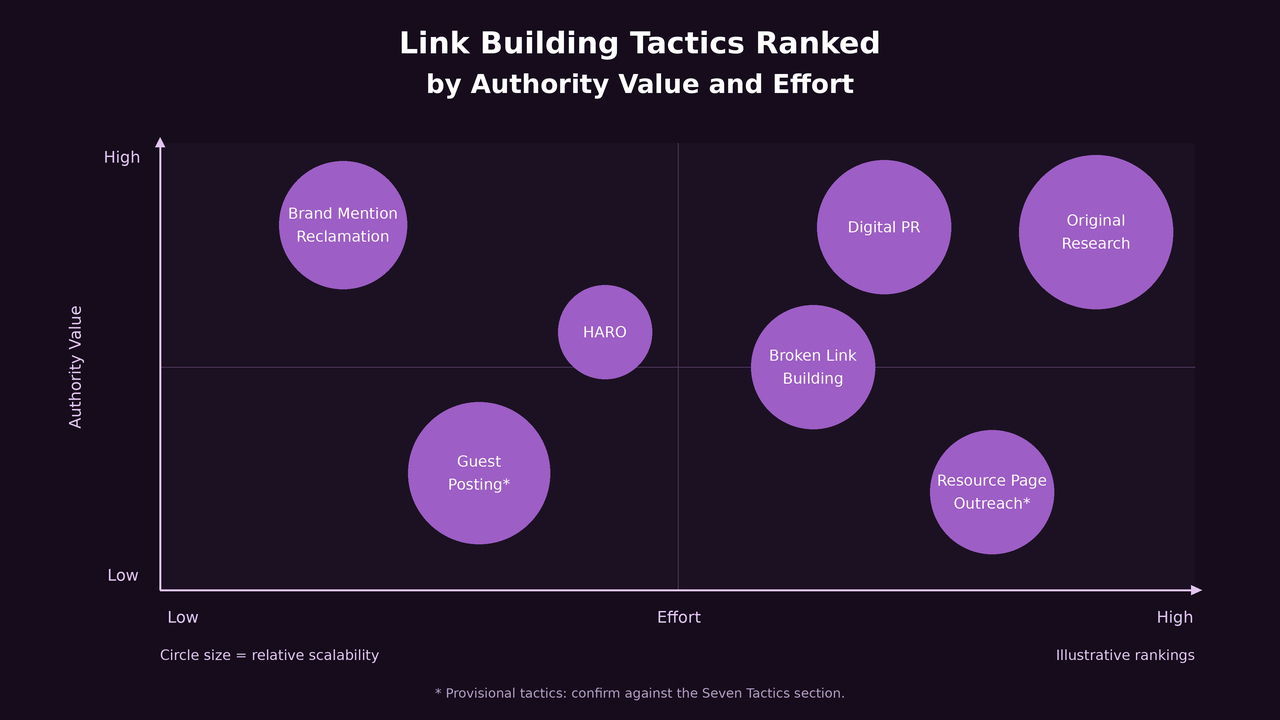
Seven tactics consistently produce the strongest results across different industries and authority levels, ranked by the quality of links they typically produce.

Tactic 1: Original Research and Data Studies

Publishing original research, industry surveys, data analyses, benchmark reports, earns the highest-quality links available because your data becomes a primary source that journalists and bloggers must cite. A 200-respondent industry survey with specific, surprising findings can earn dozens of editorial links from major publications. Publish annually and update each year to maintain a current, consistently citable resource.

Tactic 2: Digital PR Campaigns

Creating campaigns specifically designed to earn media coverage through data-driven stories, expert commentary on trending topics, or original studies framed as news. Links earned from major news sites (DR 80 to 95) provide ranking authority that no conventional outreach campaign can replicate. A single DR 85 editorial link from a national news site outweighs hundreds of links from mid-tier blogs.

Tactic 3: Comprehensive Resource Guides

Creating the single most comprehensive resource available on a specific topic in your industry earns passive links from sites that reference it as the authoritative guide. The resource must be genuinely more comprehensive than anything currently available, not just longer, but more useful, better organised, and more regularly updated. Our topical authority guide explains how to identify the resource guide opportunities where you can realistically become the definitive reference.

Tactic 4: Free Tools and Calculators

Building genuinely useful free tools earns sustained link acquisition with minimal ongoing effort. A tool that solves a real problem your audience faces will be linked to, bookmarked, and shared consistently over months and years, earning links passively once built, unlike content articles that require active ongoing promotion.

Tactic 5: Broken Link Building

Finding pages in your niche with broken outgoing links and offering your content as a replacement. This works because you provide genuine value to the linking site, fixing a broken user experience, while earning an editorial placement. Use Ahrefs broken backlinks report or Check My Links Chrome extension to find opportunities at scale in your niche.

Tactic 6: Expert Roundup and Collaborative Content

Collecting expert opinions from multiple practitioners on a specific topic and publishing the roundup. Each contributor typically shares and links to content they contributed to, producing multiple links from one content piece. Quality depends entirely on the authority of the contributors you recruit for the roundup.

Tactic 7: HARO and Media Outreach

Responding to journalist queries through Connectively (formerly HARO) to earn coverage in national and trade publications. Requires consistent participation checking queries multiple times daily and expert-level responses that provide genuine value to the journalist's story. A 5 to 10 percent placement rate is realistic with consistently high-quality responses.

Outreach Best Practices, Getting More Emails Answered

The difference between a 2% response rate and a 20% response rate is almost entirely in the personalisation, relevance, and value proposition of the outreach email. Four principles of effective link outreach: personalisation (reference something specific about the recipient's recent content, not a generic opener they receive from every outreach campaign), relevance (your link request must make obvious sense for their audience), value (explain exactly what the recipient gains by including your link, not that it would "be helpful"), and brevity (under 100 words, busy editors do not read long pitches).
Follow up once after 7 days if no response. Do not follow up more than twice. Never use automated outreach sequences for high-value targets, they consistently produce lower response rates and damage your domain reputation for future outreach to the same publishers.

How to Avoid Link Building Penalties

Google's SpamBrain AI identifies manipulative link acquisition patterns with increasing sophistication. Understanding the specific triggers prevents the penalties that can take 6 to 18 months to fully recover from. According to Google link spam policies, any links intended to manipulate PageRank or site rankings violate their guidelines.
Practice to AvoidWhy It Triggers PenaltiesSafe Alternative
Paying for followed linksDirectly violates Google guidelines; SpamBrain identifies payment patterns through network topology analysisEarn editorial links through genuinely valuable content; use rel=sponsored on legitimately paid placements
Private Blog Networks (PBNs)SpamBrain identifies PBN signatures through IP clustering, hosting patterns, and cross-site linking behavioursCreate content assets and pursue editorial outreach for all link acquisition
Exact-match anchor concentration above 15%Over-concentrated commercial anchors signal artificial building regardless of individual link qualityMaintain natural distribution: 40 to 50% branded, 20 to 25% generic, 10 to 15% topical, under 10% exact-match
Systematic link exchangesReciprocal linking at scale is a clear manipulation signal identifiable through network analysisOccasional natural reciprocal links where both parties genuinely value each other's content are acceptable
Buying links from link brokersLink broker networks are well-documented and increasingly identified in their entirety by SpamBrainNo substitute, genuinely earned editorial links are the only sustainable approach

Stop Guessing at Link Building, Let Our Specialists Build Your Authority

Our link building team combines data-driven opportunity analysis with content creation and relationship-based outreach to earn editorial backlinks from the most authoritative sites in your niche.

Start Your Link Building Campaign

Frequently Asked Questions

What is link building in SEO?

Link building is the process of acquiring hyperlinks from other websites to your own to improve your site's authority and organic search rankings. Each quality backlink signals to Google that another credible publisher endorses your content. Google uses backlinks as a primary ranking signal because they represent editorial endorsements that are harder to fabricate than on-page factors. Effective link building earns editorial links through genuinely valuable content rather than manufacturing them through automated or paid methods.

What are the best link building strategies in 2026?

The most effective strategies are: original research and data studies (earn links as a citable primary source that cannot be bypassed), digital PR campaigns (earn editorial links from major publications), comprehensive resource guide creation (become the definitive reference in your niche), free tool development (earn sustained passive links), broken link building (replace dead links with your content), expert roundup creation (earn links from contributors sharing their inclusion), and Connectively or HARO responses (earn media citations from journalist queries).

How long does link building take to impact rankings?

Link building impact typically takes 2 to 6 months from when a link is acquired. Google needs to discover the link through crawling, process it in its indexation pipeline, and re-evaluate rankings of linked pages. High-authority links from very active domains may be processed in weeks. Links from lower-crawl-frequency domains may take months to fully reflect in rankings. In low-competition niches, a single strong link can produce rapid ranking improvements; in competitive niches, sustained acquisition over months is required.

Is buying backlinks against Google's guidelines?

Yes. Buying backlinks without rel=sponsored or rel=nofollow attributes violates Google's link spam policies. SpamBrain actively identifies purchased link patterns through network analysis, and sites engaging in link buying face ranking suppression or manual action penalties. The correct approach for any paid placement is adding rel=sponsored to signal to Google that the link should not be counted as an editorial endorsement.

What is a high-quality backlink?

A high-quality backlink comes from a site that is: editorially managed with genuine original content, topically relevant to your business or content area, trusted by Google as evidenced by its own organic rankings, generating real organic traffic (not a site existing primarily for links), linking to you within the editorial body of a relevant article, and using natural contextually appropriate anchor text. Domain Rating in Ahrefs is a useful starting proxy but must always be combined with a manual quality assessment.

What is anchor text and why does it matter?

Anchor text is the visible, clickable text of a hyperlink. Google uses anchor text as a relevance signal, the words used to link to your page communicate what that page is about. However, too many links with identical exact-match commercial anchor text signals manipulation. A healthy profile has predominantly branded anchors (40 to 50%), generic or URL anchors (15 to 25%), and topical anchors (10 to 15%), with minimal exact-match commercial terms. SpamBrain specifically monitors anchor text distribution patterns across the entire backlink profile.

How do I check my competitors' backlinks?

Check competitor backlinks using Ahrefs Site Explorer. Enter a competitor domain, navigate to the Backlinks report, and filter by DR to see their strongest linking domains. The Referring Domains report shows total unique linking sites. Most valuably, use the Link Intersect tool with your domain and 2 to 3 competitor domains to find sites linking to them but not to you. These are your highest-priority outreach targets because they have already demonstrated willingness to link to content similar to yours.

Build the Domain Authority That Sustains Rankings Through Every Google Update

At Futuristic Marketing Services, we build white-hat link profiles that compound authority over time and withstand algorithm updates, because genuinely earned editorial links are what Google's quality systems are designed to reward.

Talk to a Link Building Specialist

Conclusion

Link building is the external validation layer that converts on-page relevance into competitive organic rankings. No amount of content quality or technical optimisation can fully compensate for a weak backlink profile when competing against well-authorised sites targeting the same keywords. The most durable link building programmes are built on content that genuinely merits citation, outreach that provides real value to publishers, and consistency over time rather than shortcuts that produce short-term gains and long-term penalties.
Start by auditing your existing profile, then identify the tactics most appropriate for your current authority level. Build the supporting content infrastructure with our topical authority guide, and use our off-page SEO guide as the complete measurement framework for tracking authority growth across both traditional rankings and AI-era citation signals.
Share this post :
Picture of Devyansh Tripathi
Devyansh Tripathi

Devyansh Tripathi is a digital marketing strategist with over 5 years of hands-on experience in helping brands achieve growth through tailored, data-driven marketing solutions. With a deep understanding of SEO, content strategy, and social media dynamics, Devyansh specializes in creating results-oriented campaigns that drive both brand awareness and conversion.

All Posts