SEO vs PPC: Which Digital Marketing Channel Should You Invest In?

seo vs ppc

SEO (Search Engine Optimisation) earns organic traffic through unpaid search rankings that compound over time. PPC (Pay-Per-Click) generates immediate paid traffic by bidding for ad placements in search results and paying for each click. SEO takes 4 to 12 months to produce meaningful results but creates sustainable, compounding traffic that continues even when you pause investment. PPC delivers instant visibility but stops completely the moment your budget runs out. Most businesses benefit from running both in a coordinated strategy.

This guide provides the complete SEO versus PPC comparison: how each channel works, the true costs including hidden ones, the traffic quality differences, timeline and ROI profiles over 12 and 36 months, when to choose SEO, when to choose PPC, and when to run both together for maximum search visibility. It includes a practical decision framework you can apply directly to your specific business situation. Use this alongside our SEO strategy guide and keyword research guide to build the channel strategy that fits your goals and resources.

Key Takeaways

  • SEO produces organic traffic that continues even when you pause investment, PPC traffic stops immediately when budget runs out
  • PPC delivers instant visibility and traffic, SEO typically takes 4 to 12 months to produce meaningful organic results for new or low-authority sites
  • According to HubSpot, organic search leads have a 14.6% close rate compared to 1.7% for outbound methods, reflecting the superior purchase intent of organic search visitors
  • BrightEdge Research confirms organic search drives 53.3% of all website traffic, making SEO the highest-volume digital traffic channel available
  • Both channels target users actively searching, making them both higher-intent than display advertising, social media, or email marketing
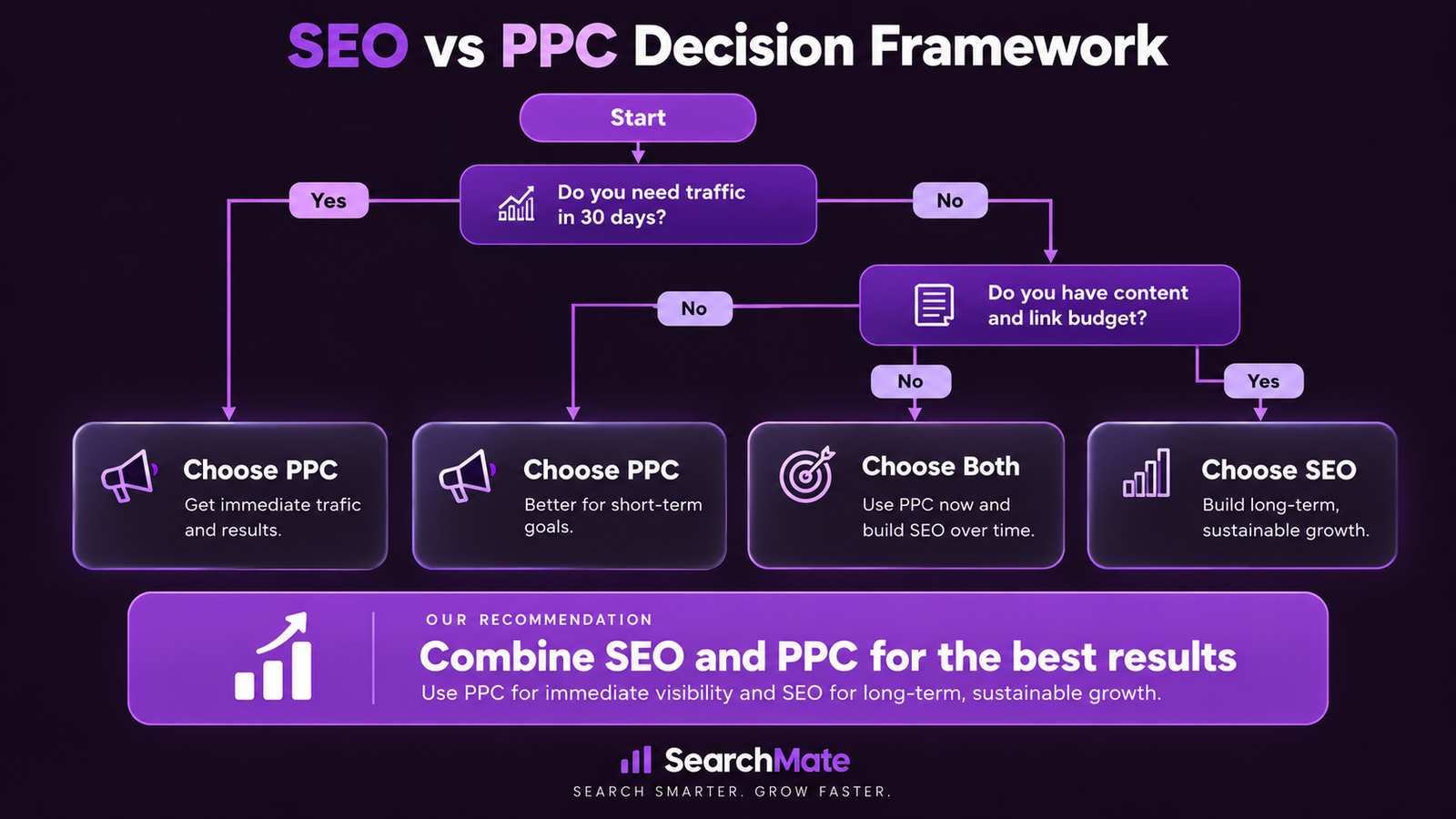
  • The most effective strategy for most businesses is running both: PPC for immediate results while SEO builds compounding long-term authority that reduces cost per acquisition over time

Not Sure Whether to Invest in SEO or PPC for Your Business?

Futuristic Marketing Services provides honest, data-driven channel recommendations based on your specific goals, budget, competition level, and timeline, not a one-size-fits-all answer.

Get a Free Channel Strategy Consultation
How SEO Works, The Compounding Organic Traffic Asset

SEO earns organic search rankings through a combination of content quality, technical performance, and external authority signals. When done correctly, SEO produces traffic that compounds over time: each new piece of ranking content adds to total monthly organic sessions, and each new quality backlink increases the ranking potential of all existing content. The three phases of SEO investment: Foundation (months 1 to 3) covers technical fixes, keyword strategy, and initial content creation. Growth (months 4 to 9) sees content volume increase, links accumulate, and early rankings appear for lower-competition keywords. Compounding (months 10 and beyond) is where established authority makes new content rank faster and existing content climbs for more keyword variants.
The economic advantage of SEO compounds over time. BrightEdge Research confirms organic search drives 53.3% of all website traffic globally. HubSpot research confirms a 14.6% close rate for organic search leads compared to 1.7% for outbound methods, showing that organic search delivers both volume and intent quality simultaneously.

How PPC Works, Immediate Paid Visibility
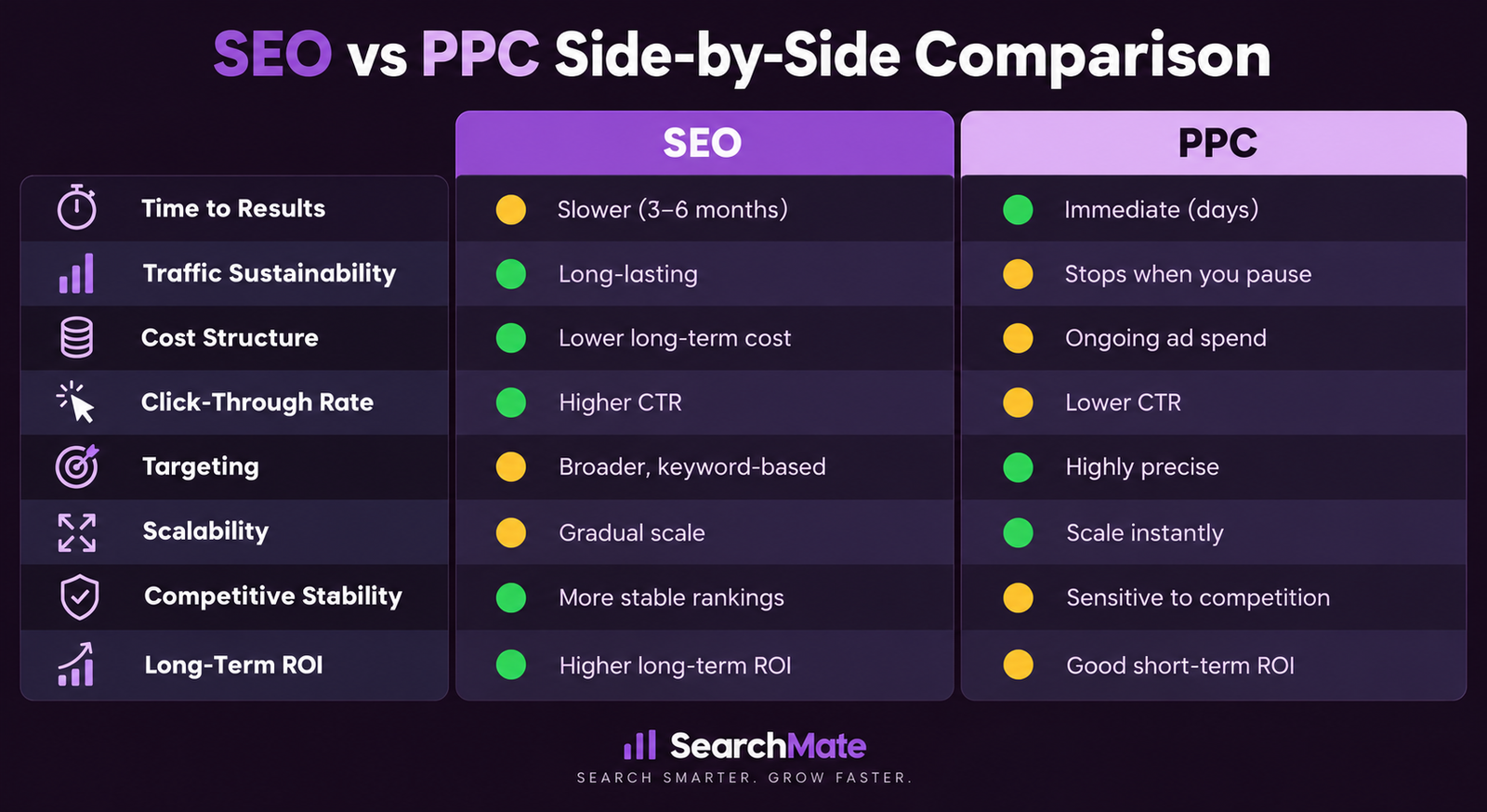
PPC advertising places paid ads at the top and bottom of Google search results for target keywords. You bid on keywords in a real-time auction, your ads appear when you win, and you pay only when a user clicks. Google Ads uses a Quality Score system that rewards relevant, high-quality ads and landing pages with better positions at lower costs per click, meaning the same bid can produce better placement for advertisers with higher relevance scores.
PPC advantages concentrate in the early stages of a business or campaign: immediate traffic (ads can drive visitors within hours of campaign launch), precise targeting (specific demographics, locations, devices, times of day, and audience intent signals), easy A/B testing (test landing pages, ad copy, and offers with direct conversion feedback), and fully controlled scaling (increase budget when ROI is positive, reduce when not). PPC limitations are equally significant: traffic stops completely when budget runs out, click costs increase as new competitors enter the market, and there is no accumulated authority reducing future costs, every month starts at the same baseline spend requirement.

The Complete SEO vs PPC Comparison

Every significant comparison dimension is covered below. Use it to identify which channel has a structural advantage for the specific outcome most important to your business right now.
FactorSEO PerformancePPC PerformanceWhich Channel Wins
Time to first results4 to 12 months for meaningful traffic from new or low-authority sitesHours to days after campaign launch and budget activationPPC for fast results; SEO for sustainable growth
Traffic sustainabilityTraffic continues with maintenance investment; compounds over timeTraffic stops immediately when ad budget reaches zeroSEO for long-term traffic asset
Cost structureUpfront content and link investment; lower ongoing maintenanceContinuous spend required at every volume level; no cost reduction over timeSEO for 3-plus year ROI; PPC for immediate needs
Click-through rateOrganic position 1 averages 28% CTR; higher trust for informational queriesSearch ads average 6 to 8% CTR; lower than organic for most queriesSEO for informational CTR; PPC for branded commercial intent
Targeting precisionKeywords and content; location and device through GSCPrecise keyword, location, device, demographic, schedule, and audience targetingPPC for precise audience targeting
ScalabilityScales through additional content and link building; slowerScales immediately with budget increase; linear with spendPPC for rapid scaling with budget
Competitive stabilityCompetitors take months to close a content or authority gapCompetitors can outbid you within hoursSEO for durable competitive positioning
Long-term ROICompounds, traffic and authority grow over time without proportional costLinear, same traffic requires same spend indefinitelySEO for 3-plus year programme ROI

The True Cost of Each Channel

True Cost of SEO

Content creation is the largest ongoing cost: high-quality SEO content ranges from Rs 3,000 to Rs 15,000 per article depending on research depth, expertise required, and word count. A content-led programme typically requires 4 to 8 articles per month. Technical SEO: initial audit and implementation is a one-time cost of Rs 25,000 to Rs 1,00,000 depending on site size and complexity. Link building: the most variable component, ranging from Rs 5,000 per guest post to Rs 50,000 or more for high-authority editorial placements. Agency management: Rs 25,000 to Rs 1,50,000 per month for a comprehensive managed programme.

True Cost of PPC

The primary PPC cost is the click budget itself. Average cost per click varies dramatically by industry: highly competitive sectors (legal, finance, real estate, insurance) regularly see CPCs of Rs 100 to Rs 2,000 per click. Less competitive industries may see CPCs of Rs 10 to Rs 50. Budget burn is constant, a Rs 1,00,000 monthly budget generates a predictable traffic volume that disappears completely if the budget is paused. Management fees for a Google Ads specialist add Rs 15,000 to Rs 75,000 per month on top of the click budget itself.
The long-term ROI advantage of SEO is the compounding effect: content ranking today continues generating traffic in year 3 and year 5 with only maintenance costs. The same PPC budget spent in year 1 must be spent again identically in year 2 and year 3 to generate the same traffic volume. Over a 3 to 5 year horizon, most well-executed SEO programmes produce significantly higher total ROI than equivalent PPC investment targeting the same keywords.

When to Choose SEO, PPC, or Both

Choose SEO When

You have 6 to 12 months before you need meaningful organic results. You are building a long-term brand rather than running a short-term campaign. Your target keywords have meaningful search volumes and your content can genuinely add value beyond existing results. You want traffic that compounds over time and continues without continuous spend. Combine with our SEO strategy guide to build the plan correctly from day one.

Choose PPC When

You need immediate traffic or leads, a product launch, a time-sensitive promotion, or a new business that cannot wait 12 months. You are testing which keywords and offers convert before investing in SEO content. Your industry has extremely competitive organic SEO requiring years of authority building. You have confirmed positive ROI on PPC spend and have budget to scale it profitably.

Run Both When

Most established businesses with sufficient budget benefit most from running SEO and PPC together. PPC fills the immediate traffic gap while SEO builds. PPC keyword conversion data reveals which queries to prioritise for SEO content investment. SEO authority improves Google Ads Quality Scores over time, reducing cost per click for the same queries. Together, they create maximum search real estate, paid ads plus organic listings, preventing competitors from owning any position for your most valuable target queries.

Using PPC Data to Accelerate Your SEO Strategy

The most sophisticated search marketing strategy integrates PPC data flows into SEO decision-making. PPC provides conversion data that SEO alone cannot generate in the same timeframe. Identify your highest-converting PPC keywords (by cost per lead or cost per acquisition) and prioritise SEO content targeting those same queries, so you eventually earn organic traffic at zero cost per click for your most commercially valuable terms. A keyword generating Rs 500 average CPC and converting at 4% is worth a dedicated high-quality SEO content investment.
Use SEO rankings to reduce PPC costs: pages with strong organic rankings for a keyword have higher Google Ads Quality Scores for that keyword, which reduces your cost per click. Investing in SEO content matching your PPC target queries produces a double benefit over time: free organic traffic plus reduced paid traffic costs for the same queries. Over time, a strong SEO programme systematically reduces the total search marketing budget required to maintain the same total search visibility.

Run Both SEO and PPC in One Coordinated Growth Programme

Our integrated search marketing team manages SEO and PPC together, using PPC data to inform SEO keyword priorities and SEO authority to reduce PPC costs, maximising the return on your total search investment.

Start Your Integrated Search Strategy

Frequently Asked Questions

Q. What is the difference between SEO and PPC?

A. SEO earns organic traffic through unpaid search rankings built over time through content quality, technical performance, and backlink authority. PPC generates immediate paid traffic by bidding for ad placements and paying for each click. SEO traffic compounds over time and continues even when you pause investment. PPC traffic is immediate but stops completely when budget runs out. SEO typically takes 4 to 12 months to produce meaningful results. PPC can drive traffic within hours of launch.

Q. Is SEO better than PPC?

A. Neither is universally better, each has distinct advantages for different situations. SEO produces more sustainable, compounding traffic with better long-term ROI for most established businesses. PPC offers immediate traffic, precise targeting, and easy budget scaling. Most businesses with sufficient budget benefit most from running both: PPC for immediate revenue while SEO builds the long-term organic authority that reduces cost per acquisition over time. The right answer depends entirely on your timeline, budget, and specific business goals.

Q. How much does SEO cost compared to PPC?

A. SEO costs are primarily upfront, content creation, technical implementation, link building, with lower ongoing maintenance costs. A comprehensive managed SEO programme in India typically costs Rs 25,000 to Rs 1,50,000 per month. PPC costs scale with traffic volume and never decrease to zero, click budgets must be spent continuously to maintain traffic. In competitive industries like legal or finance, PPC CPC can exceed Rs 500 to Rs 2,000 per click. Over 3 to 5 years, well-executed SEO typically produces superior total ROI because SEO traffic compounds while PPC traffic is linear with spend. Our SEO strategy guide covers how to project and evaluate SEO ROI.

Q. How long does SEO take compared to PPC?

A. PPC generates traffic within hours of a campaign launch. SEO typically takes 4 to 12 months to produce meaningful organic traffic for new or low-authority sites, though established sites with existing authority can see ranking improvements within 6 to 8 weeks for lower-competition keywords. This time difference is the primary reason many businesses start with PPC while building their SEO foundation in parallel, using PPC for immediate revenue while SEO builds the sustainable organic engine that eventually reduces total marketing spend.

Can SEO and PPC work together?

Yes, running SEO and PPC together produces better results than either channel alone for most businesses. PPC provides immediate traffic while SEO builds. PPC conversion data reveals which keywords actually generate leads and sales, informing which SEO content to prioritise. Strong SEO rankings improve Google Ads Quality Scores, reducing PPC cost per click for the same keywords. Together, SEO and PPC create maximum search real estate, paid positions plus organic listings, across every valuable target query.

Q. What is a good ROI for SEO vs PPC?

A. SEO ROI is typically measured over 12 to 36 months. A well-executed programme should reach positive ROI within 12 to 18 months, with ROI improving significantly in subsequent years as the traffic asset compounds. PPC ROI is immediate and measurable, if your cost per acquisition is below customer lifetime value, the ROI is positive. PPC ROI tends to remain linear with spend and can decline as competition increases CPC over time. SEO ROI tends to improve over time as accumulated authority makes future content rank faster and more broadly.

Q. Should a new business start with SEO or PPC?

A. New businesses typically benefit most from starting with both: PPC for immediate visibility and revenue validation while SEO is being built. PPC allows testing which products, services, and messages resonate with customers before investing heavily in SEO content. The PPC conversion data then informs exactly which SEO keywords and topics to prioritise. As the SEO programme matures over 6 to 12 months, the business can gradually shift budget from PPC to SEO as organic rankings begin generating free traffic for the same queries that PPC was previously covering.
div style="background:#9D5EC5;border-radius:15px;padding:40px 36px;margin:40px 0;text-align:center;">

Build the Search Presence That Dominates Both Paid and Organic Results

At Futuristic Marketing Services, we help businesses dominate search results at every position, paid ads, organic listings, and local pack entries, creating maximum search real estate for all your target queries.

Talk to a Search Marketing Specialist

Conclusion

The SEO versus PPC decision is not a binary choice for most businesses, it is a question of sequencing and resource allocation across channels that complement each other far more than they compete. PPC's immediate visibility and conversion data, combined with SEO's compounding authority and sustainable traffic, together create a search marketing system stronger than either channel alone.
For most businesses, the recommended sequence is: launch PPC immediately for revenue and data, start SEO foundation work simultaneously, and progressively shift budget from PPC to SEO as organic rankings mature over 6 to 18 months. Our SEO strategy guide, keyword research guide, and technical SEO audit provide the three core frameworks for building the SEO side of this strategy effectively from day one.
Share this post :
Picture of Devyansh Tripathi
Devyansh Tripathi

Devyansh Tripathi is a digital marketing strategist with over 5 years of hands-on experience in helping brands achieve growth through tailored, data-driven marketing solutions. With a deep understanding of SEO, content strategy, and social media dynamics, Devyansh specializes in creating results-oriented campaigns that drive both brand awareness and conversion.

All Posts
Table of Contents
Get free tips and resources right in your inbox,