
Keyword Cannibalization: How to Find and Fix Competing Pages for SEO

keyword cannibalization

Keyword cannibalization occurs when two or more pages on the same website target the same primary keyword or satisfy the same search intent. Instead of one strong page earning all the ranking authority for that query, multiple weaker pages compete against each other, splitting backlinks, internal links, and PageRank between them and producing lower rankings than a single consolidated page would achieve.

Keyword cannibalization occurs when two or more pages on the same website target the same primary keyword or satisfy the same search intent. Instead of one strong page earning all the ranking authority for that query, multiple weaker pages compete against each other, splitting backlinks, internal links, and PageRank between them and producing lower rankings than a single consolidated page would achieve.

Key Takeaways

  • According to Ahrefs, keyword cannibalization causes PageRank dilution that suppresses rankings for both competing pages, making it one of the most common causes of stagnant organic performance on sites with large content libraries
  • Google Search Central confirms that when multiple pages compete for the same query, Google must choose which to rank, and its choice may not match your most valuable page
  • The most reliable detection method is a Google site: search, site:yourdomain.com plus the target keyword, which reveals every page Google associates with that query
  • A keyword map that assigns one primary keyword to exactly one page is the only reliable prevention system, our keyword research guide covers how to build and maintain one
  • The four resolution strategies are: consolidate (merge content into one stronger page), differentiate (rewrite pages to serve distinctly different intents), redirect (301 from weaker to stronger page), or noindex (remove lowest-value page from the index)
  • Prevention through a maintained keyword map costs nothing after the initial setup and eliminates the need for reactive cannibalization audits, our SEO content strategy covers how to integrate it into content production

Struggling With Stagnant Rankings Despite Good Content? Cannibalization May Be Why.

Futuristic Marketing Services identifies every cannibalization conflict on your site, recommends the correct resolution strategy for each, and implements the consolidations and redirects that restore concentrated ranking authority to your most valuable pages.

Get a Cannibalization Audit

hello@futuristicmarketingservices.com  |  +91 8518024201

Why Keyword Cannibalization Suppresses Rankings
When two pages on your site target the same keyword or serve the same search intent, Google must select one to rank, but it distributes its crawl, indexation, and authority evaluation resources across both. Backlinks earned by either page benefit both pages partially rather than one page fully. Internal links split PageRank between the two. Google's confusion about which is the canonical ranking page produces inconsistent positioning where neither page achieves the stable top-5 ranking that a single consolidated page would earn. According to Moz, fixing cannibalization is one of the highest-ROI technical SEO actions for established sites precisely because it restores concentrated authority to pages already earning partial rankings.
The symptom pattern of cannibalization is distinctive: two pages trading positions for the same keyword (page A ranks position 6 one week, page B ranks position 8 the next, then they swap), neither page breaking above position 5 despite strong content, and both pages showing impressions for the same queries in Google Search Console Performance data. This fluctuation is Google continuously re-evaluating which page is more relevant and never reaching a confident conclusion.

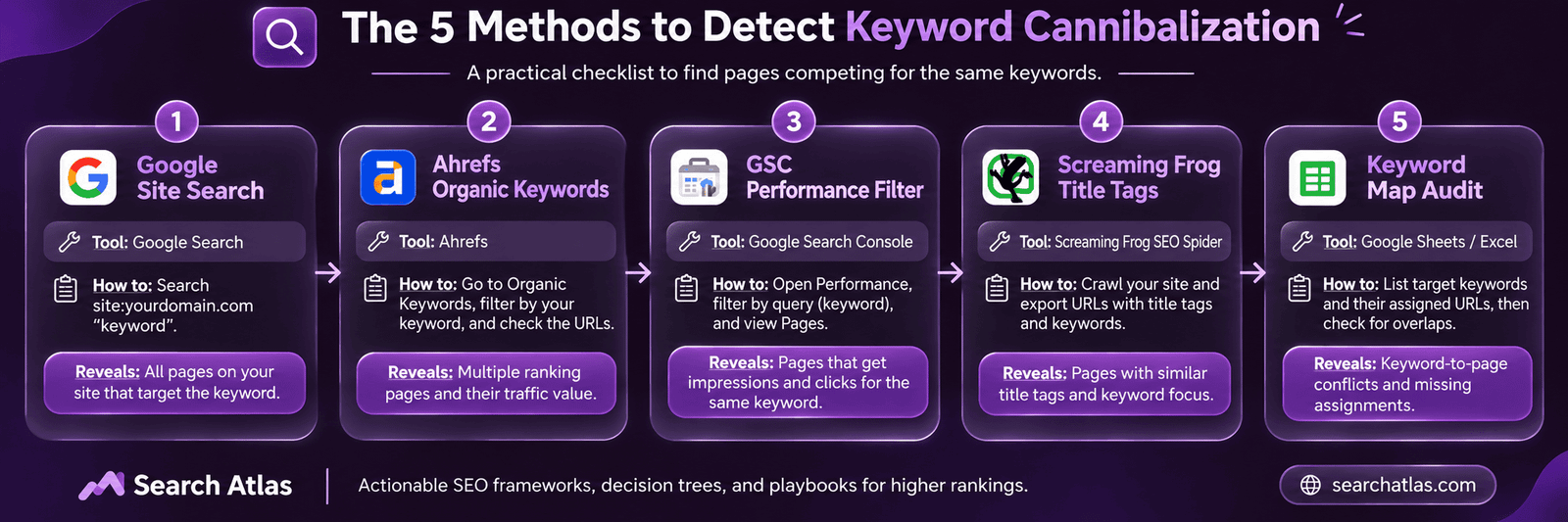
Five Methods to Detect Keyword Cannibalization

Use these five methods in combination to identify every cannibalization conflict across your site. No single method catches all instances, different detection approaches surface different types of overlap.
Detection MethodHow to Use ItWhat It RevealsBest For
Google site: searchSearch: site:yourdomain.com target-keyword in GoogleEvery page Google associates with that specific keywordQuick checks for individual keywords; free and immediate
GSC Performance filterPerformance report > Pages > filter by query > see which pages earn impressions for the same queryMultiple pages competing for identical queries with impression dataConfirming cannibalization with real traffic data; identifying which page Google currently prefers
Ahrefs Organic KeywordsSite Explorer > Organic Keywords > filter to a specific keyword > see all ranking URLsEvery URL on your site currently ranking for any given keywordComprehensive site-wide detection across hundreds of keywords simultaneously
Screaming Frog title tag exportExport all page titles > sort alphabetically > look for near-identical title tags across different URLsPages with identical or very similar title tags targeting the same keywordOn-page signal cannibalization; pages optimised for the same keyword at the HTML element level
Keyword map auditReview keyword map for any primary keyword assigned to more than one URLPlanned future cannibalization before new content is publishedPrevention-oriented detection before content goes live; most efficient long-term approach

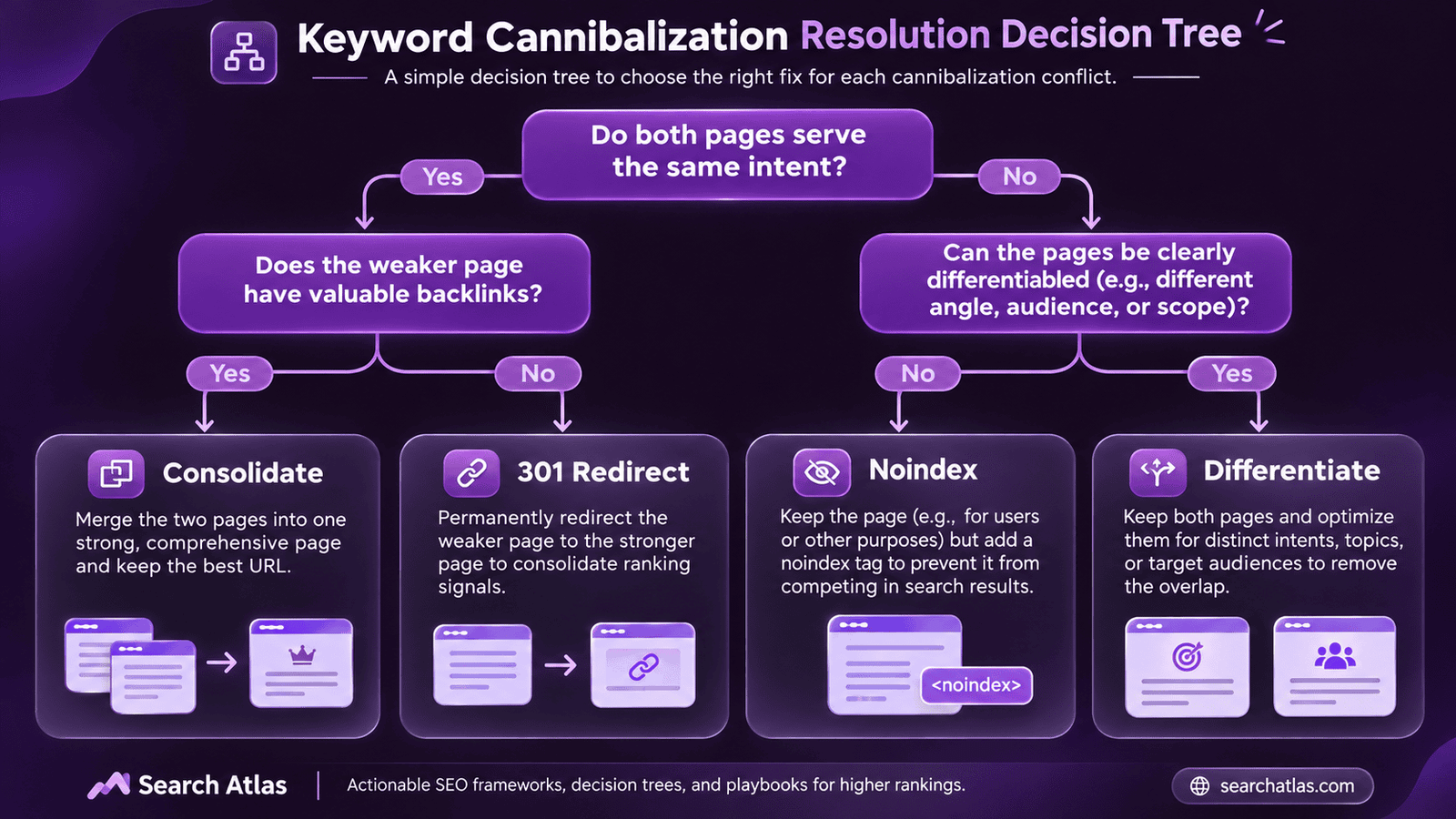
The Four Cannibalization Resolution Strategies

Once cannibalization is confirmed, choose the correct resolution strategy based on the specific relationship between the competing pages. The wrong strategy, particularly using canonical tags incorrectly or noindexing pages with valuable backlinks, can worsen the situation rather than resolve it.

Strategy 1: Consolidate the Content

Consolidation is the correct resolution when two pages cover the same topic with similar depth and neither has a meaningfully different intent from the other. Merge the best content from both pages into a single, more comprehensive article, publish it at the stronger URL (typically the one with more backlinks and higher authority), and 301 redirect the weaker URL to the consolidated page. Consolidation typically produces a significant ranking improvement within 4 to 8 weeks as Google re-evaluates the strengthened single page. Our duplicate content guide covers the full consolidation process including redirect implementation.

Strategy 2: Differentiate the Pages

Differentiation is correct when two pages cover a topic from genuinely different angles but have drifted into targeting the same intent through similar content development. Rewrite one page to serve a distinctly different search intent, for example, if two pages both target 'link building guide', rewrite one to focus on beginners (informational intent) and the other on advanced tactics (commercial intent). Update the primary keyword target, title tag, and H1 of one page to reflect the newly differentiated intent, and update your keyword map to reflect the separation.

Strategy 3: 301 Redirect the Weaker Page

A 301 redirect is correct when one page clearly outperforms the other in rankings, backlinks, and content quality, and the weaker page adds no distinct value worth preserving. This is the cleanest resolution, it concentrates all authority on the stronger page and definitively removes the competition. Redirect the weaker page to the stronger one rather than to a category page or homepage, ensuring the redirect destination is contextually relevant to the redirected page's content.

Strategy 4: Noindex the Lowest-Value Page

Noindex is rarely the first choice because it removes the page from Google's index without passing its accumulated authority elsewhere. Reserve noindex for pages that have no backlinks, no organic traffic history, and content fully covered by a more comprehensive page. For pages with any backlink value, 301 redirect is always preferable to noindex because the redirect passes authority forward while noindex discards it. Never apply noindex to a page with meaningful external backlinks without first implementing a 301 redirect, doing so wastes the accumulated link authority that took months or years to earn.

Let Our SEO Team Resolve Every Cannibalization Conflict on Your Site

Our specialists identify every cannibalization pattern across your content library, determine the correct resolution strategy for each conflict, and implement the consolidations, redirects, and differentiations that restore concentrated ranking authority to your most valuable pages.

Fix Keyword Cannibalization Now

hello@futuristicmarketingservices.com  |  +91 8518024201
Frequently Asked Questions About Keyword Cannibalization

What is keyword cannibalization in SEO?

Keyword cannibalization occurs when two or more pages on the same website target the same primary keyword or satisfy the same search intent, causing them to compete against each other in Google's ranking evaluation. This splits ranking authority between the competing pages, dilutes PageRank and backlink value across multiple URLs, and produces lower rankings for both pages than a single consolidated page would achieve. According to Ahrefs, it is one of the most common causes of stagnant organic performance on sites with large content libraries.

How do I know if I have keyword cannibalization?

The clearest signs are: two of your pages trading positions for the same keyword (fluctuating rankings with neither breaking into top 5), both pages showing impressions for identical queries in Google Search Console Performance report, or a Google site: search revealing multiple pages covering the same topic. The most efficient detection method is a site: search, type site:yourdomain.com plus your target keyword into Google and review all results for topical overlap.

What is the best way to fix keyword cannibalization?

The best fix depends on the relationship between the competing pages: consolidate when both pages cover the same topic with similar depth (merge content, 301 redirect weaker to stronger URL); differentiate when pages can legitimately serve different intents (rewrite one for a different audience or query type and update its keyword target in your keyword map); 301 redirect when one page clearly outperforms the other and the weaker page adds no distinct value; or noindex as a last resort when the page has no backlinks or traffic worth preserving.

Can keyword cannibalization cause a Google penalty?

Keyword cannibalization does not trigger a direct Google penalty, it is a structural SEO problem rather than a guideline violation. The impact is ranking suppression through authority dilution rather than active penalisation. Google simply cannot determine which of your competing pages to rank with confidence, so neither achieves the stable high position it would if it were the only page targeting that intent. The fix produces organic improvement rather than penalty recovery.

How do I prevent keyword cannibalization?

Prevent keyword cannibalization by maintaining a keyword map that assigns exactly one primary keyword to exactly one URL across your entire site. Before publishing any new piece of content, check the keyword map and perform a site: search for the target keyword to confirm no existing page already covers the same intent. Our SEO content strategy guide covers how to integrate this check into your content production workflow as a standard pre-writing step that takes under 2 minutes per article.

Is having two pages about the same topic always cannibalization?

Not necessarily. Two pages can cover the same broad topic without cannibalizing each other if they serve distinctly different search intents. A page targeting 'what is link building' (informational intent, beginner audience) and a page targeting 'advanced link building tactics' (commercial intent, experienced audience) both cover link building without competing for the same queries because Google serves them to different searchers with different underlying needs. Cannibalization occurs when both pages target the same intent, not merely the same broad topic area.

What tools detect keyword cannibalization most effectively?

The most effective tool combination for comprehensive cannibalization detection is: Google Search Console Performance report (filters queries to see which pages compete for identical queries with real traffic data), Ahrefs Organic Keywords report (shows every URL on your site ranking for any given keyword across your tracked keyword set), and Google site: search (free, immediate check for any specific keyword). Screaming Frog title tag exports also reveal on-page keyword targeting overlaps efficiently by sorting identical title tags across your URL inventory.

How long does it take to recover from keyword cannibalization?

Recovery from keyword cannibalization typically takes 4 to 12 weeks after the correct resolution is implemented. Simple consolidations with 301 redirects from pages with no backlinks often show ranking improvement within 4 weeks. Consolidations involving pages with significant backlink profiles may take 8 to 12 weeks as Google re-evaluates the strengthened consolidated page. Monitor the target keyword's ranking position in your rank tracker weekly after implementing the fix and confirm the GSC Coverage report shows the redirected URL is no longer indexed after 4 to 6 weeks.

Build a Content Architecture That Concentrates Authority Rather Than Splitting It

At Futuristic Marketing Services, we design SEO content strategies built around a maintained keyword map that prevents cannibalization from occurring, and conduct quarterly audits to catch any new conflicts before they suppress your rankings.

Talk to Our Content Strategy Team

hello@futuristicmarketingservices.com  |  +91 8518024201

Conclusion

Keyword cannibalization is a structural SEO problem that compounds silently over time on any site that publishes content without a maintained keyword map. Each new cannibalizing page adds another competing URL splitting the authority that should concentrate on your strongest ranking page. The cumulative effect is often the primary cause of stagnant organic performance on content-rich sites where individual article quality is high but total traffic fails to grow proportionally with total content volume.
Resolve existing cannibalization using the correct strategy for each conflict type, implement the keyword map process from our keyword research guide to prevent future occurrences, and monitor monthly in Google Search Console for new query overlaps emerging as new content is published. The investment in prevention through systematic keyword mapping produces compounding returns by ensuring every new page strengthens your authority architecture rather than dividing it.
Share this post :
Picture of Devyansh Tripathi
Devyansh Tripathi

Devyansh Tripathi is a digital marketing strategist with over 5 years of hands-on experience in helping brands achieve growth through tailored, data-driven marketing solutions. With a deep understanding of SEO, content strategy, and social media dynamics, Devyansh specializes in creating results-oriented campaigns that drive both brand awareness and conversion.

All Posts