SEO Copywriting: The Complete Guide to Writing Copy That Ranks and Converts in 2026

seo copywriting

SEO copywriting is the craft of writing website content that simultaneously satisfies Google’s ranking requirements and persuades human readers to take the desired action. It combines SEO technical requirements, keyword placement, search intent matching, heading structure, and E-E-A-T signals, with proven direct-response copywriting techniques, benefit-driven headlines, active voice sentences, scannable formatting, and strategically placed calls to action.

This guide covers the complete SEO copywriting framework for 2026: the EAV (Entity-Attribute-Value) sentence structure preferred by Google's AI systems, how to write introductions that retain readers and capture featured snippets simultaneously, headline and heading writing techniques, readability optimisation for mobile-first audiences, the power word vocabulary that improves click-through rates, benefit-driven CTA writing, and the pre-publish copy audit checklist that catches quality failures before they suppress rankings. Use alongside our how to write SEO blog posts guide and on-page SEO guide for the complete content production framework.

Key Takeaways

  • According to Nielsen Norman Group, users read only 20 to 28% of words on a web page on average, making scannable structure, benefit-driven headings, and front-loaded key information the most critical copywriting disciplines for web content
  • The EAV (Entity-Attribute-Value) sentence format, Subject + Verb + Object in active voice, is the writing structure preferred by Google's AI systems because it is explicit, unambiguous, and easy for crawlers to parse and extract
  • Introductions must retain readers and satisfy Google's quality evaluators simultaneously, the three-part introduction structure (direct answer, summary, key takeaways) serves both goals from the same content investment
  • Power words in title tags and meta descriptions improve click-through rate without keyword stuffing, words like complete, proven, effective, specific, and step-by-step consistently increase CTR for informational queries
  • Every paragraph must be a maximum of 4 lines for mobile readability, over 60% of search traffic arrives on mobile where large text blocks cause immediate abandonment
  • Calls to action must be benefit-specific rather than generic, "Get Your Free SEO Audit" converts at significantly higher rates than "Contact Us" for the same audience and position in the page

Want SEO Copy That Ranks on Google and Converts Visitors Into Customers?

Futuristic Marketing Services creates fully optimised SEO copy, from keyword-mapped titles and intent-matched introductions to benefit-driven CTAs and mobile-optimised formatting, that earns rankings and generates leads simultaneously.

Get Professional SEO Copywriting

hello@futuristicmarketingservices.com  |  +91 8518024201
The EAV Sentence Structure for SEO Writing

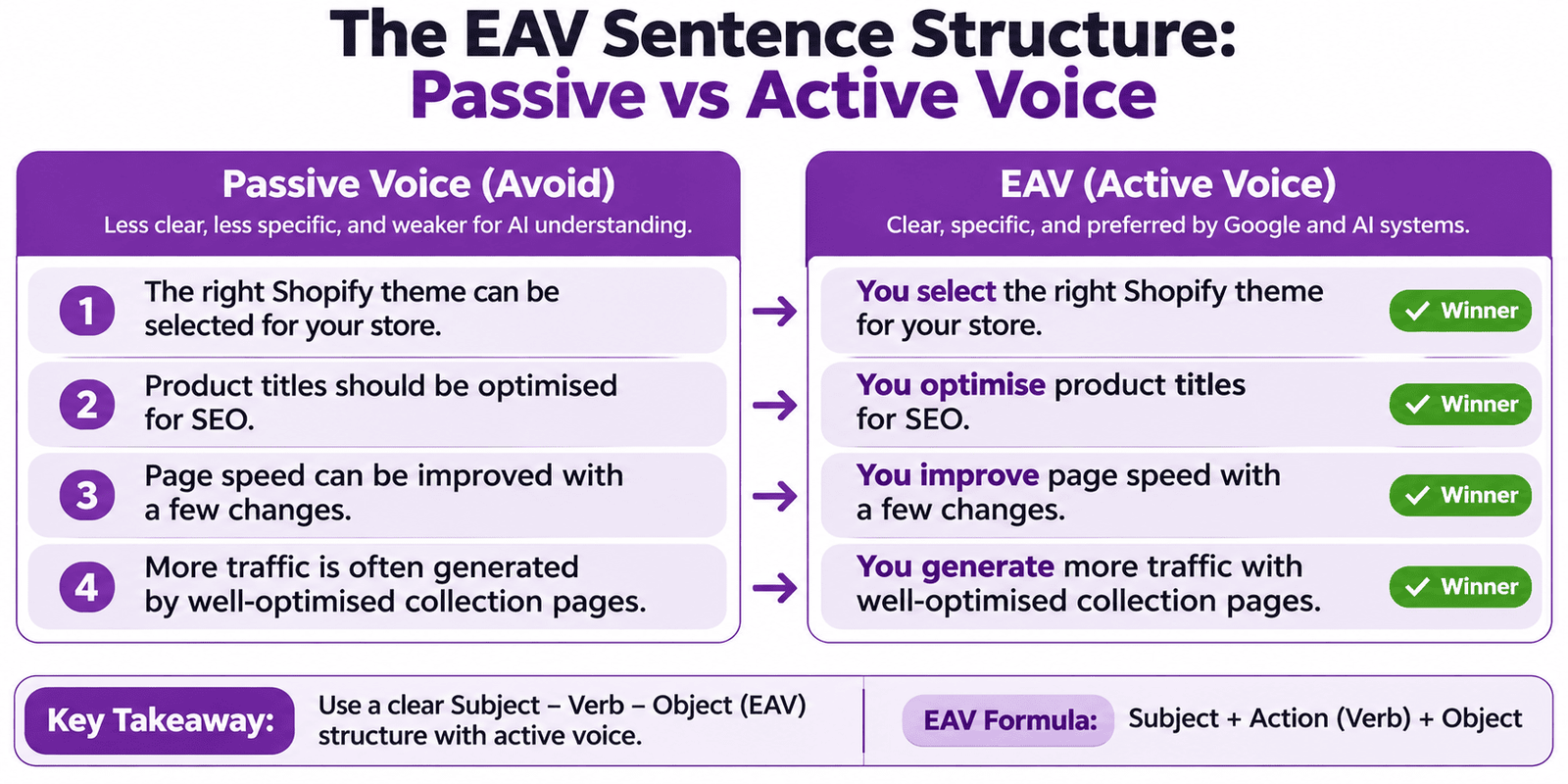
EAV stands for Entity-Attribute-Value, a writing structure that mirrors how Google's AI systems parse and evaluate content quality. The EAV format requires every sentence to follow the Subject (Entity) + Verb (Attribute action) + Object (Value) pattern in active voice. This structure is preferred by LLMs and AI retrieval systems because it is explicit, unambiguous, and delivers a complete information unit in the shortest possible construction.
PrinciplePassive Voice (Avoid)Active EAV Voice (Use)Why EAV Wins
Clear subjectRelationship problems can often be resolved through consultationA vashikaran specialist resolves relationship problems through personalised consultationGoogle identifies who does what, entity and action are explicit
Specific objectVarious methods are available for improving rankingsSEO copywriting improves rankings through keyword placement, readability, and structured contentSpecific, verifiable claim, AI systems can extract and cite it
Numeric precisionMany businesses improve with good SEOBusinesses investing in SEO earn 14.6% of leads from organic search versus 1.7% from outbound methodsSpecific number makes claim credible and AI-extractable
Active attributionIt has been found that readability mattersNielsen Norman Group research confirms users read only 20-28% of web page wordsNamed source with specific finding, maximum E-E-A-T signal

Writing Introductions That Retain Readers and Win Featured Snippets

The introduction is the most critically evaluated section of any web page, by Google's AI systems evaluating snippet eligibility, by RankBrain measuring engagement signals from the first few seconds of the visit, and by human readers deciding in under 8 seconds whether the page is worth reading. A correctly structured introduction serves all three evaluators simultaneously from the same text.
Write every SEO content introduction in three parts. Part 1, the Direct Answer: a complete, standalone response to the page's primary query in 40 to 60 words. This is the featured snippet candidate, write it as if it will be read in isolation without any surrounding context. Part 2, the Article Summary: an 80 to 120 word overview of what the full page covers, setting reader expectations and improving Google's crawl understanding. Part 3, the Key Takeaways: 5 to 7 bullet points summarising the most important information. This is the AI Overview citation format, self-contained factual points that AI systems extract and attribute. Full implementation details are in our how to write SEO blog posts guide.

Headline and Heading Copywriting for SEO

Headlines and headings are the most-read text on any web page, they determine whether a reader stays or leaves, and they are the primary signals Google uses to evaluate content organisation. Writing effective SEO headlines requires combining keyword inclusion (for relevance), benefit communication (for CTR), and intent matching (for ranking retention).
The four headline formulas that consistently outperform generic topic-only titles in organic search: (1) Number + Adjective + Keyword + Benefit (7 Proven SEO Copywriting Techniques That Improve Rankings and Conversions), (2) How to + Keyword + Specific Outcome (How to Write SEO Copy That Ranks on Page One and Converts Readers), (3) Keyword + Colon + Promise (SEO Copywriting: The Complete Guide to Writing Copy That Ranks), (4) Question format (What Is SEO Copywriting and Why Does It Affect Your Rankings?). For H2 subheadings, use the question format consistently where the content answers a specific question, this targets People Also Ask and featured snippet positions simultaneously.
Every H2 must immediately deliver on its headline's promise. The first sentence below every H2 heading must directly answer the question or deliver the promised value, this is the Immediate Answer Method covered in our featured snippets guide. Readers who encounter a heading promising a specific answer and then read two paragraphs of context before receiving it experience unmet expectations, producing the high bounce rates and low dwell times that RankBrain registers as quality failures.

Readability Optimisation for Mobile-First Audiences
Web copy must be optimised for scanning, not reading. According to Nielsen Norman Group research, users read only 20 to 28% of words on a web page on average, they scan for relevant information using headings, bullet points, bold text, and short paragraphs as navigation signals. SEO copy that assumes linear reading consistently underperforms in engagement metrics compared to copy designed for the scanning behaviour that characterises over 80% of web users.
Six readability rules that directly improve dwell time and engagement signals: (1) Maximum 4 lines per paragraph on any device, long paragraphs are visually overwhelming on mobile and signal low editorial investment to Google quality evaluators. (2) Maximum 25 words per sentence, shorter sentences are processed faster and reduce the cognitive load that causes mid-paragraph abandonment. (3) One idea per paragraph, mixing multiple concepts in one paragraph prevents readers from efficiently scanning for specific information. (4) Bold the most important phrase in long paragraphs, bold text is a visual scanning anchor that increases information extraction rate. (5) Use transition words to maintain logical flow, however, therefore, additionally, in contrast, as a result, at a minimum of 30% coverage. (6) Sub-headings every 250 to 350 words, readers expect a new navigational anchor at regular intervals and will abandon pages where headings are too sparse to facilitate efficient scanning.

Power Words for CTR and Engagement

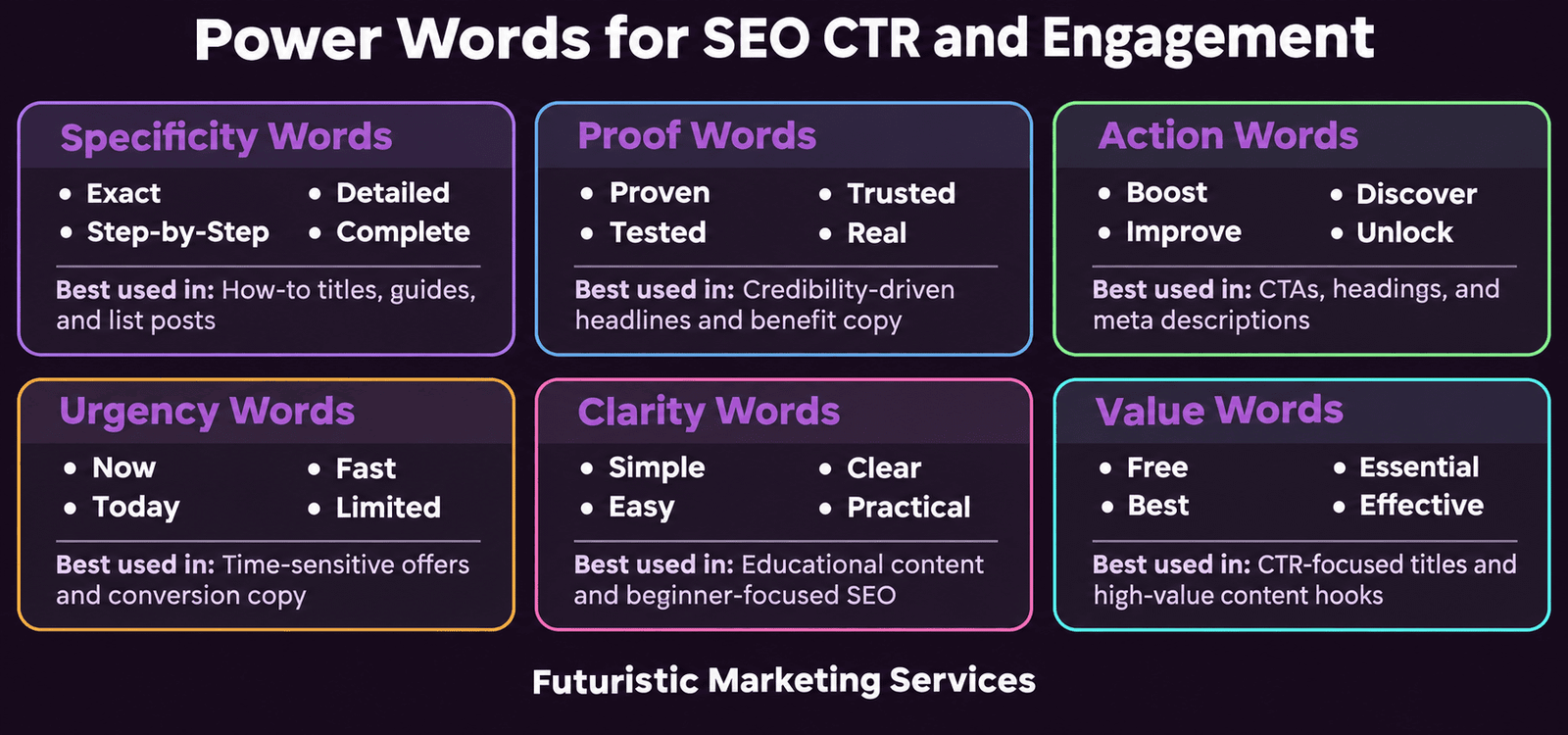
Power words are specific vocabulary choices that trigger a stronger cognitive or emotional response than neutral alternatives, improving click-through rates from search results and reader engagement once on the page. In SEO copywriting, power words are most effective in title tags, meta descriptions, H1 and H2 headings, and CTA button text where they directly influence click decisions.
Power Word CategoryExamplesBest Used InEffect
Specificity wordsComplete, Exact, Specific, Precise, DefinitiveTitle tags and H1, signal comprehensive coverageIncreases CTR by communicating depth over generic coverage
Proof wordsProven, Verified, Research-Backed, Confirmed, According toH2 subheadings and EEAT sectionsStrengthens credibility and E-E-A-T authority signals
Action wordsDiscover, Learn, Master, Build, Implement, AchieveIntroduction and CTA sectionsIncreases perceived value and action motivation
Urgency wordsNow, Today, Immediately, Without DelayCTA text, use sparinglyIncreases conversion rate on transactional CTAs
Clarity wordsStep-by-Step, Simple, Clear, Straightforward, Plain EnglishInformational query headingsReduces perceived effort barrier for the reader
Value wordsFree, Bonus, Save, Exclusive, Results-DrivenMeta descriptions and CTA subtextImproves perceived cost-benefit of clicking or converting
Avoid overusing power words, a page where every heading uses multiple power words creates a pattern that reads as hyperbolic rather than expert. The most effective application is 2 to 3 power words in the title tag, 1 to 2 in each H2 heading, and 1 strong action word in each CTA. The rest of the copy should use precise, specific, active-voice language rather than power word density.

CTA Copywriting That Converts

A call to action is a direct instruction telling the reader what to do next. CTA copy is the most commercially critical writing on any service or product page, the difference between a CTA that converts and one that does not is almost entirely in its specificity, benefit clarity, and friction reduction. Generic CTAs (Contact Us, Learn More, Click Here) consistently convert at significantly lower rates than benefit-specific alternatives because they communicate no value to the reader considering the action.
Four CTA copywriting principles: (1) Benefit-specific rather than action-specific, 'Get Your Free SEO Audit' communicates a benefit; 'Contact Us' communicates only an action. (2) First person rather than second person, 'Start My Free Trial' consistently outperforms 'Start Your Free Trial' in A/B tests because first person creates ownership of the outcome. (3) Low friction language, 'Get Instant Access' produces higher conversion than 'Buy Now' for the same product because it removes the payment friction perception. (4) Intent-matched CTA text, an informational article should end with 'Learn How' or 'Get Expert Guidance', not 'Buy Now', which creates intent mismatch between the content and the CTA.

Want Copy That Ranks in Google and Converts Every Visitor It Earns?

Our SEO copywriters create content that satisfies Google's quality evaluators and persuades human readers simultaneously, benefit-driven headlines, EAV sentence structure, mobile-optimised readability, and conversion-tested CTA copy.

Get SEO Copywriting Done for You

hello@futuristicmarketingservices.com  |  +91 8518024201

Frequently Asked Questions About SEO Copywriting

What is SEO copywriting?

SEO copywriting is the craft of writing website content that satisfies both Google's ranking requirements and human readers' engagement and conversion needs simultaneously. It combines SEO technical requirements (keyword placement, intent matching, heading structure, E-E-A-T signals) with direct-response copywriting techniques (benefit-driven headlines, active voice, scannable formatting, and strategically placed calls to action). Effective SEO copy earns organic rankings and converts the traffic those rankings generate into leads, customers, or subscribers.

What is the EAV writing formula for SEO?

EAV stands for Entity-Attribute-Value, a sentence structure where every statement follows the Subject (Entity) + Verb (Attribute action) + Object (Value) pattern in active voice. For example: 'SEO copywriting improves rankings through keyword placement and E-E-A-T signals' is EAV structure. 'Rankings can be improved through various techniques' is passive and non-EAV. Google's AI systems prefer EAV writing because it is explicit and unambiguous, the entity is clear, the action is specific, and the value or outcome is stated directly.

How long should paragraphs be in SEO content?

Paragraphs in SEO content should be a maximum of 4 lines on any screen size, and ideally 2 to 3 lines for most body copy. This limit is determined by mobile reading behaviour: over 60% of search traffic arrives on mobile devices where long paragraphs are visually overwhelming and cause abandonment before the reader reaches the content's value. According to Nielsen Norman Group, users read only 20 to 28% of web page words on average, short paragraphs help readers extract key information through scanning rather than requiring linear reading.

How do I write a meta description that improves CTR?

Write meta descriptions using three components: the specific benefit the reader gets from the page (not a generic topic description), the primary keyword used once naturally (Google bolds matching terms in results, making your snippet more visually prominent), and a clear action word at the end (Learn how, Discover, Get, Find out, Compare). Keep the description between 140 and 155 characters. Avoid keyword stuffing and generic phrases like "This page covers". Our meta tags guide includes formula templates for every intent type with real examples.

What are power words in SEO copywriting?

Power words are specific vocabulary choices that produce a stronger cognitive or emotional response than neutral alternatives, improving click-through rates in search results and reader engagement on the page. Categories include: specificity words (complete, definitive, exact), proof words (proven, research-backed, confirmed), action words (discover, master, build), and value words (free, exclusive, results-driven). Use power words in title tags, H1 and H2 headings, and CTA text where they directly influence click and conversion decisions. Avoid overuse, 2 to 3 per section prevents the hyperbolic tone that undermines credibility.

How do I write SEO copy that also converts?

Write SEO copy that converts by integrating four direct-response principles into every page: lead with the benefit the reader gets, not the feature you provide; use EAV active-voice sentences that communicate specific outcomes rather than vague capabilities; make every CTA benefit-specific rather than action-only (Get Your Free SEO Audit instead of Contact Us); and match the CTA's intent to the page's search intent, informational pages convert better with soft CTAs (Get Expert Guidance) than hard selling CTAs (Buy Now) that create intent mismatch.

What is the ideal sentence length for SEO copy?

Target a maximum of 25 words per sentence in SEO web copy. Shorter sentences are processed faster and reduce the cognitive load that causes readers to abandon paragraphs mid-way. Vary sentence length within each paragraph, two shorter sentences followed by a slightly longer one creates a natural rhythm that maintains reading momentum. Long sentences consistently over 30 words produce lower readability scores that both human readers and Google's quality evaluation systems associate with lower content quality regardless of the information's accuracy.

How do I improve the readability score of my SEO content?

Improve readability through five specific changes: (1) reduce average sentence length to under 25 words; (2) increase use of active voice, convert passive constructions like 'rankings can be improved' to active 'you can improve rankings'; (3) replace complex Latinate vocabulary with simpler Anglo-Saxon equivalents where clarity is unaffected; (4) add transition words between sentences and paragraphs to maintain logical flow (however, therefore, additionally, as a result); (5) increase use of numbered lists and bullet points for information that is naturally structured as discrete items rather than continuous prose.

Let Our SEO Copywriters Create Content That Earns Rankings and Drives Revenue

At Futuristic Marketing Services, every piece of content combines technical SEO precision with proven copywriting technique, benefit-driven headlines, EAV sentence structure, mobile-optimised formatting, and conversion-tested CTAs that turn organic traffic into measurable business results.

Talk to Our SEO Copywriting Team

hello@futuristicmarketingservices.com  |  +91 8518024201

Conclusion

SEO copywriting is not a compromise between ranking optimisation and human persuasion, it is the synthesis of both. The EAV sentence structure that Google's AI systems prefer is also the clearest, most direct writing style for human readers. The three-part introduction that captures featured snippets also retains readers by immediately delivering the answer they searched for. The scannable formatting that reduces bounce rates also makes copy easier for Google to crawl and extract key information from.
Apply the EAV formula, the three-part introduction, mobile-optimised paragraph lengths, benefit-specific power words, and intent-matched CTA copy as standard disciplines in every piece of content you produce. Combine these copywriting principles with the complete content structure framework from our how to write SEO blog posts guide, the technical on-page requirements from our on-page SEO guide, and the intent analysis process from our search intent guide for content that consistently satisfies both ranking algorithms and human readers simultaneously.
Share this post :
Picture of Devyansh Tripathi
Devyansh Tripathi

Devyansh Tripathi is a digital marketing strategist with over 5 years of hands-on experience in helping brands achieve growth through tailored, data-driven marketing solutions. With a deep understanding of SEO, content strategy, and social media dynamics, Devyansh specializes in creating results-oriented campaigns that drive both brand awareness and conversion.

All Posts