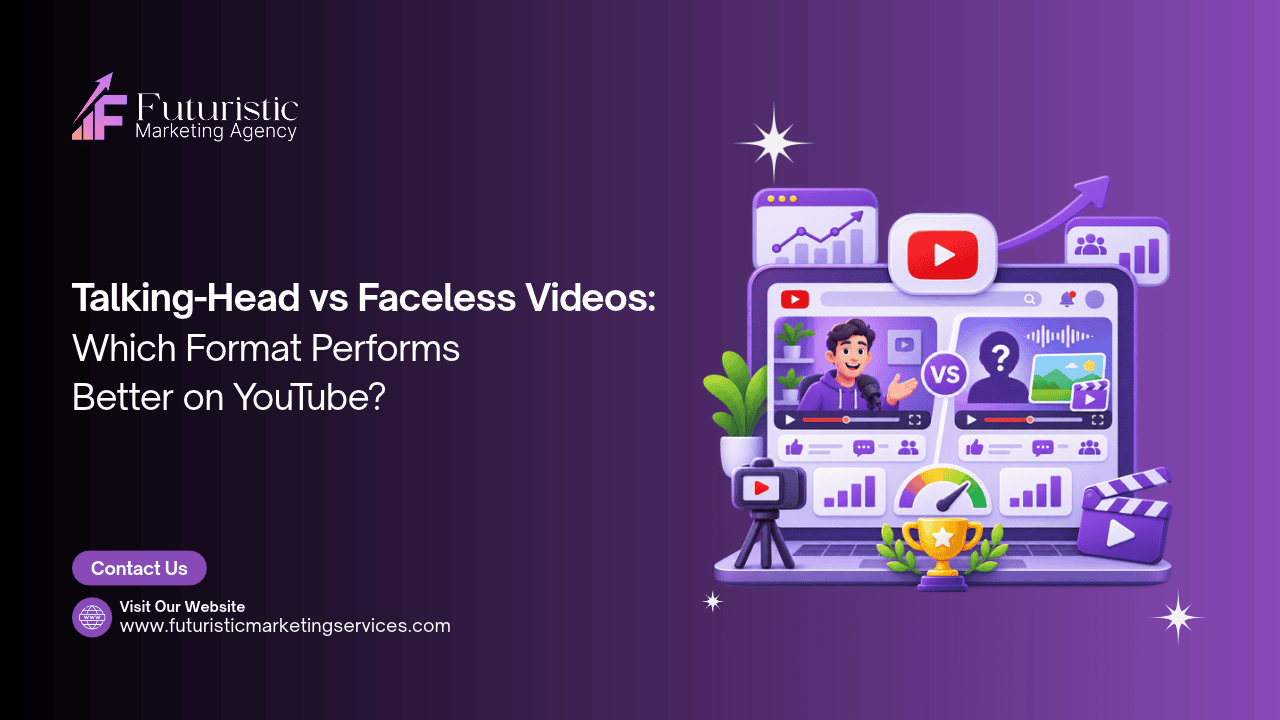
Talking-Head vs Faceless Videos: Which Format Performs Better on YouTube?

talking head vs faceless YouTube

The choice between talking-head and faceless video is one of the most consequential content strategy decisions a YouTube channel makes — and it is rarely reversible without significant audience disruption. Channels that launch as talking-head presenter formats build audience relationships around the creator’s personality and on-camera presence; switching to faceless content typically feels to the existing audience like the creator has been replaced. Channels that launch as faceless formats build audiences around the topic or niche; introducing a presenter face mid-journey can create the same friction in reverse.

The performance comparison between the two formats is nuanced: neither is unconditionally better. Each excels in specific contexts, specific niches, and specific commercial objectives. This guide provides the complete data-driven comparison across the eight dimensions that matter most for channel success -- growth rate, monetisation, audience retention, content scalability, editing requirements, cost, brand flexibility, and long-term channel value. For the professional editing services specific to each format, the talking-head video editing service guide and the faceless YouTube channel guide cover the respective production standards in detail.

Key Takeaways

  • Neither talking-head nor faceless format is unconditionally better -- each excels in specific niches and commercial contexts, and the choice should be driven by the creator's goals, resources, and the specific niche rather than by assumptions about which format performs better generically
  • Talking-head channels build faster initial subscriber loyalty because the parasocial relationship with the presenter creates emotional attachment that faceless content cannot replicate -- subscribers return for the person as much as the content
  • Faceless channels scale more efficiently because content production is not dependent on the creator's on-camera time and energy -- a faceless channel can publish daily using AI narration and stock or AI-generated footage without any filming sessions
  • Monetisation RPM is higher per view in the same niche for faceless channels in premium categories (finance, business, science) because the algorithmic audience tends to be more intent-driven and less personality-driven
  • According to VidIQ research, talking-head channels in personal niches (lifestyle, vlogging, commentary) grow faster because personal brand content earns higher subscriber conversion rates from recommendations; faceless channels in information niches grow faster because they earn stronger search rankings for specific informational queries
  • The hybrid approach -- a branded channel with both a host presence and faceless content -- is the most commercially flexible model but requires higher production capacity than either pure format

Want Professional Editing for Your Chosen YouTube Format?

Futuristic Marketing Services edits both talking-head presenter content and faceless channel content -- with the format-specific retention engineering, visual standard, and production quality that each requires.

Get Format-Specific Editing

The Core Difference: What Each Format Uses for Retention

The fundamental difference between talking-head and faceless YouTube is the primary tool each format uses to maintain viewer retention. In a talking-head channel, viewer retention is primarily carried by the presenter: their energy, personality, delivery style, and parasocial relationship with the audience create engagement that transcends the specific content of any single video. A charismatic talking-head presenter can hold audience attention through content that is moderately interesting; a faceless channel with the same content must work significantly harder through editing to achieve the same retention outcome.
In a faceless channel, viewer retention is carried entirely by the edit: pacing, visual variety, B-roll selection, music energy, and information density must compensate for the absence of presenter energy at every moment in the video. This is not a disadvantage of faceless content -- it is a different editorial discipline that, when applied well, produces content that performs comparably to or better than talking-head content in information-driven niches where audiences are primarily motivated by the topic rather than the creator.

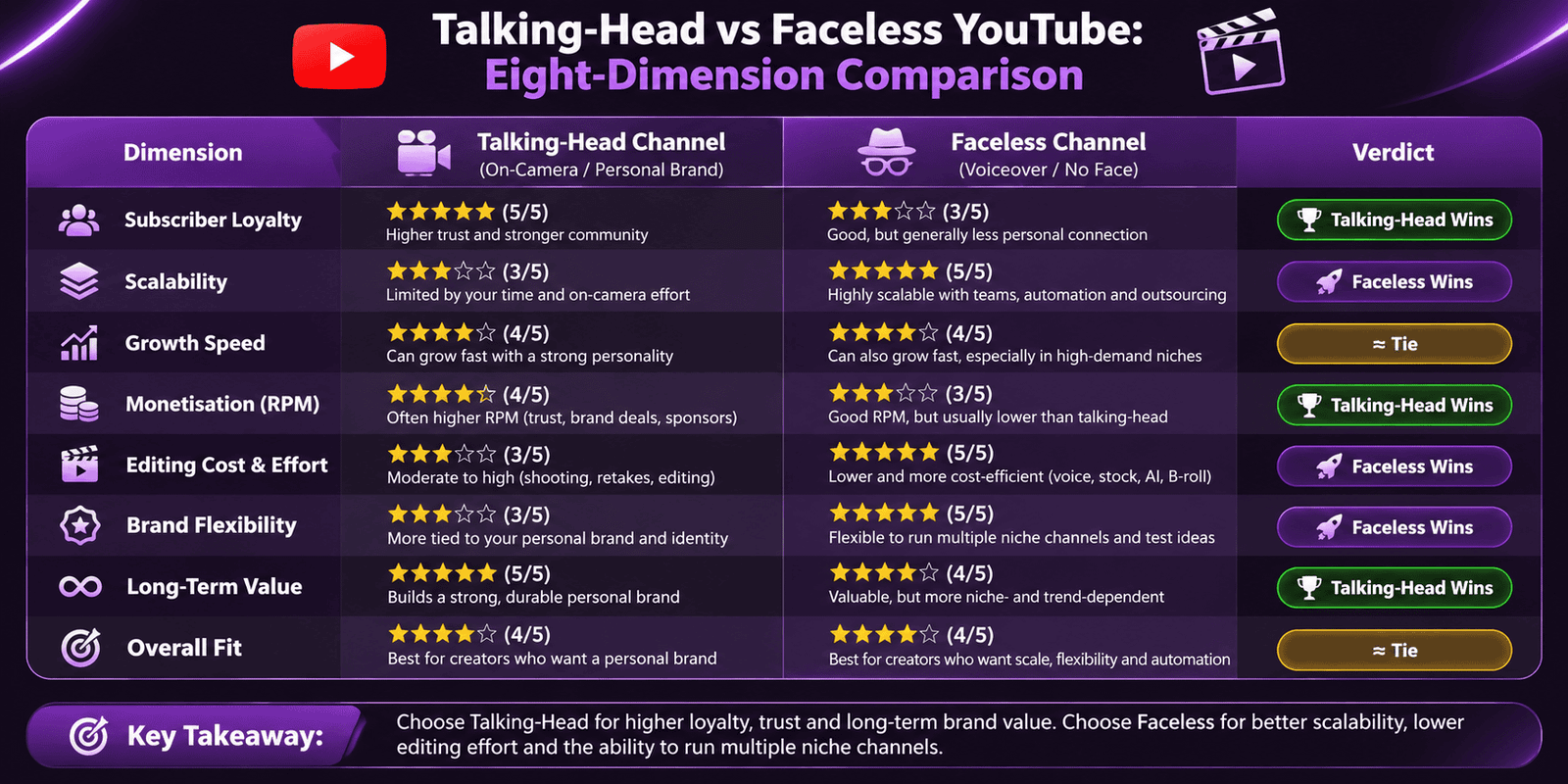
Head-to-Head Comparison: Eight Dimensions

DimensionTalking-HeadFacelessVerdict
Initial subscriber loyaltyHigh -- parasocial bond with presenterModerate -- topic loyalty, not personal loyaltyTalking-head wins
Content scalabilityLimited -- requires presenter filming timeHigh -- AI narration enables daily publishingFaceless wins
Growth speed (personality niches)Faster -- recommendations drive personal brandSlower -- requires search authority firstTalking-head wins
Growth speed (information niches)Slower -- competing with established search contentFaster -- consistent search ranking builds compounding trafficFaceless wins
Monetisation RPM (same niche)Moderate -- audience loyalty not intentHigher -- intent-driven search audienceFaceless wins (in premium niches)
Editing cost per episodeLower -- less B-roll sourcing requiredHigher -- visual variety sourcing adds costTalking-head wins
Brand flexibilityLower -- tied to presenter identityHigher -- brand separate from individualFaceless wins
Long-term channel value (sellable)Moderate -- tied to presenterHigher -- brand can continue without creatorFaceless wins

When Talking-Head Wins: The Right Contexts

Personality-driven niches: Lifestyle, vlogging, personal finance advice, commentary, opinion, comedy, and any niche where the audience's connection to the creator is a primary component of the value proposition. In these niches, the talking-head format is not just a production choice -- it is a content category requirement. Faceless content in a personal lifestyle niche does not make sense because the personal element is the product.
High-engagement community building: Channels where the creator wants to build a genuine community around shared identity -- a fitness channel where the creator embodies the lifestyle they are promoting, a business channel where the creator's own entrepreneurial journey is part of the content -- benefit from the parasocial depth that talking-head format enables and faceless format cannot replicate.
Brand-dependent business channels: When the channel is directly associated with a specific business owner or professional expert -- a marketing consultant, a financial advisor, a lawyer explaining their specialism -- the talking-head format is commercially essential because the audience is evaluating the person as much as the information. The talking-head video editing service guide covers the production standard for professional expert talking-head content.

When Faceless Wins: The Right Contexts

Information-driven niches with high search volume: Finance, science, history, technology, business education -- niches where the audience searches for specific information rather than for specific creators -- are the natural home of faceless YouTube channels. In these niches, search ranking rather than recommendation reach is the primary discovery mechanism, and faceless content's ability to scale publishing volume gives it a structural advantage in building the search-visible content library that dominates these categories.
Channels intended as business assets: A faceless channel is a brand asset that can continue operating after the creator steps back, can be managed by a team without the creator's involvement, and can be sold to a buyer who wants the audience and authority but not the creator. A talking-head channel is tied to the presenter's identity in a way that makes it less valuable as a transferable asset. The faceless channel model is therefore more appropriate when the channel is conceived as a scalable business rather than a personal platform.
Privacy-conscious creators: The fastest-growing segment of faceless channels is creators who have valuable knowledge and a willingness to publish consistently but who do not want to appear on camera for personal or professional privacy reasons. The faceless format enables these creators to build commercially significant YouTube channels without any on-camera presence, using AI narration or a separate voice talent to deliver their content anonymously. For the complete framework, the faceless AI YouTube channel guide covers the full production approach.

The Hybrid Model: Getting the Best of Both

The most commercially flexible YouTube channel model combines elements of both formats. The presenter appears on camera for high-personal-engagement content -- Q&A sessions, community updates, behind-the-scenes content, opinion pieces -- while faceless or lightly-branded content handles the high-volume informational publishing that builds search authority and drives evergreen traffic. This model requires higher production capacity than either pure format but produces a channel that benefits from both the parasocial depth of talking-head content and the scalability and search authority of faceless content.

Need Editing for Both Talking-Head and Faceless Content on Your Channel?

Futuristic Marketing Services edits both format types -- talking-head retention engineering and faceless B-roll pacing -- producing consistent channel quality across your entire content mix.

Build Your Hybrid Channel

Frequently Asked Questions

Can a faceless channel be as successful as a talking-head channel in the same niche?

Yes -- and in many information-driven niches, faceless channels significantly outperform talking-head channels at equivalent content quality levels because they can publish more consistently (no filming dependency), rank more strongly for search terms (topic authority without personality noise), and scale more efficiently (AI narration removes the production bottleneck). According to Social Blade income data, the top-earning faceless channels in finance and science niches earn comparable or higher income than top-performing talking-head channels in the same categories at equivalent view counts.

Is it possible to switch from talking-head to faceless format mid-channel?

Switching formats mid-channel is possible but carries a real risk of audience disruption. The existing subscriber base subscribed for the talking-head format and may not engage with faceless content at the same rate, which can depress the algorithmic profile of the first faceless videos. The cleanest approach is to launch a separate channel for the faceless content while gradually reducing the publishing frequency of the talking-head channel, allowing the faceless channel to build its own algorithmic profile independently.

Which format has lower production cost?

Talking-head content has lower editorial production cost per episode (less B-roll sourcing, less visual variety management) but higher recording overhead (filming setup, lighting, presenter preparation time). Faceless content has higher editorial production cost (B-roll selection, music management, visual pacing decisions) but near-zero recording overhead when using AI narration. At equivalent publishing volumes, the total production cost including editing is approximately equivalent for both formats -- the cost structure differs but the total is similar.

Get Professional YouTube Editing for Your Format -- Talking-Head or Faceless

Futuristic Marketing Services edits talking-head presenter videos and faceless channel content to the professional retention engineering standard that grows YouTube channels in either format.

Start Your Channel Editing

Conclusion

The talking-head versus faceless YouTube debate does not have a universal answer -- it has a context-dependent answer that depends on the niche, the creator's goals, and the commercial objectives of the channel. Talking-head wins in personality niches, community building, and expert personal brand contexts. Faceless wins in information niches, scalable business channel models, and high-volume search authority building. The hybrid approach provides the most flexibility but requires the highest production capacity.
For the professional editing services that serve each format, the talking-head video editing service guide and the faceless YouTube video editing service guide cover the respective production standards in full detail.
Share this post :
Picture of Devyansh Tripathi
Devyansh Tripathi

Devyansh Tripathi is a digital marketing strategist with over 5 years of hands-on experience in helping brands achieve growth through tailored, data-driven marketing solutions. With a deep understanding of SEO, content strategy, and social media dynamics, Devyansh specializes in creating results-oriented campaigns that drive both brand awareness and conversion.

All Posts