SEO Strategy: The Complete Guide to Building a Winning Organic Growth Plan in 2026

seo strategy

An SEO strategy is a documented plan that coordinates every organic search activity, keyword research, content creation, technical optimisation, link building, and performance measurement, into a single coherent programme designed to achieve specific organic traffic and revenue goals. Without a strategy, SEO activity is fragmented, often duplicated, and impossible to optimise because there is no defined baseline against which to measure improvement.

This guide covers the complete SEO strategy framework for 2026: how to audit your starting position, build a keyword map and topical authority architecture, set realistic 3 and 12 month goals, plan your content production schedule, build your technical SEO foundation, develop your link acquisition approach, integrate AI search and E-E-A-T requirements, and establish the measurement framework that turns monthly data into ongoing strategic decisions. Use this alongside our SEO audit guide, keyword research guide, and SEO content strategy guide as the operational guides for each component.

Key Takeaways

  • According to BrightEdge, organic search drives 53.3% of all website traffic globally, making a well-executed SEO strategy the highest-volume digital marketing investment available
  • According to Ahrefs, sites with a documented SEO strategy produce 3x more organic growth than those publishing content without a strategic framework guiding decisions
  • An SEO strategy has six core components: competitive audit, keyword and topical map, technical foundation, content plan, link building programme, and measurement framework, each must be present for the strategy to compound
  • Realistic SEO timelines: months 1 to 3 are foundation and early content; months 4 to 9 are growth and ranking emergence; months 10 to 18 are compounding returns and authority consolidation
  • The most common SEO strategy failure is beginning content production without completing the technical foundation, content published to a site with crawl errors, poor Core Web Vitals, or missing canonicals underperforms regardless of quality
  • Every SEO strategy must now account for AI search visibility, Google AI Overviews, ChatGPT, and Perplexity citation eligibility require entity signals and structured content formats in addition to traditional ranking factors

Want a Complete SEO Strategy Built Specifically for Your Business?

Futuristic Marketing Services builds bespoke SEO strategies, from competitive audit and keyword mapping to content roadmaps and link acquisition plans, that produce consistent, compounding organic growth measured against clear 90-day milestones.

Get Your SEO Strategy Built

hello@futuristicmarketingservices.com  |  +91 8518024201
Step 1, Conduct Your Starting Position Audit

Before building a forward-looking strategy, you need a clear picture of your starting position. The audit establishes four baselines: your current domain authority relative to competitors targeting your keywords, the technical health of your site (crawl errors, Core Web Vitals, indexation status), your existing organic rankings and traffic by keyword, and the content gaps between what you currently publish and what your audience is searching for. Our SEO audit guide covers the complete five-phase audit process.
Audit ComponentToolWhat to EstablishTime Required
Domain authority baselineAhrefs Site ExplorerYour current DR vs top 3 competitors for primary keywords30 minutes
Technical healthScreaming Frog + GSC Coverage reportCrawl errors, indexation failures, CWV field data status, mobile usability errors60 to 90 minutes
Organic ranking baselineGSC Performance + Ahrefs rank trackerCurrent positions for top 50 target keywords; traffic by page45 minutes
Content gap analysisAhrefs Content Gap toolTopics competitors rank for that you do not cover yet30 minutes
Backlink baselineAhrefs Site Explorer > BacklinksDR, referring domains, anchor text distribution, toxic link presence30 minutes

Step 2, Build Your Keyword Map and Topical Authority Architecture

The keyword map is the strategic skeleton of your entire content programme. It assigns one primary keyword to every existing and planned page on your site, organised into the topical cluster architecture that earns comprehensive authority across your core subject area. Every content decision, what to write next, how long it should be, what format to use, flows directly from the keyword map.
Build your keyword map in four stages: define your core topic (the single broadest subject your site covers), identify 8 to 12 subtopic pillars (the major categories within your core topic), discover all cluster article keywords within each subtopic (specific questions, comparisons, and processes your audience searches), and assign priority scores based on volume, keyword difficulty, and commercial relevance. Our keyword research guide covers the complete research process, and our topical authority guide covers how to organise discoveries into the cluster architecture that signals comprehensive expertise to Google.

Step 3, Establish Your Technical SEO Foundation

Technical SEO must be addressed before content investment begins in earnest. Content published to a site with crawl errors, poor Core Web Vitals, missing canonical tags, or mobile usability failures underperforms its potential regardless of how strong the content itself is. The technical foundation is not optional background work, it is the infrastructure that allows every subsequent content and link building action to produce its maximum ranking return.
The technical foundation checklist for any new or refreshed SEO strategy: all pages reachable in 3 clicks or fewer from the homepage, every important page indexed (verified in GSC Coverage report), HTTPS active with 301 redirects from HTTP variants, Core Web Vitals field data Good or Needs Improvement across all key page templates, mobile usability report showing zero errors, XML sitemap current and submitted in GSC, canonical tags on every page including self-referencing canonicals, and schema markup implemented for Article, FAQPage, and Organization types as a minimum. Address every item on this checklist before the content production phase begins.

Step 4, Build Your Content Production Plan

The content plan translates your keyword map into a scheduled production programme. It specifies what content to produce, in what order, at what frequency, and to what quality standard. Content is the primary mechanism through which your keyword map is executed and through which topical authority is built, without a production plan, your keyword map remains an aspirational list rather than a compounding authority asset.
Structure your production plan around topical cluster batches: produce all articles within a subtopic cluster before moving to the next cluster. This batch approach builds concentrated topical authority faster than spreading production randomly across unrelated topics. Set a publication frequency appropriate to your resources and current authority level: 4 articles per month as the minimum for any active SEO programme, 8 to 12 for growth-stage sites, and 16 or more for established sites with dedicated content teams. Our SEO content strategy guide covers the complete content calendar framework including quality standards and content type selection for each intent type.

Step 5, Develop Your Link Building Programme

Link building is the off-page component of your SEO strategy that determines how quickly your content earns competitive rankings against established competitors. Without systematic link acquisition, excellent content in competitive niches may take years to reach page one because competitor domain authority outweighs content quality as a ranking differentiator.
Design your link building programme around two tracks: earned link creation (producing content assets, original research, comprehensive guides, free tools, that attract links naturally over time) and proactive acquisition (outreach, digital PR, and HARO response programmes that actively accelerate link earning beyond what passive content publication produces). Set a monthly referring domain target based on competitor analysis: if your top-3 competitors for primary keywords average DR 45, and you are DR 25, you need a sustained acquisition programme adding 5 to 10 quality referring domains per month to close the gap within 12 to 18 months. Our link building guide covers the full acquisition programme including the seven highest-ROI tactics.

Step 6, Integrate AI Search and E-E-A-T Requirements

An SEO strategy in 2026 must account for two dimensions that did not exist in earlier SEO planning frameworks: AI search visibility and explicit E-E-A-T compliance. AI search visibility, appearing in Google AI Overviews, ChatGPT search citations, and Perplexity answers, now represents a meaningful share of total search impressions for many queries and requires specific content formatting and entity signals beyond traditional ranking optimisation.
Integrate E-E-A-T requirements into your strategy through three structural decisions: (1) every article must have a named author with a bio page and verifiable credentials; (2) every factual claim must be attributed to a primary source with an inline hyperlink; (3) Organization schema with complete sameAs links must be present on the homepage to establish brand entity recognition for AI citation systems. Our eeat guide covers the complete E-E-A-T implementation framework including author entity establishment, citation standards, and the AI citation content formats that maximise Overview inclusion probability.

Step 7, Set Goals and Measurement Framework

An SEO strategy without a measurement framework is an activity list, not a growth programme. Set specific, time-bound goals for three horizons: 90-day foundation goals (technical audit complete, keyword map built, first cluster of 5 articles published), 6-month growth goals (target keywords in positions 11 to 30, 20% increase in organic impressions from GSC baseline), and 12-month authority goals (target keywords reaching top 10, 50% increase in organic sessions from GA4 baseline, DR improvement of 5 to 10 points).
Monthly measurement dashboard using Google Search Console and GA4: total organic impressions trend (site-wide visibility growth), keywords in positions 1 to 10 count (authority metric), organic sessions by landing page (traffic conversion from rankings), average position for top 50 target keywords (ranking progress across the keyword map), and Core Web Vitals field data classification percentage (technical health maintenance). Review these five metrics monthly and use the data to make the strategic adjustments, prioritising different keyword clusters, accelerating link building for specific pages, or refreshing underperforming content, that keep the programme on its growth trajectory.

Ready to Build the SEO Strategy That Drives Consistent Organic Growth?

Our SEO strategists build complete, documented organic growth programmes, from competitive audit and keyword architecture to content roadmaps, link building plans, and monthly measurement dashboards, tailored to your specific business goals and timeline.

Start Building Your SEO Strategy

hello@futuristicmarketingservices.com  |  +91 8518024201

Frequently Asked Questions About SEO Strategy

What is an SEO strategy?

An SEO strategy is a documented plan that coordinates every organic search activity, keyword research, content creation, technical optimisation, link building, E-E-A-T compliance, and performance measurement, into a single coherent programme designed to achieve specific organic traffic goals. Without a documented strategy, SEO activity is fragmented and impossible to optimise because there is no defined direction or baseline against which to measure improvement. According to Ahrefs, sites with documented strategies produce 3x more organic growth than those publishing without one.

How long does it take for an SEO strategy to show results?

A well-executed SEO strategy typically shows early results within 4 to 6 months: lower-competition keywords entering page-one rankings, organic impressions growing in GSC, and initial referring domains appearing in your backlink profile. Significant competitive keyword rankings typically emerge between months 6 and 12. The compounding growth phase, where authority built in earlier months accelerates the impact of new content, becomes most visible from month 12 onwards. New domains in highly competitive niches may need 18 to 24 months for primary keyword rankings.

What are the most important elements of an SEO strategy?

The six most important elements of an SEO strategy are: (1) a keyword map assigning one primary keyword to every planned page, (2) a topical authority cluster architecture organising content into interconnected subject groups, (3) a solid technical foundation with zero crawl errors and Good Core Web Vitals field data, (4) a consistent content production schedule publishing minimum 4 articles per month, (5) a proactive link building programme targeting 5 to 10 new referring domains per month for competitive niches, and (6) a monthly measurement framework tracking impressions, rankings, and session growth against defined goals.

How do I build an SEO strategy for a new website?

For a new website SEO strategy: start with a technical foundation audit (ensure all basic technical requirements are met before any content investment), build a keyword map targeting low-competition long-tail keywords appropriate for a new domain with no authority (KD under 15 using Ahrefs), create your first topical cluster of 5 to 8 interlinked articles before publishing any other content, build the internal linking architecture that connects your cluster articles to each other and to your primary service or conversion page, and launch a basic link building programme through HARO responses and broken link building to begin earning authority during the content build phase.

What is the difference between SEO strategy and SEO tactics?

SEO strategy is the overarching plan that defines goals, priorities, resource allocation, and the sequence of activities across a 6 to 18 month horizon. SEO tactics are the specific actions executed within the strategy, writing a title tag, building a backlink, fixing a crawl error. Strategy answers the question of what to prioritise and why. Tactics answer the question of how to execute specific tasks. Most SEO programmes fail not because of poor tactics but because tactics are executed without a strategic framework determining which actions produce the greatest impact for the specific site's current authority level and competitive position.

How much does an SEO strategy cost?

SEO strategy costs range significantly based on the scope and execution model. A professionally developed strategy document (competitive audit, keyword map, topical architecture, content plan, link building programme) typically costs Rs 25,000 to Rs 1,00,000. A fully managed monthly SEO programme executing the strategy costs Rs 25,000 to Rs 1,50,000 per month for an established agency. DIY strategy implementation using the framework in this guide plus Ahrefs (approximately Rs 8,000 per month) and Screaming Frog (approximately Rs 15,000 per year) is viable for sites in low to medium competition niches with internal content production capacity.

How do I prioritise SEO activities within my strategy?

Prioritise SEO activities using an impact-versus-effort matrix: critical technical blocking issues first regardless of effort (crawl errors, noindex mistakes, Core Web Vitals Poor classifications), then high-impact low-effort wins (missing title tags, meta descriptions, internal links to commercial pages), then medium-impact ongoing work (new cluster content production, link building outreach), then low-impact refinements (minor on-page tweaks, social sharing optimisation). Never invest heavily in content production before the technical foundation is solid, content published to a technically broken site consistently underperforms its potential.

What SEO metrics should I track monthly?

Track five metrics monthly using Google Search Console and GA4: (1) total organic impressions trend from GSC (site-wide visibility growth signal), (2) total keywords in positions 1 to 10 (authority accumulation metric), (3) organic sessions by landing page from GA4 (traffic conversion from rankings), (4) average position trend for your top 50 target keywords in Ahrefs rank tracker (ranking progress across keyword map), and (5) Core Web Vitals field data Good classification percentage in GSC (technical health maintenance). These five metrics together provide a complete, actionable picture of strategic progress.

Build the SEO Strategy That Compounds Traffic Month After Month

At Futuristic Marketing Services, we build complete documented SEO strategies, keyword architecture, content roadmap, technical foundation plan, link building programme, and monthly measurement dashboard, all aligned to your specific competitive position and business goals.

Talk to Our SEO Strategy Team

hello@futuristicmarketingservices.com  |  +91 8518024201

Conclusion

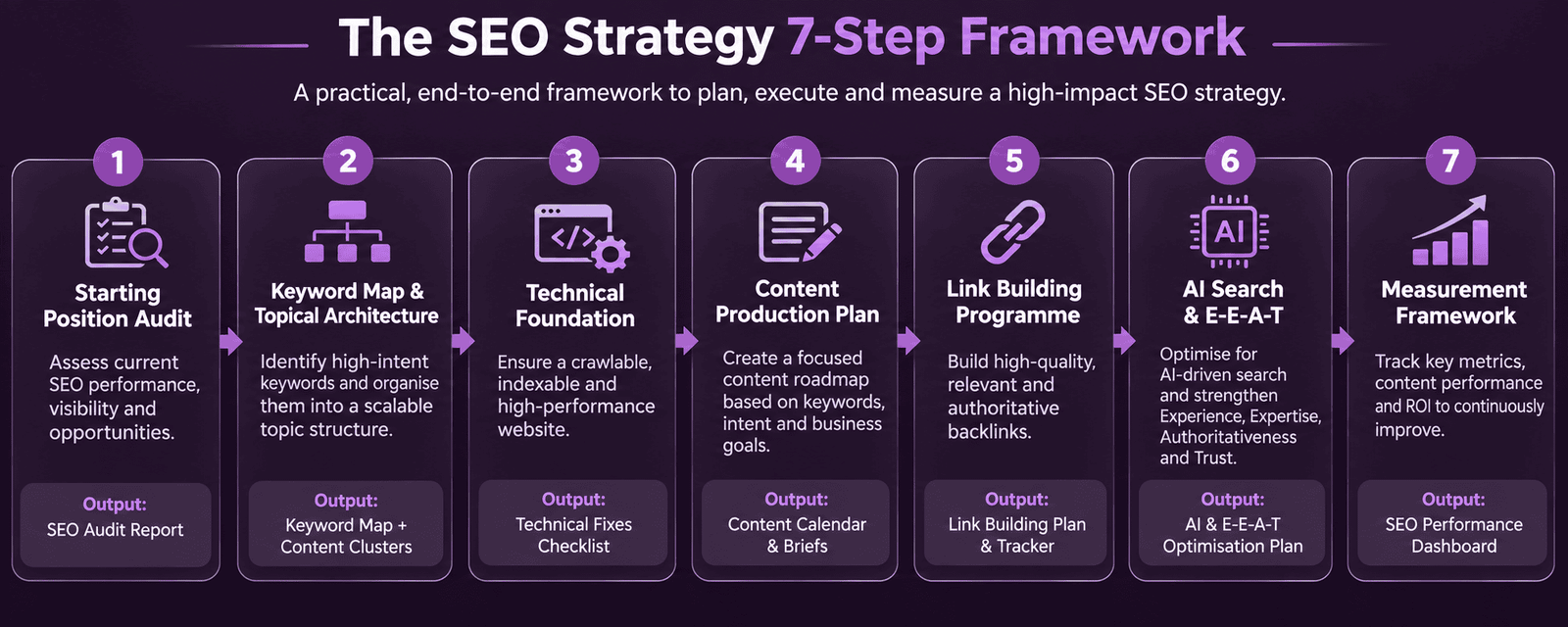
An SEO strategy is what transforms individual SEO activities from a collection of disconnected tasks into a coordinated growth programme that compounds over time. The seven-step framework, starting position audit, keyword map and topical architecture, technical foundation, content production plan, link building programme, AI search and E-E-A-T integration, and measurement framework, provides the complete structure every effective SEO programme requires regardless of industry, site size, or budget level.
Start by completing the starting position audit to establish your baseline. Build the keyword map using our keyword research guide before writing a single piece of content. Fix all technical issues identified in the SEO audit guide before investing in content production at scale. Then execute the content and link building programmes in parallel, measuring monthly against defined goals and using the data to refine priorities. The compound effect of this systematic approach becomes most visible in months 10 to 18 when content published in the first quarter begins to earn authority that accelerates everything produced thereafter.
Share this post :
Picture of Devyansh Tripathi
Devyansh Tripathi

Devyansh Tripathi is a digital marketing strategist with over 5 years of hands-on experience in helping brands achieve growth through tailored, data-driven marketing solutions. With a deep understanding of SEO, content strategy, and social media dynamics, Devyansh specializes in creating results-oriented campaigns that drive both brand awareness and conversion.

All Posts