How to Use Facebook Groups for Business: Complete Strategy Guide

Facebook Groups for business

Facebook Groups for business work by creating a niche community around a topic genuinely valuable to the target audience, publishing a mix of educational content, discussions, and member resources that generates the high-intent engagement the platform rewards, and converting engaged Group members into Business Page followers and paying customers through consistently demonstrated expertise rather than direct promotional posting.

This guide covers the complete strategy for using Facebook Groups for business, including the critical difference between Groups and Pages and why Groups are the only Facebook surface still delivering meaningful organic reach, how to decide whether to create a Group or join and participate in existing ones, the step-by-step setup process for a new business Group, the content strategy that builds a genuinely engaged community rather than a promotional channel that members quickly disengage from, how to generate leads from Group activity without triggering the spam responses that remove the business from the community, and the most common Group management mistakes that produce inactive Groups despite significant initial setup effort.

Key Takeaways

  • Facebook Groups maintain organic reach of 20% to 40% of members per post, compared to 1% to 6% for standard Business Pages, according to FB Group Bulk Poster's 2026 organic reach analysis, making Groups the single most powerful free distribution channel remaining on Facebook.
  • A post in an active 10,000-member Group reaches 2,000 to 4,000 people organically. The same post published to a Business Page with 10,000 followers reaches only 100 to 600 people, a 6x to 20x reach advantage in favor of Groups.
  • Over 1.8 billion people use Facebook Groups monthly, according to SocialPilot's 2026 Facebook statistics, making Groups one of the most active community surfaces on any social platform.
  • Brands using Facebook Groups experience 30% higher organic engagement compared to Page-only marketing strategies, reflecting both the higher reach and the higher-intent audience that self-selects into Group membership.
  • Joining a Group is a high-intent opt-in from members. They are actively choosing to receive content from the Group, creating a qualitatively different audience relationship than passive page following.
  • Private Groups are recommended for most businesses because they create the sense of trust, exclusivity, and higher-quality discussion that generates the meaningful conversations the algorithm rewards with its most favorable organic distribution.
  • The Facebook algorithm views Group content as high-trust, high-intent signals, giving Group posts a reach advantage that neither page posts nor paid advertising can fully replicate through the same mechanism.

Want to Build a Facebook Community That Generates Business?

We Build and Manage Facebook Groups as Part of Your Complete Marketing Strategy

Futuristic Marketing Services creates and manages Facebook Groups for businesses across India, building engaged communities that generate organic reach, brand authority, and qualified leads every single month.

Get Your Free Facebook Strategy Session
Facebook Groups vs Facebook Pages: Why Groups Win on Organic Reach

Facebook Business Pages and Facebook Groups serve fundamentally different functions in a complete Facebook marketing strategy, and understanding the difference between them is the foundation for using each one effectively. A Business Page is the public commercial identity of a brand, the place where advertising is managed, analytics are accessed, WhatsApp Business is integrated, and the professional first impression is controlled. A Group is a community space where people with shared interests gather to share information, ask questions, and build relationships, and where content reaches a dramatically larger proportion of members than any page post reaches followers.
The most important practical difference is organic reach. According to FB Group Bulk Poster's 2026 organic reach research, Facebook Business Page posts average 1% to 6% organic reach. Facebook Group posts maintain 20% to 40% reach among members. This difference reflects Facebook's deliberate algorithmic strategy: the platform wants to foster genuine community engagement and treats Group content as high-trust, high-intent interactions that deserve wider distribution. A 10,000-member Group post reaching 2,000 to 4,000 people produces 6x to 20x more visibility per post than a Business Page post to the same number of followers, making the reach advantage of Groups one of the most significant opportunities in Facebook marketing that most businesses have yet to fully capitalize on.

What Facebook Groups Deliver That Pages Cannot

Facebook Groups deliver three things that Business Pages cannot replicate regardless of how well the page is optimized or how actively it posts. The first is genuine community belonging. When a member joins a Group around a topic they care about, they are making an active choice to be part of a community, a qualitatively different relationship from the passive act of following a business page. Sprout Social's Facebook Group marketing guide describes this as a "high-intent opt-in," where members are actively choosing to receive content and engage with the brand in a way that creates the kind of community loyalty that page following simply does not generate.
The second is algorithmic favorability. The Facebook algorithm views activity inside Groups as high-trust, high-intent signals because Group conversations are among the most genuinely interactive content on the platform, members are not passively scrolling past but actively participating in discussions relevant to their interests and professional challenges. This algorithmic view produces the 20% to 40% reach rate that makes Groups so commercially valuable. The third is lead quality. Members who convert from Group participation into business enquiries have already spent time observing the business's expertise, values, and communication style through Group interactions, making them significantly more pre-qualified than cold leads generated through advertising or standard page content.

Should You Create a Group or Join Existing Ones First?

Most businesses benefit from pursuing both approaches in parallel, starting with participation in existing Groups while building a new Group simultaneously. Participating actively in existing, established Groups relevant to the target audience provides immediate visibility and community engagement from Day 1 without requiring the member recruitment effort that a new Group demands. Providing genuinely helpful answers, sharing expert perspectives, and contributing valuable resources in existing Groups builds the personal and business brand reputation that motivates Group members to visit the Business Page and follow it, generating warm, high-quality followers from an already-engaged community without any direct promotional effort.
Creating a new Group is a longer-term investment that takes three to six months to build sufficient membership and engagement for the community dynamic to become genuinely valuable. However, the business that creates and owns a Group holds a strategic position that participating in other Groups cannot replicate: it controls the content environment, the Group rules, the membership questions that screen for target customer profile alignment, and the conversation topics that naturally position the business's expertise at the centre of the community. Both approaches should be part of the complete Facebook marketing strategy, participation in existing Groups for immediate reach and the owned Group for long-term community authority.

How to Create and Set Up a Facebook Group for Business

Creating a Facebook Group that genuinely serves its target audience and grows into a commercially valuable community requires careful decisions at the setup stage that shape every aspect of the Group's subsequent performance. The setup decisions covered below affect who joins, how active the Group becomes, how the algorithm distributes Group content, and how effectively the Group converts member relationships into business outcomes.

Naming the Group and Choosing the Right Privacy Setting

The Group name is the primary searchability and first-impression element of the Group's public profile. The most effective Group names for business purposes describe the community's topic and audience rather than the business's name, because people search for communities around their interests and challenges, not around specific brand names. A social media marketing agency naming their Group "Social Media Marketing for Indian Small Businesses" attracts members who are searching for that community, while naming it "Futuristic Marketing Community" would attract far fewer organic joiners because no one is searching for a community built around an agency's brand name.
The privacy setting determines who can see the Group's content and who can join. According to Sprout Social's Group marketing guidance, Private with Visible status is the recommended setting for most business Groups. This means the Group appears in search results so it can be discovered organically, but only members can see the posts, creating the sense of exclusive access that motivates joining and the trust environment that produces the genuine, substantive conversations the algorithm rewards. Public Groups maximize reach and discoverability but tend to attract lower-quality membership and more spam, reducing the quality of community interactions. Hidden Groups are appropriate only for existing customer communities or VIP member groups where discovery through search is not the goal.

Writing the Group Description and Setting Rules

The Group description is optimized for two audiences simultaneously: the Facebook search algorithm and the potential members who read it before deciding whether to join. For the algorithm, include the primary keywords that describe the Group's topic and the audience it serves, these keywords help the Group surface in Facebook's search results when users look for communities relevant to those terms. For potential members, the description must clearly and specifically answer three questions: who this Group is for, what members will get from participating, and what the expected community culture and engagement style is.
Set five to seven Group rules that establish the community standards the business intends to maintain. The most important rules for a business-managed Group are: no self-promotion or advertising without prior approval from admins, constructive discussion only with personal attacks and disrespect prohibited, relevant content only with off-topic posts removed, member responsibility for fact-checking before sharing information, and a clear process for members to ask for business-specific help. These rules signal to potential members that the Group is a managed, quality community rather than an open forum susceptible to spam and low-quality content, and they protect the admin from the content moderation burden that permissive rule sets create as Group membership scales.

Setting Up Membership Questions to Screen for Target Audience

Facebook Groups allow admins to set up to three mandatory questions that potential members must answer before their join request is approved. These questions serve a dual purpose: they screen for genuine target audience alignment, filtering out accounts that do not match the member profile the Group is designed for, and they capture lead information from people who are actively seeking to join a business-managed community.
The three most effective membership questions for a business-managed Group are: a question confirming the potential member's role or situation that makes them a fit for the Group ("Are you a business owner, marketing manager, or entrepreneur? Tell us about your business"), a question about their primary challenge or goal related to the Group's topic ("What is your biggest challenge with social media marketing for your business right now?"), and an email address request if the Group is being used as part of a lead generation strategy ("To send you our free resource guide, please share your email address below, optional but recommended"). Responses to these questions provide direct insight into the Group membership's needs and challenges, creating a continuous stream of content ideas and pre-qualified lead information from every new member who joins.

Facebook Group Content Strategy: What to Post and How Often

The content strategy for a Facebook Group must be fundamentally different from the content published on a Business Page. Page content is broadcast to an audience that has chosen to follow the brand. Group content is published to a community that joined for the topic, not for the brand, and that distinction determines everything about what works and what destroys the community engagement that makes the Group commercially valuable.
The core principle of Group content strategy is value-first at all times. Members will tolerate the business owner's presence in the Group and even trust their expertise recommendations only after experiencing consistent genuine value through the Group's discussions and resources. Promotional posts, particularly direct service pitches, should represent no more than 10% of the Group's total post volume. If the Group feels like an advertising channel dressed up as a community, members will disengage rapidly and eventually leave. If the Group feels like a genuinely valuable resource community that the business facilitates rather than controls, members become advocates who recommend the Group to their networks, organically growing the membership with exactly the right audience profile.
Use the social media content calendar framework to plan Group content across the week in advance, assigning different content types to different days of the week to create the rhythmic variety that maintains member engagement without requiring daily reactive content creation decisions.

7 Content Types That Drive Facebook Group Engagement

The most effective Facebook Group content types for business communities consistently produce the genuine conversations and high-quality interactions that the algorithm rewards with the widest distribution. Rotating through all seven types across the weekly publishing schedule maintains the content variety that prevents the repetitive experience that causes member disengagement over time.

7 Content Types for Business Facebook Groups

1. Expert Tip Posts

A single actionable tip related to the Group's topic, framed as a short post with a question that invites members to share their own experience with the tip. Generates saves and personal responses that build the two-way conversation the algorithm rewards.

2. Discussion Prompts

An open-ended question that invites members to share opinions, experiences, or challenges related to the Group topic. The most engagement-generative content type in any Group, as members respond to each other's answers and build organic discussion threads.

3. Resource Shares

A free resource, checklist, template, guide, or tool recommendation, shared directly in the Group. Generates saves, bookmarks, and member gratitude that builds the trust relationship that eventually converts to business enquiries.

4. Member Wins and Celebrations

Inviting members to share recent wins or successes related to the Group topic, building the positive, collaborative atmosphere that motivates members to remain active and invite others to join.

5. Live Q&A Sessions

A scheduled Facebook Live within the Group where the business answers member questions on the Group's topic. Generates real-time comment engagement, notifies all active members through the Group notification system, and positions the business as a live, accessible expert resource.

6. Case Studies and Examples

Real examples of the approach the Group's topic covers working in practice, with specific numbers and outcomes. Generates comments from members who relate to the situation and questions from members who want to apply the same approach to their own situation.

7. Poll Posts

A simple two to four-option poll on a topic relevant to the Group community. Facebook's poll format requires only a single click to respond, producing high participation rates from members who do not have time for full comment responses but still engage meaningfully.

How Often to Post in the Group and When

Publishing three to five posts per week in a business-managed Facebook Group maintains the level of activity that keeps the Group appearing in members' notification feeds without overwhelming members with volume that prompts them to turn off Group notifications. The first few weeks after a Group launches require more intensive posting, one to two posts per day, to generate the initial discussion threads that make the Group feel active and worth participating in when new members join. After the community develops its own posting rhythms with members sharing their own content and starting their own discussions, the admin's posting frequency can reduce to three to five times per week while the total Group activity remains high from member contributions.
The best times to post in a Facebook Group broadly align with when the target audience is most active on Facebook, which for most Indian business audiences peaks in the early morning window of 8 AM to 10 AM and the evening window of 7 PM to 10 PM. However, Group posts have a longer organic reach window than page posts because the Group notification system delivers content to members who were not online at the exact moment of publication, giving Group posts a longer active engagement tail of 24 to 48 hours rather than the 2 to 6 hour window that page posts typically sustain.

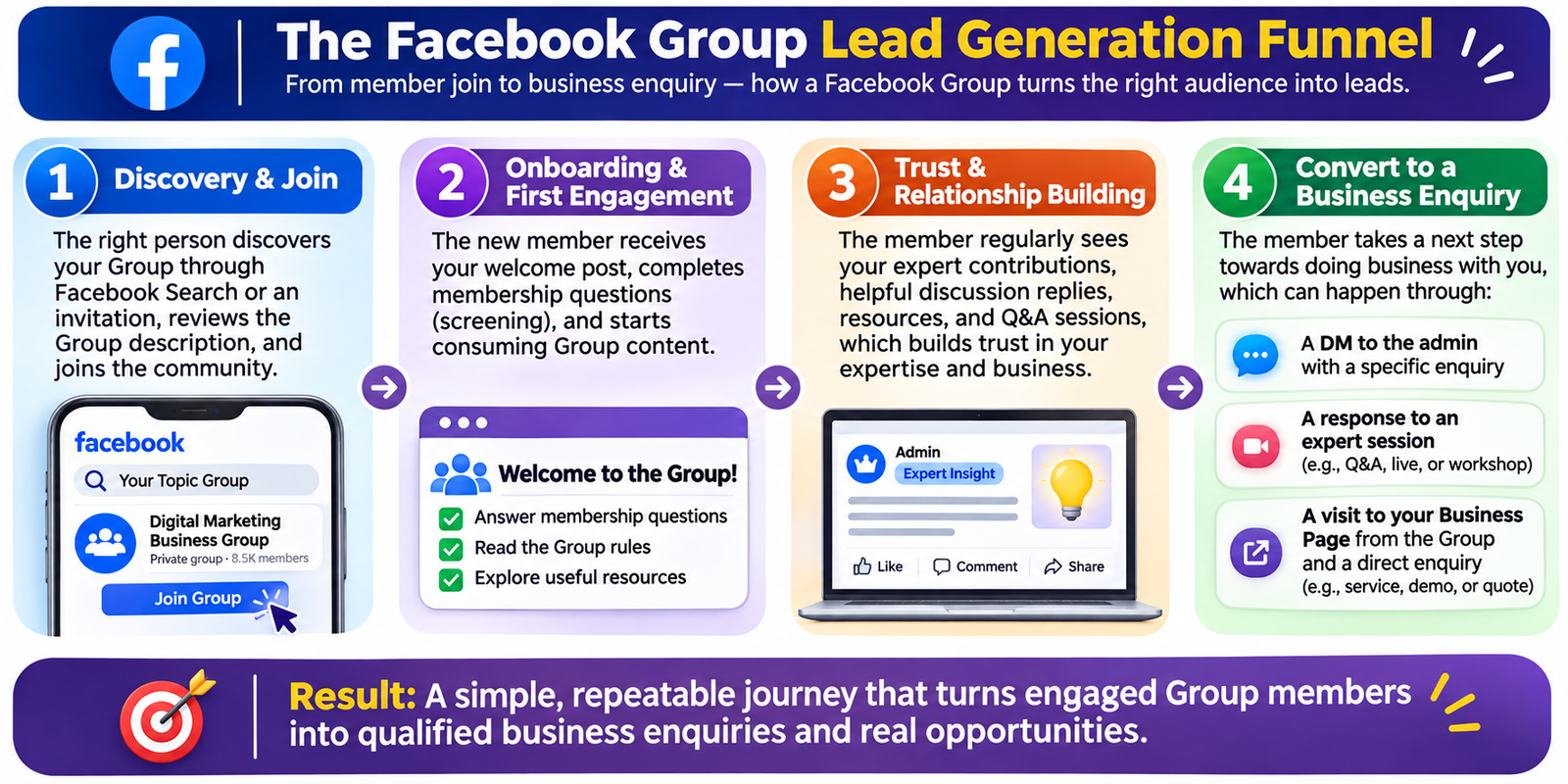
How to Generate Business Leads from a Facebook Group Without Being Promotional

The most commercially effective approach to lead generation from a Facebook Group is positioning rather than promotion. A business that consistently provides the most helpful, most insightful, most practically useful content in its Group naturally becomes the first resource its members think of when they need professional help with the Group's topic, producing inbound enquiries without requiring any promotional posts that would undermine the community trust the Group was built to create.
Four specific practices convert Group engagement into business enquiries through positioning rather than promotion. The first is expert reputation building through the consistent, high-quality contribution of tip posts, resource shares, and thoughtful responses to member questions. When a member posts a question about social media marketing and the Group admin provides the most comprehensive, most specific, most actionable answer in the thread, every member who reads that thread receives an unprompted demonstration of the business's expertise that no advertisement can replicate in terms of trust-building impact.
The second practice is the monthly or bimonthly expert session, a pinned post or Facebook Live in which the business admin offers to answer any Group member's questions on the topic for a defined period. These sessions generate high comment volumes that boost algorithmic reach, position the business's expertise prominently within the community, and often prompt members who have been observing but not asking to finally raise the specific challenge they have been dealing with, which frequently becomes the opening of a business conversation.
The third practice is having a pinned welcome post that mentions the business without being promotional. A welcome message that says "I am the founder of [Business Name], a social media marketing agency in Indore, and I created this Group to build a community of Indian small business owners who want to grow through social media. I will share everything I know here for free, and if you ever need professional support, my team and I are always happy to chat" introduces the commercial context transparently without making it the primary message of the Group. Members know the business exists and what it offers without feeling that Group membership comes with a continuous sales pitch.
The fourth practice is responding to every member question with both a helpful community answer and, where directly relevant, a mention of additional depth available through a private consultation. "Great question, the short answer is [genuine, useful answer]. If you want to go deeper and get a strategy tailored to your specific business, feel free to DM me" converts a community answer into a business invitation without being pushy or inappropriate within the Group context. Our social media management services include Facebook Group setup and community management as part of complete Facebook marketing packages for businesses that want the commercial benefits of Group strategy without the time investment of daily management.

Common Facebook Group Mistakes That Kill Community Engagement

Treating the Group as a promotional channel rather than a community resource is the most common and most damaging Facebook Group mistake. Business owners who create Groups and immediately begin publishing promotional posts about their services, sharing links to their website in every post, and using the Group as a broadcast channel for product announcements destroy the community trust that makes Group membership valuable within weeks of launch. Members join Groups for genuine community value, not to receive advertising from the Group admin. When they receive advertising instead of value, they either leave the Group or mute its notifications, both of which reduce the Group's active membership and engagement rate, and both of which tell the algorithm that the Group's content is not worth distributing widely.
Creating a Group but failing to actively manage it in the early months is the second most common cause of Group failure. A Facebook Group that accumulates members but receives no new content from the admin, does not respond to member comments, does not enforce its own rules, and does not create discussion prompts is an inactive Group that members quickly stop paying attention to. The first 90 days after Group creation require the most intensive admin involvement, daily posting, active response to every member comment, welcoming new members personally, and maintaining the conversation energy that makes the Group feel like a living community rather than an archive of old posts.
Approving every membership request without reviewing the membership questions is a quality control mistake that allows unrelated businesses, spammers, and audience-mismatched members into the Group, degrading the community quality and making the moderation burden progressively heavier. Review every membership request individually, read the answers to the membership questions, and decline requests from accounts that clearly do not match the Group's target member profile. A Group of 500 highly relevant, genuinely engaged members consistently produces more business value than a Group of 5,000 members that includes a high proportion of accounts who joined without genuine interest in the topic.
Not linking the Group to the Business Page is a setup mistake that prevents two-way discovery between the two assets. When a Group is linked to a Business Page, Group members can discover the page through the Group profile, and page visitors can discover the Group through the page. This bidirectional relationship allows the Group to contribute to page follower growth and the page to contribute to Group membership growth, amplifying the value of both assets simultaneously through the same audience. The Facebook Business Page guide covers the complete page setup including the Group linking process as part of the full optimization checklist. Similarly, strategies for growing the Business Page audience through Group community are covered in the Facebook page likes and followers guide.

Facebook Group Types for Business: Which Model Fits Your Goals

Different Facebook Group models serve different business goals and require different management approaches. Selecting the right model before creating the Group prevents the mismatch between Group design and business objective that causes most Group strategies to underdeliver on commercial potential despite genuine member engagement.
Group Model Primary Goal Content Focus Promotional Level Best For
Topic Community Group Build brand authority and a warm audience through consistent expert contribution to a niche topic community 90%+ educational and community posts; topic discussions; expert Q&A; member resources Maximum 10% promotional; business introduced through expertise, not advertising Service businesses, agencies, consultants, professional services building thought leadership
Customer Community Group Retain existing customers, build advocacy, reduce churn, and generate referrals from the established client base Product tips, customer success sharing, exclusive updates, early access announcements, community celebrations Moderate; can promote exclusive offers and updates more directly as members are already customers SaaS companies, subscription businesses, coaching programs, product brands with repeat buyers
Lead Generation Group Capture email addresses and qualify leads through membership questions and valuable resource distribution High-value free resources, templates, guides, and webinars that attract the target customer profile Moderate; free resources lead naturally to awareness of paid offerings without aggressive promotion Businesses with strong content assets and an email nurture sequence ready to activate captured leads
Local Community Group Build hyper-local brand authority and generate referrals from a geographically concentrated community Local events, neighborhood news, local business spotlights, community resources and recommendations Low; business identity is signaled through admin role rather than promotional posts Local service businesses, restaurants, retailers, clinics, and any business whose customer base is geographically concentrated
Private VIP Group Provide premium value to high-value clients or members of a paid program as part of the service offering Exclusive content, direct access to the business owner, priority Q&A, members-only resources and sessions None; the Group is itself a premium product rather than a marketing channel Coaching programs, membership communities, premium service packages, mastermind groups

Want a Facebook Group That Generates Real Business?

We Set Up, Manage, and Grow Your Facebook Group Community

Our team creates the Group strategy, posts weekly content, manages member questions and moderation, and converts the community engagement into qualified business enquiries, so your Facebook Group becomes a consistent lead generation asset rather than an abandoned project.

Book Your Free Group Strategy Session

Frequently Asked Questions About Using Facebook Groups for Business

What is the difference between a Facebook Group and a Facebook Business Page for marketing?

A Facebook Business Page is the public commercial identity of a business where advertising is managed, analytics are tracked, and professional contact information is displayed. It reaches 1% to 6% of followers per post organically. A Facebook Group is a community space where members gather around a shared interest and receive content from the admin at 20% to 40% organic reach. Pages are for brand identity and advertising infrastructure. Groups are for community building and organic reach. The most effective Facebook strategy uses both simultaneously, the Page for commercial credibility and advertising, and the Group for organic community engagement and lead nurturing.

Should I create a Facebook Group or join existing Groups for my business?

Do both in parallel. Joining existing relevant Groups provides immediate access to an established, active community where expert contributions can build personal and business brand reputation without waiting for a new Group to accumulate members. Creating an owned Group is a longer-term investment that takes three to six months to develop genuine community energy but provides strategic control over the environment that participating in others' Groups cannot. Begin participating in three to five existing Groups from day one while setting up a new Group simultaneously, so both pathways are developing in parallel rather than sequentially.

How many members does a Facebook Group need to be useful for business?

A Group of 200 to 500 highly relevant, genuinely engaged members is more commercially valuable than a Group of 10,000 members with low engagement and poor audience-to-business alignment. The commercial value of a Group comes from the quality of the member-to-business relationship, not the total membership count. A 500-member Group where 30% of members actively engage with posts and the admin has answered most members' questions at least once generates significantly more business enquiries than a 10,000-member Group where the admin posts promotional content, fewer than 1% of members engage, and no genuine community relationships have been built.

How often should a business post in its Facebook Group?

Three to five posts per week is the optimal frequency for a business-managed Facebook Group once it reaches a self-sustaining level of member activity. In the first 30 to 60 days after Group creation, post daily or even twice per day to build the initial activity density that makes the Group feel active when new members join. As the Group grows and members begin contributing their own posts and questions, the admin's posting frequency can reduce to three to five times per week while the total Group activity remains high from member contributions. Never allow more than three days to pass without any admin activity in the Group, as visible admin absence signals to members that the community is unmaintained.

Can I use a Facebook Group to promote my products and services?

Promotional content is acceptable in a business-managed Group at a maximum of 10% of total post volume, approximately one promotional post for every ten community and value-driven posts. Exceeding this ratio rapidly erodes the community trust that makes Group membership valuable for members and commercially valuable for the business. The most effective form of promotion in a Group is not direct advertising but rather consistent expert contribution that demonstrates the value the business provides, making members naturally receptive to mentions of paid services when they arise within the context of a genuine community conversation rather than as standalone promotional interruptions.

What type of content performs best in a Facebook Group for business?

Discussion prompts that ask open-ended questions relevant to the Group's topic consistently generate the highest engagement in Facebook Groups because they invite personal, opinionated responses that naturally spark multi-comment threads. Expert tip posts that provide specific, immediately actionable guidance generate saves and grateful responses. Resource shares including free templates, checklists, and guides generate strong member gratitude and saves that build the trust relationship most valuable for eventual lead conversion. Facebook Live sessions within the Group generate real-time comment activity that the algorithm treats as the strongest engagement signal for Group content distribution.

How do I get more members to join my Facebook Group?

Promote the Group through every available channel: mention it in the Facebook Business Page bio and in posts, share it in email newsletters, add a link to the website, invite existing customers personally via WhatsApp or email, share the Group link in relevant posts on other social platforms, and participate actively in existing related Groups where mentioning the new Group is appropriate within the Group's rules. Within the Group itself, ask satisfied existing members to invite colleagues who might benefit from the community, peer-to-peer invitations consistently produce the highest-quality new members because personal endorsement from a trusted connection is more persuasive than any promotional invitation the business could send directly.

How do I prevent spam in my Facebook Group?

Prevent spam through three complementary mechanisms. First, use Facebook's membership questions to filter out accounts that do not match the target member profile before they join. Second, set clear Group rules that explicitly prohibit self-promotion and unauthorized linking, and enforce them consistently by removing rule-violating posts and warning or removing repeat offenders. Third, use Facebook's Group admin tools to turn on post approval for new members, requiring admin review of any post from accounts that joined within the last 30 days before the post is published. This approval workflow catches most spam attempts at the source without requiring reactive removal after the fact.

Should a Facebook Group be public or private?

Private with Visible status is the recommended setting for most business Facebook Groups. This setting makes the Group discoverable through Facebook's search so it can attract organic join requests from people searching for communities around the Group's topic, while keeping the content visible only to members, creating the sense of trusted, exclusive access that motivates joining and produces the quality discussion environment the algorithm rewards. Public Groups maximize initial discoverability but attract more spam, lower-quality engagement, and less substantive conversation because the public visibility removes the exclusivity that motivates members to contribute genuinely in private communities.

How long does it take to build an active Facebook Group for business?

Most business Facebook Groups require three to six months of consistent admin investment to develop the self-sustaining community activity where members regularly post their own questions and contributions without admin prompting. The first month is almost entirely admin-driven content and engagement. Months two and three begin to see regular member participation as the community develops its own culture and engagement habits. By months four through six, an actively managed Group typically reaches a point where member activity exceeds admin activity, indicating that the community has become genuinely self-sustaining. Setting realistic timeline expectations prevents the early abandonment that causes most Group strategies to fail before reaching the community energy threshold that makes Groups commercially valuable.

Can I run Facebook ads targeting members of a Facebook Group?

Facebook does not currently allow advertisers to directly target members of a specific Facebook Group through the standard Ads Manager audience targeting system. However, businesses can achieve similar targeting by building a Custom Audience from people who have engaged with the Business Page, visited the website, or been uploaded from the email list, which often includes many of the same people who match the Group's member profile. Facebook Ads Manager's interest-based targeting can also reach people who have demonstrated interest in topics aligned with the Group's subject matter, providing audience targeting that approximates Group member targeting without direct Group-to-ads connectivity.

How do I measure whether my Facebook Group is working for the business?

Track five Group-specific metrics monthly through Facebook's Group Insights section and supplementary tracking. Member growth rate shows how many new members joined relative to the starting count. Active member percentage shows what proportion of members have interacted with Group content in the past 30 days, a healthy Group typically achieves 15% to 30% monthly active member rates. Average post engagement measures the typical likes, comments, and shares per post published. Enquiries from Group shows how many direct Messenger conversations were initiated by Group members mentioning the Group as their discovery context, tracked manually through conversations. And Business Page follower growth attributable to Group activity shows how effectively the Group is converting community engagement into page audience growth through the bidirectional discovery the linked Group and Page enable.

Futuristic Marketing Services

Build a Facebook Community That Reaches More People and Generates More Business.

We create your Facebook Group strategy, manage the content and community engagement, and integrate Group marketing with your complete Facebook presence, so your business benefits from Facebook's highest-reach organic channel while you focus on running your business.

Talk to a Facebook Community Specialist

Conclusion

Facebook Groups represent the most significant organic reach opportunity remaining on the platform, a surface that consistently delivers 20% to 40% reach per post compared to the 1% to 6% that standard Business Page posts achieve. For businesses willing to commit to the community-first approach that makes Groups commercially valuable, the combination of higher reach, higher-intent membership, and the trust-based authority that consistent expert contribution builds over months creates a lead generation and brand authority asset that no other Facebook surface can replicate at zero advertising cost.
The strategy in this guide, choosing the right Group model for the business goal, setting up the Group correctly from the beginning, publishing a mix of community content types that generate genuine engagement, generating leads through positioning rather than promotion, and avoiding the management mistakes that kill community activity, gives every business a complete framework for building a Facebook Group that produces measurable commercial outcomes rather than community activity that exists in isolation from the business's growth goals.
If you want professional support creating and managing a Facebook Group as part of a complete Facebook marketing strategy for your business, Futuristic Marketing Services builds engaged communities for businesses across India, handling everything from Group setup and content strategy through member management, community engagement, and integration with the Business Page, advertising, and broader social media marketing system.
Share this post :
Picture of Devyansh Tripathi
Devyansh Tripathi

Devyansh Tripathi is a digital marketing strategist with over 5 years of hands-on experience in helping brands achieve growth through tailored, data-driven marketing solutions. With a deep understanding of SEO, content strategy, and social media dynamics, Devyansh specializes in creating results-oriented campaigns that drive both brand awareness and conversion.

All Posts