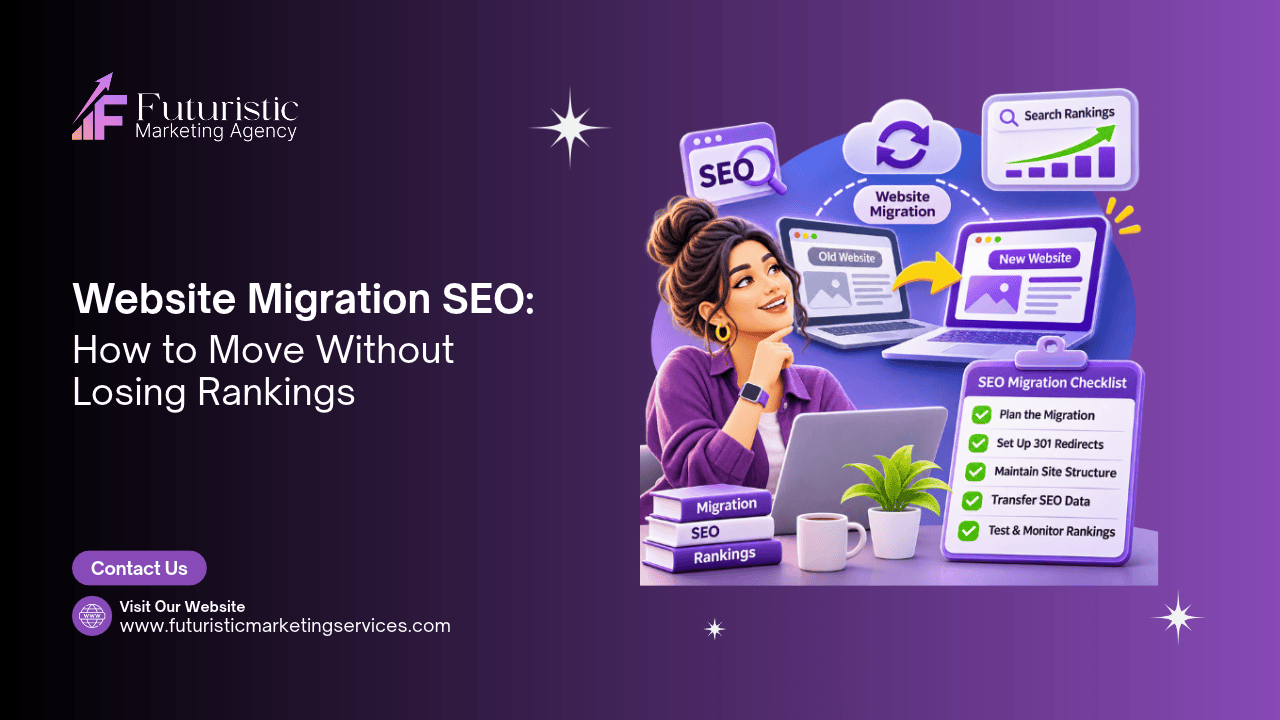
Website migration SEO is the process of preserving and protecting organic search rankings when a website undergoes a significant structural change, a domain change, platform migration (e.g. moving from Magento to WooCommerce), URL restructure, HTTPS implementation, or site redesign that changes URLs. Without a structured migration SEO process, a poorly executed migration can destroy years of accumulated organic authority and traffic within days of launch. With the correct process, migrations can be completed with minimal ranking disruption and often produce ranking improvements from the cleaner technical foundation the new site provides.
Key Takeaways
- Google recommends a structured migration process with 301 redirects from every old URL to its new equivalent. Missing even a small proportion of redirects causes permanent ranking loss for the affected pages, organic authority cannot be recovered without the redirect.
- The pre-migration audit is the most valuable investment in any migration project. Crawling the existing site with Screaming Frog and exporting every URL, its inbound link count, its organic traffic, and its current title tag produces the redirect mapping source list and the baseline against which post-migration performance is measured.
- Ranking recovery after a correctly executed migration with 301 redirects takes 3 to 6 months according to Ahrefs research. During this period, rankings may fluctuate significantly before stabilising. A monitoring programme, weekly GSC checks and ranking tracking, distinguishes normal fluctuation from genuine migration problems requiring correction.
- The most common migration SEO failures: missing 301 redirects for the highest-traffic URLs; noindex tags applied to the new site and not removed before launch (a staging-to-live deployment error); canonical tags pointing to old URLs on the new site; and failing to submit the new XML sitemap to Google Search Console. Each is preventable with a pre-launch checklist.
- Core Web Vitals performance should be established on the new site in staging before launch. A migration that simultaneously changes URLs and degrades performance signals compounds ranking risk, the migration and the performance change create two simultaneous negative signals.
- Domain migrations (changing the primary domain) carry the highest ranking risk and the longest recovery timeline. Domain migrations should be avoided unless there is a compelling business reason (brand change, domain consolidation). A domain migration with correct 301 redirects and GSC domain change notification typically recovers rankings within 6 to 12 months.
- The post-migration observation period is 90 days minimum. During this period, prioritise monitoring over additional changes, layering new URL restructures or design changes on top of a recent migration makes it impossible to attribute ranking changes to their specific cause. Stabilise first, then iterate.
Migration Planning
Protect Your Rankings Through Your Website Migration
Futuristic Marketing Services manages website migration SEO, pre-migration audit, redirect mapping, staging validation, launch checklist, and 90-day post-migration monitoring.
Plan Your MigrationThe Four Migration Types and Their Risk Levels
| Migration Type | Description | SEO Risk Level | Recovery Timeline |
|---|---|---|---|
| HTTPS implementation | Moving from HTTP to HTTPS on the same domain and URL structure | Low, if 301 redirects and canonical updates are correct | 2 to 8 weeks for Google to update indexed URLs |
| CMS platform migration (same URLs) | Moving from one CMS to another (e.g. Magento to WooCommerce) while keeping all URLs identical | Low to medium, URL structure preserved; risk from technical differences in new site | 4 to 8 weeks of monitoring; risk concentrated in technical SEO quality of new CMS |
| URL restructure (same domain) | Changing URL slugs or folder structure within the same domain (e.g. /blog/post to /resources/post) | Medium, every changed URL requires a 301 redirect; missed redirects cause permanent loss | 3 to 6 months for full ranking stabilisation with correct redirects |
| Domain migration | Moving the entire site to a new primary domain | High, all accumulated domain authority must transfer via 301s and GSC domain change tool | 6 to 12 months for full recovery; some authority loss is typical even with perfect execution |
| Combined migration (domain + URL restructure) | Changing domain and URL structure simultaneously | Very high, compound risk; harder to diagnose individual issues | 9 to 18 months; avoid unless absolutely necessary from a business perspective |
The Rule of One Change at a Time
The Pre-Migration SEO Checklist
| Pre-Migration Task | How to Execute | Output |
|---|---|---|
| Full site crawl | Run Screaming Frog on the live site, all pages, all status codes. Export to CSV. This is the source list for redirect mapping. | Complete URL inventory with status codes, title tags, meta descriptions, inbound link counts, and crawl depth |
| Organic traffic baseline | Export 12 months of organic traffic by page from Google Analytics 4. Sort by sessions. The top 100 organic traffic pages are the highest-priority redirect targets. | Top pages by organic traffic, these pages must have working 301 redirects on day one of launch |
| Backlink profile export | Export all backlinks from Ahrefs or Google Search Console → Links → Top linked pages. Pages with many external backlinks carry the most accumulated authority, their redirects are the highest commercial priority. | Pages with significant external link equity, redirect failures on these pages cause the greatest authority loss |
| Keyword ranking baseline | Export current keyword rankings for all target keywords from Ahrefs, Semrush, or GSC → Performance. Record the position of each keyword and the URL currently ranking for it. | Pre-migration ranking snapshot, the comparison baseline for post-migration monitoring |
| GSC property verification | Verify the new domain or subdomain as a property in Google Search Console before migration. Create the new property but do not submit sitemaps until the new site is live. | New GSC property ready for sitemap submission on launch day |
| Staging site technical audit | Run a technical SEO audit on the staging site before launch, check for noindex tags, missing canonical tags, broken internal links, missing meta titles, and Core Web Vitals performance. | Technical issues list to resolve before any traffic is sent to the new site |
The 301 Redirect Mapping Process
301 Redirect Mapping Rules
Map every organic traffic URL
The top-priority redirect category. Export organic traffic by URL from GA4, sort by sessions descending, and map every URL with any organic traffic to its new equivalent. No organic URL should go without a redirect.
Map every linked-to URL
Export all URLs with external backlinks from Ahrefs or Screaming Frog link analysis. Every URL receiving external backlinks must redirect to its new equivalent to preserve the accumulated link authority.
Map every internally linked URL
Run Screaming Frog on the old site and export the inlinks report. Every URL receiving internal links should have a redirect, internal links also transfer authority and affect crawl behaviour.
Direct 301 only, no chains
Every redirect must go directly from the old URL to the new URL. Redirect chains (A redirects to B which redirects to C) lose authority at each hop and add latency. Review for chains in Screaming Frog and collapse all chains to direct 301s before launch.
Redirect to relevant content
Each old URL should redirect to the most topically relevant new URL. A blog post about WordPress SEO redirecting to the homepage loses all topical relevance signal. If no equivalent page exists on the new site, redirect to the closest topically related page.
Homepage and site-wide redirects
Add a catch-all redirect from the old domain root to the new domain root (for domain migrations). Add individual page redirects before the catch-all so specific page matches take priority over the catch-all.
Post-Migration Monitoring
Post-Migration Recovery
Rankings Dropped After a Migration? Get a Recovery Audit
Futuristic Marketing Services provides post-migration SEO recovery audits, identifying missing redirects, indexation failures, and technical issues causing ranking loss, with a prioritised fix plan.
Request a Recovery Audit