Facebook Marketing Strategy for Small Businesses: Complete Guide

A complete Facebook marketing strategy for small businesses combines a fully optimized Business Page, a consistent organic content schedule built around the 80/20 value-to-promotion ratio, active participation in or management of a relevant Facebook Group, targeted paid advertising that amplifies proven organic content, and monthly performance review that identifies which elements are driving leads and which need adjustment before the next publishing cycle.

This guide builds a complete, practical Facebook marketing strategy for small businesses, covering why Facebook remains commercially essential despite declining organic reach, a six-component framework that integrates organic content, Facebook Groups, Messenger engagement, and paid advertising into a single coordinated system, a content strategy guide showing what to post and when, a realistic budget guide for Facebook advertising investment at different business sizes, and the most common Facebook marketing mistakes that cause small businesses to get poor returns from the time and money they invest in the platform. Every recommendation reflects how the platform currently operates rather than the organic-first model that produced results in earlier years but requires significant adaptation for current conditions.

Key Takeaways

  • Facebook has 3.07 billion monthly active users, and an estimated 40% of consumers plan to spend more time on the platform, according to Sprout Social's 2026 Facebook marketing research.
  • India has over 410 million active Facebook users, the largest national audience on the platform globally, making Facebook non-negotiable for any Indian business with a local or national consumer audience.
  • Organic reach for Facebook Business Pages now averages 1.4% to 5.9% per post, making paid advertising an essential component of any strategy that needs to reach audiences beyond the existing follower base.
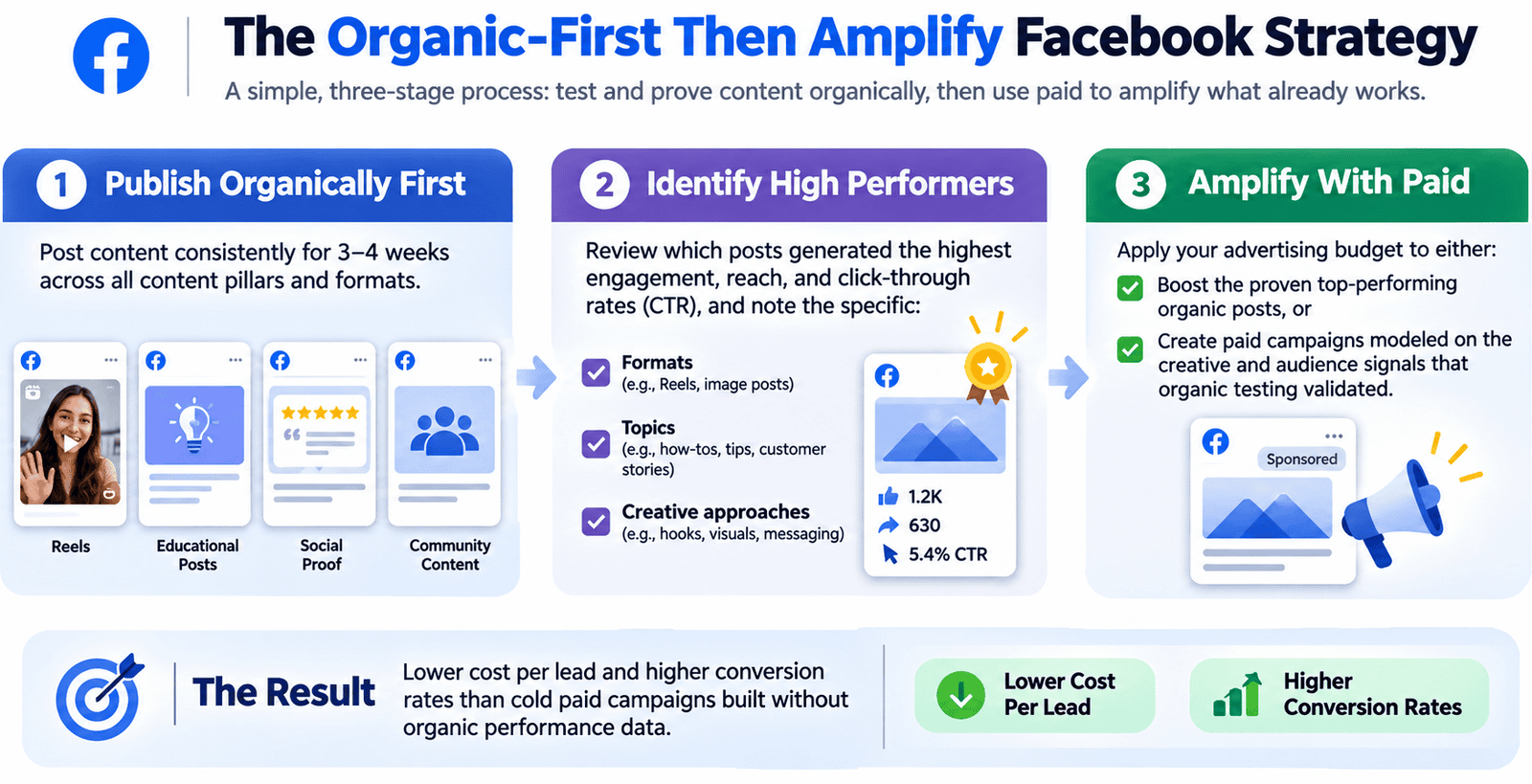
  • The most effective Facebook marketing strategy publishes organically first to identify high-performing content, then amplifies proven posts through paid campaigns, combining trust-building and reach-scaling in a single coordinated system.
  • Facebook Groups provide significantly higher organic reach than standard page posts because content reaches all Group members rather than only the algorithm-selected fraction of page followers.
  • According to CremyX's 2026 Facebook marketing guide, small businesses can begin testing paid Facebook advertising from as little as INR 800 to INR 1,600 per day ($10 to $20), with most seeing meaningful results at INR 40,000 to INR 1,65,000 per month in total ad spend.
  • Organic Facebook content makes paid advertising work harder, when someone clicks an ad and lands on a page with consistent, valuable content, the credibility signal converts that click into an enquiry or purchase at a meaningfully higher rate than clicking to an empty or stale page.

Want a Facebook Strategy That Actually Generates Leads?

We Build and Manage Complete Facebook Marketing Strategies for Businesses Across India

From page optimization and content strategy through Facebook Groups management, paid campaign execution, and monthly reporting, Futuristic Marketing Services handles every component of a Facebook marketing strategy that produces consistent, measurable results.

Get Your Free Facebook Strategy Session

Why Facebook Remains Essential for Small Business Marketing

Facebook's commercial relevance for small businesses has not diminished, it has changed. The platform that once rewarded consistent organic posting with generous reach and reliable audience growth has evolved into primarily what CremyX's 2026 Facebook marketing guide accurately describes as "an advertising and community platform." Organic reach through standard page posts averages 1.4% to 5.9% per post. Median engagement rates hover near 0.06% for many page categories. The businesses that continue to grow consistently on Facebook are those that have adapted their strategy to work with the platform's current economics rather than expecting the organic-first model to deliver what it produced years ago.
What has remained constant, and in many ways strengthened, is Facebook's advertising infrastructure, its Groups ecosystem, and its position as the primary social platform for adult consumers across India. With over 410 million active users in India alone, according to ThePlanetSoft's comprehensive 2026 Facebook strategy analysis, and with an estimated 40% of consumers planning to increase time spent on the platform, Facebook retains a scale and demographic breadth that no alternative social platform matches for the majority of Indian businesses targeting adult consumers of any category.

What Has Changed and What Still Works on Facebook
Three significant changes in how Facebook marketing works require strategy adaptation. Organic page reach has declined from the double-digit percentages available in earlier years to the current 1.4% to 5.9% average, making paid amplification increasingly necessary for reaching audiences beyond the existing follower base rather than an optional addition for ambitious growth. The platform's algorithm now filters weak content aggressively, rewarding original video in Reel format and genuine community conversation in Groups while reducing the distribution of static image posts and low-engagement promotional content that once performed adequately through sheer posting volume. And audience expectations for business responsiveness have increased, with customers now expecting replies through Facebook comments and Messenger rather than treating the platform as a one-way broadcast channel.
What continues to work strongly is Facebook's paid advertising targeting system, which remains the most sophisticated and commercially precise audience targeting infrastructure available on any social platform. Facebook Groups continue to deliver organic reach that standard page posts cannot approach, because Group content is distributed to all members rather than a fraction of page followers. Facebook Reels, the platform's short-form video format, generate engagement rates significantly above the platform average and are actively promoted by Meta's algorithm in the same way Instagram Reels are prioritized on that platform. And Messenger, which facilitates 12 billion business messages monthly, remains a high-intent enquiry channel that no competing platform approaches in direct customer communication volume.

Why India's Facebook Market Makes the Platform Non-Negotiable
India's position as Facebook's largest national market globally is a commercial reality that makes the platform's role in Indian small business marketing fundamentally different from its position in Western markets where alternative platforms have made more significant inroads into Facebook's audience share. With over 410 million active Indian Facebook users spanning urban and rural populations across age groups from 18 to 65+, Facebook reaches a breadth of the Indian adult population that no alternative platform comes close to matching for businesses that serve diverse geographic or demographic customer profiles.
For local service businesses in cities like Indore, the combination of Facebook's local targeting capabilities, WhatsApp Business integration through the Business Page, and the Facebook Marketplace's 1.1 billion monthly shoppers creates a commercial ecosystem that generates customer acquisition at costs that remain competitive with other digital channels. The 25-34 age group is the largest demographic at 24.2% of Facebook's user base, followed by 35-44 year olds at 19%, the exact demographic profile of the primary purchasing decision-makers for most service, professional, home improvement, and consumer product categories that Indian small businesses operate in.

The 6-Component Facebook Marketing Strategy for Small Businesses

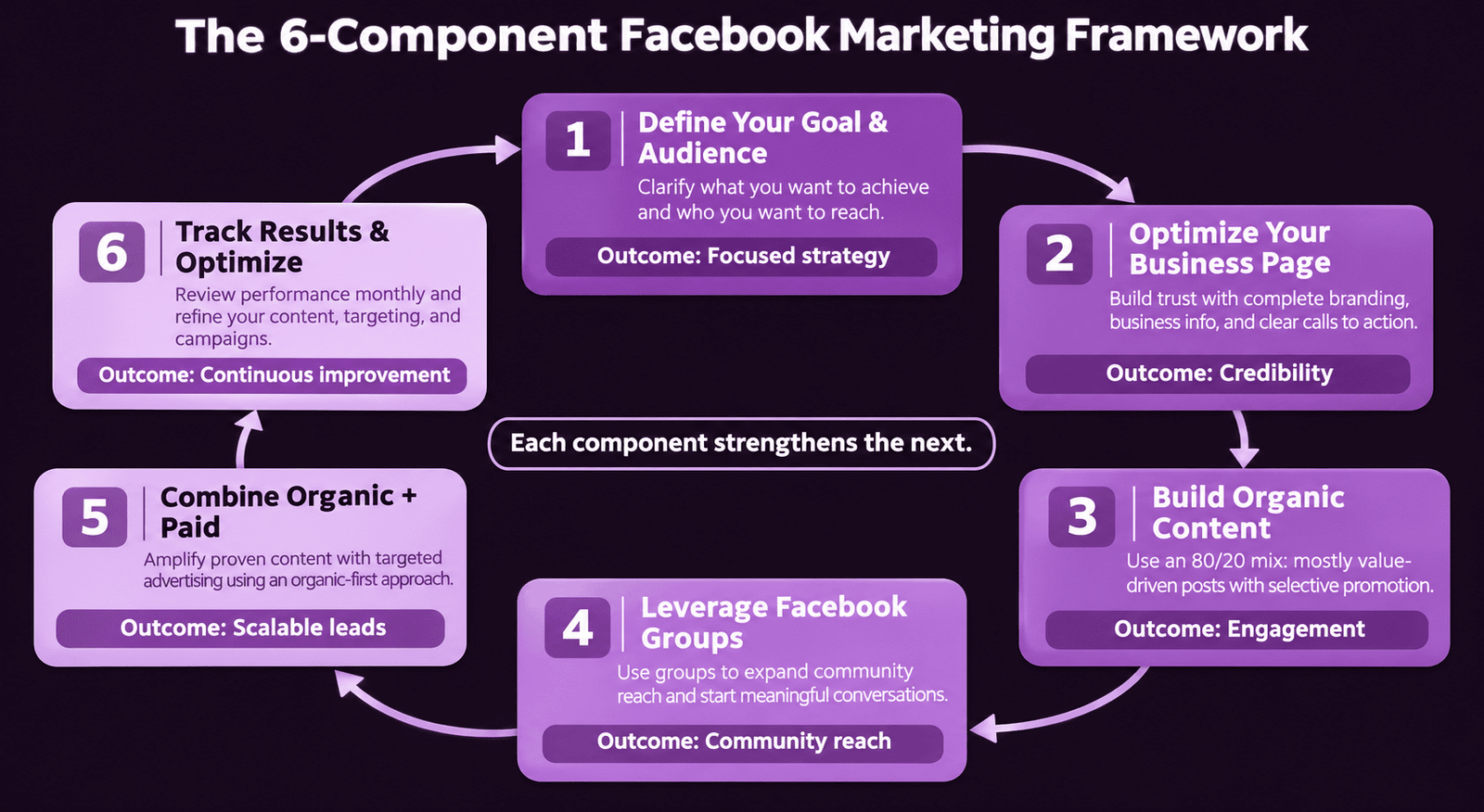
The framework below organizes all Facebook marketing activity into six coordinated components that work together as a system rather than as isolated tactics. Implementing all six components in sequence, beginning with the foundation and building toward paid amplification, consistently produces stronger results than implementing any individual component in isolation. The sequence matters because each component creates the conditions that make the next one more effective.

Component 1: Define Your Goal and Target Audience

Every Facebook marketing strategy begins with a single, clearly defined business goal that determines every subsequent decision about content, advertising, and measurement. The most commercially practical starting goals for small businesses are local brand awareness (reaching a defined number of people in a specific geographic area), lead generation (producing a specific number of enquiries or contact form submissions each month), website traffic (driving a defined volume of qualified visitors to a specific page), or direct sales (generating purchases through Facebook Shops or a linked product page). Setting clear social media marketing goals with specific metrics before any content or advertising work begins is what allows monthly performance review to determine whether the strategy is working rather than simply whether the account is active.
The target audience definition for Facebook must go beyond demographic parameters to include behavioral signals, life event triggers, and interest categories that identify potential buyers rather than broad demographic groups. A legal services firm targeting family law clients benefits from Facebook's ability to target people who have recently experienced a relationship status change, divorce-related searches, or engagement with family-focused community pages, audiences that demographic targeting alone could not identify. The more precisely the target audience is defined before any content or advertising work begins, the more efficiently every hour of content effort and every rupee of advertising spend is directed toward people who are genuinely likely to become customers.

Component 2: Optimize the Facebook Business Page Foundation

The Facebook Business Page is the credibility foundation that every other component of the Facebook marketing strategy relies on. A poorly optimized page undermines the performance of strong organic content, reduces the conversion rate of paid advertising campaigns, and creates a negative first impression for every potential customer who arrives at the page from any source. A fully optimized page, with a professional cover image, complete About section, accurate contact details, configured CTA button, WhatsApp integration, and active Services tab, converts a higher proportion of every visitor into an enquiry or website click regardless of how that visitor arrived.
The complete Facebook Business Page setup and optimization process is covered in detail in our step-by-step guide on how to create a Facebook Business Page, which includes a complete optimization checklist covering every page element that requires configuration before the content strategy is launched. Complete the page optimization checklist fully before publishing any content or running any advertising, because every visitor who encounters an incomplete page loses trust in the business before any content has had the opportunity to earn it back.

Component 3: Build Organic Content That Builds Trust

Organic Facebook content serves the trust-building function that makes paid advertising more effective rather than serving as the primary reach driver it once was. As YoungUrbanProject's 2026 Facebook strategy analysis observes, when someone clicks a Facebook ad and lands on a page with consistent, valuable content, that content signals to the visitor that the business is credible, active, and worth following, converting the paid click into a follower, enquiry, or purchase at a meaningfully higher rate than a click to a sparse or outdated page. This is the mechanism that makes organic and paid work as complementary components rather than competing alternatives.
Apply the 80/20 content balance: 80% value-driven content including educational posts, behind-the-scenes content, client results, and community-focused posts, and 20% promotional content including service announcements, offers, and direct commercial calls to action. Facebook Reels should be the primary content format within the 80% because they generate the highest organic engagement rates of any page content type, averaging 1.83% engagement versus 0.06% for standard posts. Publish three to four Facebook Reels per week as the content backbone and supplement with static images, carousel posts, and Stories at a combined two to three additional posts per week. A structured social media content calendar that plans the full weekly publishing mix in advance ensures the 80/20 balance is maintained without requiring content decisions to be made reactively on the day of publication.

Component 4: Leverage Facebook Groups for Organic Community Reach

Facebook Groups represent the most significant organic reach opportunity remaining on the platform for businesses that use them strategically. With 1.8 billion people using Facebook Groups monthly, Group content reaches every member who has notifications enabled, a fundamentally different distribution model from page posts, which reach only the 1.4% to 5.9% of followers the algorithm selects for each post. A business that creates and manages a Group around a topic genuinely relevant to its target audience builds a community that the algorithm does not filter, providing a direct publishing channel to a growing, engaged audience at zero paid reach cost.
The most effective Group strategy for small businesses follows a value-first approach: create the Group around a topic or community of interest that the target audience would join for its own value, not primarily to hear from the business. A social media marketing agency might create a Group for "Small Business Marketing in India" where members share tips, ask questions, and discuss challenges across the full category, with the agency's expertise naturally positioning it as a trusted authority within the community rather than as an advertiser. Promotional content in Groups should represent no more than 20% of the Group's post volume, with the remaining 80% dedicated to facilitating genuine member conversation, answering member questions, and sharing genuinely useful resources. This approach builds the kind of community trust that converts Group members into clients at rates significantly higher than cold advertising audiences.

Component 5: Combine Organic with Targeted Paid Advertising

The organic-first then amplify approach described by YoungUrbanProject is the most cost-effective paid Facebook advertising strategy for small businesses: publish content organically, identify which posts generate the strongest engagement and reach from the existing audience, then apply paid budget specifically to amplify those proven posts rather than creating separate ad creative from scratch. This approach consistently produces lower cost per result than running cold paid campaigns because the organic engagement data provides validation that the creative resonates with the target audience before any advertising budget is committed.
Beyond boosting proven organic content, Facebook Ads Manager enables three additional campaign types that deliver the strongest commercial returns for small businesses. Lead generation ads that display a short form directly in the Facebook feed collect potential customer contact details without requiring a website click, reducing friction and typically improving conversion rates over website-destination campaigns. Retargeting campaigns that show ads specifically to people who have already visited the business website or engaged with the Facebook page reach audiences who have already demonstrated interest, consistently achieving conversion rates three to five times higher than cold audience campaigns at lower cost per result. Lookalike audience campaigns that instruct Facebook to find new potential customers who match the behavioral and demographic profile of the business's best existing customers extend reach to high-quality new audiences identified by the platform's own data systems rather than manual audience selection. Our social media advertising services cover the complete setup and management of all three campaign types for businesses across India.
For a comprehensive understanding of how organic and paid advertising strategies interact and which approach to prioritize at different stages of business growth, our detailed guide on organic vs paid social media marketing covers the complete decision framework with specific budget guidance and timeline expectations for each approach.

Component 6: Track Results and Optimize Monthly

Monthly performance review is what converts a Facebook marketing activity into a managed, improving business channel. Without regular data review, small businesses have no way of identifying which specific content types, posting times, audience segments, and ad formats are driving business outcomes and which are consuming resources without producing proportional returns. Use Meta Business Suite's Insights section to track five monthly metrics: page reach (how many unique people saw content from the page), post engagement rate (what percentage of people who saw each post interacted with it), website clicks from Facebook (tracked through Google Analytics social referral data), Messenger conversations initiated (indicating direct enquiry generation from the page), and advertising cost per lead (from paid campaigns, tracked through Ads Manager).
Review these five metrics at the end of each month and make one or two specific adjustments to the following month's strategy based on what the data shows rather than what intuition suggests. If Reels are generating ten times the reach of static posts but the content calendar shows only one Reel per week, the adjustment is clear. If retargeting campaigns are producing leads at one-fifth the cost of cold audience campaigns, the budget allocation adjustment is equally clear. This monthly cycle of measurement and incremental improvement is the mechanism through which a Facebook marketing strategy compounds in effectiveness over time rather than delivering the same inconsistent results regardless of how much time and money is invested.

Facebook Content Strategy, What to Post and When

The content strategy table below provides a weekly publishing framework that maintains the 80/20 value-to-promotion balance, prioritizes the formats generating the highest current engagement rates, and distributes posting across the days and times proven to produce the strongest audience activity. Adapt the specific topics to the business's content pillars and the best posting times to the Insights data from the specific page's audience activity analysis.
Day Content Type Content Pillar Best Posting Time Primary Goal
Monday Facebook Reel (60 to 90 seconds) Educational, how-to tip or common mistake correction relevant to the target audience's primary challenge 9 AM to 11 AM Reach and profile visits from non-followers; start-of-week discovery
Tuesday Static image or carousel post Social proof, client result or testimonial with specific metric or outcome; real name and context where permitted 12 PM to 2 PM Trust building and direct enquiry generation from consideration-stage audience
Wednesday Facebook Reel (30 to 60 seconds) Behind-the-scenes or personality, team moment, process reveal, or founder perspective on an industry topic 11 AM to 1 PM Brand trust, DM generation, community relationship depth with existing audience
Thursday Text post or carousel with story-driven caption Community engagement, opinion post, question, or poll that invites the audience to share their perspective on a relevant topic 9 AM to 11 AM Comment generation and algorithm engagement signals; audience insight collection
Friday Promotional post or service spotlight (20% content slot) Promotion, specific service or offer with clear CTA linking to contact page or booking system; result-forward framing 10 AM to 12 PM Direct enquiry and conversion from audience that has been warmed through the week's value content
Saturday Facebook Group post (if Group is active) Community facilitation, a prompt, question, or resource share designed to generate member discussion; never directly promotional 10 AM to 12 PM Group member engagement and organic reach through full-member distribution
Sunday Facebook Reel (educational or entertainment) Educational or personality, Sunday browsing behavior suits longer-form educational content or personal brand story content that audiences engage with at leisure 12 PM to 3 PM Weekend reach and follower growth from leisure-browsing audiences with higher content dwell time than weekday posts

Facebook Advertising Budget Guide for Small Businesses

Setting a realistic Facebook advertising budget before launching any paid campaigns prevents the most common small business advertising mistake: committing insufficient budget for an insufficient period and concluding that Facebook ads "don't work" when the reality is that the budget was too low or the test period too short to collect meaningful performance data. According to CremyX's Facebook marketing guide, small businesses should start with the equivalent of INR 800 to INR 1,600 per day for initial testing, expect meaningful results from INR 40,000 to INR 1,65,000 per month in total ad spend, and commit to at least 30 days of consistent testing before evaluating whether a campaign is performing well enough to scale.
Budget Level Monthly Spend (INR) Campaign Focus Realistic Expectations Best For
Testing Tier INR 15,000 to 30,000 Boosting proven organic posts to extended audiences; single lead generation campaign with narrow local targeting 5 to 15 enquiries per month depending on industry and offer quality; enough data to identify what works before scaling Businesses running first Facebook ads; local service businesses testing digital advertising for the first time
Growth Tier INR 30,000 to 75,000 Lead generation campaigns plus retargeting of website visitors; audience A/B testing across two to three creative variations 15 to 40 enquiries per month; clear data on best-performing audiences and creative; retargeting typically showing 3x to 5x better conversion than cold audiences Established local businesses with proven service offerings wanting consistent monthly lead volume
Scale Tier INR 75,000 to 2,00,000+ Full-funnel campaigns: awareness targeting with Reels, consideration campaigns with lead forms, retargeting with conversion offers, lookalike audiences scaling from best existing clients 40+ qualified enquiries per month; predictable cost per lead with campaign-level ROI tracking; scalable growth with consistent creative refresh Businesses with validated offers, clear conversion processes, and growth targets that require predictable paid lead volume
Organic Only INR 0 (time investment only) Consistent Reels publishing, Groups management, Messenger engagement, and community building without paid amplification Gradual brand awareness and community growth over 6 to 12 months; occasional enquiries from organic reach; limited lead volume without paid amplification Businesses building the content foundation before paid investment; budget-constrained businesses supplementing other lead generation channels

Common Facebook Marketing Mistakes That Produce Poor Results for Small Businesses

Treating Facebook as a free organic marketing channel and posting without any paid investment while expecting significant reach and lead generation is the most common strategic misalignment in small business Facebook marketing. The platform's current economics simply do not support the expectation that consistent organic posting will generate meaningful lead volume for most business categories. Organic content serves the trust-building function, it proves credibility to ad-clicked visitors and maintains the brand relationship with existing followers. Lead generation at meaningful volume requires paid advertising investment. Businesses that allocate no paid budget to Facebook while expecting commercial returns from organic posting are using the channel in a way that cannot produce the outcomes they are measuring against.
Running paid campaigns without a content history is the inverse error that produces high advertising costs and low conversion rates. When someone clicks a Facebook ad and arrives at a page with no posts, months-old content, or only promotional posts, the absence of organic credibility signals undermines the conversion the ad was designed to produce. As ThePlanetSoft's analysis confirms, paid ads are more credible and convert at higher rates when the page demonstrates an active, valuable content presence, because the content history serves as social proof that the business is genuine, established, and worth engaging with. Build at least 30 days of consistent organic content before launching any paid campaigns, and maintain organic publishing throughout any paid campaign period rather than suspending organic activity in favor of paid-only activity.
Ignoring Facebook Groups entirely is a missed opportunity that becomes increasingly costly as organic page reach continues to decline. Groups represent the most significant remaining organic reach mechanism on Facebook, the only surface that consistently reaches a large proportion of its members without paid amplification. Businesses that invest exclusively in page content while ignoring the Group ecosystem are surrendering the platform's most accessible organic reach tool to competitors who have recognized its value. Even small, niche Groups of 500 to 2,000 highly relevant members consistently produce more qualified enquiries per month than page posting with the same content reaching 1.4% to 5.9% of a 10,000-follower audience. Our social media marketing agency integrates Groups strategy into every Facebook management engagement because the Groups-plus-page combination consistently outperforms page-only strategies for organic reach at every budget level.

Ready to Make Facebook Work for Your Business?

We Build and Execute Complete Facebook Marketing Strategies

From content strategy and Reels production through Facebook Groups management, paid campaign execution, Messenger handling, and monthly performance reporting, our team manages your complete Facebook marketing system so your business generates consistent, measurable results every month.

Book Your Free Facebook Strategy Session

Frequently Asked Questions About Facebook Marketing Strategy

What is a Facebook marketing strategy?

A Facebook marketing strategy is a structured plan for how a business uses Facebook's full ecosystem, Business Page, organic content, Facebook Groups, Messenger, and paid advertising, to reach target customers, build brand trust, generate enquiries, and drive sales. An effective strategy integrates all of these components into a coordinated system where organic content builds the credibility that makes paid advertising more efficient, Groups deliver organic reach that standard page posts cannot generate, and Messenger converts incoming interest into qualified conversations that lead to business outcomes.

How much should a small business spend on Facebook marketing?

Small businesses starting with Facebook advertising should budget between INR 15,000 and INR 30,000 per month as a testing investment that generates enough data to identify what works before scaling. Most small businesses see meaningful, sustained lead generation results at INR 40,000 to INR 1,65,000 per month in total advertising spend. Organic content publishing costs nothing directly but requires time investment in content creation. The total cost of a professionally managed Facebook marketing strategy, covering content creation, advertising management, and community engagement, ranges from INR 15,000 to INR 60,000 per month in agency or specialist fees plus the advertising budget itself.

Does Facebook organic reach still work for small businesses?

Facebook organic reach averages 1.4% to 5.9% per page post, which means organic posting alone cannot generate meaningful lead volume for most businesses at the pace that paid advertising can. However, organic content still serves a critical function in the Facebook marketing system: it builds the content credibility that makes paid advertising more effective, maintains the existing audience relationship between paid campaigns, and contributes to the brand trust that converts ad-clicked visitors into enquiries. The question is not whether organic works but what it is best designed to achieve, trust-building and credibility signaling, versus what paid advertising achieves better, which is targeted reach and scalable lead generation.

What type of content performs best on Facebook for small businesses?

Facebook Reels generate the highest engagement rates of any content format on the platform, averaging 1.83% versus approximately 0.06% for standard page posts, making short-form video the top priority format for any business page focused on organic reach. Beyond Reels, carousel posts that contain educational step-by-step content generate meaningful engagement and saves, particularly for service businesses demonstrating expertise. Behind-the-scenes content consistently outperforms promotional posts in engagement and DM generation. The 80/20 rule applies across all formats: 80% of all content, regardless of format, should deliver genuine value to the audience before any promotional content is introduced.

How do Facebook Groups help small business marketing?

Facebook Groups provide a significantly higher organic reach than standard page posts because Group content is distributed to all Group members rather than the 1.4% to 5.9% of page followers that each page post typically reaches. With 1.8 billion people using Facebook Groups monthly, a well-managed Group around a relevant topic builds a community that the algorithm does not filter, providing a direct publishing channel to a growing, engaged audience at zero paid reach cost. Groups also position the managing business as a trusted authority within the community, which generates qualified enquiries from Group members who have observed the business's expertise through consistent valuable contributions rather than through advertising.

What is the best Facebook advertising strategy for small businesses?

The most cost-effective Facebook advertising strategy for small businesses follows a three-stage approach. First, publish content organically and identify which posts generate the highest engagement and reach. Second, boost those proven posts to extended audiences who match the target customer profile, using the organic performance data as validation that the creative resonates before committing larger paid budgets. Third, build dedicated lead generation campaigns and retargeting campaigns that reach website visitors and social media engagers with offers matched to their demonstrated level of interest. This organic-first then amplify approach consistently produces lower cost per lead than cold paid campaigns built without organic performance data to guide creative and audience decisions.

How often should a small business post on Facebook?

Three to five posts per week is the optimal frequency for most small business Facebook pages, balancing posting consistency with the content quality required to generate meaningful engagement within the platform's modest organic reach environment. The weekly schedule in this guide covers four page posts and one Group post as a practical starting framework. Businesses with dedicated content teams can maintain five to seven posts per week, which research suggests produces the highest average engagement rates, but only when quality is maintained across the higher volume. Never increase posting frequency at the expense of content quality, as low-engagement posts drag down the account's algorithmic performance history more than they contribute through additional posting volume.

How does Facebook Messenger fit into a small business marketing strategy?

Facebook Messenger is the direct customer communication channel that converts page visits and content views into actual business conversations. With 12 billion business messages sent through Messenger monthly, customers now expect to be able to contact businesses through Messenger rather than only through phone or email. Configure the page's Messenger settings with an instant reply that acknowledges enquiries immediately, a greeting message that sets context and response time expectations, and automated FAQ responses for common questions that can be answered without human intervention. Respond to every Messenger conversation within one hour during business hours to maintain the "Very responsive" badge that the platform awards to pages meeting this threshold, a credibility signal that measurably increases visitor-to-enquiry conversion rates.

Can Facebook marketing work for B2B businesses?

Facebook is less directly effective for B2B businesses than LinkedIn, primarily because the platform's user behavior and content consumption patterns are oriented toward personal rather than professional contexts. However, Facebook advertising's targeting capabilities, including the ability to target by job title, employer, and professional interests, can reach B2B decision-makers effectively for businesses that cannot justify LinkedIn's significantly higher advertising cost per click. Facebook Groups also work well for B2B businesses that serve professional communities, as industry-specific Groups provide direct access to the relevant professional audience without the advertising cost of LinkedIn's targeting system. Most B2B businesses benefit from treating Facebook as a secondary platform to LinkedIn rather than the primary B2B marketing channel.

What is the Facebook Pixel and why does a small business need it?

The Facebook Pixel is a small piece of code installed on a business website that tracks visitor behavior and sends that behavioral data back to Facebook's advertising system. It enables retargeting campaigns that show ads specifically to people who have already visited the website, viewed specific pages, or taken specific actions, audiences who have demonstrated interest and therefore convert at significantly higher rates and lower cost than cold audiences who have never encountered the business. The Pixel also enables conversion tracking that attributes sales or enquiries to specific Facebook campaigns, providing the data needed to measure advertising ROI accurately. Every business running or planning to run Facebook advertising should install the Facebook Pixel on its website before any campaigns are launched.

How long does it take to see results from Facebook marketing?

Organic Facebook content begins producing measurable improvements in reach and engagement within four to six weeks of consistent, quality publishing, but meaningful lead generation from organic activity alone typically requires three to six months of sustained effort to build the audience size and credibility depth that generates regular enquiries. Paid Facebook advertising produces results significantly faster, well-targeted lead generation campaigns can generate qualified enquiries within days of launch, though most campaigns require two to four weeks of optimization before reaching their best performance level. The combination of organic content foundation and paid advertising consistently produces the fastest path to consistent lead generation, with most businesses seeing meaningful combined results within 60 to 90 days of implementing the complete six-component framework.

Should a small business boost posts or run proper Facebook ad campaigns?

Both have a place in a complete Facebook marketing strategy, serving different functions. Boosted posts are the simpler option, they amplify existing page posts to larger audiences with basic targeting parameters and are best used for posts that are already performing well organically and deserve wider distribution. Proper Facebook Ads Manager campaigns offer significantly more targeting precision, creative flexibility, objective optimization, and performance measurement than boosted posts and are better suited for lead generation, website conversion, retargeting, and lookalike audience campaigns that require control over objectives and measurement that the boost button cannot provide. Start with boosted posts as an introduction to paid Facebook activity, then transition to Ads Manager campaigns as the advertising strategy matures and more precise targeting and measurement becomes important.

Futuristic Marketing Services

A Facebook Strategy That Actually Generates Leads. Every Single Month.

We build and manage complete Facebook marketing strategies for businesses across India, from page optimization and Reels content through Groups management, paid campaign execution, Messenger response, and monthly performance reporting. One team. One integrated strategy. Consistent, measurable results.

Talk to a Facebook Marketing Specialist

Conclusion

An effective Facebook marketing strategy for small businesses in the current environment is not a single tactic but a coordinated system where each component reinforces the others. Organic content builds the credibility that makes paid advertising more efficient. Facebook Groups deliver the organic reach that standard page posts can no longer produce reliably. Paid advertising scales what organic testing has already validated as resonating with the target audience. Messenger converts incoming interest into qualified conversations before competitors have the opportunity to respond. And monthly performance review transforms the system from a static plan into an improving machine that produces better results with every cycle.
The six-component framework in this guide gives small businesses in India a practical, sequenced approach to Facebook marketing that is designed around how the platform actually works rather than how it worked years ago. The businesses that grow consistently on Facebook are not the ones with the largest budgets or the most posts, they are the ones that have the clearest strategy, the most consistent execution, and the most disciplined commitment to measuring and improving results rather than simply maintaining activity.
If you want professional support building and executing a complete Facebook marketing strategy for your business, Futuristic Marketing Services provides comprehensive Facebook management for businesses across India, with every component of the six-part framework designed, executed, and continuously optimized by a specialist team committed to producing measurable business results every month.
Share this post :
Picture of Devyansh Tripathi
Devyansh Tripathi

Devyansh Tripathi is a digital marketing strategist with over 5 years of hands-on experience in helping brands achieve growth through tailored, data-driven marketing solutions. With a deep understanding of SEO, content strategy, and social media dynamics, Devyansh specializes in creating results-oriented campaigns that drive both brand awareness and conversion.
All Posts