Podcast Video Editing Checklist: 29 Things Every Editor Must Do Before Publishing

podcast video editing checklist

A podcast episode that goes live with a buzzing background, unsynchronised captions, a missing guest lower third, or a clip with a dead opening fails on multiple audience fronts simultaneously, the listener hears the quality lapse, the YouTube viewer sees the visual error, and the social clip underperforms because the hook was not engineered. Every one of these failures is preventable with a systematic pre-publication checklist applied to every single episode without exception.

This checklist covers all 29 quality checks required before publishing a professional podcast episode: audio mastering standards, full episode video requirements, short-form clip quality, show notes SEO, and thumbnail specifications. Use it as a final gate before every episode goes live. For the complete production standard behind each item, the podcast video editing service guide covers the technical and editorial framework in depth.

Key Takeaways

  • According to Edison Research, audio quality problems are the single most common reason podcast listeners stop following a show, making the audio mastering checklist section the highest-stakes quality gate in the entire pre-publication process
  • The Spotify loudness standard and Apple Podcasts standard both specify -16 LUFS integrated loudness, a podcast mastered outside this range plays at incorrect perceived volume in every listener's feed
  • 10–15 short-form clips per episode is the professional standard for growth-focused podcasts; services producing fewer than 10 clips per episode are not maximising the available reach multiplier from each recording
  • Captions are mandatory for all short-form clips, approximately 85% of social video is watched with sound off at least some of the time, making uncaptioned clips invisible to the majority of their potential audience
  • A missing lower third on a guest's first appearance is one of the most common professional quality failures in podcast video editing, and one of the easiest to prevent with a systematic checklist
  • For the complete service that applies this checklist to every episode with a guaranteed SLA turnaround, the best podcast editing services guide covers the evaluation framework for choosing the right editing partner

Want Every Episode Checked Against This 29-Point Standard Before Publishing?

Futuristic Marketing Services applies this complete quality checklist to every podcast episode, with dedicated editor, SLA-backed turnaround, and the full 5-deliverable package.

Get Professional Podcast Editing

Section 1: Audio Master Checklist (8 Items)

Audio quality is the non-negotiable quality floor for any podcast. These 8 checks must all pass before the audio master is exported for distribution.
1. Noise reduction applied: Background hiss, HVAC hum, and room tone have been processed through noise reduction (Descript, iZotope RX, or DaVinci Resolve Fairlight). The noise floor sits below -60 dBFS. No audible background noise remains at normal listening volume.
2. High-pass filter applied: A high-pass filter at 80–120 Hz has been applied to all speaker tracks to remove low-frequency rumble. This prevents the low-end muddiness that makes podcast audio sound muffled and unprofessional on earbuds and headphones.
3. EQ presence boost applied: A 2–4 dB boost at 2,000–4,000 Hz has been applied to improve vocal clarity and intelligibility. Speech sounds direct and clear rather than distant or muddy.
4. Dynamic compression applied: A compressor (4:1 ratio, fast attack, -18 dB threshold) has been applied to reduce volume differences between loud and quiet passages, producing a consistent level throughout the episode regardless of how animated or subdued different speakers become.
5. All speakers level-matched: Every speaker in the episode, host, co-host, guests, plays at the same perceived volume level. No single speaker is noticeably louder or quieter than others. Tested by listening to a transition between speakers.
6. Loudness normalised to -16 LUFS: The final mixed audio has been normalised to -16 LUFS integrated loudness as specified by Spotify and Apple Podcasts. True peak does not exceed -1 dB. Verified in the loudness metering display of the editing software.
7. Dead air removed: Pauses over 0.8 seconds between sentences have been removed. Filler words (um, uh, you know, like) appearing more than twice per minute have been removed. False starts and restated sentences have been cut. The episode flows at a consistently high information density.
8. Exported at correct specification: The audio master has been exported as MP3 (320 kbps or 128 kbps for spoken word) or AAC. The file name follows the show's naming convention. The file plays correctly from start to finish in at least two different players before being uploaded to the podcast host.

Section 2: Full Episode Video Checklist (9 Items)
The full episode video is the YouTube distribution asset and the source for all short-form clips. These 9 checks ensure it meets broadcast-quality standard before upload.
9. Intro card present and timed correctly: The show's branded intro card (show title, episode number, guest name) plays for 5–8 seconds at the opening. It uses the show's current brand colours, fonts, and layout. No placeholder text or incorrect episode numbers.
10. Guest lower thirds present: Every guest (and host, if not a recurring face the audience knows) has a branded lower third with their full name, professional title, and organisation at their first appearance. Lower third remains on screen for a minimum of 10 seconds. Text is correctly spelled, especially the guest's name.
11. Chapter markers added: YouTube chapter markers have been set at every major topic transition, minimum one chapter per 8–10 minutes of content. Chapter titles are descriptive (not just "Section 1" or "Part 2"). The chapters display correctly in YouTube Studio before publishing.
12. Outro card present and links correct: The show's branded outro card plays for 8–12 seconds. Subscribe button animation is present. Any social media handles or website URLs shown are current and correctly spelled. The next episode preview (if used) references the correct upcoming episode.
13. End screen elements positioned correctly: YouTube end screen elements (subscribe button, video recommendations) have been positioned to not cover important visual content in the final 20 seconds of the video. End screen duration is 15–20 seconds minimum for YouTube to serve the suggestions.
14. Video exported at correct specification: 1080p minimum (3840×2160 for 4K), H.264 encoding, 16:9 aspect ratio, 30fps or 60fps. File size is within YouTube's 256 GB maximum. The exported file plays correctly from start to finish before upload.
15. Thumbnail uploaded and correct: A custom thumbnail has been uploaded in YouTube Studio (1280×720 pixels, JPG or PNG, under 2 MB). The thumbnail shows the correct guest and episode topic. The title text on the thumbnail (if used) is correctly spelled and legible at small size in search results.
16. YouTube metadata complete: Title includes the primary keyword naturally. Description contains a keyword-rich summary (150–300 words), complete timestamp list, guest bio and links, and all resource links mentioned in the episode. Tags include the primary keyword, secondary keywords, and show name. Category is set correctly (typically People & Blogs or Education).
17. Video reviewed end-to-end: The complete published video has been played from start to finish at least once, not just spot-checked, to catch any remaining audio glitches, visual errors, or chapter marker misplacements that occurred during export.

Section 3: Short-Form Clips Checklist (7 Items)

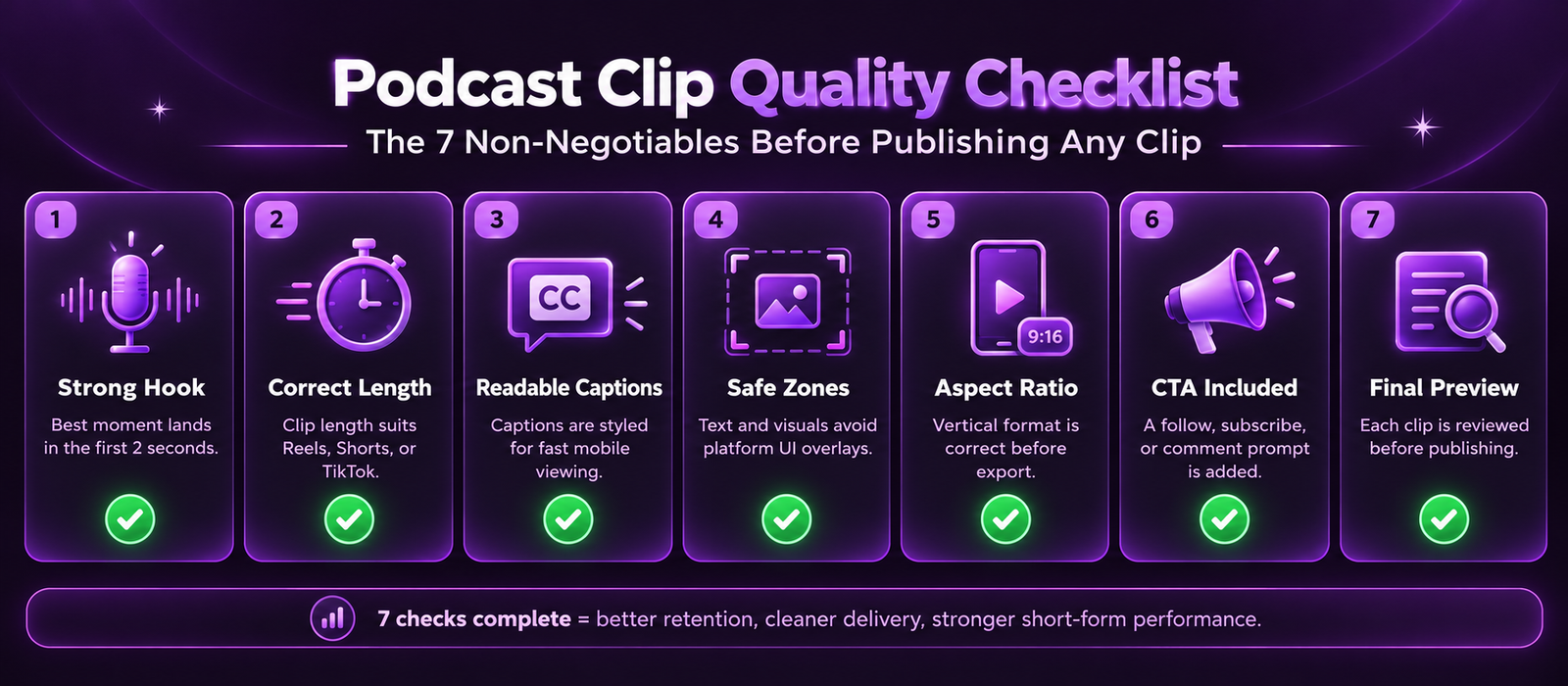
Short-form clips are the primary audience growth mechanism for most podcasts. These 7 checks apply to every clip before it is published on any social platform. For the complete clip editing workflow, the podcast to YouTube Shorts guide covers the step-by-step process.
18. Clip opens at the highest-energy moment: The clip does not open with context-setting or table-setting. The first spoken word is the most compelling statement in the clip. If needed, a bold title card has been added at frame zero identifying the clip's core topic or claim.
19. Clip length is 45–90 seconds: The clip is long enough to develop one complete point and short enough to maintain high completion rates. Clips under 30 seconds often feel incomplete for podcast content; clips over 2 minutes start to lose the Shorts algorithm distribution advantage.
20. Captions are present, accurate, and styled correctly: Word-by-word or phrase-by-phrase animated captions are applied to all spoken content. Caption accuracy has been reviewed, particularly for proper nouns, industry terms, and numbers. Font, size, and colour match the show's caption style guide. Captions are legible on a mobile screen without expanding the player.
21. 9:16 reframe is correctly applied: The clip has been exported at 1080×1920 pixels (9:16 vertical format). Speaker faces are correctly positioned within the vertical frame, not cut off at the top or pushed to the bottom. For two-speaker clips, a split-screen layout is used.
22. Podcast logo branding is present: The show's logo appears as a lower-third branding element in the bottom 15% of the frame. It does not cover the caption track. It is visible but does not dominate the frame.
23. Platform variants have been exported: In addition to the 9:16 vertical for TikTok, Reels, and YouTube Shorts, a 1:1 square variant (1080×1080) has been exported for LinkedIn and Facebook. Both variants have been checked for correct framing of the speaker(s).
24. At least 10 clips have been produced from the episode: The minimum clip volume for a growth-focused podcast is 10 per episode, enough for daily publishing across two platforms for 10 days without recycling content. A below-standard clip count indicates incomplete harvest of the episode's available content value.

Section 4: Show Notes Checklist (3 Items)

25. Opening paragraph is keyword-targeted: The show notes begin with a 150–200 word paragraph that naturally includes the episode's primary keyword and frames the content for both readers and search engine crawlers. Not a generic "In this episode we discuss..." opener.
26. Complete timestamp list is present: Every major topic transition in the episode has a corresponding timestamp in the format MM:SS or HH:MM:SS. Timestamps are formatted for YouTube chapter compatibility (they create clickable navigation in the video description). A minimum of one timestamp per 8–10 minutes of content.
27. All resources are linked: Every book, tool, person, company, or resource mentioned in the episode is linked in the show notes. Guest social profiles and website are included. No broken links, each link has been clicked and verified to load correctly before publishing.

Section 5: Thumbnail Checklist (2 Items)

28. Thumbnail is correctly sized and technically compliant: The primary YouTube thumbnail is 1280×720 pixels, saved as JPG or PNG, under 2 MB file size. An A/B variant with a different layout or headline approach has been prepared for CTR testing. Both variants have been reviewed on a mobile screen to confirm legibility at small thumbnail size.
29. Thumbnail text (if used) is correctly spelled and legible: Any text overlay on the thumbnail has been proofread, including the guest's name. Text is large enough to read in the YouTube search results grid at thumbnail size (minimum 10–12% of frame height for headline text). Contrast between text and background is sufficient for mobile screen legibility.

Want This 29-Point Checklist Applied to Every Episode by a Dedicated Editor?

Futuristic Marketing Services applies the complete quality standard to every podcast episode, audio mastering, full video, 10–15 clips, show notes, and thumbnail, with SLA-backed turnaround.

Get Podcast Editing Started

Frequently Asked Questions

Q. How long should the pre-publication quality check take?

A. A systematic review against this 29-point checklist takes approximately 20–30 minutes for an experienced editor who has applied it consistently. The first few applications of any checklist take longer as the reviewer becomes familiar with each check and where to look for each issue. After 10–15 episodes of consistent use, the checklist review becomes a fast, systematic final pass rather than a laborious inspection. The time investment is recovered many times over by preventing audience-facing quality failures that damage show credibility and listener retention.

Q. What are the most commonly missed items on this checklist?

A. The five most commonly missed items are: incorrectly spelled guest names in lower thirds (number one cause of published errors requiring correction), missing or incorrectly timed chapter markers (frequently set to approximate timestamps rather than the exact topic transition frame), captions not reviewed for accuracy after AI generation (AI transcription errors at 5–10% of words pass unnoticed without a dedicated review pass), clip count below 10 per episode (teams habitually produce 3–5 clips when 10–15 are achievable from the same recording), and show notes missing keyword structure in the opening paragraph (generic summaries that provide no SEO value). The best podcast editing services guide covers how to evaluate whether a current editing service is applying this standard consistently.

Professional Podcast Editing That Passes All 29 Quality Checks Every Episode

Futuristic Marketing Services produces every podcast episode to the complete professional standard, full episode video, 10–15 clips, audio master, SEO show notes, and thumbnail.

Start Your Podcast Editing


Conclusion

A checklist does not make a podcast editor, but it does make an editor's work consistently excellent. Every quality failure that reaches publication could have been caught with a systematic final review. The 29 items in this checklist cover every dimension of a professional podcast episode: the audio quality that determines whether listeners stay, the video production that determines how the episode performs on YouTube, the clip quality that determines how much new audience the episode reaches on social platforms, and the show notes and thumbnail that determine how discoverable the episode is through search.
For the complete production standard behind each checklist item, including the technical specifications for audio mastering, the clip editing workflow, and the show notes SEO framework, the podcast video editing service guide provides the full reference.
Share this post :
Picture of Devyansh Tripathi
Devyansh Tripathi

Devyansh Tripathi is a digital marketing strategist with over 5 years of hands-on experience in helping brands achieve growth through tailored, data-driven marketing solutions. With a deep understanding of SEO, content strategy, and social media dynamics, Devyansh specializes in creating results-oriented campaigns that drive both brand awareness and conversion.

All Posts