Custom Website Development: When to Go Bespoke and What It Costs

custom website development

Custom website development is the process of building a website or web application from scratch using code, without relying on a pre-built CMS or hosted platform as the foundation. The result is a codebase written specifically for the client requirements with no platform constraints on design, functionality, or scalability. Custom development is the highest-investment, highest-ceiling approach, and it is the correct choice for a specific, relatively small subset of projects. For the vast majority of business websites, established platforms deliver equivalent outcomes at 10 to 20 percent of the cost.

This guide provides the honest framework for custom website development decisions, when it is genuinely justified, when it is not, realistic cost benchmarks by project type, the technology stack options and when each is appropriate, the development process, and the most common failure modes that turn custom projects into expensive disasters. If you are evaluating custom development for a new project, this guide gives you the questions to ask and the data to evaluate the answers.

Key Takeaways

  • 90 percent or more of business website requirements, marketing sites, eCommerce stores, content platforms, service business sites, are served by WordPress, WooCommerce, Shopify, or Webflow at a fraction of custom development cost.
  • Custom development is genuinely justified for: SaaS applications and web products where the site IS the product; unique business logic no platform plugin can implement; regulatory requirements demanding specific security architecture; or performance requirements above 90 Lighthouse that no page builder platform can achieve.
  • The most expensive website development mistake is commissioning custom development for requirements that a platform handles, then discovering after delivery that the ongoing maintenance cost is 3 to 5 times what a platform would have cost annually.
  • Custom development projects that fail most often do so because of vague specifications, single-developer dependency with no documentation, deferred performance engineering, or no staging environment, not because of the technology choice.
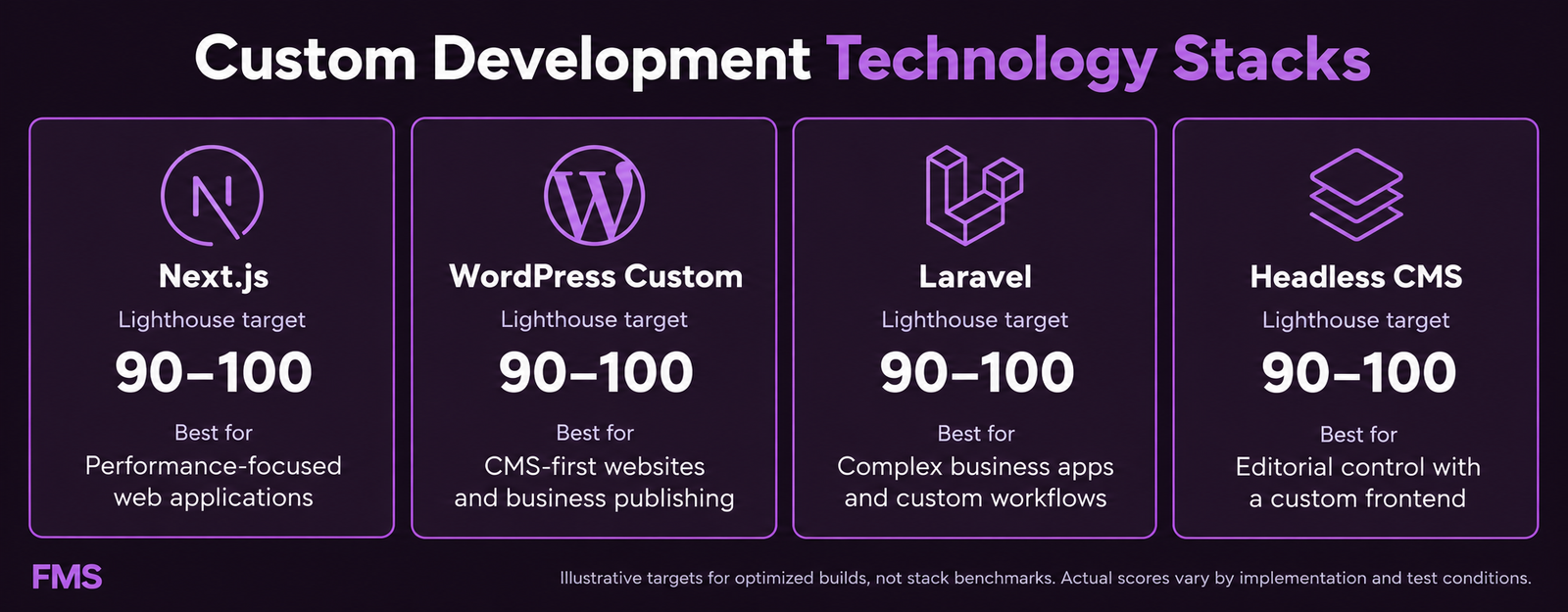
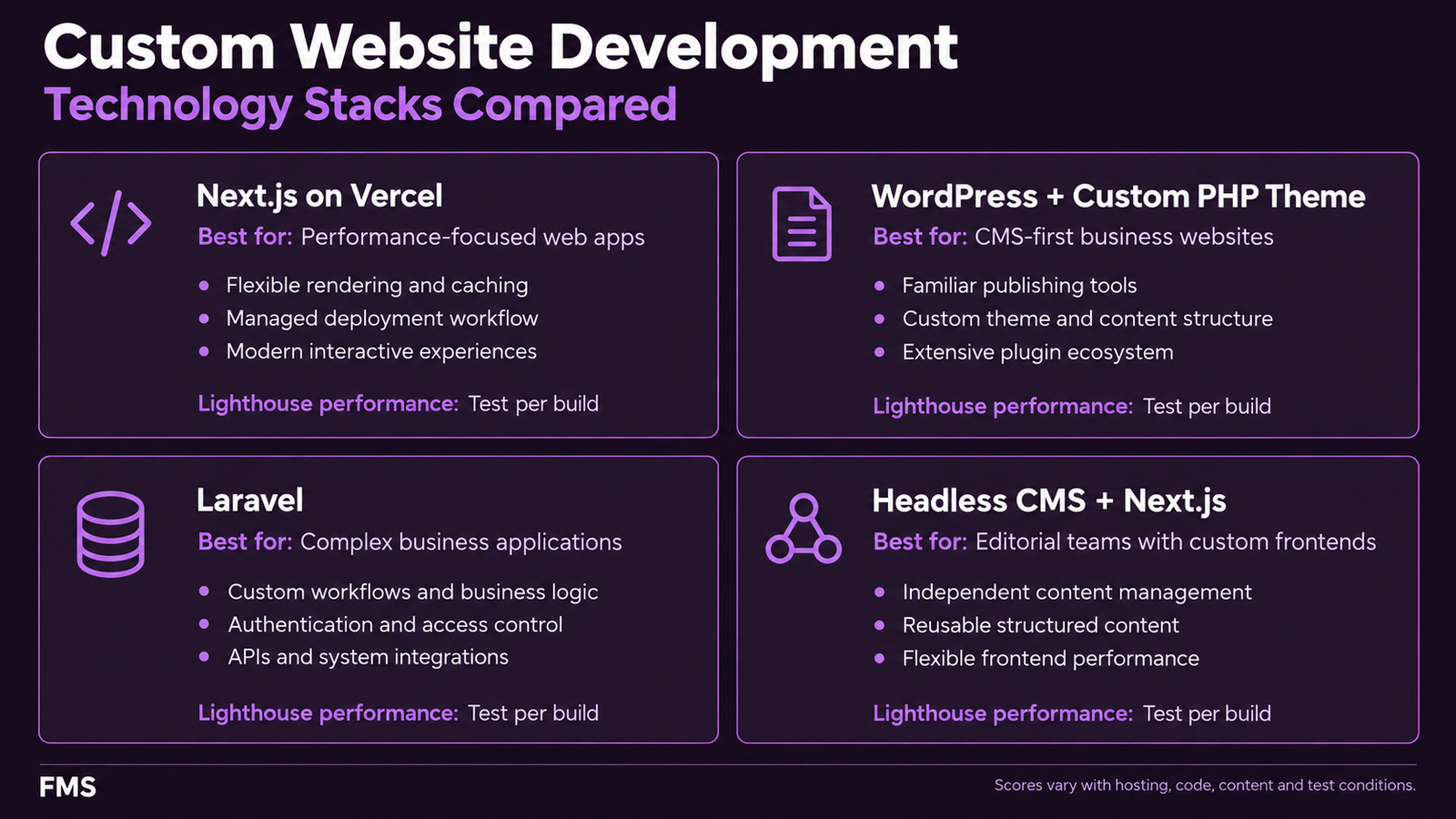
  • Next.js on Vercel is the technology stack of choice for performance-critical custom builds, achieving 90 to 98 on mobile Lighthouse from the edge network. WordPress custom themes achieve 85 to 95 on managed hosting. Both significantly outperform page builder platforms. See our Core Web Vitals guide.
  • The total cost of a custom web application includes not just the build, which typically receives 100 percent of the budget attention, but ongoing maintenance development at 25 to 50 percent of build cost annually, hosting infrastructure, and monitoring.
  • Headless CMS with a Next.js front-end is the hybrid approach that delivers custom performance with non-technical content management, a strong middle ground for businesses that need 90 or higher Lighthouse but also need editors to manage content without developer involvement.

Evaluating a Custom Development Project?

Get an Honest Platform vs Custom Assessment

Futuristic Marketing Services gives honest platform versus custom development assessments, recommending the approach that best serves your goals and budget, not the most expensive option.

Get a Free Consultation

When Custom Development Is and Is Not Justified

The decision to build custom should be made after genuinely confirming that no platform meets the requirement, not as a default assumption based on a preference for ownership or a belief that custom is more professional. Platforms are more professional than custom development for the vast majority of requirements, because they are maintained by dedicated engineering teams, tested across millions of installations, and benefit from continuous improvement. Custom development is professional for the requirements that platforms genuinely cannot meet.
Scenario Custom Justified? Why or Why Not
We want a unique design No WordPress with a custom theme or Webflow deliver completely unique designs at a fraction of custom development cost. Design uniqueness is not a custom development requirement.
We want to own the code No WordPress is open-source, you own every file. WooCommerce is fully portable. Platform ownership without custom development is available.
We need it to scale to high traffic No WordPress on managed hosting scales to millions of page views. Shopify scales to enterprise eCommerce. Scaling is a hosting challenge, not a custom code requirement.
We have complex pricing logic Maybe Evaluate platform plugins first. Custom if the logic is genuinely too complex for any plugin to implement.
The website is a SaaS product Yes A SaaS application with user accounts, subscriptions, and product-specific data models is a web application, not a website. Custom development is the correct path.
We need proprietary ERP integration Yes No platform plugin can know your internal system API. Custom integration code is required.
We need 95 or higher Lighthouse performance Yes (or headless) Page builder platforms cannot exceed 75 to 85. Custom or headless Next.js achieves 90 to 98.
We have unique regulatory requirements Yes Specific security architecture for financial services or healthcare data may require custom implementation.

The Platform First Principle

Before any custom development decision, document the specific requirement that platforms cannot meet. Not a preference, not a general desire for flexibility, not a belief that custom is better, a specific documented requirement with a specific reason why WordPress, WooCommerce, Shopify, and Webflow each fail to meet it. If this documentation cannot be produced, the project should be built on a platform. If it can, custom development is justified.

Custom Development Cost Benchmarks

Project Type Build Cost Annual Maintenance Timeline
Custom WordPress theme (bespoke PHP) £8,000 to £25,000 £3,000 to £8,000 per year 4 to 10 weeks
Small custom web application £30,000 to £100,000 £15,000 to £40,000 per year 3 to 6 months
Medium custom web application £80,000 to £250,000 £30,000 to £80,000 per year 6 to 12 months
Enterprise platform £200,000 to £2,000,000 or more £100,000 to £500,000 per year 12 to 24 or more months
Headless eCommerce (Shopify plus Next.js) £50,000 to £200,000 £15,000 to £40,000 per year 3 to 6 months
Headless CMS plus Next.js marketing site £25,000 to £80,000 £8,000 to £25,000 per year 2 to 5 months
The maintenance cost, frequently omitted from custom development discussions, is the most important cost consideration for long-term projects. A £60,000 custom web application requires £15,000 to £30,000 per year in maintenance development to remain compatible with framework updates, security patches, and feature additions. Over 5 years, the total cost of ownership of a custom application is typically 2 to 3 times the initial build cost. Budget for the lifecycle, not just the build.

Technology Stack Options for Custom Development

Stack Best For Mobile Lighthouse Key Strength When to Choose
Next.js (React) on Vercel Marketing sites to complex web applications requiring top performance 90 to 98 Best-in-class edge performance; React ecosystem; ISR and SSG Performance is a hard requirement; team has React expertise; SaaS products
WordPress custom PHP theme Content-driven sites; eCommerce; CMS-first applications 80 to 92 Complete CMS flexibility; largest plugin ecosystem Clients need non-technical content management; eCommerce with WooCommerce
Laravel plus custom front-end Complex business applications; data-heavy back-ends Application-dependent Powerful MVC framework; Eloquent ORM; API-first architecture PHP teams; complex business logic; API back-ends for mobile apps
Headless CMS plus Next.js Marketing sites needing editorial control plus developer performance 90 to 96 Non-technical content editing with developer-controlled performance Marketing teams need content control; performance above 88 Lighthouse required

The Staging Environment Requirement

Any custom development project that does not include a staging environment, an identical copy of the production site where all development and testing happens before deployment, is being built dangerously. Changes go live on the production site without testing. A broken deployment takes the live site down until fixed. There is no rollback mechanism. A staging environment is the minimum viable professional infrastructure for any custom project, alongside Git version control with branch-based deployment. These are non-negotiable requirements to include in any custom development brief. See our website UX audit guide for the post-launch quality framework.

Evaluating Custom vs Platform for Your Project?

Honest Assessment, Platform or Custom, Based on Your Actual Requirements

Futuristic Marketing Services builds both platform-based and custom sites. We recommend the approach that best serves your goals, never the most expensive option.

Get Your Free Project Assessment

Frequently Asked Questions About Custom Website Development
What is custom website development?

Custom website development is building a website or web application from scratch using code, without relying on a pre-built CMS or hosted platform. Every template, every function, and every integration is written specifically for the project requirements. Custom development removes all platform constraints on design, functionality, and scalability, but adds cost and ongoing maintenance responsibility that platforms handle automatically. For most business websites, established platforms like WordPress or Shopify deliver equivalent outcomes at 10 to 20 percent of custom development cost.<

When should I choose custom development over a platform?

Custom development is justified when: the site IS the product (SaaS applications, marketplaces, data portals with complex user account structures); functionality genuinely cannot be delivered by any platform plugin; performance above 90 Lighthouse is a hard requirement and a headless approach is not acceptable; or regulatory requirements demand specific security architecture. For the vast majority of marketing sites, eCommerce stores, and content sites, WordPress, WooCommerce, Shopify, or Webflow are the correct choice.

How much does custom website development cost in the UK?

Custom website development in the UK in 2026 ranges from £8,000 for a custom WordPress theme to £2,000,000 or more for a large enterprise platform. The most common custom web application build, user accounts, database, API integrations, React front-end, costs £30,000 to £100,000. Add 25 to 50 percent of the build cost annually for maintenance. The total cost of ownership over 5 years for a £60,000 custom application is typically £120,000 to £180,000. Always budget for the full lifecycle.

What technology stack should I use for a custom website?

For performance-critical marketing sites and web applications, Next.js on Vercel achieves 90 to 98 on mobile Lighthouse, the highest performance available. For CMS-first sites where non-technical editors manage content, WordPress custom theme plus WooCommerce is the strongest combination. For complex business back-end logic with a PHP team, Laravel. For editorial control with top-end performance, a headless CMS (Contentful, Sanity) with a Next.js front-end. See our Core Web Vitals guide.

What is headless website development?

Headless website development separates the content management back-end from the presentation front-end. A headless CMS (WordPress used as a back-end, Contentful, Sanity) stores and serves content via API. A separate front-end application (Next.js, Gatsby, Astro) fetches the content and renders it as HTML, typically as pre-built static pages served from a CDN edge. The result is 90 to 98 Lighthouse performance with non-technical content management. Headless is the recommended approach for businesses that need both editorial flexibility and top-end performance.

How long does custom web development take?

A custom PHP WordPress theme takes 4 to 10 weeks. A small custom web application takes 3 to 6 months. A medium application takes 6 to 12 months. Enterprise platforms take 12 to 24 or more months. The most common cause of overrun is scope change during development, requirements that expand after the specification is signed off. A well-written specification and a formal change request process prevent the majority of timeline and budget overruns.

What is a specification for a custom development project?

A specification (or functional spec) is a document that precisely defines every function the custom site or application must perform, inputs, outputs, integrations, data models, user flows, and edge cases. A good specification removes ambiguity from the development process. Every decision that must be made without a specification gets made by the developer according to their interpretation, and developers interpret requirements differently from business owners. The specification phase typically takes 5 to 20 percent of total project cost but prevents the majority of budget overruns.

Who owns the code in a custom development project?

The client should own 100 percent of the code, database, and all associated assets. All source code should be committed to a Git repository owned by the client from day one, not held in the developer account. Credentials for hosting, domain, analytics, and all third-party services should be in the client account. IP ownership and code transfer should be explicitly stated in the development contract. Never begin a custom development project without confirming these ownership terms in writing.

What is the difference between custom development and using a CMS?

A CMS (Content Management System) like WordPress provides a pre-built foundation, content editing interface, user management, plugin architecture, and database structure, that custom themes and plugins extend. Pure custom development builds these foundation layers from scratch. Using a CMS (custom theme on WordPress) is usually the better choice because the CMS handles the 80 percent of requirements that are universal across websites, content management, user roles, SEO infrastructure, allowing custom development effort to focus on the 20 percent that is specific to the project.

What is a staging environment and why is it required?

A staging environment is an identical copy of the production website used for development and testing before changes go live. All development work happens on staging; only tested, approved changes are deployed to production. Without a staging environment, every change is made directly on the live site, introducing breakage risk on every deployment. Professional custom development requires staging with Git version control and a documented deployment process. It is not an optional extra, it is the minimum viable infrastructure for any custom project.

Can I migrate from a custom site to a platform later?

Yes, migrating from a custom site to WordPress or Shopify is common when a business decides the ongoing maintenance cost of custom development exceeds the value of the functionality it provides. The migration involves: rebuilding the design and functionality in the target platform; migrating content from the custom database; setting up 301 redirects from all old URLs; and verifying analytics and tracking continuity. A well-executed migration preserves search rankings. An improperly managed one, missing redirects, changed URL structures, can cause significant ranking loss.

What questions should I ask a custom development agency?

Key questions for evaluating a custom development agency: Who owns the code and credentials from day one? Does the project include a staging environment and Git version control? What is the deployment process? How do you handle the specification phase? What testing is included? How are post-launch bugs handled? What is the ongoing maintenance arrangement? What is your approach to Core Web Vitals performance targets? See our hire a WordPress developer guide for the complete evaluation framework, which applies to custom development agencies as well.

Futuristic Marketing Services

Build the Right Site, Platform or Custom, With the Right Team

Futuristic Marketing Services delivers honest project assessments and executes the correct approach for each client, whether that is a WordPress build, a custom theme, a WooCommerce store, or a full custom web application.

Start Your Project Assessment

The Right Foundation for the Right Project

Custom website development is not inherently better than platform-based development, it is appropriate for a specific subset of requirements where platforms genuinely cannot deliver the required functionality or performance. For the majority of business websites, WordPress, WooCommerce, Shopify, or Webflow deliver better outcomes than custom development: faster time to market, lower ongoing maintenance cost, and the security and reliability of platforms maintained by large dedicated engineering teams.
When custom development is justified, SaaS products, unique business logic, specific regulatory requirements, maximum performance requirements, the investment is right. But the decision should be made on the basis of documented specific requirements that platforms cannot meet, not on a general preference for ownership or a belief that custom is more professional. The most expensive mistake in web development is building custom when a platform would have served equally well.
For the platform evaluation framework, see our WordPress vs Wix vs Squarespace guide. For the eCommerce platform decision, see our WooCommerce vs Shopify comparison. For the developer evaluation process, see our hire a developer guide.
Share this post :
Picture of Devyansh Tripathi
Devyansh Tripathi

Devyansh Tripathi is a digital marketing strategist with over 5 years of hands-on experience in helping brands achieve growth through tailored, data-driven marketing solutions. With a deep understanding of SEO, content strategy, and social media dynamics, Devyansh specializes in creating results-oriented campaigns that drive both brand awareness and conversion.

All Posts