How to Choose the Right Social Media Platform for Your Business

best social media platform for business

The best social media platform for your business is the one where your specific target audience spends time and where your content format strengths align with what the platform distributes most widely. Facebook and Instagram suit most consumer-facing businesses. LinkedIn is the correct choice for B2B companies and professional services. YouTube delivers the best long-term returns for businesses that can commit to consistent video production.

This guide compares the six major social media platforms in detail, covering audience demographics, content formats, business use cases, and the types of results each platform produces for different business categories. You will find a complete platform comparison table, a business-type recommendation guide that matches specific industries to their strongest platforms, a five-step decision framework for choosing your starting combination, and the most effective platform pairings that experienced marketers use to balance reach with relationship-building. By the end, you will have a clear, data-backed platform selection decision for your specific business rather than a generic recommendation that ignores the critical differences between business types, audience profiles, and content capabilities.

Key Takeaways

  • Platform selection must be driven by where your specific target audience is most active, not by which platform you personally prefer or which one currently receives the most media attention.
  • According to RecurPost, LinkedIn generates 80% of all B2B social media leads, making it the clear choice for any business targeting other businesses or professional decision-makers.
  • Facebook remains essential for most consumer businesses, with over 3 billion monthly active users and the most sophisticated paid advertising targeting system available on any social platform.
  • Instagram is the primary product discovery platform for 61% of its users, making it indispensable for consumer brands, retailers, and any business where visual storytelling drives purchasing decisions.
  • Start with two platforms and build genuine quality and consistency on both before expanding. Every additional platform added without sufficient production capacity dilutes quality across all of them.
  • Content format capability is as important as audience demographics. A business that cannot produce quality short-form video should prioritize platforms where carousel and written content also generate strong organic reach.
  • The strongest platform combinations pair one high-reach discovery platform such as Instagram Reels or YouTube Shorts with one relationship-building platform such as LinkedIn or Facebook Groups.

Not Sure Which Platforms Are Right for Your Business?

Get a Free Platform Audit and Social Media Strategy

Futuristic Marketing Services analyzes your target audience, business type, and content capabilities to identify the exact platforms and strategy that will produce the strongest results for your specific business.

Get Your Free Platform Audit
Why Platform Selection is the Most Important Social Media Decision

Every hour your team spends creating content, every rupee invested in advertising, and every piece of creative effort your business puts into social media is filtered through one critical variable: whether those resources are being deployed on the platforms where your target customers are actually spending time. Getting this decision wrong does not just produce weak results; it produces invisibility in front of audiences who are not your potential customers while your actual target audience is active elsewhere and your competitors are reaching them there.
Platform selection is the decision that determines the ceiling on every other social media marketing effort. A technically perfect content strategy executed on the wrong platforms will always underperform a modest strategy executed on the right ones. This is why experienced marketers analyze platform demographics, content format performance, and business type alignment before creating a single piece of content, and why social media marketing strategy documents always address platform selection as a foundational decision rather than an afterthought.

The Real Cost of Being on the Wrong Platform

The cost of wrong platform selection is not just wasted time and budget. It is the opportunity cost of months spent building an audience that has no commercial relationship with your business. A B2B professional services firm that invests six months in Instagram while neglecting LinkedIn does not just miss leads on LinkedIn. It actively builds a following of consumers who are never going to become clients, creating metrics that look acceptable on a social media report while producing zero contribution to the business development pipeline.
Wrong platform selection also produces a misleading data signal that can persist for months. If a business chooses a platform because it feels familiar and generates modest engagement from the wrong audience, it may interpret that engagement as evidence that social media "is working" while missing the far stronger results that would be available on the correct platform. The absence of comparison data from the right platform is what makes this error so difficult to self-diagnose without external guidance from someone who has seen the same mistake across multiple businesses and industries.
For a foundational understanding of what social media marketing is and what each major platform type can realistically deliver for a business, our guide on what is social media marketing covers the complete definition, platform overview, and business application context before any platform selection decision is made.

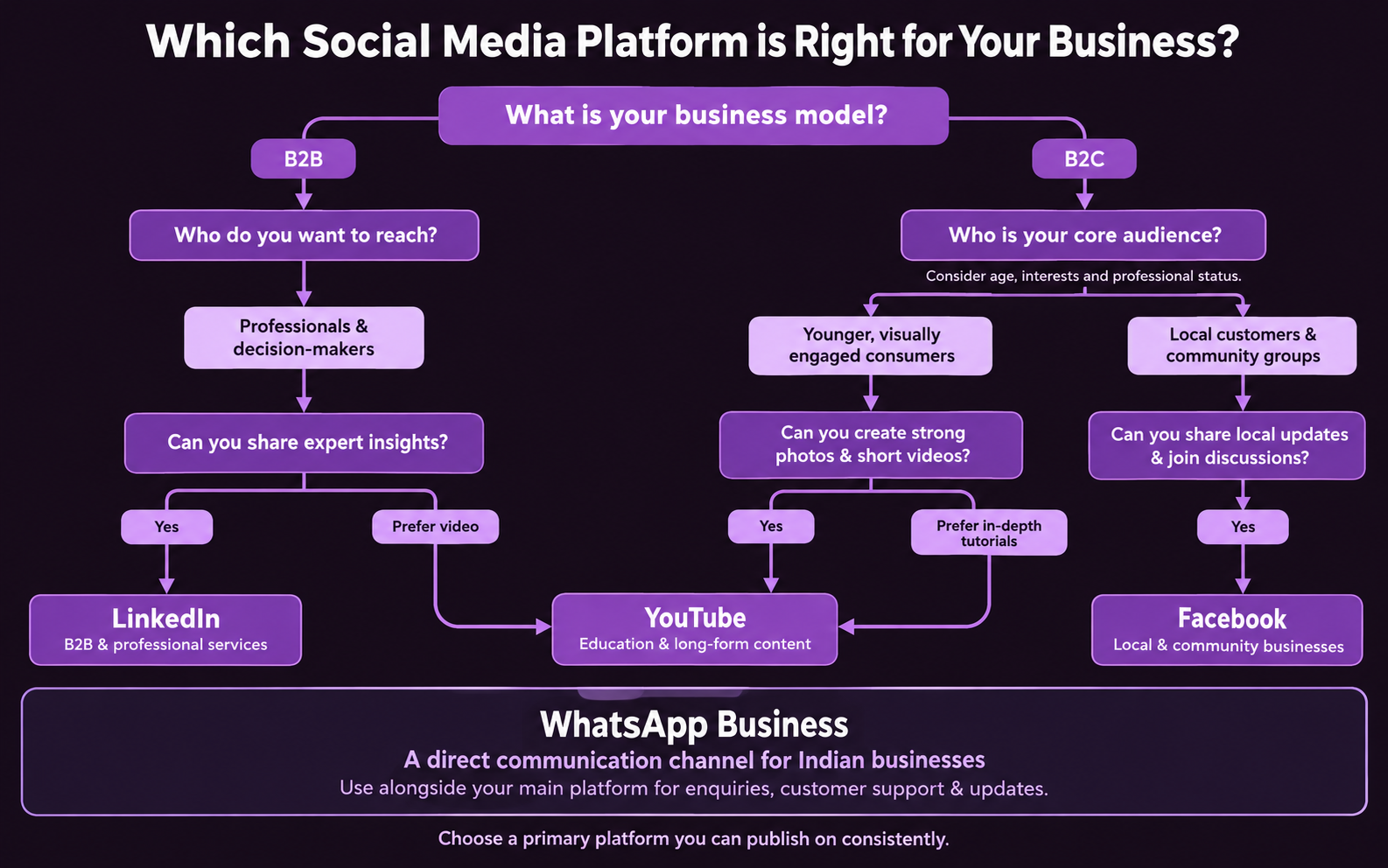
The 4 Questions That Should Drive Every Platform Selection Decision

Before evaluating any individual platform, every business should answer four questions that eliminate emotionally-driven or trend-following platform choices and replace them with decisions grounded in audience reality, content capability, and business objective alignment.
The first question is: where does my specific target audience spend the most time on social media? The answer to this is found through customer research, not assumption. Survey existing customers about which platforms they use most actively. Check competitor accounts to see which platforms generate the strongest engagement from the shared audience. Review platform demographic data to match your target customer profile against the actual user base of each platform you are considering.
The second question is: what content formats can my business produce consistently and at a quality standard that reflects well on the brand? A business with no video production capability should not prioritize YouTube or TikTok as primary platforms. A business with strong visual design skills and product photography should prioritize Instagram. A business whose founder writes compelling long-form professional content should prioritize LinkedIn. Matching content format strengths to platform preferences eliminates the common trap of choosing a platform where success requires a content format the business cannot realistically sustain.
The third question is: what specific business goal will this platform advance? Brand awareness goals, lead generation goals, community building goals, and direct sales goals each have platform profiles that align most effectively with their achievement. Understanding which goal each platform serves best prevents the confusion of expecting a platform to deliver an outcome it is not structurally designed to produce. The fourth question is: what resources can the business realistically commit to this platform consistently for the next 90 days? Every platform selected is a commitment of time, creative resources, and attention. A platform that requires more of these than the business can genuinely provide will be under-resourced and will produce results that reflect that underinvestment rather than the platform's actual potential for that business type.

The 6 Major Social Media Platforms: A Complete Business Decision Guide

Each major social media platform serves different audiences, rewards different content formats, and produces different types of business outcomes. Understanding these differences in detail is what makes platform selection a strategic decision rather than a popularity contest. The profiles below cover each platform's current user base, the types of businesses it suits most effectively, the content formats it rewards most, and the primary business outcomes it is best positioned to deliver.

Facebook, The Community and Advertising Powerhouse

Facebook remains the largest social media platform in the world with 3.07 billion monthly active users, according to Buffer's social media platform research. In India specifically, Facebook has 378 million users, making it the single largest social media platform in the country by user base. Despite consistent predictions of its decline over the past decade, Facebook has maintained its position as the platform most critical for local businesses, community-oriented brands, and businesses running paid advertising campaigns targeting adults aged 25 and above.
Facebook's primary strength for business is the depth of its advertising and targeting system, which is the most sophisticated available on any social platform. The ability to target by age, location, interests, behaviors, income level, life events, and custom audiences built from website visitors or existing customer lists gives businesses unmatched precision in reaching their ideal buyer profile through paid campaigns. For organic content, Facebook Groups have emerged as the highest-engagement surface on the platform, giving community-focused businesses a way to build deeply engaged audiences around shared interests rather than competing for declining organic feed reach.
According to Sprout Social's 2026 Social Media Content Strategy Report, 52% of consumers identify Facebook as their top platform for community building, and 85% of consumers maintain active Facebook profiles across all generational groups. These figures confirm that despite the platform's age, its audience depth and advertising infrastructure make it irreplaceable for most consumer-facing businesses as both an organic and paid channel.
Facebook is the right primary platform for local businesses of every type, service businesses targeting adults over 25, community-driven brands, healthcare and education businesses, and any business whose primary growth driver is paid advertising rather than organic content virality.

Instagram, The Visual Commerce and Discovery Platform

Instagram has grown to 3 billion monthly active users and has become the primary product discovery channel for a significant portion of its audience. Research cited by RecurPost shows that 61% of Instagram users actively discover new products on the platform, making it the most effective social media channel for consumer brands that want to be found by audiences who are not yet aware of them. This discovery function, combined with Instagram's high-engagement visual format and Reels-driven organic reach, makes it the strongest platform for most consumer-facing businesses with compelling visual content.
Instagram Reels is the platform's highest-reach format by a significant margin. Reels are distributed to non-followers more aggressively than any other content type on the platform, making them the primary vehicle for organic audience growth. Businesses that consistently publish Reels aligned with their target audience's interests regularly achieve reach figures that are five to ten times larger than their follower count, which is the mechanism that makes Instagram the most effective organic growth platform for visual businesses without a paid advertising budget.
Instagram is the right primary platform for fashion, food, fitness, beauty, interior design, travel, retail, coaching, photography, and any consumer-facing business where visual storytelling is central to the brand identity and customer experience. It performs less effectively for B2B businesses, industrial companies, and professional services firms whose target audience is primarily LinkedIn-active rather than Instagram-active.

LinkedIn, The B2B Lead Generation and Thought Leadership Channel

LinkedIn is the most commercially effective platform for B2B businesses and professional services firms, generating 80% of all B2B social media leads according to data published by LinkedIn Marketing Solutions and referenced by RecurPost's 2026 platform analysis. The platform hosts over 1 billion members globally including 63 million decision-makers and 10 million C-suite executives, giving B2B marketers direct access to the specific individuals who authorize purchasing decisions within their target organizations, an audience concentration that no other social media platform approaches.
LinkedIn's visitor-to-lead conversion rate of 2.74% is nearly three times higher than Facebook or Twitter X, making it the most efficient social media channel for converting content engagement into qualified business enquiries. The platform's organic reach is also disproportionately favorable for business accounts: data from Buffer confirms that only 1% of LinkedIn users post content regularly, creating unusually low content saturation that gives individual posts significantly higher visibility and engagement opportunity than the same post would achieve on more crowded platforms like Instagram or Facebook.
According to Sprout Social, nearly 70% of LinkedIn users engage with brand content at least once a week, and the platform now generates B2B leads at 28% lower cost than paid search advertising for comparable targeting precision. After three years of consistent LinkedIn activity, research from FirstPageSage shows the platform delivers 229% ROI for organic social and 192% ROI for paid social, the strongest long-term return figures available for any single social platform.
LinkedIn is the right primary platform for B2B services of every type, consultants, agencies, professional services firms, software and technology businesses, recruitment, legal, financial, and any business whose primary buyer is a working professional or organizational decision-maker rather than a general consumer.

YouTube, The Long-Term Search-Driven Content Platform

YouTube holds a unique position in the social media landscape as both a social platform and the world's second largest search engine after Google. With 2.6 billion monthly active users, it is the only social platform that achieves near-universal adoption across every generational group: 91% of Gen Z, 90% of Millennials, 83% of Gen X, and 69% of Baby Boomers use YouTube, making it the single most versatile platform for businesses that need to reach diverse age groups with a unified content strategy.
YouTube content has a dramatically longer lifespan than content on any other social platform. A well-optimized tutorial, product demonstration, or educational video published on YouTube continues attracting organic views, subscribers, and leads for months or years after publication through both YouTube's internal search engine and Google's search results, which regularly surface YouTube videos in response to informational queries. This compounding discovery effect makes YouTube the highest-return content investment over a 12 to 24 month timeframe for businesses that can commit to consistent video production.
YouTube Shorts, the platform's short-form video format, has grown to 200 billion daily views and is distributed with the same aggressive organic reach mechanics as Instagram Reels and TikTok, giving businesses a discovery-driven content format that complements the depth and longevity of long-form YouTube content. YouTube is the right platform for education businesses, software companies, home improvement and DIY businesses, finance and legal services, coaching and training businesses, and any business type where product demonstrations or detailed educational content build meaningful purchasing confidence that shorter content formats cannot achieve.

Twitter X, The Real-Time Conversation and News Platform

Twitter X serves a fundamentally different function from every other major social platform. Where other platforms are primarily content consumption and community environments, Twitter X is a real-time conversation and news distribution channel. This distinction determines which businesses benefit most from it and which ones waste resources attempting to build the kind of audience and engagement on Twitter X that the platform's structure is simply not designed to produce.
Twitter X is most effective for businesses that have strong opinions on rapidly evolving industry topics, that need real-time visibility during live events or news cycles relevant to their audience, or that benefit from being perceived as fast-moving and current within their field. Technology companies, media organizations, political organizations, financial services brands, and thought leaders who regularly comment on breaking developments in their industry consistently generate disproportionate visibility on the platform compared to brands that use it primarily for scheduled promotional content.
Twitter X is a lower priority for most consumer businesses, local service providers, and industries where product quality and relationship trust matter more than speed-of-commentary. For these businesses, the time and creative energy required to maintain an active, engaging Twitter X presence produces lower returns than the same investment would generate on Facebook, Instagram, or LinkedIn. Twitter X performs best as a secondary platform for businesses that have already built strong foundations on their primary channels.

WhatsApp Business, The Direct Customer Communication Channel

WhatsApp Business occupies a category distinct from other social media platforms because it functions primarily as a direct customer communication and retention tool rather than a content discovery or audience-building channel. With 3 billion monthly active users globally and India representing one of the largest WhatsApp markets in the world, WhatsApp Business is an essential tool for Indian businesses across virtually every industry sector.
The platform's strengths for business marketing are its extremely high message open rates compared to email (WhatsApp messages achieve open rates above 90% compared to email's 20 to 30%), its direct access to opted-in customers without algorithmic filtering of who sees each message, and its catalog feature that allows businesses to showcase products or services directly within the messaging interface. WhatsApp Business is most effective as a retention and conversion channel for existing customers and warm leads rather than as a discovery platform for reaching new audiences who have never encountered the brand.
Every Indian business that has direct customer relationships should have an active WhatsApp Business account regardless of which other social platforms they use, because the direct communication channel it provides serves a different function than any other platform in the strategy stack. Our social media management services include WhatsApp Business setup and broadcast strategy as part of complete social media management packages for Indian businesses.

Social Media Platform Comparison Table for Business Decision-Making

The table below consolidates the key business decision variables for each major platform into a single reference that allows side-by-side comparison. Use this table alongside the detailed platform profiles above to identify the two platforms that most closely match your target audience demographics, content capabilities, and primary business goal before making your final selection decision.
Platform Monthly Active Users Primary Audience Age Best Business Model Top Content Formats Primary Business Outcome Organic Reach Difficulty
Facebook 3.07 billion 25 to 55+ B2C, local businesses, services, community brands Video, Groups posts, live video, paid ads Community building, local awareness, lead generation via paid ads High for feed posts; low for Groups
Instagram 3 billion 18 to 44 Visual consumer brands, D2C, lifestyle, retail, coaching Reels, carousels, Stories, product tags Product discovery, brand awareness, direct sales via shopping Low for Reels; medium for feed posts
LinkedIn 1 billion+ 25 to 55 B2B services, consulting, agencies, professional services Text posts, carousels, native video, articles, newsletters B2B lead generation, thought leadership, professional network building Low, only 1% of users post regularly
YouTube 2.6 billion All ages (91% Gen Z to 69% Boomers) Education, software, coaching, home improvement, finance, tech Long-form tutorials, YouTube Shorts, product demos, reviews Long-term brand authority, organic search discovery, deep trust building Low for Shorts; medium for long-form
Twitter X 300 million+ 18 to 49 Tech, media, finance, political, thought leadership brands Short text posts, threads, news commentary, live discussions Real-time brand visibility, thought leadership, industry engagement Variable, engagement highly conversation-dependent
WhatsApp Business 3 billion All ages; dominant in India All business types; essential for Indian local and service businesses Broadcast messages, product catalog, direct conversation Customer retention, direct sales to existing audience, service delivery No algorithm, direct delivery to opted-in contacts

Platform Recommendations by Business Type

Matching your business type to the correct platform combination is the fastest path to platform selection without extensive self-directed research. The recommendations in the table below are based on audience demographic alignment, content format strengths, and the types of business outcomes each platform consistently delivers for specific industry categories. Use your primary business type as the starting point, then validate the recommendation against your specific target audience profile and content capabilities before finalizing your selection.
Business Type Primary Platform Secondary Platform Why This Combination Works Avoid This Platform
B2B Services and Consulting LinkedIn YouTube LinkedIn reaches decision-makers directly; YouTube builds deep authority through educational content that converts researchers into enquiries TikTok, wrong audience demographic for professional services purchasing
Fashion, Beauty, and Lifestyle Brands Instagram YouTube Instagram Reels drives product discovery at scale; YouTube tutorials build deep brand trust and ongoing engagement with buyers researching before purchase LinkedIn, wrong platform for consumer lifestyle purchasing decisions
Local Service Businesses Facebook Instagram or WhatsApp Business Facebook Groups and local targeting reach the community audience most likely to convert; Instagram or WhatsApp handles direct enquiries and retention LinkedIn, professional network has minimal local consumer purchase intent
Food, Restaurant, and Hospitality Instagram Facebook Instagram visual content drives appetite appeal and new customer discovery; Facebook handles event promotion, local community engagement, and paid local targeting Twitter X, not aligned with food discovery or local booking behavior
Education and Online Coaching YouTube Instagram or LinkedIn YouTube free content builds trust and authority that converts to paid course enrollments; Instagram or LinkedIn reaches the specific audience segment by course topic Twitter X, insufficient depth for educational relationship building
Healthcare and Medical Clinics Facebook YouTube or Instagram Facebook reaches the adult demographic most actively making healthcare decisions; YouTube educational content builds the trust required for medical service conversion TikTok, demographic and content tone misalignment for healthcare trust-building
eCommerce and D2C Products Instagram Facebook Instagram Shopping drives product discovery and in-app purchasing; Facebook retargeting ads convert visitors who have already shown purchase intent LinkedIn, purchasing intent on LinkedIn is professional and B2B, not consumer product-focused
Real Estate and Property Facebook Instagram or YouTube Facebook Groups and paid targeting reach buyers in specific geographic areas effectively; Instagram and YouTube property tours and neighborhood content attract buyers in the research phase Twitter X, property purchase decisions are not driven by real-time commentary

The 5-Step Platform Selection Decision Framework

The platform selection decision framework below converts the qualitative guidance in this guide into a structured, reproducible decision process that produces a specific platform recommendation grounded in research rather than opinion. Work through each step in sequence before making your final platform selection.

Step 1: Map Your Target Audience to Platform Demographics

Begin by documenting your target audience's core demographic profile: age range, gender split if relevant, professional status, location, and income level. Then compare this profile against the demographic data for each platform you are considering. A target audience of business decision-makers aged 35 to 55 maps directly to LinkedIn's user base. A target audience of young urban consumers aged 18 to 30 maps to Instagram. A local adult consumer audience of any age maps most reliably to Facebook.
The demographic mapping exercise eliminates platforms where the mismatch is severe enough that no content strategy can overcome the fundamental audience absence. No amount of creative content quality will generate business results on a platform where the people who fit your buyer profile are not meaningfully present. Audience match is the non-negotiable foundation that every other platform decision is built on.

Step 2: Assess Your Content Format Strengths

Each platform rewards specific content formats above all others. Instagram's algorithm distributes Reels to non-followers far more widely than any other format. LinkedIn's algorithm rewards original text posts with personal perspective and practical insight above everything else. YouTube's discovery system rewards long-form educational content that directly answers searchable questions. Facebook's algorithm increasingly favors video content and Group activity over standard feed posts.
Honestly assess which content formats your business can produce consistently at a quality standard that reflects well on the brand. If your business has strong visual content capabilities, Instagram and YouTube are natural fits. If your founder can write compelling professional perspectives and industry insights, LinkedIn is the correct starting point. If your team is comfortable on camera and can produce weekly video content, YouTube should be part of the selection. Never choose a platform based on where you want to be if it requires a content format your business cannot realistically produce at the required quality level and frequency.

Step 3: Match Platforms to Your Primary Goal

Platform selection should be validated against the primary social media marketing goals your business is trying to achieve. Different platforms are structurally designed to produce different types of outcomes, and expecting a platform to produce an outcome it is not built for leads to persistent underperformance regardless of content quality.
Brand awareness at scale is best pursued through Instagram Reels, YouTube Shorts, and Facebook video, all of which have algorithm-driven distribution to non-followers. Direct B2B lead generation is most efficiently produced through LinkedIn organic content and LinkedIn advertising. Community building around shared interests is most effectively done through Facebook Groups. Long-term thought leadership and search-driven discovery are best built through YouTube and LinkedIn articles. Direct customer communication and retention in India is most efficiently managed through WhatsApp Business. Match your primary goal to the platform best designed to produce it before considering any secondary factors.

Step 4: Research Where Your Competitors Are Active

Competitor platform presence is valuable information but requires careful interpretation. If all major competitors are active on a platform and generating strong engagement from your shared target audience, that platform is validated as relevant for your market. If competitors are absent from a platform where your audience is active, that absence may represent an opportunity rather than evidence that the platform is unsuitable for the industry.
Look specifically at where competitors generate their highest engagement and most active follower communities, not just where they maintain accounts. Many businesses maintain inactive accounts on multiple platforms. The platforms where they invest significant creative resource and generate genuine audience response are the ones that are actually delivering results for that business type. Those platforms deserve priority consideration for your own strategy, with the additional angle of identifying what your competitors are doing poorly or ignoring entirely that your content could address more effectively.

Step 5: Commit to Two Platforms for 90 Days Before Expanding
The final step is committing to a maximum of two platforms for a 90-day trial period and evaluating performance with real data before adding any additional channels. This constraint prevents the platform proliferation that kills most new social media strategies by spreading creative resources across more channels than can be served with quality content and consistent engagement.
Select one primary platform where your target audience is most concentrated and your content format capabilities are strongest. Select one secondary platform that serves a complementary function, such as a discovery platform paired with a relationship-building platform. Build your entire strategy around these two platforms for 90 days. At the 90-day mark, review which platform is producing stronger results relative to your primary goal and make a data-informed decision about whether to expand, shift emphasis between platforms, or add a third channel. Our social media marketing agency uses this exact 90-day framework with every new client to establish a data foundation before making long-term platform investment decisions.

Platform Combination Strategies That Work Best Together

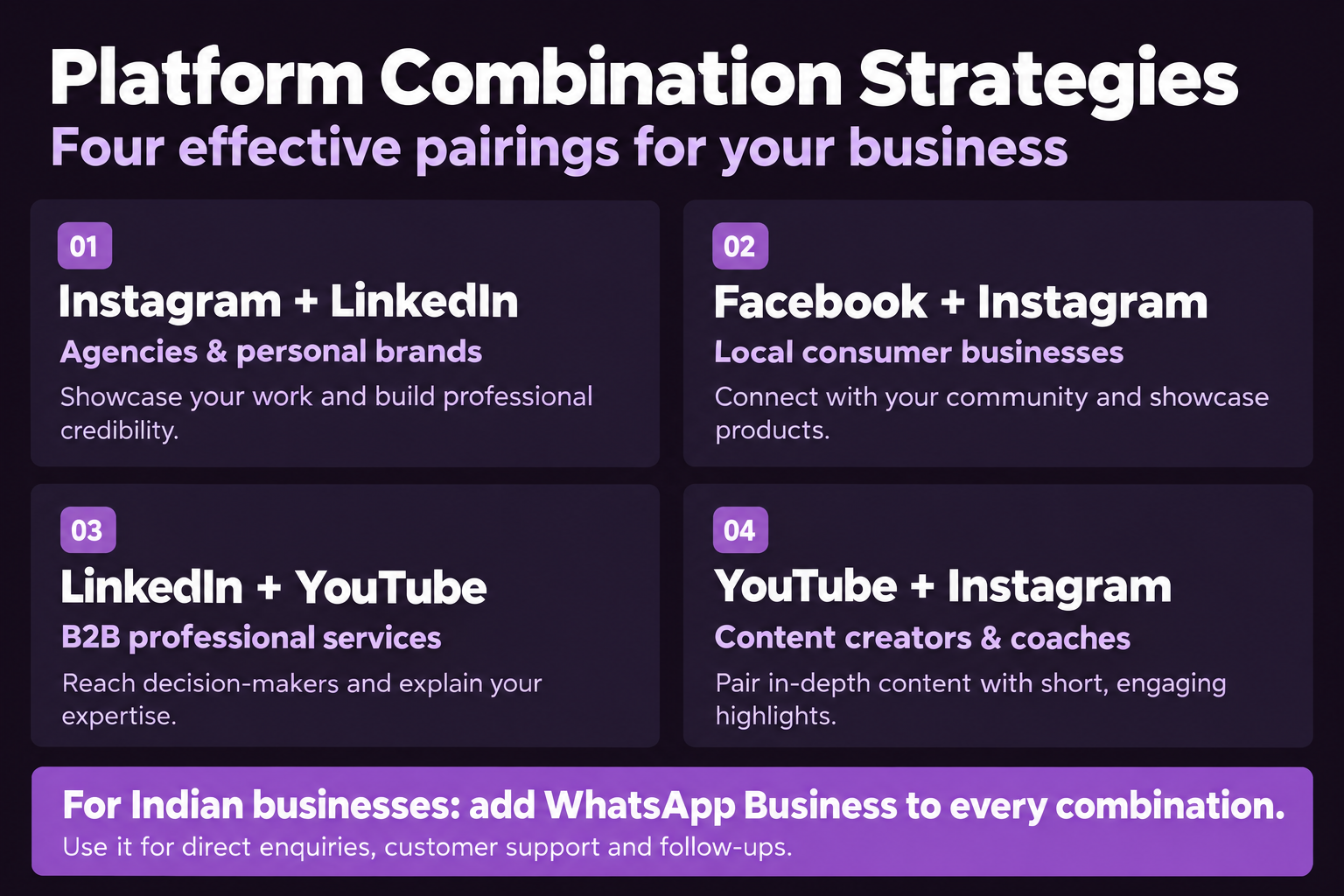
The most effective social media strategies do not treat each platform in isolation. They select platform combinations where the strengths of each platform reinforce the weaknesses of the other, creating a system where discovery, engagement, relationship-building, and conversion each have a dedicated home. The most consistently effective pairings are built around the principle of one reach platform combined with one relationship platform.

4 Most Effective Platform Combinations

Instagram + LinkedIn

Best for: agencies, marketing consultants, business coaches, and personal brands serving both professional and consumer audiences. Instagram builds visual brand recognition; LinkedIn converts that recognition into B2B enquiries.

Facebook + Instagram

Best for: local consumer businesses, retail, food, beauty, and lifestyle brands. Instagram Reels drives new audience discovery; Facebook advertising and Groups deepen community and convert intent into purchase with the adult audience that Facebook dominates.

LinkedIn + YouTube

Best for: B2B service businesses, consultants, and professional services firms. LinkedIn organic content and direct networking generates near-term leads; YouTube educational content builds long-term search authority that compounds over years.

YouTube + Instagram

Best for: content creators, coaches, educators, and consumer brands with strong video capabilities. YouTube Shorts and long-form content build search-driven discovery; Instagram Reels builds community and direct product engagement with the same content repurposed for a different platform format.

Every combination above should include WhatsApp Business as an additional channel for Indian businesses, used specifically for direct customer communication and lead follow-up rather than as a discovery platform. Our social media advertising services are structured around these platform combinations to ensure paid campaigns run on the platforms most likely to produce qualified results for each specific client's business type and audience profile.

Common Platform Selection Mistakes Businesses Make

Platform selection mistakes are among the most expensive errors in social media marketing because they compound over time. Every month spent building on the wrong platform is a month of content creation, community management, and potential advertising spend that produced results for the wrong audience. Recognizing the most common mistakes before making your selection decision prevents the months of wasted investment that correcting a wrong platform choice requires.
Choosing platforms based on current trends rather than audience alignment is the most widespread selection mistake. A platform that is growing rapidly or receiving extensive media coverage attracts businesses regardless of whether their specific target audience is meaningfully present there. The growth of a new platform in the 18 to 24 demographic does not make it the right choice for a financial services firm whose clients are aged 35 to 55. Platform decisions must be driven by where your actual target customer is active, not by where the marketing industry's attention is currently focused.
Selecting platforms based on personal comfort rather than strategic fit is equally common. Business owners choose the platform they personally enjoy using and feel most familiar with, regardless of whether their target audience shares that preference. A founder who uses Twitter X frequently assumes their potential clients do too. A business owner who avoids LinkedIn because they are unfamiliar with it overlooks the platform that would generate the most leads for their specific business. Personal platform preferences should play no role in business platform selection decisions.
Expanding to additional platforms before achieving consistent results on the initial two is a mistake that consistently prevents the compounding performance that sustained platform focus produces. Adding a third or fourth platform before the first two are producing measurable results against the primary business goal diverts the creative and management resources that the existing platforms need to reach their potential. The research consistently shows that depth of presence on fewer platforms outperforms shallow presence on many. Businesses that resist platform expansion until they have genuinely maximized performance on their initial selection almost always outperform those that spread resources across five or six platforms simultaneously in the first six months.
Treating all social media platforms as interchangeable and publishing identical content across all of them without adaptation is another error that reduces performance on every platform simultaneously. Each platform has distinct content format preferences, audience expectations, caption length norms, and optimal posting frequencies that require platform-specific content adaptation. A carousel designed for Instagram requires reformatting for LinkedIn. A LinkedIn professional text post does not perform well as a Facebook caption. Our social media management services include platform-specific content adaptation as a standard component because cross-posting identical content without adaptation is one of the most common and preventable performance suppressors in social media management.

Get the Right Platform Mix for Your Business

We Identify Your Best Platforms and Build a Strategy Around Them

Our team analyzes your target audience, business model, and content capabilities to identify the exact two or three platforms where your business will generate the strongest results, then builds and manages the complete strategy to deliver them.

Book Your Free Platform Audit

Frequently Asked Questions About Choosing the Right Social Media Platform

Which is the best social media platform for business in India?

For most Indian businesses, Facebook and Instagram together form the strongest starting combination because of their combined reach across the Indian market, mature advertising infrastructure, and the breadth of business types they serve effectively. Facebook has 378 million users in India and is particularly strong for local businesses and community building. Instagram is the leading product discovery platform for younger Indian consumers. LinkedIn is the essential B2B platform for professional services and technology companies. WhatsApp Business should be part of every Indian business's strategy as a direct customer communication channel regardless of which other platforms are selected.

How do I know which social media platform my target audience uses?

Survey your existing customers directly by asking which social media platforms they use most actively and which ones they use to research products and services like yours. Review the comment sections and follower demographics of competitor accounts across multiple platforms to observe where your shared audience is most actively engaged. Check the published demographic data for each platform you are considering, available through each platform's business resources section, and match those figures against your target customer profile. Use Google Analytics to check which social platforms are already sending referral traffic to your website, as this reveals where your existing online audience is active.

Should a small business be on every social media platform?

No. A small business should focus on two platforms where its target audience is most active and where it can produce quality content consistently. Being present on every platform simultaneously without the production resources to maintain quality and posting frequency on all of them produces universally mediocre performance. Two platforms executed well always outperform six platforms executed poorly. Start with two, build genuine quality and audience growth on both over 90 days, then evaluate based on results whether adding a third platform is justified by the available production capacity and the potential audience reach.

Is LinkedIn worth it for small businesses?

LinkedIn is worth the investment for any small business whose target customers are business professionals, organizational decision-makers, or company owners regardless of company size. The platform generates 80% of all B2B social media leads and produces the highest visitor-to-lead conversion rate of any social platform at 2.74%, according to HubSpot research. For B2B service businesses, consultants, and agencies, LinkedIn is not just worth it, it is typically the single highest-ROI social media platform available, particularly for organic content where only 1% of users post regularly, creating an unusually uncrowded content environment.

Is Facebook still relevant for business marketing?

Facebook is not only still relevant but remains the largest social media platform in the world with 3.07 billion monthly active users and the most sophisticated paid advertising targeting system available on any platform. For local businesses, community-oriented brands, service businesses, and any company running paid advertising campaigns, Facebook is irreplaceable. Its organic reach for standard page posts has declined significantly over the past decade, but Facebook Groups, paid advertising, and video content consistently deliver strong business results for businesses that use the platform's current capabilities rather than the organic reach model that existed years ago.

Can a B2B business benefit from Instagram?

B2B businesses can generate results from Instagram, but it typically serves a brand awareness and recruiting function rather than a direct lead generation function for most B2B categories. B2B companies in creative industries, marketing, design, architecture, food manufacturing, or fashion use Instagram effectively to build brand recognition and communicate company culture. Pure B2B services businesses such as software, consulting, and professional services will almost always generate higher-quality leads more efficiently through LinkedIn. If a B2B company uses Instagram, it should treat it as a secondary awareness channel rather than the primary lead generation platform.

How many social media platforms should a business be active on?

Two to three platforms is the optimal range for most businesses. One platform is too limited for sustainable growth because any algorithm change or account issue creates a single point of failure for the entire social media strategy. More than three platforms without a dedicated content team and sufficient production resources inevitably leads to either declining quality, inconsistent posting frequency, or both. Two primary platforms with WhatsApp Business as a direct communication channel gives most Indian businesses the right balance of reach, relationship-building, and direct customer engagement without requiring enterprise-level content production resources.

What is the fastest-growing social media platform for business?

LinkedIn is growing at 14% year-over-year with continued acceleration in B2B content engagement, making it the fastest-growing platform for business-to-business marketing specifically. Among general social platforms, TikTok continues to grow at 17% year-over-year in monthly active users, though its primary value for most businesses remains in direct-to-consumer product categories rather than professional services. For businesses that are early-stage and want to benefit from low competitive saturation on a fast-growing platform, LinkedIn offers the strongest combination of rapid growth and high commercial intent among its professional audience.

How do I choose between Facebook and Instagram for my business?

Choose Facebook if your primary target audience is adults aged 30 and above, your business is locally focused, community building through Groups is central to your strategy, or paid advertising targeting precision is your primary tool for reaching potential customers. Choose Instagram if your target audience is aged 18 to 45, your business relies on visual content for product appeal or brand expression, short-form video is a format you can produce consistently, or product discovery through organic Reels reach is more important than community depth. Most consumer businesses benefit from maintaining active presence on both platforms because they reach overlapping but distinct audience segments with different content consumption behaviors.

Should a business be on YouTube if it is already on Instagram?

Adding YouTube to an Instagram-first strategy makes strong sense for businesses that can produce long-form video content regularly alongside their short-form Instagram content. YouTube complements Instagram by providing search-driven content discovery that brings in audiences who are actively looking for specific information rather than passively browsing a feed, which typically produces higher purchase intent among new viewers. YouTube Shorts can also be repurposed directly from Instagram Reels with minimal adaptation, making dual-platform short-form video publishing more efficient than starting YouTube from scratch. The key question is whether weekly long-form video production is genuinely sustainable given current resources.

What is the easiest social media platform for a beginner to start with?

Instagram is generally the most beginner-friendly platform for consumer businesses because the content creation barrier is low with a smartphone camera and a free tool like Canva, the Reels format provides strong organic distribution for new accounts without requiring an established following, and the platform's analytics are straightforward enough for beginners to act on without extensive data analysis experience. For B2B beginners, LinkedIn is the easiest starting point because text-based posts with personal professional perspectives require no design or video production and consistently generate meaningful engagement when they address genuine audience questions or share authentic professional experience

Can a business change platforms if the initial choice does not work?

Yes, but allow a minimum of 90 days of consistent, quality activity before concluding that a platform is not working. Many businesses experience slow early growth on any platform because the algorithm needs time to understand the account's content and audience, and because audience trust is not built on a timeline faster than the audience's own discovery pace. After 90 days of consistent quality posting and engagement, if the primary goal metric is showing no positive trend at all, review whether the platform-to-audience match is the problem or whether content quality, posting frequency, or engagement practice is the limiting factor before making a platform change. Our social media marketing for beginners guide covers the measurement framework for diagnosing early performance issues before making strategy changes.

Futuristic Marketing Services

Choose the Right Platforms. Build the Right Strategy. Get Real Results.

We identify the exact platforms that match your audience and business type, then build and manage the complete content and advertising strategy that produces measurable leads, brand growth, and revenue for your business every month.

Talk to a Platform Specialist

Conclusion

Choosing the right social media platform for your business is the decision that determines whether every subsequent content, engagement, and advertising investment produces results for an audience of potential customers or for an audience that will never buy from you. Get this decision right and every other social media effort is amplified by the foundation of being in the right place. Get it wrong and even excellent content strategy produces weak returns indefinitely.
The framework in this guide gives every business the tools to make this decision based on audience research, content capability assessment, business goal alignment, and competitive analysis rather than trend-following or personal preference. For most Indian businesses, the decision simplifies to Facebook and Instagram for consumer brands, LinkedIn and YouTube for B2B and professional services, and WhatsApp Business for every business as a direct customer communication channel.
If you want professional guidance on identifying the exact platform combination that will produce the strongest results for your specific business, Futuristic Marketing Services provides complete platform audits and social media strategy development for businesses across India, with every platform recommendation backed by audience research and validated against your specific business type, target customer, and marketing goals.
Share this post :
Picture of Devyansh Tripathi
Devyansh Tripathi

Devyansh Tripathi is a digital marketing strategist with over 5 years of hands-on experience in helping brands achieve growth through tailored, data-driven marketing solutions. With a deep understanding of SEO, content strategy, and social media dynamics, Devyansh specializes in creating results-oriented campaigns that drive both brand awareness and conversion.

All Posts