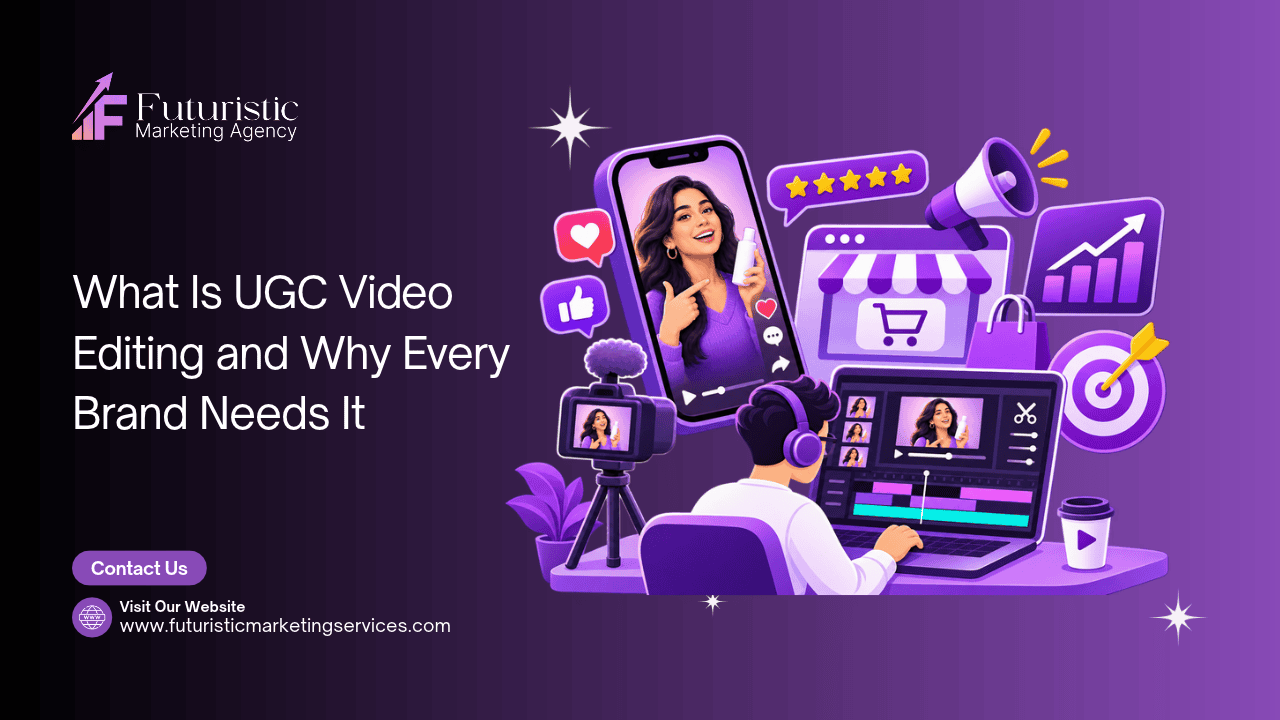
What Is UGC Video Editing and Why Every Brand Needs It

what is UGC video editing

UGC video editing is the process of taking raw, user-generated style video content — footage filmed by creators, customers, or employees on personal devices in natural settings — and refining it into a publish-ready asset that performs as paid or organic content, without stripping away the authentic, native aesthetic that makes UGC effective in the first place. It sits at the intersection of two skill sets that are usually treated separately: the technical editing craft of traditional video production, and the platform-native creative instinct of social media content.

According to Nielsen research, 92% of consumers trust content created by real people more than branded advertising -- and that trust gap has widened as audiences become more sophisticated at identifying paid promotion. This guide explains what UGC video editing actually involves, why it has become essential across every brand category, and how professional editing transforms raw creator footage into content that drives measurable commercial results. For the complete editing workflow, the UGC video editing service guide covers the full 7-step production standard.

Key Takeaways

  • UGC video editing is the process of adding commercial structure -- a hook, narrative pacing, captions, and a call to action -- to authentic creator or customer footage, while deliberately preserving the native visual and audio characteristics that make the content feel like organic social media content
  • According to Nielsen, 92% of consumers trust content created by real people more than branded advertising, and this trust gap continues to widen as audiences become more sophisticated at identifying paid promotion
  • UGC is no longer confined to direct-to-consumer startups -- enterprise brands, B2B companies, and traditional retailers are all shifting creative budget toward UGC formats because performance data consistently favours them in paid social campaigns
  • Meta Business research shows UGC-style ads outperform studio-produced ads on hook rate and cost per acquisition -- the two metrics that most directly determine paid social campaign profitability
  • Raw UGC almost never performs as a finished asset without editing: the gap between authentic footage and high-performing content is closed entirely through editorial decisions about hook placement, pacing, captions, and CTA structure
  • For the platform-specific editing requirements, the how to edit UGC for TikTok ads guide and the UGC video editing for eCommerce guide cover the detailed application of UGC editing by use case

Want to Understand How UGC Editing Could Work for Your Brand?

Futuristic Marketing Services helps brands build UGC content programmes -- from creator sourcing through professional editing that preserves authenticity while engineering commercial performance.

Talk to Our UGC Team
UGC Video Editing Defined

UGC video editing is distinct from both traditional ad production editing and from doing nothing to raw creator footage. Traditional ad production editing applies a full studio treatment to footage filmed under controlled conditions. Publishing raw creator footage unedited means the content retains its authenticity but typically fails to perform because it lacks the structural elements -- a hook, a clear narrative arc, captions, a CTA -- that convert a viewer into a customer.
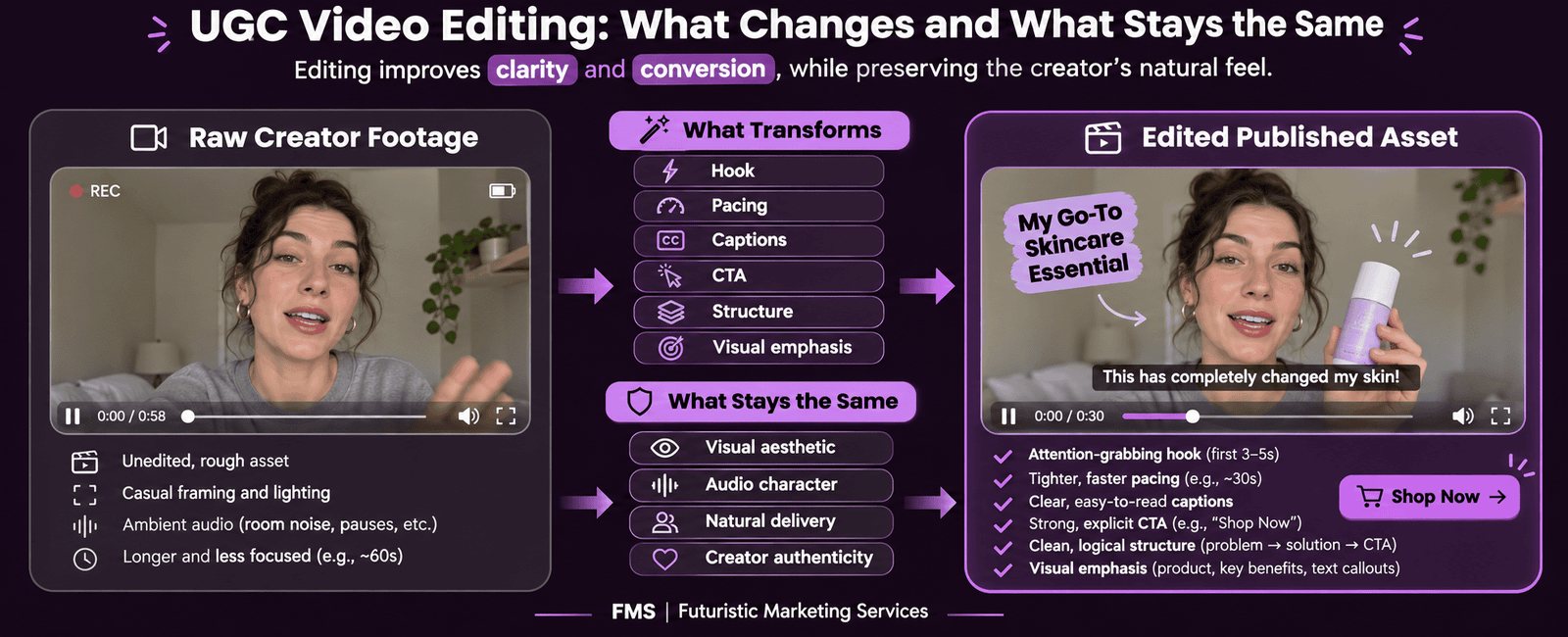
UGC video editing occupies the middle ground deliberately: it takes the raw, native-feeling footage and applies a light editorial layer that adds commercial structure without adding the visual polish that would signal "advertisement." The skill is restraint as much as technique -- knowing what not to change is as important as knowing what to fix.

THE CORE DEFINITION

UGC video editing is the practice of adding commercial structure -- a hook, narrative pacing, captions, and a call to action -- to authentic creator or customer footage, while deliberately preserving the native visual and audio characteristics that make the content feel like organic social media content rather than an advertisement.
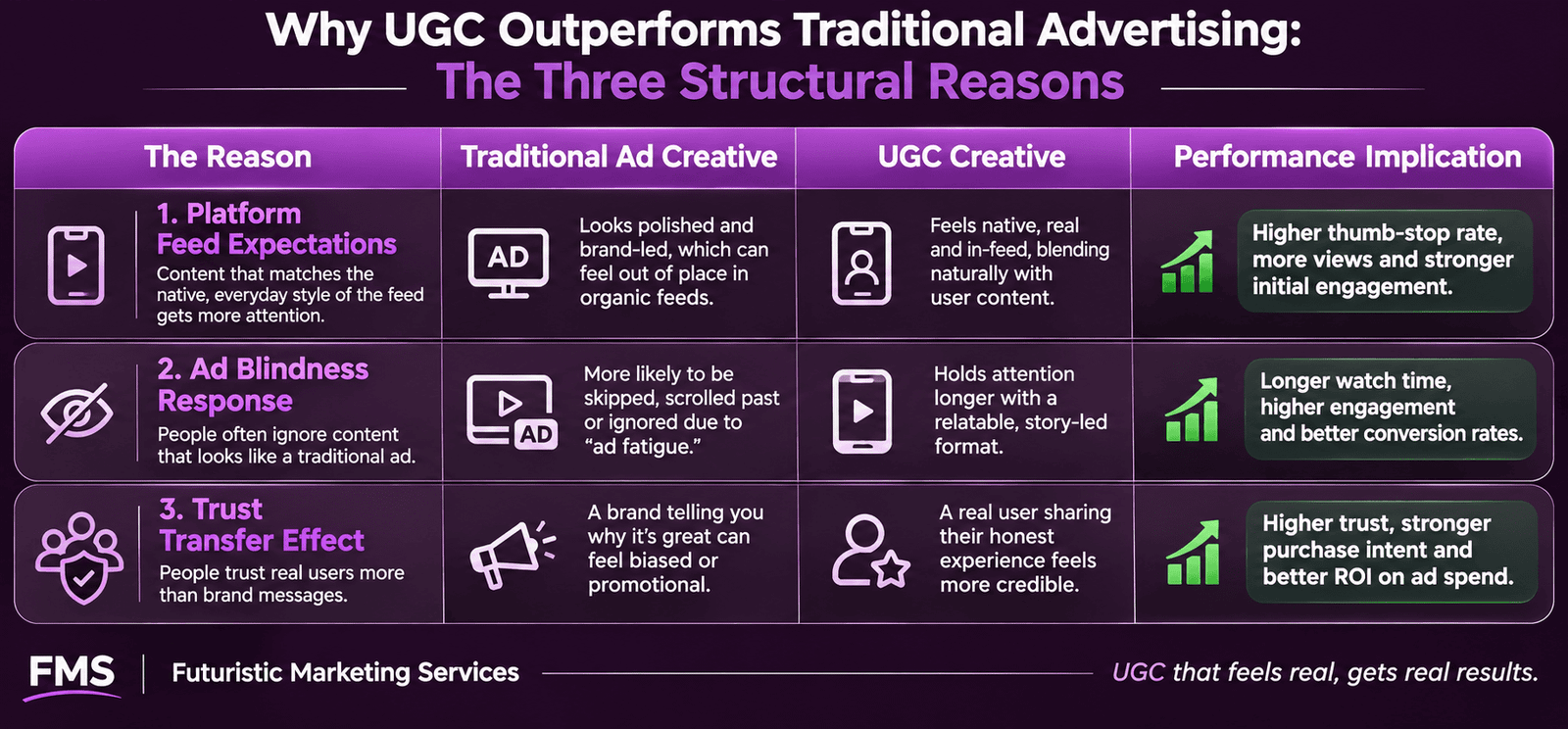
Why UGC Outperforms Traditional Ad Creative

The performance gap between UGC-style content and traditional studio advertising shows up consistently in paid social campaign data. Three structural reasons explain why this gap exists and is widening.
1. Platform feeds have trained audience expectations. TikTok, Instagram Reels, and YouTube Shorts feeds are dominated by content created by individuals on personal devices. Audiences scrolling these feeds have an implicit visual expectation, and content that deviates -- through obvious studio lighting, professional colour grading, or scripted delivery -- registers as "different from what I came here for," triggering the skip reflex before the message is even processed.
2. Ad-blindness has made polish a negative signal. Decades of advertising exposure have trained consumers to recognise and filter out content that looks like an advertisement. The visual cues that once signalled quality -- high production value, professional lighting, polished graphics -- now function as signals to disengage. Lower-fidelity, authentic-looking content bypasses this learned filter.
3. Trust transfers from the creator to the brand. When a real person demonstrates genuine enthusiasm or a genuine problem-solution narrative, some of the audience's trust in that person transfers to the product. This transfer does not occur with a studio actor reading a script, regardless of production quality.

Why Every Brand Category Needs UGC

Brand CategoryCommon MisconceptionWhy UGC AppliesExample Application
Enterprise B2B"UGC is for consumer products, not B2B"Decision-makers scroll the same feeds and respond to the same trust signalsEmployee screen-recording demos, genuine customer implementation stories
Traditional retail"Our brand is too established for UGC aesthetics"Established brands face the same ad-blindness; UGC creates a complementary discovery laneIn-store customer reactions, staff product walkthroughs
Healthcare and finance"Our category is too regulated for casual content"Compliance requirements apply to claims, not aesthetics -- UGC can be fully compliantPatient or client testimonial-style content with compliance review
Luxury and premium"UGC undermines our premium positioning"Premium brands use UGC for top-of-funnel discovery while maintaining polished assets for considerationUnboxing-style content, genuine first-impression reactions
SaaS and technology"Our product is too complex for casual content"Screen-recorded UGC showing real usage builds more trust than polished feature walkthroughsDay-in-the-life screen recordings, genuine before-and-after tool adoption stories

How Professional Editing Transforms Raw UGC

The gap between raw creator footage and high-performing UGC is closed entirely through editorial decisions -- not through changing what was filmed, but through how it is structured for the viewer. A raw 90-second clip with a 20-second introduction, no captions, inconsistent audio, and no CTA becomes, with professional editing, a 45-second asset that opens with the most compelling 3 seconds of the original recording, maintains tight pacing, includes word-by-word captions, and closes with a specific call to action -- while sounding and looking like the same authentic recording.
Three categories of editorial judgment work together. Structural editing identifies the hook moment and re-sequences content so it leads with the most compelling material. Technical polish applies the minimum necessary audio cleanup and caption production without introducing visual elements that signal professional production. Commercial engineering adds or strengthens the call to action and ensures the content addresses a specific objective appropriate to where it will be deployed in the funnel.

The Commercial Case: UGC Editing ROI

The ROI case for investing in UGC editing rather than either ignoring UGC or publishing it raw is straightforward: editing is a small incremental cost relative to creator content acquisition or traditional ad production, and it directly affects hook rate, click-through rate, and cost per acquisition. A creator clip costing £50-200 to source becomes, with £50-150 of professional editing, an asset deployable across multiple platforms as multiple ad variants.
InvestmentWithout EditingWith Professional EditingCommercial Difference
Raw creator footageWeak hook, no CTA, inconsistent audioHook-engineered, captioned, CTA-optimised, audio-cleanedHigher hook rate and CTR, lower cost per acquisition
Customer testimonialsLong, unfocused, hard to extract value fromTightened to key moments, multiple shorter assets producedOne testimonial becomes 3-5 usable ad variants
Employee demo contentInternal-feeling, not externally publishableStructured with hook and CTA for external audiencesInternal content becomes external marketing asset at near-zero extra cost
Platform native contentSame edit reused across all platformsPlatform-specific edits for format and caption conventionsEach platform receives content optimised for its algorithm and audience

Ready to Build a UGC Content Programme for Your Brand?

Futuristic Marketing Services sources, edits, and optimises UGC content -- applying the structural and technical editing that transforms raw creator footage into content that performs across every stage of the funnel.

Start Your UGC Programme

Frequently Asked Questions

Is UGC video editing the same as influencer marketing?

No. Influencer marketing is a content acquisition strategy -- paying creators with existing audiences to produce and distribute content. UGC video editing is a production discipline that can be applied to content from influencers, from paid creator briefs with no existing audience, from genuine customers, or from a brand's own employees. A brand can run a complete UGC content programme using only customer testimonials and internal team content with no influencer relationships at all -- the editing approach is what defines UGC content, not the source of the talent.

Does UGC editing work for video content that was not originally filmed as UGC?

To a degree. "Studio UGC" or "pro-UGC" involves filming content specifically designed to look user-generated -- using handheld smartphone footage, natural lighting, and conversational delivery -- then applying UGC-style editing. This produces content with the performance characteristics of genuine UGC while giving the brand full control over messaging and talent. The editing techniques are largely the same; the difference is in the source material's authenticity, which audiences can sometimes detect over time if a brand relies exclusively on studio UGC without any genuinely organic content.

How much UGC content does a brand need to see results?

Most brands see meaningful signal from a UGC testing programme with 8-15 distinct edited assets running across 2-3 platforms simultaneously. This volume provides enough variation to identify which hooks, creators, and formats resonate with the target audience, while remaining achievable within typical monthly content budgets. The UGC video content pricing guide covers the complete budget planning framework for brands building their first UGC content programme.

Start Your UGC Content Programme Today

Futuristic Marketing Services builds complete UGC content programmes -- creator sourcing, professional editing that preserves authenticity, and platform-specific optimisation for every channel.

Get Started with UGC

Conclusion

UGC video editing is the discipline that makes authentic content commercially effective -- adding the hook, structure, captions, and CTA that determine performance while preserving the native aesthetic that earns audience trust. Every brand category faces the same shift in audience behaviour toward distrust of polished advertising and trust in content from real people.
For the complete technical workflow that professional UGC editors apply to transform raw footage into high-performing content, the UGC video editing service guide provides the full 7-step production standard. For platform-specific applications, the UGC video editing for eCommerce guide and the how to edit UGC for TikTok ads guide cover the detailed requirements for each context.
Share this post :
Picture of Devyansh Tripathi
Devyansh Tripathi

Devyansh Tripathi is a digital marketing strategist with over 5 years of hands-on experience in helping brands achieve growth through tailored, data-driven marketing solutions. With a deep understanding of SEO, content strategy, and social media dynamics, Devyansh specializes in creating results-oriented campaigns that drive both brand awareness and conversion.

All Posts