

Anchor Text SEO: The Complete Guide to Optimising Link Text for Rankings

anchor text seo

Anchor text is the visible, clickable text of a hyperlink. For SEO, anchor text is a direct relevance signal that communicates to Google what the linked page is about. Google reads anchor text from both external backlinks and internal links to understand page topics, evaluate authority, and identify potential link manipulation, making correct anchor text strategy essential for both rankings and penalty avoidance.

This guide covers the complete anchor text SEO framework: the six anchor text types and when to use each, the optimal distribution ratio for external backlink profiles, internal anchor text strategy for maximum topical relevance signals, how over-optimisation triggers Google's SpamBrain penalty system, how to audit your current anchor profile using Ahrefs and Google Search Console, and the exact approach to recovering from an over-optimised anchor text profile without triggering further penalties.

Key Takeaways

  • According to Google Search Central, Google uses anchor text to understand what the linked page is about, making anchor text one of the most direct relevance signals available for both on-page and off-page SEO
  • According to Ahrefs research, over-optimised exact-match anchor text is one of the leading causes of manual link penalties and SpamBrain algorithmic suppression
  • The correct external backlink anchor distribution is approximately 40 to 50% branded anchors, 20 to 25% generic anchors, 10 to 15% topical partial-match anchors, and under 10% exact-match commercial anchors
  • Internal links should primarily use partial-match descriptive anchor text matching the target page's primary keyword, our internal linking strategy guide covers the full internal anchor framework
  • Generic anchor text (click here, read more, learn more) provides Google with no relevance signal and wastes every internal and external linking opportunity it occupies
  • Auditing your anchor text distribution quarterly using Ahrefs prevents the slow build-up of over-optimised patterns that trigger SpamBrain even when individual links appear clean, covered in our link building guide

Want Your Anchor Text Profile Audited for Over-Optimisation Risk?

Futuristic Marketing Services analyses your complete anchor text distribution across internal and external links, identifies over-optimisation patterns before they trigger penalties, and implements the corrective strategy.

Get an Anchor Text Audit

hello@futuristicmarketingservices.com  |  +91 8518024201
What Is Anchor Text and Why It Matters for SEO

Anchor text is both an opportunity and a risk. Used correctly, with a natural distribution of branded, generic, and descriptive partial-match anchors, it strengthens topical relevance signals for your most important pages and helps Google understand your site's authority structure. Used incorrectly, with excessive exact-match commercial anchors concentrated on target keywords, it creates the manipulation patterns that SpamBrain is specifically designed to identify and penalise.
The risk dimension of anchor text is equally significant. A backlink profile where a large proportion of links use identical exact-match commercial anchor text, for example, 80% of all links saying 'buy SEO services cheap', signals to Google's SpamBrain AI that links were artificially acquired with the specific goal of manipulating rankings. This pattern triggers ranking suppression regardless of how individually legitimate each link appears. According to Moz, anchor text is one of the strongest off-page relevance signals available, but also one of the most abused.
Anchor text is the readable text that a hyperlink displays to users. When another website links to your page with the anchor text 'best keyword research tools', Google reads that anchor as a relevance vote confirming that your page is about keyword research tools. When a site links with 'click here', Google receives no topic information about your linked page at all.

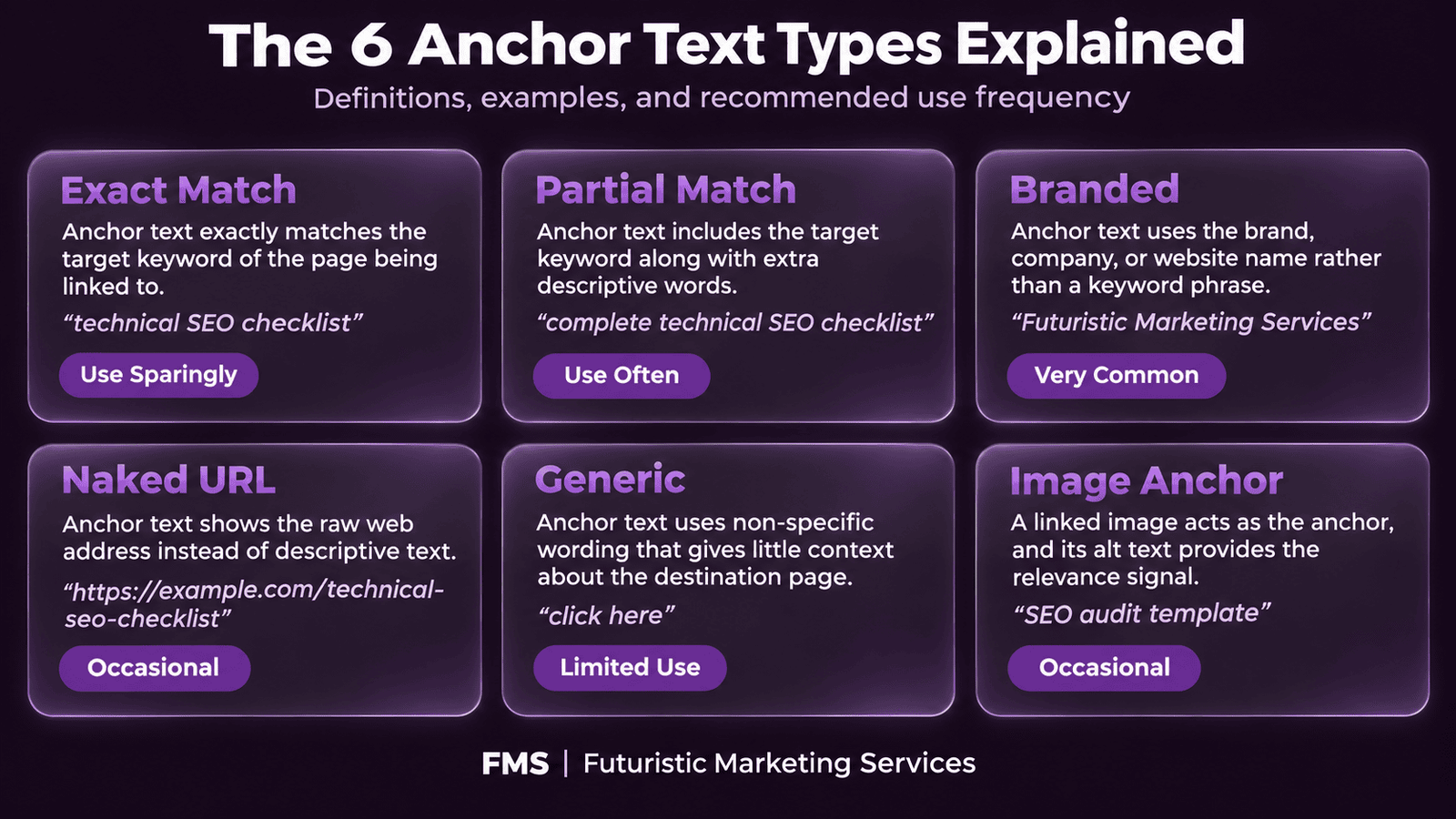
The Six Anchor Text Types

Understanding the six anchor text types and their appropriate use cases is the foundation of a clean, effective anchor text strategy for both internal and external links.
Anchor TypeDefinitionExampleBest Used For
Exact matchThe precise target keyword of the linked pagekeyword research guideOccasional internal links to high-priority pages; maximum 10% of external profile
Partial matchIncludes the target keyword plus additional wordscomplete guide to keyword research for SEOPrimary internal link type; 20-30% of external profile
BrandedUses the brand or site nameFuturistic Marketing Services, devtripathi.in40-50% of external backlink profile, the healthiest anchor type
Naked URLThe raw URL used as the anchorfuturisticmarketingservices.com/Blogs/seo/5-10% of external profile, provides brand signal without keyword pressure
GenericNon-descriptive filler textclick here, read more, this articleAvoid entirely, provides zero relevance signal; wastes every link opportunity
Image anchorAlt text of a linked image serves as anchorAlt text of linked imageEnsure all linked images have descriptive alt text matching linked page topic

Optimal Anchor Text Distribution for External Backlinks

A natural backlink profile, one that reflects genuine editorial decisions by independent publishers, has a characteristic anchor text distribution that SpamBrain has learned to recognise and reward. Deviation from this natural distribution pattern triggers algorithmic suppression, even when individual links appear legitimate in isolation.
Anchor TypeRecommended ShareReasoningRisk if Exceeded
Branded anchors40 to 50%Natural, most legitimate publishers link to a brand using its nameLow, branded anchors are the safest link type regardless of volume
Generic and naked URL20 to 25%Natural, many editorial links use the URL or generic phrasesLow, provides no manipulation signal to Google
Topical partial match10 to 15%Editorial writers naturally include descriptive contextMedium, watch total volume of commercial-adjacent terms
Exact match commercialUnder 10%Rare in natural editorial, publishers rarely use your exact keywordHigh, above 10% triggers SpamBrain pattern recognition
LSI and semantic variants5 to 10%Naturally occurring variations of your topic vocabularyLow, semantic variety is a positive quality signal

Internal Anchor Text Strategy

Internal links do not carry the same manipulation risk as external backlinks because you control them entirely, but they still significantly affect rankings through PageRank distribution and topical relevance signalling. The correct internal anchor text strategy maximises relevance signals while maintaining natural reading flow.
For internal links, use descriptive partial-match anchor text that includes the primary keyword of the destination page as part of a natural sentence. Linking to your technical SEO audit page, use anchors like 'complete technical SEO audit process', 'how to audit your site's technical SEO', or 'technical SEO audit checklist'. Vary the anchor text across different pages linking to the same destination, using identical anchor text from every internal link creates an over-optimised pattern even within your own site architecture.
Never use generic anchor text for internal links. When you write 'for more information, click here', you provide Google with no topical information about the destination page and waste the relevance signal entirely. Every internal link represents an opportunity to strengthen the linked page's relevance for its target keyword, treating it as a generic navigation action discards that opportunity completely.

How Over-Optimised Anchor Text Triggers Penalties

Google's SpamBrain AI identifies over-optimised anchor text through statistical pattern analysis of your entire backlink profile rather than examining individual links in isolation. A site that ranks for 'SEO services' and has 60% of all backlinks pointing to the homepage with anchor text 'SEO services' or variations of it has a statistically improbable anchor distribution, one that only occurs when links are being actively manufactured rather than editorially acquired.
The penalty mechanism is typically algorithmic suppression rather than a manual action, rankings decline gradually as the pattern builds rather than dropping suddenly. This gradual nature makes the cause harder to identify without a quarterly anchor text audit. Run an Ahrefs anchor text report for your domain quarterly: export all anchors, calculate the percentage share of each anchor type, and flag any movement toward exact-match concentration above 10%. Proactive monitoring prevents the slow accumulation that produces penalty-level patterns over 12 to 18 months of unmonitored link building.
Recovery from an over-optimised anchor profile requires two actions: disavowing the most manipulative links (those with unnatural exact-match commercial anchors from low-authority sources) and actively acquiring new branded and generic anchors through natural link building to dilute the over-optimised share. Our link building guide covers the recovery process and white-hat acquisition methods.

Ready to Build a Clean, High-Authority Backlink Profile?

Our link building specialists monitor anchor text distribution on every campaign, ensuring your profile stays within healthy parameters while earning the editorial authority that drives organic rankings.

Start Your Link Building Programme

hello@futuristicmarketingservices.com  |  +91 8518024201

Frequently Asked Questions About Anchor Text SEO

What is anchor text in SEO?

Anchor text is the visible, clickable text of a hyperlink. For SEO, it functions as a direct relevance signal, Google reads anchor text from external backlinks and internal links to understand what the linked page covers. When multiple authoritative sites link to your page with topic-relevant anchor text, Google receives consistent confirmation of that page's subject matter, strengthening its rankings for related queries. Our internal linking guide covers how to use anchor text strategically for internal links.

What is the best anchor text for backlinks?

The best anchor text for a backlink profile is a natural mix of branded anchors (40 to 50%), generic and naked URL anchors (20 to 25%), topical partial-match anchors (10 to 15%), and minimal exact-match commercial anchors (under 10%). This distribution mirrors how independent publishers naturally link, primarily by brand name or URL, occasionally with descriptive context, and rarely with precise commercial keyword phrases.

What is exact match anchor text?

Exact match anchor text uses the precise target keyword of the linked page as the clickable link text. For example, linking to a page targeting 'keyword research guide' with the anchor text 'keyword research guide' is an exact match anchor. Exact match anchors are strong relevance signals but carry over-optimisation risk when they constitute more than 10% of a page's external backlink profile. Use them sparingly for external links and as one variant among many for internal links.

Does anchor text affect internal links?

Yes, anchor text affects internal links significantly. Descriptive partial-match anchor text on internal links strengthens the topical relevance signals for linked pages and helps Google understand the relationship between pages in your site's architecture. Generic internal anchor text (click here, read more) wastes this opportunity entirely. Our internal linking strategy guide covers the complete framework for maximising internal anchor text effectiveness across your site's topical cluster architecture.

How do I check my anchor text distribution?

Check your external anchor text distribution using Ahrefs Site Explorer: enter your domain, navigate to Anchors report, and export all anchor text with their link counts. Calculate the percentage share of each anchor type (branded, exact match, partial match, generic, naked URL). Flag any exact-match commercial anchor concentration above 10%. For internal anchors, use Screaming Frog's anchor text report. Run this audit quarterly and review alongside your Google Search Console guide data for any ranking pattern changes.

What is over-optimised anchor text?

Over-optimised anchor text occurs when a disproportionately large share of backlinks to a page use identical or very similar exact-match commercial keywords as anchor text. For example, 60% of links to a page using 'cheap SEO services India' or close variants creates an unnatural statistical distribution that SpamBrain identifies as manufactured. Google treats this pattern as a quality manipulation signal and applies algorithmic ranking suppression to the affected pages.

Q. Does posting time matter more for Reels or feed posts?

A. Posting time matters for both formats but through different mechanisms. For feed posts, timing primarily affects the proportion of existing followers who see the content during the early engagement window, publishing when followers are active improves follower-driven early engagement signals. For Reels, timing affects the initial algorithmic distribution test in a slightly different way, as Reels reach is driven more heavily by interest-based recommendation to non-followers. Later's data showing Reels perform best at midnight Monday suggests that Reels timing optimization requires separate testing from feed post timing rather than applying the same schedule to both formats.

How do I recover from an anchor text penalty?

Recover from an anchor text penalty through two parallel actions. First, submit a disavow file to Google Search Console identifying the most manipulative links from low-authority sources using exact-match commercial anchors. Second, proactively build new branded and generic anchors through outreach and digital PR to dilute the over-optimised share. Recovery typically takes 3 to 6 months after the disavow is processed. Monitor your anchor distribution monthly during recovery to track the percentage shift toward a natural profile.

Should I use keyword anchor text for all internal links?

Use descriptive partial-match anchor text for internal links rather than exact-match keywords exclusively. Partial-match anchors that include the destination page's target keyword within natural surrounding words provide the relevance signal without creating an artificial pattern. Vary the anchor phrasing across different pages linking to the same destination. Never use generic anchors like click here for internal links, these provide zero SEO benefit. Our internal linking strategy guide covers the complete internal anchor text framework.

Q. What is the best time to post on Instagram for maximum engagement?

A. Based on Buffer's analysis of 9.6 million Instagram posts, the best times to post on Instagram are Wednesday at 12 PM and Thursday at 9 AM in the audience's local timezone. Evening hours from 6 PM to 9 PM perform strongly across most weekdays, with Wednesday and Thursday consistently generating the highest engagement rates and Friday and Saturday performing worst. For Indian business accounts specifically, the peak engagement window is 8 PM to 10 PM due to different daily routine patterns compared to Western markets.

Q.What is the worst time to post on Instagram?

A. Late Friday afternoons, Saturday evenings after 9 PM, and early Sunday mornings consistently produce the lowest engagement rates across most business account categories. Friday and Saturday are identified as the worst-performing days for business content in multiple large-scale research studies. Within any day, publishing between midnight and 5 AM produces minimal engagement because the majority of any business's target audience is asleep during these hours and the few users who are active are unlikely to represent the account's target customer profile.

Q. Does posting time affect Instagram reach?

A. Yes. Posting time affects Instagram reach through the algorithm's early engagement window mechanism. The algorithm evaluates the quality of engagement generated in the first 30 to 60 minutes after a post is published to determine how widely to distribute the content beyond the initial test audience. Publishing during peak audience activity times increases the number of people who could engage during this critical window, improving the early engagement rate that the algorithm uses to justify expanded distribution. The effect is real but secondary to content quality, strong content at a suboptimal time will still outperform weak content at the perfect time.

What is the best time to post Reels on Instagram?

A. According to Later's analysis of over 6 million Instagram posts, Reels perform best when published at midnight on Monday in the audience's local timezone. This contrasts with the optimal feed post windows and suggests that Reels reach, which is driven by algorithmic distribution to non-followers rather than by existing follower activity, follows different consumption patterns than traditional feed content. Test Reels timing independently from feed post timing by publishing at the midnight-to-early-morning window for several weeks and comparing early engagement and 24-hour reach figures against Reels published during standard peak windows.

Q. How do I find the best time to post on Instagram for my specific audience?

A. Open your Instagram app, navigate to your professional profile, tap the Insights button below the bio, and select the Audience tab. Scroll to the Most Active Times section to view a breakdown of when your specific followers are most active by hour of day and day of the week. The hours with the tallest bars in the hourly chart represent your account's personalized peak engagement windows. These windows are more accurate than any industry benchmark for your specific account because they reflect the actual behavior of your current follower base rather than aggregate patterns across millions of different accounts.

Q. Is it better to post every day on Instagram or focus on timing?

A. Posting at a consistent, sustainable frequency at well-timed windows outperforms both posting every day at random times and posting infrequently at perfect times. The hierarchy is: content quality first, posting consistency second, timing optimization third. A business that publishes three genuinely valuable posts per week at its audience's peak activity windows and maintains that schedule consistently for six months will significantly outperform a business that posts daily at random times or posts at perfect times with inconsistent frequency. Determine a posting frequency that is sustainable with current resources and optimize timing within that frequency, not instead of it.

Q. Does posting time matter more for Reels or feed posts?

A. Posting time matters for both formats but through different mechanisms. For feed posts, timing primarily affects the proportion of existing followers who see the content during the early engagement window, publishing when followers are active improves follower-driven early engagement signals. For Reels, timing affects the initial algorithmic distribution test in a slightly different way, as Reels reach is driven more heavily by interest-based recommendation to non-followers. Later's data showing Reels perform best at midnight Monday suggests that Reels timing optimization requires separate testing from feed post timing rather than applying the same schedule to both formats.

Q. Should I post at the same time every day on Instagram?

A. Posting at consistent, predictable times builds both audience expectation and algorithmic performance history, making consistency one of the most valuable timing practices available. You do not need to publish at the exact same time every single day, but maintaining a predictable rhythm, such as every Tuesday at 9 AM and every Thursday at 8 PM, trains both the algorithm and the audience to expect new content at specific intervals. This predictability improves the average early engagement rate per post over time because the most engaged followers learn to check the account at the times content typically appears and engage more quickly after publication.

Q. Does the day of the week matter for Instagram posting?

A. Yes. Wednesday and Thursday are the highest-engagement days for most business categories on Instagram, based on multiple large-scale research datasets. Tuesday also performs strongly for most niches. Friday and Saturday consistently produce lower engagement rates across most business categories, with some exceptions for consumer lifestyle and e-commerce brands on Saturday mornings. If the posting frequency allows selection of specific days, prioritizing Tuesday through Thursday for the week's most important content pieces, such as educational carousels and product launches, gives those posts the best statistical starting conditions for strong early engagement.

Q. Can scheduling Instagram posts at the wrong time hurt engagement long-term?

A. Consistently publishing at low-activity times suppresses average engagement rates over time because the algorithm's account model is built on cumulative performance history. An account that consistently produces below-average early engagement because it always posts when its audience is inactive gradually builds an algorithmic baseline that assumes the account's content generates weak engagement, reducing the default distribution the algorithm provides for new content even when the timing is eventually corrected. Correcting the posting schedule after a prolonged period of off-peak publishing typically requires four to eight weeks of consistently well-timed, high-quality content before the account's algorithmic performance baseline meaningfully improves.

Q. How does posting time relate to the Instagram algorithm?

A. Posting time is connected to Instagram's algorithm through the early engagement window, the 30 to 60 minute period after publication during which the algorithm evaluates engagement quality to determine whether to expand the content's distribution. Posts published during peak audience activity times receive more early engagement because more followers are online and available to interact. Higher early engagement rates signal to the algorithm that the content is valuable and resonates with the audience, prompting wider distribution to remaining followers and, for Reels, to non-follower audiences through the Reels discovery feed. The full explanation of how the Instagram algorithm uses early engagement as its primary distribution signal is covered in detail in our guide on how the Instagram algorithm works.

Q. What tools can I use to find the best time to post on Instagram?

A. Instagram's native Insights tool, accessible directly in the app for all professional accounts, provides audience activity data that identifies peak active hours and days for the specific account's current followers. This is the most accurate tool for personalized timing because it reflects the actual behavior of the account's specific audience. For additional analytics depth, scheduling tools such as Later, Buffer, and Sprout Social provide enhanced posting time recommendations based on the account's performance history combined with broader dataset benchmarks. Meta Business Suite, available free for all business accounts, also provides audience insights and allows content to be scheduled at optimal times automatically when the Creator Studio scheduling function is used.

Build the Anchor Text Profile That Earns Rankings Without Penalties

At Futuristic Marketing Services, every link building campaign is monitored for anchor text distribution in real time, ensuring your profile stays within safe parameters while building the authority that drives sustainable organic rankings.

Talk to Our Link Building Team

hello@futuristicmarketingservices.com  |  +91 8518024201

Conclusion

Audit your anchor text distribution quarterly using Ahrefs to prevent over-optimisation from accumulating gradually. Apply the internal anchor text framework from our internal linking strategy guide to every new article you publish. Use our link building guide to ensure every new backlink acquired follows the anchor text diversity standards that keep your profile within healthy parameters long-term.
Share this post :
Picture of Devyansh Tripathi
Devyansh Tripathi

Devyansh Tripathi is a digital marketing strategist with over 5 years of hands-on experience in helping brands achieve growth through tailored, data-driven marketing solutions. With a deep understanding of SEO, content strategy, and social media dynamics, Devyansh specializes in creating results-oriented campaigns that drive both brand awareness and conversion.

All Posts