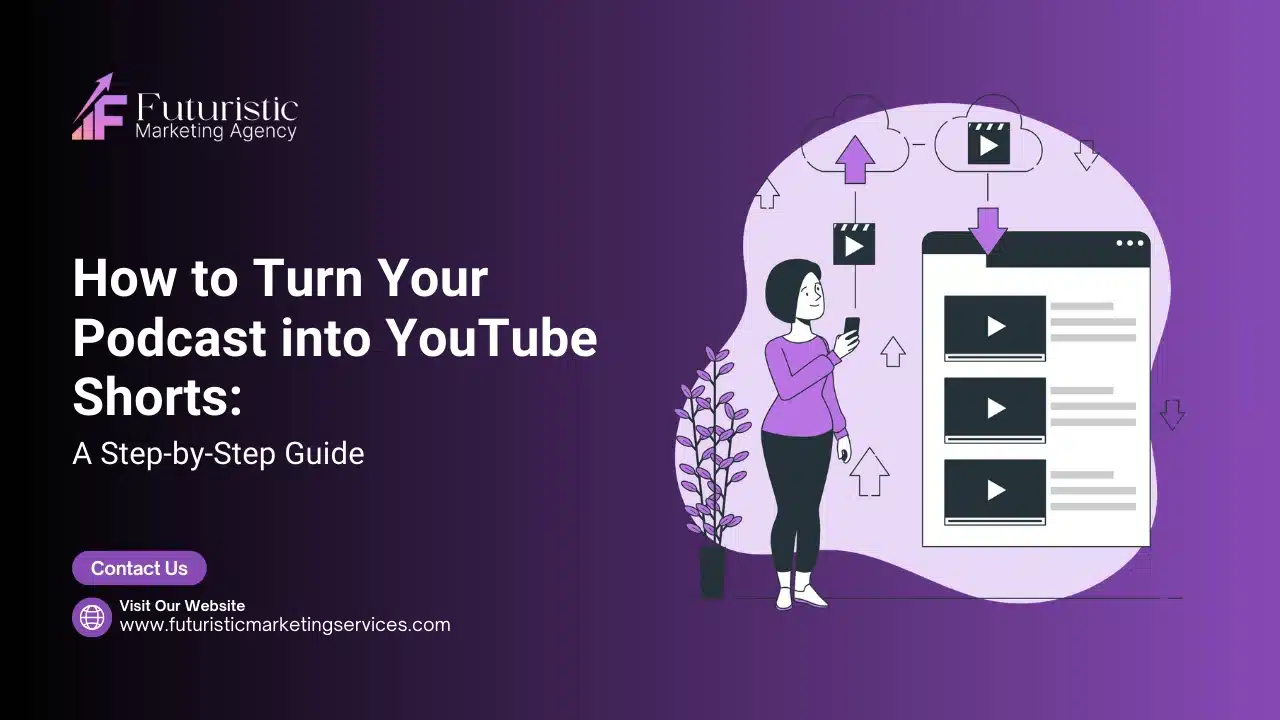
Every podcast episode you record contains multiple high-performing YouTube Shorts – you just need to know how to find and cut them. The podcasters who are growing fastest on YouTube in 2026 are not publishing more episodes. They are publishing the same number of episodes and getting 5–10 times more views from each one by converting key moments into short-form clips that reach entirely new audiences through YouTube’s discovery algorithm. Converting podcasts into YouTube Shorts is a powerful social media growth strategy that can significantly amplify your content’s reach and engagement.
This guide gives you the exact step-by-step process for turning any podcast episode into YouTube Shorts that drive views, grow subscribers, and funnel new listeners to your full episodes – whether you do it manually, use AI clip tools, or outsource to a professional editing service. Short-form videos are becoming essential for social media growth helping brands reach a wider audience quickly.
1. Why YouTube Shorts Is the Most Powerful Podcast Growth Channel in 2026
Most podcasters think of YouTube as a place to upload their full episodes. That is only half of the opportunity. YouTube Shorts – the platform’s short-form vertical video feed – operates on a separate, highly aggressive discovery algorithm that regularly surfaces content to users who have never encountered your channel before.
When a Shorts viewer watches your clip, pauses, or replays it, the algorithm learns to show it to similar viewers. A single well-performing Short can reach tens or hundreds of thousands of viewers in 24–72 hours – viewers who would never have found a 90-minute podcast episode through YouTube search or Spotify browse. The Short becomes a discovery mechanism; the description link and verbal call-to-action drive curious viewers to the full episode.
THE GROWTH MATH | A podcast channel publishing only full episodes on YouTube might gain 500 views per episode. The same channel publishing 8 Shorts per episode sees 500 views on the full episode PLUS an average of 3,000–15,000 views across the Shorts – a 6×–30× increase in total content views from the same amount of recording time. This is why short-form clip strategy is now considered essential, not optional, for podcast growth. |
2. What Makes a Podcast Moment Work as a YouTube Short?
Not every moment in a podcast episode makes a good Short. Understanding the characteristics of high-performing podcast clips helps you make better selection decisions – whether you are scanning manually, using AI clip tools, or briefing a professional editor. This approach aligns with modern performance marketing channels, where short-form video content plays a key role in audience acquisition and engagement.
The 5 Types of Podcast Moments That Perform Best as Shorts
- Sharp opinions and hot takes: "Most people think X, but actually Y" is the foundational structure of viral opinion content. If your guest or host makes a claim that challenges conventional wisdom, that moment is a Short candidate. The opening line should start mid-argument, not mid-explanation.
- Surprising facts and statistics: Moments where a guest cites a counterintuitive statistic or reveals something most people do not know generate strong watch time because viewers stay to hear the full context. The key is that the surprise needs to land within the first 3 seconds - if the setup is too long, viewers swipe before reaching the payoff.
- Emotional peaks and personal stories: Genuine emotion - a guest's voice breaking, a laugh that comes from real joy, a moment of vulnerability - holds viewer attention far more effectively than smooth professional delivery. These moments are often the most valuable clips but the easiest to overlook when scanning a transcript.
- Actionable advice distilled into a simple principle: "The one thing I would tell any entrepreneur starting out is this..." followed by a clear, memorable insight that performs extremely well because viewers save these clips. Saved clips drive significantly stronger algorithmic distribution than watched-and-swiped clips.
- Moments of direct disagreement or tension: When two guests or a host and guest respectfully disagree on something, the tension creates emotional investment. Viewers want to hear both sides resolved. This is one of the highest-watch-time structures for interview podcast clips.
The Structures That Do Not Work
- Episode introductions: "Welcome to the podcast, today we're talking about..." is the worst possible clip opening. Never start a Short at the beginning of a topic introduction.
- Long contextual setups without a payoff: If a 90-second clip spends 60 seconds on setup and 30 seconds on insight, the insight needs to be extraordinary to justify the setup. Most do not.
- Tangential conversation: Moments where the conversation wanders away from the core topic tend to lose viewers quickly. Shorts work best when they have a clear through-line from first second to last.
THE 3 SECOND RULE | If your Short’s first 3 seconds do not give the viewer a clear reason to keep watching, they will swipe. The most effective podcast Shorts start mid-sentence, mid-argument, or with a direct hook statement. Cut the pleasantries, the introductions, and the setup. Start at the moment the value begins. |
3. The 6-Step Process: How to Turn Any Podcast Episode Into YouTube Shorts
- 1. Find your hook moments using the transcript: The fastest way to find Short-worthy moments is to read the episode transcript, not re-watch the video. Most professional transcription tools (Descript, Otter.ai, Riverside.fm's built-in transcription) produce transcripts within minutes of recording completion. Read through highlighting moments that would work as standalone content. AI clip tools like Opus Clip and Munch automate this step by analysing transcripts and scoring moments for virality potential.
- 2. Cut the segment with surgical precision: The ideal podcast Short is 45–90 seconds long. Longer clips (up to the 3-minute Shorts limit) can work for complex arguments, but most podcast content performs best under 90 seconds. Start your cut 2–3 words into a sentence to create an instant "in media res" hook - the viewer's brain is already trying to understand the context, which creates attention. End on a high: the insight, the punchline, the emotional beat, or a verbal call-to-action.
- 3. Reframe for vertical 9:16 format: Podcast video is typically shot in 16:9 widescreen. For Shorts, you need to reframe to 9:16 vertical. This means cropping to the active speaker's face (tight crop showing head and shoulders), zooming in if the original frame was too wide, and - for multi-host or interview podcasts - cutting between speakers to keep the active voice in frame. Most editing tools (CapCut, DaVinci Resolve, Descript) have automatic reframing features that track faces automatically.
- 4. Burn in accurate captions: Captions are not optional for YouTube Shorts. 85% of short-form videos is watched without sound at least some of the time. Style matters: high-contrast text (white text with black outline, or the reverse), positioned in the lower third without blocking the speaker's face, timed at a comfortable reading pace. Word-by-word or short-phrase timing performs better than full-sentence captions for short-form content.
- 5. Apply consistent brand overlays: Every clip needs your show name or logo - a small, persistent bug in the corner of the frame. This is not about vanity; it is about brand recall across thousands of impressions. Viewers who see your show name repeated across multiple Shorts begin to associate the clips with a show worth finding, even before they search for it. Add episode context if useful ("From Episode 247 with [Guest Name]") as a lower third in the first 3 seconds.
- 6. Optimize title, description, and hashtags before uploading: Every Short deserves an SEO-optimised title. Include the core topic keyword and a compelling hook phrase: "Why 99% of podcasters get distribution wrong" outperforms "Episode 247 clip" in click-through rate by an enormous margin. Add 3–5 relevant hashtags including #Shorts, your niche topic hashtag, and #Podcast. In the description, add a link to the full episode in the first line with a clear call-to-action.
4. The Anatomy of a High-Performing Podcast Short
Understanding the structural elements of a great podcast Short helps you evaluate your own clips before publishing and brief editors more effectively. Here is what every element of your Short should be doing:
Each element of a high-performing podcast Short serves a specific retention function. The hook earns the first 5 seconds of watch time. The tight framing and captions ensure the message lands even without sound. The brand elements build recall across repeated exposure. The CTA converts viewers who liked the clip into subscribers and full-episode listeners. Remove any element and you reduce the clip’s effectiveness in a measurable way.
5. How Many Shorts Should You Produce Per Episode?
The question of clip volume is one of the most common points of confusion for podcasters starting their short-form strategy. Here is the evidence-based answer:
OPTIMAL CLIP VOLUME | Channels producing 5–10 Shorts per episode consistently outperform channels producing 1–3. The reason is algorithmic: more clips mean more opportunities for the algorithm to find a matching audience. Not every clip will perform – but channels that produce 8 clips per episode will typically have 2–3 “breakout” clips per episode that drive the majority of new channel exposure. With only 1–2 clips, you are likely missing those breakout moments. |
Clips Per Episode | Expected Weekly Shorts Views | Realistic New Subscriber Impact | Recommended For |
1–2 clips | 500–3,000 | Minimal | Testing / extremely low bandwidth |
3–4 clips | 2,000–8,000 | Slow growth | Podcasts with basic clip workflow |
5–7 clips | 8,000–30,000 | Moderate growth | Most podcasters, standard target |
8–10 clips | 20,000–80,000+ | Strong growth | Growth-focused channels |
10+ clips | 50,000–200,000+ | Rapid growth | Full-service or large teams |
These ranges assume good clip selection, quality editing with captions, and consistent publishing. Channels in high-engagement niches (personal finance, true crime, business) tend to perform at the upper end of these ranges; more specialised niches may perform at the lower end but with higher subscriber conversion rates.
6. Tools for Converting Podcasts to YouTube Shorts
AI-Powered Clip Tools (Best for Semi-Automated Production)
Today, advanced AI SEO tools and automation platforms can quickly identify key moments in your podcast and convert them into engaging short-form videos. Your choice of tool depends on your budget, technical comfort level, and how much time you want to invest in the clip production process. Here is the full comparison:
(Free–$50/mo)
($50–$150/mo)
($300+/mo)
AI-Powered Clip Tools (Best for Semi-Automated Production)
- Opus Clip is the leading AI podcast-to-clips tool in 2026. Upload a video URL or file, and Opus Clip's AI analyses the transcript, scores moments for virality, and generates formatted short-form clips with captions automatically. Results vary - the AI is excellent at identifying high-information density moments but sometimes misses emotional nuance. Best used as a starting point that you refine rather than a finished product.
- Munch takes a similar approach with a stronger emphasis on social media context - Short-form video content has become extremely powerful, especially when brands focus on social media growth to increase reach and visibility. it analyses trends across platforms to predict which clips are likely to perform on YouTube Shorts specifically versus TikTok or Instagram. If you're publishing across multiple platforms with different audience preferences, Munch's platform-specific recommendations add value.
- Descript is the most editor-friendly transcript-based tool - edit the video by editing the text, mark clip-worthy moments with #highlight tags, and Descript assembles clips automatically. More manual than Opus Clip but produces higher editorial quality because you maintain direct control over every cut decision.
Manual Editing Tools (Best for Quality-First Production)
- CapCut (free) is the most popular mobile and desktop tool for short-form clip production, with an excellent auto-caption feature, face tracking for automatic reframing, and a library of branded text styles. For podcasters doing their own editing, CapCut is the recommended starting point.
- DaVinci Resolve (free) offers professional-grade editing capabilities including advanced colour grading and multi-track audio, but has a significantly higher learning curve than CapCut. Recommended for podcasters who already have video editing experience and want maximum quality control.
7. Publishing Strategy: When and How Often to Post Podcast Shorts
Even the best clips underperform if you publish at the wrong time or with an inconsistent schedule. To stay ahead of the competition, analyzing trends and using insights from Google Ads competitor analysis can help you create more impactful and targeted Shorts. Here is the evidence-based publishing framework for podcast Shorts:
- Publish your clips across 5–7 days following each episode: Do not upload all 8 clips at once. YouTube's algorithm gives each new Short a discovery window when it is first published. By spacing your clips over the week, you create multiple discovery opportunities from a single episode's content. A Monday full-episode publish followed by 1–2 Shorts every day through the week creates a continuous content presence.
- Optimal posting times: Tuesday through Thursday, 12pm–3pm in your primary audience's timezone, consistently outperforms other posting windows for podcast Shorts. Check your YouTube Studio Analytics for when your existing audience is most active - your specific audience may differ from general benchmarks.
- Maintain a content reserve: Batch-produce 2–3 weeks of clips at once so you always have a publishing reserve. Missing a week of Shorts breaks your posting consistency and reduces algorithmic favour - algorithms reward channels that post predictably.
- Repurpose top-performing Shorts across platforms: Your best-performing YouTube Short should also be published on Instagram Reels (same file, different caption optimised for Instagram) and TikTok (with the appropriate native audio approach for that platform). Triple-platform publishing from a single clip asset maximises reach per hour of production time.
8. Measuring the Performance of Your Podcast Shorts Strategy
Understanding which metrics matter helps you allocate production effort to the clips and topics that generate the highest return. Strong visuals and captions, supported by effective graphic design elements, can make your Shorts more engaging and scroll-stopping. Here are the metrics to track:
Metric | Where to Find It | What It Tells You | Target Benchmark |
Average view duration (%) | YouTube Studio Analytics | How well your clips hold attention | 50%+ for strong content |
Click-through rate (impressions) | YouTube Studio Analytics | How compelling your title/thumbnail is | 5–12% for Shorts |
Subscriber conversion rate | YouTube Studio Analytics | How many viewers become subscribers | 0.3–1.5% per Short |
Full-episode click rate | YouTube Analytics > End screens | How many Short viewers go to full ep | 2–5% from well-placed CTAs |
Comments per view | YouTube Studio | Viewer engagement and relevance | Higher = more niche relevance |
Shares | YouTube Studio + cross-platform | Viral distribution indicator | Any share = strong signal |
THE MOST IMPORTANT METRIC | Average view duration percentage is the single most important signal for podcast Shorts. A clip watched to 90% completion tells the algorithm “people love this content” and drives explosive organic distribution. A clip watched to only 30% tells the algorithm to stop showing it. Edit your clips ruthlessly to remove anything that loses viewer attention – every second that does not earn its place should be cut. |
9. Frequently Asked Questions
Q1: How long should a podcast YouTube Short be?
Q2: Can I use a podcast Short to promote the full episode on YouTube?
Q3: Do I need a video podcast to make YouTube Shorts?
Q4: What is the best AI tool for converting podcasts to YouTube Shorts?
Q5: How do I find the best clip moments in a long podcast episode?
Q6: Should I post podcast shorts on TikTok and Instagram as well as YouTube?
Q7: How can YouTube Shorts help grow a podcast?
Conclusion: Start Clipping Your Podcast Episodes This Week
The gap between podcasters who grow on YouTube and those who plateau on audio platforms alone comes down to one decision: are you converting your episodes into short-form clips or not? The recording already happened. The content is already there. The only question is whether you extract its full distribution value.
Whether you build a DIY clip workflow with CapCut and Opus Clip, invest in an AI-assisted production process, or engage a professional editing service that handles everything end-to-end, the podcasters who commit to 5–10 Shorts per episode consistently grow 2–3× faster than those who do not.
Tracking the performance of your Shorts is essential, and understanding key metrics like email marketing KPIs can help you measure conversions and audience behavior effectively. Start with your best recent episode. Find three moments. Cut, caption, brand, and upload. Measure the results. Then scale what works.
Want Us to Turn Your Podcast Into YouTube Shorts Every Week?Futuristic Marketing Services produces 5–10 branded short-form clips per episode from your podcast – formatted for YouTube Shorts, Instagram Reels, and TikTok. Captions, branding, and SEO included. Zero editing time on your part. |