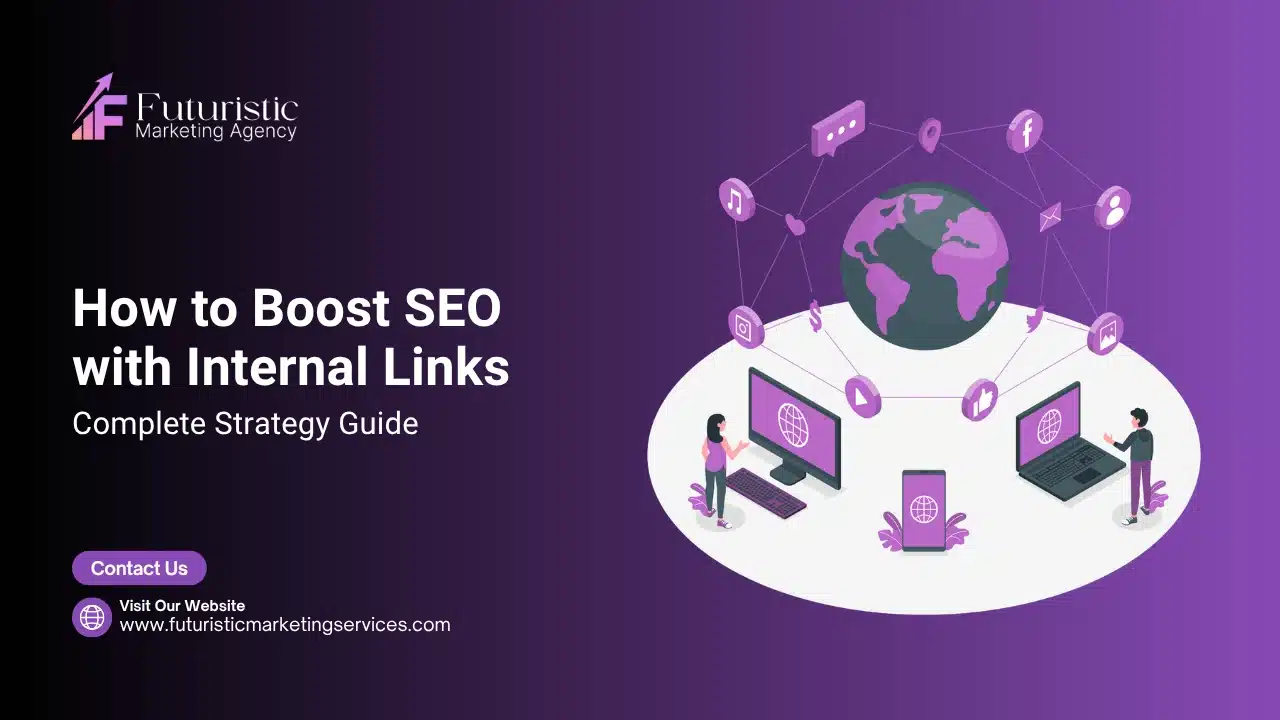
If you want to dramatically improve your SEO rankings without building a single new backlink, internal linking is the most underutilised lever available to you right now.
Most websites spend months chasing external backlinks but ignore the powerful link equity already flowing through their own pages. A well-executed internal linking strategy passes PageRank throughout your site, signals topical authority to Google, accelerates the indexing of new content, and guides visitors towards your most valuable pages – all without needing anyone else to link to you.
Internal linking SEO is the practice of strategically connecting your web pages to each other using hyperlinks embedded in your content. Unlike external backlinks that you have to earn from third-party websites, internal links are entirely within your control. You decide which pages to link to, which anchor text to use, and how much link equity flows to your most important content.
In this complete guide, you will learn exactly how internal linking works, why it matters for SEO today, the different types of internal links, how to build a topic cluster architecture, and the step-by-step process for auditing and improving your internal link structure.
40% of sites have orphan pages with zero internal links (Semrush) | 3.2× more PageRank flows to pages with strategic internal links (Moz) | 75% of SEO experts rate internal linking as high impact for rankings | 2–3 wks faster Google indexing when new pages receive internal links immediately |
What Are Internal Links and How Do They Work for SEO?
An internal link is a hyperlink that connects two pages on the same domain. When you link from one blog post to another post on your website, or from a service page to a relevant guide, you are creating an internal link.
From a technical SEO perspective, internal links perform three critical functions:
- They distribute link equity (PageRank): Every page that receives backlinks from external websites accumulates PageRank - a measure of authority and trust. Internal links redistribute that PageRank across your site, passing authority from strong pages to weaker but related pages. A page with no internal links receives none of this equity, regardless of how good the content is.
- They signal topical relevance and context: The anchor text you use for an internal link - the clickable words - tells Google what the destination page is about. When multiple pages across your site link to a specific page using keyword-rich anchor text, Google receives strong signals that your site is authoritative on that topic.
- They help Googlebot crawl and index your pages: Google discovers your pages primarily by following links. A page that has no internal links pointing to it (an orphan page) may never be crawled, indexed, or ranked. Pages that receive links from multiple other pages on your site are crawled more frequently and indexed faster.
Key Definition: PageRank and Internal Links |
PageRank is Google’s original algorithm for measuring the authority and importance of a web page based on the number and quality of links pointing to it. |
External backlinks from other websites are the primary source of PageRank. But internal links determine HOW that PageRank is distributed across your site. |
Think of PageRank like water flowing through pipes. External links are the water entering your site. Internal links are the pipes that decide which pages receive the most water (authority). |
A page buried deep in your site with no internal links is like a room with the water turned off – no matter how good the content, it receives no authority and struggles to rank. |
The 6 Types of Internal Links (and Which Ones Matter Most for SEO)
Not all internal links carry the same SEO value. Understanding the different types of internal links – and which deliver the most ranking benefit – is essential before you build your strategy.
Link Type | What It Is | SEO Impact | When to Use | |
|---|---|---|---|---|
Navigational Links | Connect main sections of your site – homepage, services, about, contact. Usually found in navigation menus and footers. | High | Always | |
Contextual Links | Embedded within body copy – the most powerful type for SEO as they pass full link equity and signal topical relevance. | Highest | Every post | |
Footer Links | Links repeated across all pages in the footer. Useful for authority links but carry less weight due to repetition. | Medium | Site-wide | |
Sidebar Links | Related posts, popular articles, or category links in a sidebar widget. Good for discovery but lower SEO value than contextual links. | Medium | As needed | |
Image Links | Clickable images that link to other pages. Alt text becomes the anchor text – always include a descriptive keyword-rich alt attribute. | Medium | As needed | |
Breadcrumb Links | Show the page hierarchy (Home > Blog > SEO > Internal Linking). Improve UX and help Google understand your site architecture. | High | All pages |
Contextual links embedded within body copy are the most valuable type of internal link for SEO. They pass the most PageRank, contain the most relevant anchor text context, and are the type Google weights most heavily when evaluating topical authority. The rest of your internal link types support navigation and UX, but your SEO wins will come primarily from contextual linking within your content.
Why Internal Linking Strategy Matters More Than Ever today
Internal linking has always mattered for SEO, but several changes in 2024–2025 have made a strategic approach more important than it has ever been.
Google's Topic Cluster Algorithm Update
Google’s algorithm now places significant weight on topical authority – a site’s demonstrated expertise and depth across a specific subject area. Sites that have built clear topic clusters, where a central pillar page covers a broad topic and links to multiple in-depth cluster pages, consistently outperform sites with isolated, unlinked content.
Internal links are the technical foundation of topic clusters. Without them, your cluster pages are just individual posts. With them, they become a unified, authoritative body of content that Google recognises as comprehensive coverage of a topic.
AI Overviews Favour Topically Authoritative Sites
Google’s AI Overviews (formerly Search Generative Experience) pull content primarily from sites that demonstrate deep topical expertise. A strong internal linking architecture signals this expertise by showing Google that your site covers a topic comprehensively across multiple interlinked pages – not just in a single post.
Crawl Budget Efficiency Is Critical for Large Sites
For websites with hundreds or thousands of pages, Google allocates a specific crawl budget – a limit on how many pages it will crawl in a given period. Orphan pages and poorly linked content waste this budget. A logical, well-linked site architecture ensures Googlebot spends its crawl budget on your most important pages.
PageRank Sculpting for Competitive Keywords
In competitive niches, small ranking differences matter enormously. Strategically directing internal link equity towards pages targeting your most valuable commercial keywords can lift them from positions 4–10 into the top 3 – the positions that capture 75%+ of all organic clicks.
How to Build a Topic Cluster Architecture with Internal Links
The most powerful internal linking strategy is built around the topic cluster model. This architecture consists of three elements:
Pillar Page The Authority Hub A comprehensive guide covering a broad topic (e.g., “What Is SEO”). Links OUT to all cluster pages. Must be the most internally linked page in the cluster. | Cluster Pages 8–15 Focused Posts In-depth posts covering specific subtopics (e.g., keyword research, technical SEO). Each links BACK to the pillar and to 2–3 sibling clusters. | Internal Links The Connective Tissue Bidirectional links between pillar and cluster, and lateral links between related cluster pages. Keyword-rich anchor text throughout. | Compound Effect Authority Builds Over Time Each new cluster post adds more internal link equity to the pillar. The entire cluster benefits as new pages reinforce the topical signal. | External Links Amplification Layer Backlinks to any cluster page benefit the entire cluster via internal link flow. One strong backlink can lift multiple pages via strategic internal linking. |
How to Build Your Topic Cluster Step by Step
Start by identifying one broad pillar topic and creating a comprehensive guide targeting that head keyword – this becomes the hub every cluster page links back to. Then publish 8–12 cluster pages, each targeting a specific long-tail subtopic, with contextual internal links pointing both to the pillar and to two or three sibling cluster pages where genuine topical relevance exists.
- 1. Identify your core topic: Choose the broad topic you want to be known for. For a digital marketing agency, this might be "SEO". For an e-commerce brand, it might be "skincare routines".
- 2. Create (or designate) your pillar page: This is a long-form, comprehensive guide that covers your topic at a high level. It should be 3,000–5,000 words and include an introduction to every subtopic you will cover in cluster posts.
- 3. Map your cluster posts: Identify 8–15 specific subtopics within your core topic. Each will become a dedicated cluster post that covers that subtopic in detail (1,500–3,000 words).
- 4. Link pillar to clusters: Within your pillar page, include a contextual link to each cluster post using keyword-rich anchor text. Create a "Related Guides" section near the end that links to all cluster posts.
- 5. Link every cluster back to the pillar: Within the first 300 words of every cluster post, include a contextual link back to the pillar page. The anchor text should include the pillar's primary keyword.
- 6. Create lateral links between clusters: Where cluster posts share topical overlap, add links between them. A post on "keyword research" should link to "on-page SEO" because readers of one will benefit from the other.
Real Example: This Blog Series as a Topic Cluster |
The blog series on futuristicmarketingservices.com demonstrates the exact topic cluster architecture described above: |
PILLAR: Blog 01 – “What Is SEO? A Complete Beginner’s Guide” → the authority hub for the SEO cluster |
TIER 1 CLUSTERS (Foundational): |
• Blog 02 – Keyword Research Complete Guide |
• Blog 03 – On-Page SEO Ultimate Guide |
• Blog 04 – Technical SEO Audit Checklist |
• Blog 05 – What Is Off-Page SEO |
• Blog 06 – Link Building Strategies |
TIER 2 CLUSTERS (Specific Subtopics): |
• Blog 07 – Keyword Research for Beginners |
• Blog 08 – Core Web Vitals |
• Blog 09 – Local SEO Guide |
• Blog 10 – SEO vs PPC |
• Blog 11 – SEO Content Strategy |
• Blog 12 – How to Write SEO Blog Posts |
• Blog 13 – Internal Linking Strategy ← YOU ARE HERE |
All cluster posts link back to Blog 01 (pillar). Blog 01 links out to all clusters. Lateral links connect related clusters to each other. This architecture signals comprehensive SEO topical authority to Google. |
Anchor Text Strategy: How to Choose the Right Anchor Text for Internal Links
Anchor text – the clickable words that form your internal link – is one of the most important, and most misunderstood, elements of internal linking strategy. Get it right and you send powerful topical signals to Google. Get it wrong and you risk over-optimization penalties or diluted link value.
Anchor Type | Example | Recommended % | Best Practice |
|---|---|---|---|
Exact Match | “internal linking SEO” | 10–20% | Use sparingly – risk of over-optimisation if overused. Reserve for most important target keywords. |
Partial Match | “internal linking strategy for blogs” | 20–30% | Natural-sounding. Includes the keyword with additional descriptive context. Best balance of SEO value and readability. |
Semantic/LSI | “boost rankings with anchor text” | 20–30% | Topically related phrases that reinforce keyword context without repeating exact match. Highly recommended. |
Branded | “Futuristic Marketing SEO Guide” | 10–15% | Use for links to your own brand pages or when citing yourself as a source. Builds brand entity associations. |
Generic/Natural | “click here”, “read more”, “learn” | 10–15% | Avoid wherever possible. Provides zero topical signal to Google. Only use when context makes other anchor types unnatural. |
URL | futuristicmarketingservices.com/… | 5–10% | Acceptable for citations or resource links but carry no topical context. Keep to a minimum in body copy. |
The Golden Rules of Internal Link Anchor Text
Always use descriptive, keyword-rich anchor text that tells Google exactly what the destination page is about – “internal linking strategy” is a strong anchor, “click here” passes no topical signal at all. Vary your anchor text naturally across different linking pages; using the exact same phrase repeatedly from multiple pages looks manipulative and can trigger over-optimisation signals in Google’s algorithm.
- Never use the same exact-match anchor text more than once per target URL: If you link to your "technical SEO audit" page from multiple posts, vary the anchor text between posts. Use "technical SEO checklist", "how to audit your website for SEO", and "50-point SEO audit" rather than "technical SEO audit" every time.
- Match anchor text to the target page's primary keyword: The anchor text should reflect the topic of the page you are linking to, not the topic of the page you are linking from. Readers and Google should be able to predict the destination from the anchor text alone.
- Write anchor text that flows naturally in the sentence: Force-fitted anchor text ("click here for our great guide about seo tips and tricks for beginners") degrades user experience and often triggers over-optimisation flags. Write the sentence first, then choose which words to make the link.
- Prioritise longer, more descriptive anchors over single words: Single-word anchors like "SEO" are too vague to provide meaningful context. Multi-word anchors like "complete guide to technical SEO for beginners" give Google far more information about the destination page.
The 10-Step Internal Linking Checklist for Every Blog Post
Run this checklist on every post before publishing – not as a retrospective audit. Several steps, particularly identifying pillar link targets and planning anchor text, are faster to execute during the writing stage than after the content is live.
Step | Task | How To Do It | Phase |
|---|---|---|---|
1 | Audit existing internal links | Use Screaming Frog Google Search Console or Google Search Console to map all current internal links and identify pages with zero inbound links (orphans). | Pre-publish |
2 | Identify linking opportunities | For every new post, list 3–5 existing pages that are topically related and relevant enough to link to or receive a link from. | Pre-publish |
3 | Plan anchor text in advance | Decide on specific anchor text for each link before writing. Avoid repeating the same anchor text for the same target URL across multiple posts. | Pre-publish |
4 | Link to pillar from every cluster post | Every cluster post must include at least one contextual link back to the parent pillar page with keyword-rich anchor text. | During writing |
5 | Link from pillar to cluster posts | Pillar pages must link out to all related cluster posts. Keep the cluster architecture tight and well-connected. | During writing |
6 | Add 3–5 contextual links per post (minimum) | Include links naturally within body paragraphs. Every major section should contain at least one relevant internal link to a related resource. | During writing |
7 | Do NOT link to irrelevant pages | Links between unrelated topics dilute topical relevance. Only link when there is a genuine topical or informational connection. | During writing |
8 | Avoid nofollow on internal links | Never add rel=”nofollow” to your own internal links. This wastes PageRank and prevents authority passing through your site structure. | Technical check |
9 | Fix broken internal links | After any URL change, redirect old URLs and update internal links pointing to the old path. Broken links waste crawl budget and damage UX. | Maintenance |
10 | Update old posts with new links | Every time you publish a new post, go back to 2–3 existing related posts and add a link to the new page. This immediately accelerates indexing. |
How to Audit Your Internal Links: Finding and Fixing Problems
Before you can improve your internal link structure, you need to know what your current state looks like. A thorough internal link audit will reveal orphan pages, link equity leaks, anchor text problems, and structural weaknesses.
Step 1: Crawl Your Website
Use a site crawl tool (Screaming Frog is recommended for most sites) to map every internal link on your website. The crawl will show you:
- Which pages have zero inbound internal links (orphan pages)
- Which pages have too many inbound internal links (often homepage and contact page - overlinked pages that hoard equity)
- Which pages have broken internal links (returning 404 errors)
- Which pages are buried at 4+ clicks from the homepage (too deep in the architecture)
- Redirect chains in your internal link paths (link going through multiple redirects before reaching the destination)
Step 2: Identify Orphan Pages
An orphan page is a page on your website that no other internal page links to. Orphan pages are never crawled by Googlebot unless they appear in your XML sitemap, and even then they are crawled infrequently. Orphan pages almost never rank.
To find orphan pages: export your sitemap URLs into a spreadsheet, then compare against the list of internally linked pages from your site crawl. Any URLs in the sitemap that don’t appear in the “inlinks” list from your crawl are orphans.
Step 3: Analyse Link Depth
Pages that require more than 3 clicks from your homepage to reach are considered “deep” pages. Deep pages receive less crawl attention and tend to accumulate less PageRank. Audit your top-performing and most commercially important pages – if any are more than 3 levels deep, add internal links from shallower pages to bring them closer to the surface.
Step 4: Review Anchor Text Distribution
Export your internal link data from Ahrefs or Screaming Frog and filter by destination URL for your most important pages. If more than 40% of internal links to a single page use identical anchor text, diversify – use natural variations of the target keyword, branded anchors, and partial-match phrases across your existing posts. Export your internal link anchor text data and analyse for:
- Over-optimization: Are you using the same exact-match anchor text too many times for the same target URL? Diversify immediately.
- Generic anchors: How many of your internal links use "click here", "read more", or "here"? Every one of these is a wasted SEO opportunity. Replace them with descriptive anchors.
- Mismatched anchors: Are there links where the anchor text does not reflect the content of the destination page? Correct these to improve relevance signals.
Step 5: Check for Broken Internal Links
Broken internal links (returning 404 errors) waste PageRank and damage user experience. Screaming Frog will flag all broken links in your crawl. Fix them by either updating the URL to the correct destination or setting up a 301 redirect from the old URL to the new one.
Common Internal Linking Mistakes That Hurt SEO Rankings
Even experienced SEOs make internal linking mistakes that dilute the value of their link structure. These are the most common errors and how to fix them.
DO THIS | NEVER DO THIS |
|---|---|
DO: Use keyword-rich anchor text | DON’T: Use “click here” or “read more” |
DO: Link deep into your content (not just homepage) | DON’T: Link only to your top-level pages |
DO: Add 3–5 contextual links per new post | DON’T: Publish posts with zero internal links |
DO: Update old posts to link to new content | DON’T: Let new pages sit as orphans for weeks |
DO: Follow a topic cluster architecture | DON’T: Link randomly without a content structure plan |
DO: Use descriptive, naturally flowing anchor text | DON’T: Force exact-match keywords into unnatural sentences |
DO: Link to pages with genuine informational overlap | DON’T: Add links between completely unrelated topics |
DO: Audit for orphan pages quarterly | DON’T: Let orphan pages go unlinked for months |
Mistake 1: Orphan Pages - The Most Damaging Error
Orphan pages are the single biggest internal linking mistake. A technically perfect page with excellent content and a strong primary keyword will never rank if it receives no internal links. Every time you publish new content, check that at least 3–5 existing pages on your site link to it before you submit it to Google Search Console.
Mistake 2: Over-Linking from a Single Page
A page with 200+ internal links passing from it dilutes the PageRank passed by each individual link. Focus on a maximum of 100–150 outbound internal links per page for high-traffic pages, and ensure that your most commercially important target pages receive multiple links from high-authority pages – not from a single link-heavy page.
Mistake 3: Ignoring the Link Between New and Old Content
Many site owners add internal links only when writing new content and never go back to update older posts. This means that new posts often sit as orphans for weeks, slowing indexing and delaying ranking. Establish a workflow where every time you publish a new post, you immediately go to 3 existing related posts and add links to the new URL.
Mistake 4: Using Redirect Chains as Internal Links
If you restructured your site and used 301 redirects to handle old URLs, check that none of your internal links are pointing to redirect URLs. Redirects pass 90–99% of link equity but lose a small amount with each redirect in the chain. Update internal links to point directly to the final destination URL.
Best Tools for Internal Link Analysis and Strategy
Screaming Frog is the fastest way to audit your existing internal link structure at scale – crawl your site, filter by inlinks, and immediately identify orphan pages and underlinked priority content. Ahrefs’ Site Audit adds a layer of PageRank flow visualisation that shows exactly which pages are receiving authority and which are being starved of it despite strong content.
Tool | Price | What It Does | Best For |
|---|---|---|---|
Screaming Frog SEO Spider | Free (up to 500 URLs) / £149/yr | Crawl your entire site to find orphan pages, broken links, redirect chains, and pages with too few inbound internal links. | Best for: Full site audits |
Free | Use the Links report to see which pages have the most internal links pointing to them. Identify underlinked priority pages. | Best for: Quick internal link overview | |
Ahrefs Site Audit | From $99/mo | Advanced internal link analysis: maps link flow, identifies link equity waste, and flags over-optimized anchor text patterns. | Best for: Enterprise/agency audits |
Link Whisper (WordPress) | $97/year | WordPress plugin that automatically suggests internal links as you write, drastically speeding up the linking process. | Best for: WordPress site owners |
Sitebulb | From $13.50/mo | Visual site crawl that generates internal link diagrams, depth reports, and orphan page lists with colour-coded insight cards. | Best for: Visual site architecture mapping |
InLinks | From $39/mo | AI-powered tool that builds entity-based internal link maps across your content cluster, automatically suggesting contextually relevant links. | Best for: Topic cluster optimisation |
Recommended Tool Stack by Site Size |
|
SMALL SITES (under 100 pages): |
|
Free tools: Google Search Console Links report + free version of Screaming Frog (500 URL limit) |
|
Manual approach: maintain a simple spreadsheet mapping all internal links and orphan pages |
|
MEDIUM SITES (100–1,000 pages): |
|
Screaming Frog (paid) + Google Search Console + Link Whisper (for WordPress) |
|
Run a full crawl audit quarterly, maintain topic cluster link map |
|
LARGE SITES / AGENCIES (1,000+ pages): |
|
Ahrefs Site Audit or Sitebulb + InLinks for AI-powered link suggestions |
|
Monthly automated crawl reports, dedicated internal linking workflow for every publish |
Internal Linking for E-commerce Websites: Special Considerations
E-commerce websites face unique internal linking challenges due to their scale (often thousands of product and category pages) and the importance of directing link equity to high-converting commercial pages.
Category to Product Page Linking
Every category page should link directly to its most important product pages using keyword-rich anchor text (product name + key attribute). Avoid relying solely on filtered navigation links, which are often noindexed or blocked by robots.txt. Create editorial contextual links within category page description text.
Blog to Product Page Linking
Your blog is one of the most powerful tools for building internal link equity to product pages. Every informational blog post about a topic related to your products is an opportunity to contextually link to those products. A guide on “how to choose the right running shoes” should link to your running shoes category or specific product pages.
Breadcrumbs Are Essential for E-commerce
On e-commerce sites with deep navigation hierarchies (Homepage > Women’s Clothing > Dresses > Summer Dresses > Page 3), breadcrumb navigation is critical. It creates multiple internal links from product pages back up through the hierarchy, distributing equity upward and helping Google understand the site structure.
Handle Pagination Carefully
For paginated category pages (/category?page=2, /category?page=3 etc.), ensure that your primary category page (/category/) receives the majority of internal links – not the paginated versions. Use rel=canonical on paginated pages pointing to the main category, and avoid duplicating internal links across all pagination.
Frequently Asked Questions About Internal Linking SEO
The FAQs below address the questions that come up most often when implementing an internal linking strategy – including how many internal links per page is too many, whether footer links pass PageRank, how to handle orphan pages discovered in a Screaming Frog audit, and how quickly Google redistributes PageRank after new internal links are added. Each answer applies directly to the strategy framework covered in this guide.
How many internal links should I include per blog post?
Does internal linking help with Google rankings?
What is the ideal anchor text for internal links?
What is an orphan page in SEO?
How do internal links differ from external backlinks?
Should I use nofollow on internal links?
How often should I audit my internal links?
Can too many internal links hurt SEO?
What is PageRank sculpting and does it still work?
How do I find pages on my website with no internal links?
Does internal linking help with featured snippets?
How should internal links be structured for an e-commerce website?
Building a strategic internal linking architecture is one of the highest-ROI improvements you can make to an existing website. Our SEO team provides:
- Full internal link audit using Screaming Frog + Ahrefs Site Audit
- Topic cluster architecture design and implementation
- Orphan page identification and linking remediation
- Anchor text optimisation review and rewrite recommendations
- Monthly link equity tracking and cluster performance reporting
Contact us: info@futuristicmarketingservices.com
SEO Services: SEO Company in Indore
Conclusion
Internal linking is one of the few SEO tactics that is entirely in your hands. You do not need other websites to give you anything. You already have the pages. You already have the content. You just need to connect them strategically.
The three principles that will drive the most impact from your internal linking strategy are: build topic clusters with a clear pillar page and supporting cluster posts, use descriptive keyword-rich anchor text on every contextual link, and audit orphan pages regularly to ensure every piece of content on your site receives link equity.
Start today. Pick your most important commercial keyword. Find the page targeting it on your website. Then identify every related page on your site and add a contextual internal link to that priority page from each of them. Do that for your top five priority pages, and you will see measurable ranking improvements within 4–8 weeks.
Futuristic Marketing Services SEO Team
The Futuristic Marketing Services SEO team comprises experienced digital marketers, SEO strategists, and content specialists with 10+ years of experience helping businesses across the UK, USA, and Australia grow their organic search presence.
We specialise in SEO content strategy, technical SEO audits, link building, and local SEO – with a proven track record of ranking clients on the first page of Google for competitive commercial keywords.